

Diagnostic value of the lumbar extension-loading test in patients with lumbar spinal stenosis: a cross-sectional study
Open accessThe DOI matches its Crossref record; 31 of the 31 references it cites were found in a registry or an index.
Abstract
BACKGROUND: The gait-loading test is a well known, important test with which to assess the involved spinal level in patients with lumbar spinal stenosis. The lumbar extension-loading test also functions as a diagnostic loading test in patients with lumbar spinal stenosis; however, its efficacy remains uncertain. The purpose of this study was to compare the diagnostic value of the lumbar extension-loading test with that of the gait-loading test in patients with lumbar spinal stenosis. METHODS: A total of 116 consecutive patients (62 men and 54 women) diagnosed with lumbar spinal stenosis were included in this cross-sectional study of the lumbar extension-loading test. Subjective symptoms and objective neurological findings (motor, sensory, and reflex) were examined before and after the lumbar extension-loading and gait-loading tests. The efficacy of the lumbar extension-loading test for establishment of a correct diagnosis of the involved spinal level was assessed and compared with that of the gait-loading test. RESULTS: There were no significant differences between the lumbar extension-loading test and the gait-loading test in terms of subjective symptoms, objective neurological findings, or changes in the involved spinal level before and after each loading test. CONCLUSIONS: The lumbar extension-loading test is useful for assessment of lumbar spinal stenosis pathology and is capable of accurately determining the involved spinal level.
Overview
The claims and statistics of this paper haven’t been checked yet.
Free: it reads the open-access text and checks the first 5 claims that cite a source we can check. Create a free account to check every claim.
Integrity signals
Registry
Cites
Statistics
Figures
Verification
Claims the paper makes
The claims and statistics of this paper haven’t been checked yet.
Free: it reads the open-access text and checks the first 5 claims that cite a source we can check. Create a free account to check every claim.
Claims other papers make about this one
Each is checked against this paper’s own text: does it say what the citing paper says it does?
The source backs part of the claim, not all of it — or backs it for a different population, condition or comparison.
In the citing paper
“DTR is typically assessed in an examination room at rest; thus, symptoms that change during walking or standing are likely undetectable [53].”
From The usefulness of deep tendon reflexes in the diagnosis of lumbar spine diseases: a narrative review (2024) · cites this paper as [53]
Experimental — accuracy not yet measured
Self-check
Percentages, sums and reported differences re-computed from the paper’s own numbers.
The self-check needs the paper’s full text.
Citations
Cites
Boden, S. D., McCowin, P. R., Davis, D. O., Dina, T. S., Mark, A. S., & Wiesel, S. (1990) · The Journal of Bone & Joint Surgery · doi:10.2106/00004623-199072080-00008 · Cited by 2,708
Magnetic Resonance Imaging of the Lumbar Spine in People without Back Pain
Jensen, M. C., Brant-Zawadzki, M. N., Obuchowski, N., Modic, M. T., Malkasian, D., & Ross, J. S. (1994) · New England Journal of Medicine · doi:10.1056/nejm199407143310201 · Cited by 2,402
Boden, S. D., Davis, D. O., Dina, T. S., Patronas, N. J., & Wiesel, S. W. (1990) · The Journal of Bone & Joint Surgery · doi:10.2106/00004623-199072030-00013 · Cited by 2,115 · cited 1×
“Subjective symptoms of LSS do not necessarily correspond with the spinal level of anatomical neural compression identified on magnetic resonance imaging (MRI) and/or myelography because of asymptomatic neural compression [3-5].”
BackgroundA RADICULAR SYNDROME FROM DEVELOPMENTAL NARROWING OF THE LUMBAR VERTEBRAL CANAL
Verbiest, H. (1954) · The Journal of Bone and Joint Surgery. British volume · doi:10.1302/0301-620x.36b2.230 · Cited by 778 · cited 1×
“Verbiest defined the pathomorphologic changes that take place in patients with LSS, specifically the encroachment of the canal by hypertrophied articular processes [1,2].”
BackgroundWIESEL, S. W., TSOURMAS, N., FEFFER, H. L., CITRIN, C. M., & PATRONAS, N. (1984) · Spine · doi:10.1097/00007632-198409000-00003 · Cited by 720 · cited 1×
“Subjective symptoms of LSS do not necessarily correspond with the spinal level of anatomical neural compression identified on magnetic resonance imaging (MRI) and/or myelography because of asymptomatic neural compression [3-5].”
BackgroundExperimental spinal fusion with recombinant human bone morphogenetic protein-2.
Schimandle, J. H., Boden, S. D., & Hutton, W. (1995) · PubMed · Cited by 315
Experimental Spinal Fusion With Recombinant Human Bone Morphogenetic Protein-2
Schimandle, J. H., Boden, S. D., & Hutton, W. C. (1995) · Spine · doi:10.1097/00007632-199520120-00002 · Cited by 278
Degenerative lumbar spinal stenosis diagnostic value of the history and physical examination
Katz, J. N., Dalgas, M., Stucki, G., Katz, N. P., Bayley, J., Fossel, A. H., Chang, L. C., & Lipson, S. J. (1995) · Arthritis & Rheumatism · doi:10.1002/art.1780380910 · Cited by 275 · cited 2×
“Therefore, the truly responsible spinal level in patients with NIC should be diagnosed [7,9-15] based on changes in subjective symptoms and objective neurological findings before and after the gait-loading test [9-12,14] and nerve root block [13,14,16-18].”
BackgroundAn evidence‐based approach to human dermatomes
Lee, M. W. L., McPhee, R. W., & Stringer, M. D. (2008) · Clinical Anatomy · doi:10.1002/ca.20636 · Cited by 219 · cited 4×
“Therefore, the truly responsible spinal level in patients with NIC should be diagnosed [7,9-15] based on changes in subjective symptoms and objective neurological findings before and after the gait-loading test [9-12,14] and nerve root block [13,14,16-18].”
BackgroundInfluentialVerbiest, H. (1955) · The Journal of Bone and Joint Surgery. British volume · doi:10.1302/0301-620x.37b4.576 · Cited by 194 · cited 1×
“Verbiest defined the pathomorphologic changes that take place in patients with LSS, specifically the encroachment of the canal by hypertrophied articular processes [1,2].”
BackgroundNerve Root Infiltration in the Diagnosis of Radicular Pain
DOOLEY, J. F., McBROOM, R. J., TAGUCHI, T., & MACNAB, I. (1988) · Spine · doi:10.1097/00007632-198801000-00019 · Cited by 166 · cited 1×
“Therefore, the truly responsible spinal level in patients with NIC should be diagnosed [7,9-15] based on changes in subjective symptoms and objective neurological findings before and after the gait-loading test [9-12,14] and nerve root block [13,14,16-18].”
BackgroundEpidural Pressure Measurements
TAKAHASHI, K. G., Miyazaki, T., Takino, T., Matsui, T., & Tomita, K. (1995) · Spine · doi:10.1097/00007632-199503150-00003 · Cited by 149 · cited 2×
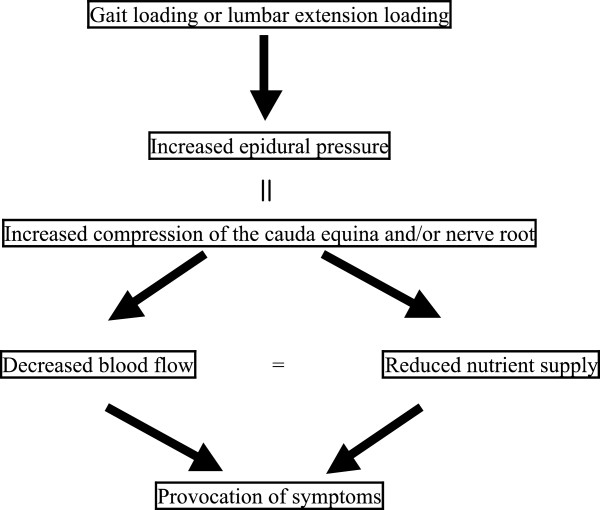
“The development of NIC may be related to venous congestion caused by increased pressure in the epidural space [25] (Figure 1).”
BackgroundDiagnosis of Lumbar Spinal Stenosis: A Systematic Review of the Accuracy of Diagnostic Tests
de Graaf, I. M., Prak, A., Bierma‐Zeinstra, S., Thomas, S., Peul, W. C., & Koes, B. W. (2006) · Spine · doi:10.1097/01.brs.0000216463.32136.7b · Cited by 142 · cited 2×
“Therefore, the truly responsible spinal level in patients with NIC should be diagnosed [7,9-15] based on changes in subjective symptoms and objective neurological findings before and after the gait-loading test [9-12,14] and nerve root block [13,14,16-18].”
BackgroundVasogenic Edema Induced by Compression Injury to the Spinal Nerve Root
Kobayashi, S., Yoshizawa, H., Hachiya, Y., Ukai, T., & Morita, T. (1993) · Spine · doi:10.1097/00007632-199309010-00004 · Cited by 120 · cited 1×
“It may be considered that NIC is provoked by an alteration of the microcirculation supplying nerves, causing a subsequent lack of nutrient supply that can result from persistent nerve root and/or cauda equina compression during walking or the postural change involved in lumbar extension [21-24].”
BackgroundOOI, Y., Mita, F., & Satoh, Y. (1990) · Spine · doi:10.1097/00007632-199006000-00021 · Cited by 108 · cited 1×
“It may be considered that NIC is provoked by an alteration of the microcirculation supplying nerves, causing a subsequent lack of nutrient supply that can result from persistent nerve root and/or cauda equina compression during walking or the postural change involved in lumbar extension [21-24].”
BackgroundKonno, S., Kikuchi, S., Tanaka, Y., Yamazaki, K., Shimada, Y., Takei, H., Yokoyama, T., Okada, M., & Kokubun, S.-I. (2007) · BMC Musculoskeletal Disorders · doi:10.1186/1471-2474-8-102 · Cited by 106 · cited 1×
“The examiner recorded the subjective symptoms and objective neurological findings immediately after stopping the test while the standing posture was maintained [11,20].”
BackgroundSelf-citationVascular and neural pathology of lumbosacral spinal stenosis
Watanabe, R., & Parke, W. W. (1986) · Journal of neurosurgery · doi:10.3171/jns.1986.64.1.0064 · Cited by 100 · cited 1×
“symptoms provoked by the gait-loading and lumbar extension-loading tests [25,27-29].”
BackgroundExperimental Nerve Root Compression
Olmarker, K., Holm, S. H., Rosenqvist, A.-L., & Rydevik, B. L. (1991) · Spine · doi:10.1097/00007632-199101000-00012 · Cited by 97 · cited 1×
“symptoms provoked by the gait-loading and lumbar extension-loading tests [25,27-29].”
BackgroundOlmarker, K., Holm, S., Rosenqvist, A.-L., et al. (1991) · PubMed · Cited by 91
Wolff, A. P. (2001) · Regional Anesthesia & Pain Medicine · doi:10.1053/rapm.2001.21436 · Cited by 78
TAKAHASHI, K. G., Olmarker, K., Holm, S. H., Porter, R. W., & Rydevik, B. L. (1993) · Journal of Orthopaedic Research® · doi:10.1002/jor.1100110112 · Cited by 74 · cited 1×
“symptoms provoked by the gait-loading and lumbar extension-loading tests [25,27-29].”
BackgroundTHE NATURAL HISTORY OF INTERMITTENT CLAUDICATION OF THE CAUDA EQUINA
Blau, J. N., & Logue, V. (1978) · Brain · doi:10.1093/brain/101.2.211 · Cited by 70 · cited 9×
“Because of the nature of NIC, a dynamic study involving gait-loading may be useful in the diagnosis of the spinal level truly responsible for producing symptoms in patients with LSS. Confirmation of the involved spinal level and decompression of only the spinal level responsible for the symptoms are basic principles o…”
MethodInfluentialSato, K., & Kikuchi, S. (1997) · Spine · doi:10.1097/00007632-199708150-00018 · Cited by 60 · cited 2×
“Hence, the gait-loading test is indispensable for determination of the involved spinal level in patients with LSS [9-12,14].”
BackgroundSelf-citationThe diagnostic value of a treadmill test in predicting lumbar spinal stenosis
Barz, T., Melloh, M., Staub, L., Roeder, C., Lange, J., Smiszek, F.-G., Theis, J., & Merk, H. R. (2008) · European Spine Journal · doi:10.1007/s00586-008-0593-1 · Cited by 56 · cited 1×
“[8] suggested that the treadmill test has high diagnostic value for identifying LSS as detected on MRI.”
BackgroundKonno, S., Olmarker, K., Byröd, G., Rydevik, B. L., & Kikuchi, S. (1995) · Spine · doi:10.1097/00007632-199506000-00002 · Cited by 38
Self-citationIwamoto, H., Kuwahara, H., Matsuda, H., Noriage, A., & Yamano, Y. (1995) · Spine · doi:10.1097/00007632-199512150-00018 · Cited by 37 · cited 4×
“It may be considered that NIC is provoked by an alteration of the microcirculation supplying nerves, causing a subsequent lack of nutrient supply that can result from persistent nerve root and/or cauda equina compression during walking or the postural change involved in lumbar extension [21-24].”
BackgroundInfluentialCombined Contrast Studies in Lumbar Spine Diseases
Kikuchi, S., & HASUE, M. (1988) · Spine · doi:10.1097/00007632-198811000-00020 · Cited by 27
Self-citationIwamoto, H., Matsuda, H., Noriage, A., & Yamano, Y. (1997) · Spine · doi:10.1097/00007632-199711150-00011 · Cited by 18 · cited 1×
“It may be considered that NIC is provoked by an alteration of the microcirculation supplying nerves, causing a subsequent lack of nutrient supply that can result from persistent nerve root and/or cauda equina compression during walking or the postural change involved in lumbar extension [21-24].”
BackgroundThe Clinical Effect of Gait Load Test in Two Level Lumbar Spinal Stenosis
Kim, Y. S., Park, S. J., Oh, I.-S., & Kwan, J.-Y. (2009) · Asian Spine Journal · doi:10.4184/asj.2009.3.2.96 · Cited by 16
Westergaard, L., Hauerberg, J., & Springborg, J. B. (2009) · Spine · doi:10.1097/brs.0b013e3181ac9166 · Cited by 9 · cited 1×
“The lumbar extension-loading test is also used to evaluate symptoms due to LSS [19].”
MethodA Histologic and Functional Study on Cauda Equina Adhesion Induced by Multiple Level Laminectomy
Takahashi, N., Konno, S., & Kikuchi, S. (2003) · Spine · doi:10.1097/00007632-200301010-00003 · Cited by 9 · cited 1×
“Less invasive surgery may be advantageous in terms of decreased morbidity and mortality and a lower risk of various complications, such as postoperative arachnoiditis [6]”
BackgroundSelf-citation
Research works printed but not linked: 3
- Kikuchi S Masue M Clinical analyses of neurogenic intermittent claudication in lumbar spine diseases [abstract] Orthopaedic Trans 1985 9 514
- Kikuchi S Hasue M Treatment of neurogenic intermittent claudication in degenerative stenosis [abstract] Orthopaedic Trans 1988 12 106
- Takayama B Kikuchi S Konno S Sekiguch M Nordin M Diagnostic value of the gait-loading test in patients with lumbar canal stenosis – A prospective cohort study Proceeding of the 32nd Annual Meeting: 10–14 May 2005 2005 New York: International Society for the Study of the Lumbar Spine 51
Cited by
Management of lumbar spinal stenosis
Lurie, J., & Tomkins-Lane, C. (2016) · BMJ · doi:10.1136/bmj.h6234 · Cited by 569
Filardo, G., Madry, H., Jelic, M., Roffi, A., Cucchiarini, M., & Kon, E. (2013) · Knee Surgery, Sports Traumatology, Arthroscopy · doi:10.1007/s00167-012-2329-3 · Cited by 236
Lumbar Spinal Stenosis in Older Adults
Lafian, A. M., & Torralba, K. D. (2018) · Rheumatic Disease Clinics of North America · doi:10.1016/j.rdc.2018.03.008 · Cited by 85
Kawakami, M., Takeshita, K., Inoue, G., Sekiguchi, M., Fujiwara, Y., Hoshino, M., Kaito, T., Kawaguchi, Y., Minetama, M., Orita, S., et al. (2022) · Journal of Orthopaedic Science · doi:10.1016/j.jos.2022.03.013 · Cited by 66
Genevay, S., Courvoisier, D. S., Konstantinou, K., Kovacs, F. M., Marty, M., Rainville, J., Norberg, M., Kaux, J., Cha, T. D., Katz, J. N., et al. (2017) · The Spine Journal · doi:10.1016/j.spinee.2017.10.003 · Cited by 59
Metadata
- Authors
- Takahashi, N., Kikuchi, S.-I., Yabuki, S., Otani, K., & Konno, S.-I.
- Affiliations
- Fukushima Medical University (JP)
- Corresponding author
- Takahashi, Naoto
- Venue
- BMC Musculoskeletal Disorders
- Published
- 2014-07-31
- Volume
- 15
- Issue
- 1
- Pages
- 259-259
- ISSN
- 1471-2474 (ISSN-L)
- PMC
- PMC4236630
- OpenAlex
- W2161522244
- Cited by
- 23
- References
- 30
- Citations by year
- 2026: 2 · 2025: 2 · 2024: 3 · 2023: 2 · 2022: 2 · 2021: 1 · 2019: 4 · 2018: 2 · 2017: 1 · 2016: 2
- FWCI
- 0.74
- Type
- journal article
- Language
- en
- Open access
- gold
- doi.org
- Licence
- Locations
- BMC Musculoskeletal Disorders (publishedVersion, cc-by)
- PubMed Central (publishedVersion, cc-by)
- PubMed (publishedVersion)
- Funders
- Japan Society for the Promotion of Science (24592205)
- Topics
- Health Sciences › Medicine › Orthopedics and Sports Medicine › Spine and Intervertebral Disc Pathology
- Health Sciences › Health Professions › Physical Therapy, Sports Therapy and Rehabilitation › Musculoskeletal pain and rehabilitation
- Health Sciences › Medicine › Surgery › Cervical and Thoracic Myelopathy
- Keywords
- lumbar spinal stenosis, diagnostic accuracy, neurological signs, load testing
- MeSH terms
- Aged, Aged, 80 and over, Biomechanical Phenomena, Cross-Sectional Studies, Female, Gait, Humans, Lumbar Vertebrae, Male, Middle Aged, Motor Activity, Physical Examination, Predictive Value of Tests, Reflex, Spinal Stenosis, Walking, Weight-Bearing, Pain Threshold
About these checks
Registry, retraction, Cites and statistics results are computed, not judged, with one exception: a printed reference that no index lists is read once by a model before it counts as a citation error. Claims are extracted by a model and kept only when their quote appears verbatim in the text; each cited source is then checked, with a model’s help, for whether it says what the claim relies on. Those verdicts can be wrong — read the claim’s quote and the cited source before relying on one.
Statistics and arithmetic are recomputed, not judged.
Confidence bands are shown only for fields calibrated on our annotated test set. None is calibrated yet, so no band is shown.
What counts as a claim ›How we measure confidence ›How we check this ›
Are you an author, or do you see a problem with this page? Request a review
Data sources
Bibliographic data: Semantic Scholar, OpenAlex, Crossref.
Contains information from the Semantic Scholar Academic Graph Datasets, made available under the ODC Attribution License (ODC-BY 1.0).
Semantic Scholar’s data is described in: Kinney, R., et al. (2023). The Semantic Scholar Open Data Platform. arXiv:2301.10140.
