

The DOI matches its Crossref record; 64 of the 65 references it cites were found in a registry or an index.
Osteopathic manipulative treatment for nonspecific low back pain: a systematic review and meta-analysis
Open accessAbstract
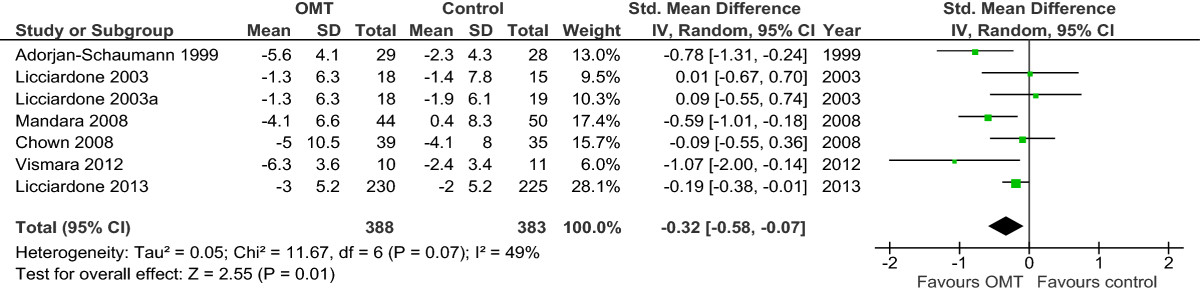
BACKGROUND: Nonspecific back pain is common, disabling, and costly. Therefore, we assessed effectiveness of osteopathic manipulative treatment (OMT) in the management of nonspecific low back pain (LBP) regarding pain and functional status. METHODS: A systematic literature search unrestricted by language was performed in October 2013 in electronic and ongoing trials databases. Searches of reference lists and personal communications identified additional studies. Only randomized clinical trials were included; specific back pain or single treatment techniques studies were excluded. Outcomes were pain and functional status. Studies were independently reviewed using a standardized form. The mean difference (MD) or standard mean difference (SMD) with 95% confidence intervals (CIs) and overall effect size were calculated at 3 months posttreatment. GRADE was used to assess quality of evidence. RESULTS: We identified 307 studies. Thirty-one were evaluated and 16 excluded. Of the 15 studies reviewed, 10 investigated effectiveness of OMT for nonspecific LBP, 3 effect of OMT for LBP in pregnant women, and 2 effect of OMT for LBP in postpartum women. Twelve had a low risk of bias. Moderate-quality evidence suggested OMT had a significant effect on pain relief (MD, -12.91; 95% CI, -20.00 to -5.82) and functional status (SMD, -0.36; 95% CI, -0.58 to -0.14) in acute and chronic nonspecific LBP. In chronic nonspecific LBP, moderate-quality evidence suggested a significant difference in favour of OMT regarding pain (MD, -14.93; 95% CI, -25.18 to -4.68) and functional status (SMD, -0.32; 95% CI, -0.58 to -0.07). For nonspecific LBP in pregnancy, low-quality evidence suggested a significant difference in favour of OMT for pain (MD, -23.01; 95% CI, -44.13 to -1.88) and functional status (SMD, -0.80; 95% CI, -1.36 to -0.23), whereas moderate-quality evidence suggested a significant difference in favour of OMT for pain (MD, -41.85; 95% CI, -49.43 to -34.27) and functional status (SMD, -1.78; 95% CI, -2.21 to -1.35) in nonspecific LBP postpartum. CONCLUSION: Clinically relevant effects of OMT were found for reducing pain and improving functional status in patients with acute and chronic nonspecific LBP and for LBP in pregnant and postpartum women at 3 months posttreatment. However, larger, high-quality randomized controlled trials with robust comparison groups are recommended.
Overview
The claims and statistics of this paper haven’t been checked yet.
Run the check — free, no account needed. It reads the open-access text and checks the sources it cites.
Integrity signals
Registry
Cites
Statistics
Figures
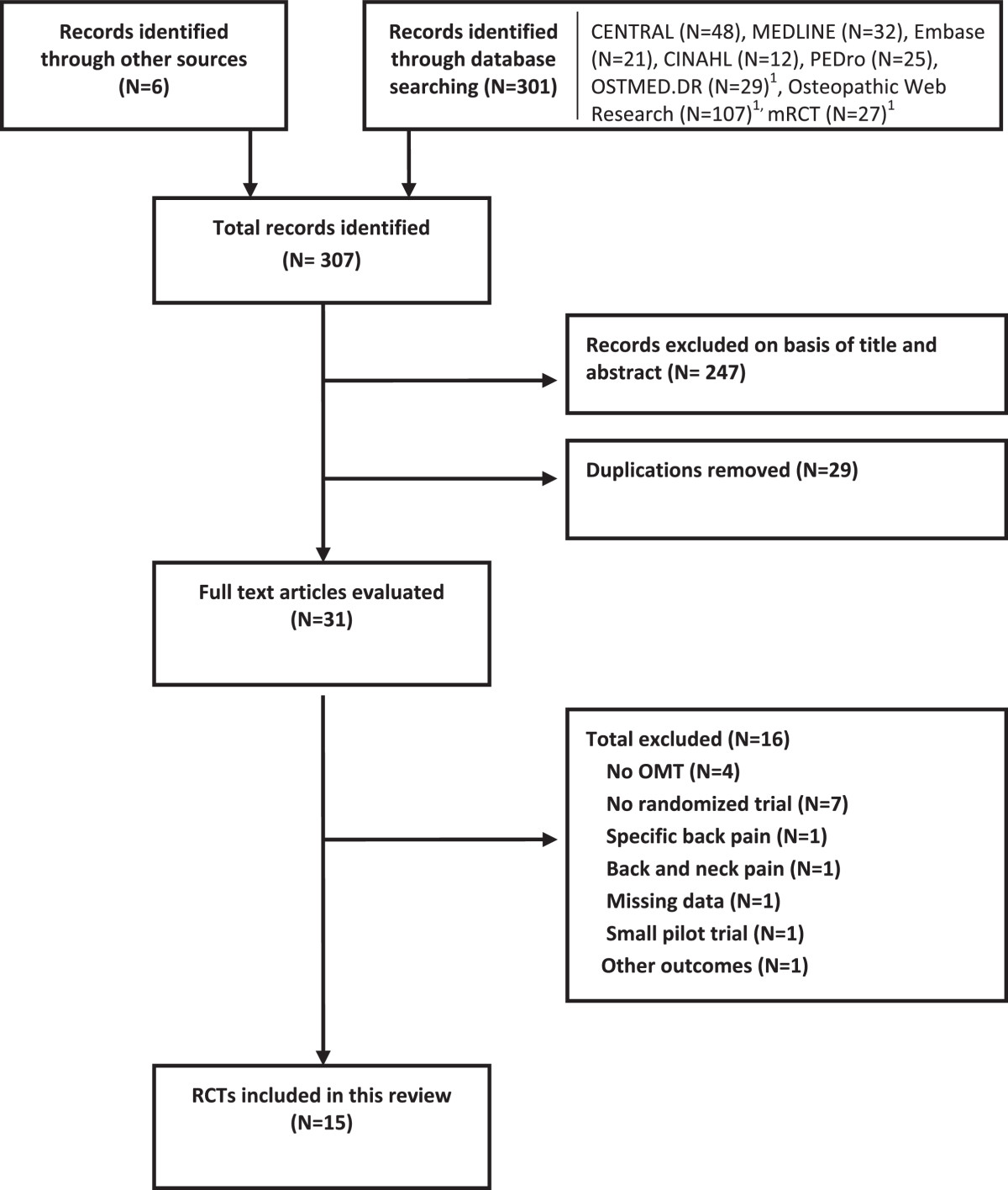
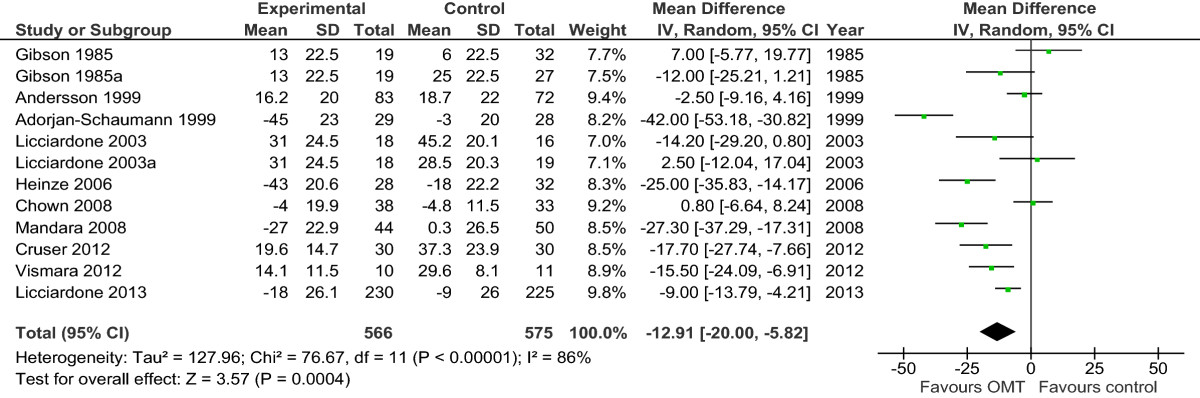
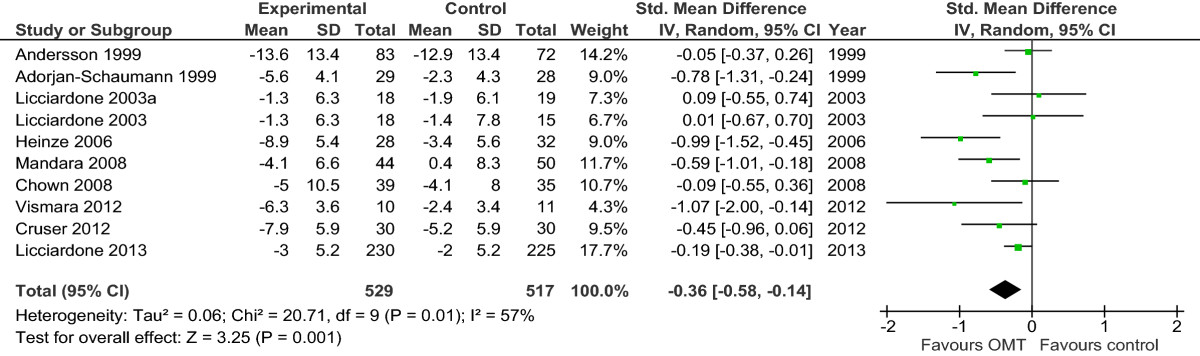
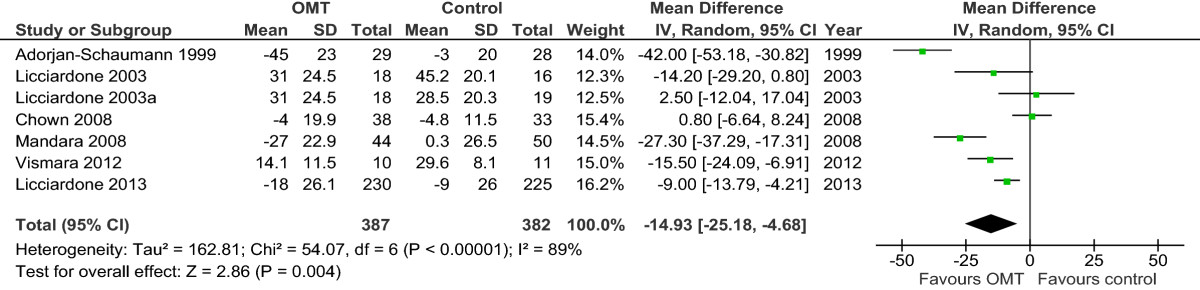




Verification
Claims the paper makes
The claims and statistics of this paper haven’t been checked yet.
Run the check — free, no account needed. It reads the open-access text and checks the sources it cites.
Claims other papers make about this one
Each is checked against this paper’s own text: does it say what the citing paper says it does?
The cited source doesn’t support the claim as written.
In the citing paper
“Finally, domain 15 (publication bias assessment) was rated as not applicable for all the SRs due to lack of a meta-analysis24 30–32 or the inclusion in the meta-analysis of fewer than 10 trials.25–29”
From Efficacy and safety of osteopathic manipulative treatment: an overview of systematic reviews (2022) · cites this paper as [25]
Checked by a reasoning model — may be wrong.
Experimental — accuracy not yet measuredThe source backs part of the claim, not all of it — or backs it for a different population, condition or comparison.
In the citing paper
“Four reviews24–27 with 34 RCTs (41 comparators) and 3369 participants assessed the efficacy of OMT on LBP, including acute LBP, chronic LBP (CLBP), LBP with sciatica, CLBP with menopause symptoms, LBP in obese patients, acute non-specific LBP (ANSLBP), chronic non-specific LBP (CNSLBP) and/or LBP and pelvic girdle pain in pregnancy and postpartum (PP). Taking into account overlapping, there were 2”
From Efficacy and safety of osteopathic manipulative treatment: an overview of systematic reviews (2022) · cites this paper as [25]
Experimental — accuracy not yet measuredThe source backs part of the claim, not all of it — or backs it for a different population, condition or comparison.
In the citing paper
“The GRADE performed by the authors revealed both a moderate quality of evidence for pain and a high quality of evidence for functional status.”
From Efficacy and safety of osteopathic manipulative treatment: an overview of systematic reviews (2022) · cites this paper as [25]
Experimental — accuracy not yet measuredThe source backs part of the claim, not all of it — or backs it for a different population, condition or comparison.
In the citing paper
“The methodological quality of all RCTs, evaluated by the authors using the RoB from the CBRG,18 reported a low and a high RoB for 13 and 2 RCTs, respectively.”
From Efficacy and safety of osteopathic manipulative treatment: an overview of systematic reviews (2022) · cites this paper as [25]
Experimental — accuracy not yet measuredThe source backs part of the claim, not all of it — or backs it for a different population, condition or comparison.
In the citing paper
“Similar meta-analysis results (effect and heterogeneity) have also been found in a subanalysis evaluating the effectiveness of OMT in CNSLBP patients (six trials, 771 participants).”
From Efficacy and safety of osteopathic manipulative treatment: an overview of systematic reviews (2022) · cites this paper as [25]
Experimental — accuracy not yet measured
The source backs part of the claim, not all of it — or backs it for a different population, condition or comparison.
In the citing paper
“The OTLE for the outcomes of each condition was assessed to be yellow.”
From Efficacy and safety of osteopathic manipulative treatment: an overview of systematic reviews (2022) · cites this paper as [25]
Experimental — accuracy not yet measuredThe source backs part of the claim, not all of it — or backs it for a different population, condition or comparison.
In the citing paper
“Considerable (pain) and substantial (functional status) heterogeneity were found.”
From Efficacy and safety of osteopathic manipulative treatment: an overview of systematic reviews (2022) · cites this paper as [25]
Experimental — accuracy not yet measuredThe source backs part of the claim, not all of it — or backs it for a different population, condition or comparison.
In the citing paper
“Adverse events were evaluated in only 4 out of the 15 primary studies. Two RCTs reported minor adverse events such as stiffness and tiredness, one no adverse event and the last one evidenced adverse events not related to the treatment intervention.”
From Efficacy and safety of osteopathic manipulative treatment: an overview of systematic reviews (2022) · cites this paper as [25]
Experimental — accuracy not yet measuredThe source backs part of the claim, not all of it — or backs it for a different population, condition or comparison.
In the citing paper
“Two RCTs with 119 participants evaluated the effectiveness of OMT for NSLBP in PP women. A large effect of OMT in reducing pain and improving functional status was identified. No heterogeneity was found. However, a moderate quality of evidence for both outcomes was revealed.”
From Efficacy and safety of osteopathic manipulative treatment: an overview of systematic reviews (2022) · cites this paper as [25]
Experimental — accuracy not yet measuredThe source backs part of the claim, not all of it — or backs it for a different population, condition or comparison.
In the citing paper
“Moreover, considerable (pain) and moderate (functional status) heterogeneities were found.”
From Efficacy and safety of osteopathic manipulative treatment: an overview of systematic reviews (2022) · cites this paper as [25]
Experimental — accuracy not yet measuredThe source backs part of the claim, not all of it — or backs it for a different population, condition or comparison.
In the citing paper
“In our overview, we found that seven SRs25–28 30–32 evaluated adverse events, and from these SRs, it emerges that no severe incident involving musculoskeletal, neurological, visceral or paediatric disorders occurred after OMT.”
From Efficacy and safety of osteopathic manipulative treatment: an overview of systematic reviews (2022) · cites this paper as [25]
Experimental — accuracy not yet measuredThe cited source says what the claim attributes to it.
In the citing paper
“GRADE evaluation by the authors reported a low quality of evidence for both outcomes.”
From Efficacy and safety of osteopathic manipulative treatment: an overview of systematic reviews (2022) · cites this paper as [25]
The cited source says what the claim attributes to it.
In the citing paper
“The meta-analysis revealed a medium and small effect in reducing pain and improving functional status, respectively, and a moderate quality of evidence (downgraded due to inconsistency).”
From Efficacy and safety of osteopathic manipulative treatment: an overview of systematic reviews (2022) · cites this paper as [25]
The cited source says what the claim attributes to it.
In the citing paper
“Three trials (four comparators) with 242 participants evaluated the effectiveness of OMT versus obstetric care, sham ultrasound and untreated, for NSLBP in pregnant women. A large and a medium effects in reducing pain and improving functional status, respectively, were identified.”
From Efficacy and safety of osteopathic manipulative treatment: an overview of systematic reviews (2022) · cites this paper as [25]
The cited source says what the claim attributes to it.
In the citing paper
“Eight SRs performed an appropriate literature search,25–32”
From Efficacy and safety of osteopathic manipulative treatment: an overview of systematic reviews (2022) · cites this paper as [25]
The cited source says what the claim attributes to it.
In the citing paper
“All SRs24–32 evaluated the RoB of the included studies”
From Efficacy and safety of osteopathic manipulative treatment: an overview of systematic reviews (2022) · cites this paper as [25]
The cited source says what the claim attributes to it.
In the citing paper
“five SRs reported justification for the exclusion of primary studies.25 26 28 31 32”
From Efficacy and safety of osteopathic manipulative treatment: an overview of systematic reviews (2022) · cites this paper as [25]
The cited source says what the claim attributes to it.
In the citing paper
“Eight SRs25–32 accounted for the RoB when interpreting and discussing the results of the SR.”
From Efficacy and safety of osteopathic manipulative treatment: an overview of systematic reviews (2022) · cites this paper as [25]
The cited source says what the claim attributes to it.
In the citing paper
“five SRs25–29 carried out a meta-analysis and used appropriate methods for the statistical combination of findings.”
From Efficacy and safety of osteopathic manipulative treatment: an overview of systematic reviews (2022) · cites this paper as [25]
The check wasn’t confident either way, so it gives no verdict — never disputed.
In the citing paper
“According to the critical domain established in Shea et al,12 seven25–29 31 32 and two SRs 24 30 were rated as low and critically low quality, respectively.”
From Efficacy and safety of osteopathic manipulative treatment: an overview of systematic reviews (2022) · cites this paper as [25]
Experimental — accuracy not yet measured
Self-check
Percentages, sums and reported differences re-computed from the paper’s own numbers.
The self-check needs the paper’s full text.
Citations
Cites
Liberati, A., Altman, D. G., Tetzlaff, J., Mulrow, C., Gøtzsche, P. C., Ioannidis, J. P. A., Clarke, M., Devereaux, P. J., Kleijnen, J., & Moher, D. (2009) · PLoS Medicine · doi:10.1371/journal.pmed.1000100 · Cited by 28,164
Liberati, A., Altman, D. G., Tetzlaff, J., Mulrow, C., Gotzsche, P. C., Ioannidis, J. P. A., Clarke, M., Devereaux, P. J., Kleijnen, J., & Moher, D. (2009) · BMJ · doi:10.1136/bmj.b2700 · Cited by 17,648
Estimating the mean and variance from the median, range, and the size of a sample
Hozo, S. P., Djulbegovic, B., & Hozo, I. (2005) · BMC Medical Research Methodology · doi:10.1186/1471-2288-5-13 · Cited by 9,062
Cochrane Handbook for Systematic Reviews of Interventions Version 5.0.1. The Cochrane Collaboration
Higgins, J., Green, S. R., & Higgins, J. (2008) · Cited by 5,544
GRADE guidelines: a new series of articles in the Journal of Clinical Epidemiology
Guyatt, G. H., Oxman, A. D., Schünemann, H. J., Tugwell, P., & Knottnerus, A. (2011) · Journal of Clinical Epidemiology · doi:10.1016/j.jclinepi.2010.09.011 · Cited by 3,094
Chapter 4 European guidelines for the management of chronic nonspecific low back pain
Airaksinen, O., Brox, J. I., Cedraschi, C., Hildebrandt, J., Klaber-Moffett, J., Kovacs, F., Mannion, A. F., Reis, S., Staal, J. B., Ursin, H., et al. (2006) · European Spine Journal · doi:10.1007/s00586-006-1072-1 · Cited by 2,594
Dagenais, S., Caro, J., & Haldeman, S. (2008) · The Spine Journal · doi:10.1016/j.spinee.2007.10.005 · Cited by 2,046
Deyo, R. A., & Weinstein, J. N. (2001) · New England Journal of Medicine · doi:10.1056/nejm200102013440508 · Cited by 1,675
2009 updated method guidelines for systematic reviews in the Cochrane Back Review Group
Furlan, A. D., Pennick, V., Bombardier, C., & van Tulder, M. (2009) · Spine · doi:10.1097/brs.0b013e3181b1c99f · Cited by 1,663
The economic burden of back pain in the UK
Maniadakis, N., & Gray, A. (2000) · Pain · doi:10.1016/s0304-3959(99)00187-6 · Cited by 1,510
Research works printed but not linked: 9
- Croft P, Papageorgiou A: Low back pain in the community and in hospitals. A report to the Clinical Standards Advisory Group of the Department of Health, Arthritis and Rheumatism Council. 1994, Manchester: Epidemiology Research Unit University of Manchester
- DiGiovanna EL, Schiowitz S, Dowling DJ: An Osteopathic Approach to Diagnosis & Treatment. 2005, Philadelphia: Lippincott William & Wilkins, 3
- General Osteopathic Council: Snapshot Survey. 2001, London, UK: General Osteopathic Council,http://www.osteopathy.org.uk/uploads/survey2snapshot_survery_results_2001.pdf,
- Heinze G: Unpublished D.O. Thesis. The Effectiveness of a Holistic Osteopathic Treatment in Subacute Low Back Pain. A Randomized Controlled Trial. 2006, Akademie für Osteopathie,http://www.osteopathic-research.com/index.php?option=com_jresearch&view=publication&task=show&id=13797&lang=en,
- Adorjàn-Schaumann K, Höhrhan G, Wille H, Wolff A: Unpublished D.O. Thesis. Osteopathic Treatment of Chronic Low Back Pain. A Randomized Controlled Trial. 1999, Akademie für Osteopathie,http://www.osteopathic-research.com/index.php?option=com_jresearch&view=publication&task=show&id=13311&lang=en,
- Gundermann S: Unpublished D.O. Thesis. Effectiveness of Osteopathic Treatment in Pregnant Women Suffering From Low Back Pain. A Randomized Controlled Trial. 2013, Akademie für Osteopathie,http://www.osteopathic-research.com/index.php?option=com_jresearch&view=publication&task=show&id=15363&lang=en,
- Peters R, Van Der Linde M: Unpublished D.O. Thesis. Osteopathic Treatment of Women with Low Back Pain during Pregnancy. A Randomized Controlled Trial. 2006, Akademie für Osteopathie,http://www.osteopathic-research.com/index.php?option=com_jresearch&view=publication&task=show&id=13801&lang=en,
- Recknagel C, Roá J: Unpublished D.O. Thesis. Study on the Effectiveness of Osteopathic Treatment for Women with Persistent Post Partum Back Pain. A Randomized Controlled Trial. 2007, Akademie für Osteopathie,http://www.osteopathic-research.com/index.php?option=com_jresearch&view=publication&task=show&id=13395&lang=en,
- Schwerla F, Rother K, Rother D, Ruetz M: Osteopathic treatment of women with persistent low back/pelvic girdle pain postpartum. Vol Proceedings of the 9th International Symposium of Osteopathy 2012. 2012, Nantes, France: Akademie für Osteopathie,http://www.osteopathic-research.com/index.php?option=com_jresearch&view=publication&task=show&id=15181&lang=en,
Cited by
Sorted by citations
Rubinstein, S. M., de Zoete, A., van Middelkoop, M., Assendelft, W. J., de Boer, M. R., & van Tulder, M. W. (2019) · BMJ · doi:10.1136/bmj.l689 · Cited by 407
Interventions for preventing and treating low-back and pelvic pain during pregnancy
Liddle, D., & Pennick, V. (2015) · Cochrane Database of Systematic Reviews · doi:10.1002/14651858.cd001139.pub4 · Cited by 378
Nahin, R. L., Boineau, R., Khalsa, P. S., Stussman, B. J., & Weber, W. J. (2016) · Mayo Clinic Proceedings · doi:10.1016/j.mayocp.2016.06.007 · Cited by 260
Chenot, J.-F., Greitemann, B., Kladny, B., Petzke, F., Pfingsten, M., & Schorr, S. G. (2017) · Deutsches Ärzteblatt international · doi:10.3238/arztebl.2017.0883 · Cited by 282
Zügel, M., Maganaris, C. N., Wilke, J., Jurkat‐Rott, K., Klingler, W., Wearing, S. C., FINDLEY, T. W., Barbe, M. F., Steinacker, J. M., Vleeming, A., et al. (2018) · British Journal of Sports Medicine · doi:10.1136/bjsports-2018-099308 · Cited by 223
Metadata
- Authors
- Franke, H., Franke, J.-D., & Fryer, G.
- Affiliations
- University of Siegen (DE)
- Victoria University (AU)
- Corresponding author
- Fryer, Gary
- Venue
- BMC Musculoskeletal Disorders
- Published
- 2014-08-30
- Volume
- 15
- Issue
- 1
- Pages
- 286-286
- ISSN
- 1471-2474 (ISSN-L)
- PMC
- PMC4159549
- OpenAlex
- W2100515050
- Cited by
- 261
- References
- 65
- Citations by year
- 2026: 20 · 2025: 26 · 2024: 30 · 2023: 17 · 2022: 20 · 2021: 33 · 2020: 33 · 2019: 19 · 2018: 22 · 2017: 19 · 2016: 14 · 2015: 8
- FWCI
- 1.75
- Type
- journal article
- Language
- en
- Open access
- gold
- doi.org
- Licence
- Locations
- BMC Musculoskeletal Disorders (publishedVersion, cc-by)
- PubMed Central (publishedVersion, cc-by)
- PubMed (publishedVersion)
- Victoria University Research Repository (Victoria University) (submittedVersion, cc-by)
- Funders
- A.T. Still University
- Topics
- Health Sciences › Health Professions › Physical Therapy, Sports Therapy and Rehabilitation › Musculoskeletal pain and rehabilitation
- Health Sciences › Medicine › Obstetrics and Gynecology › Pregnancy-related medical research
- Health Sciences › Health Professions › Physical Therapy, Sports Therapy and Rehabilitation › Myofascial pain diagnosis and treatment
- Keywords
- osteopathic manipulative treatment, non-specific low back pain, analgesia, functional status, chronic low back pain, acute low back pain, pregnancy, postpartum women, manual therapy, quality of evidence, GRADE assessment, risk of bias, treatment effect heterogeneity, subgroup analysis
- MeSH terms
- Female, Humans, Postnatal Care, Pregnancy, Randomized Controlled Trials as Topic, Treatment Outcome, Low Back Pain, Manipulation, Osteopathic
About these checks
Registry, retraction, Cites and statistics results are computed, not judged, with one exception: a printed reference that no index lists is read once by a model before it counts as a citation error. Claims are extracted by a model and kept only when their quote appears verbatim in the text; each cited source is then checked, with a model’s help, for whether it says what the claim relies on. Those verdicts can be wrong — read the claim’s quote and the cited source before relying on one.
Statistics and arithmetic are recomputed, not judged.
Confidence bands are shown only for fields calibrated on our annotated test set. None is calibrated yet, so no band is shown.
What counts as a claim ›How we measure confidence ›How we check this ›
Are you an author, or do you see a problem with this page? Request a review
