

The AQUA-FONTIS study: protocol of a multidisciplinary, cross-sectional and prospective longitudinal study for developing standardized diagnostics and classification of non-thyroidal illness syndrome
Open accessThe DOI matches its Crossref record; 33 of the 34 references it cites were found in a registry or an index.
Abstract
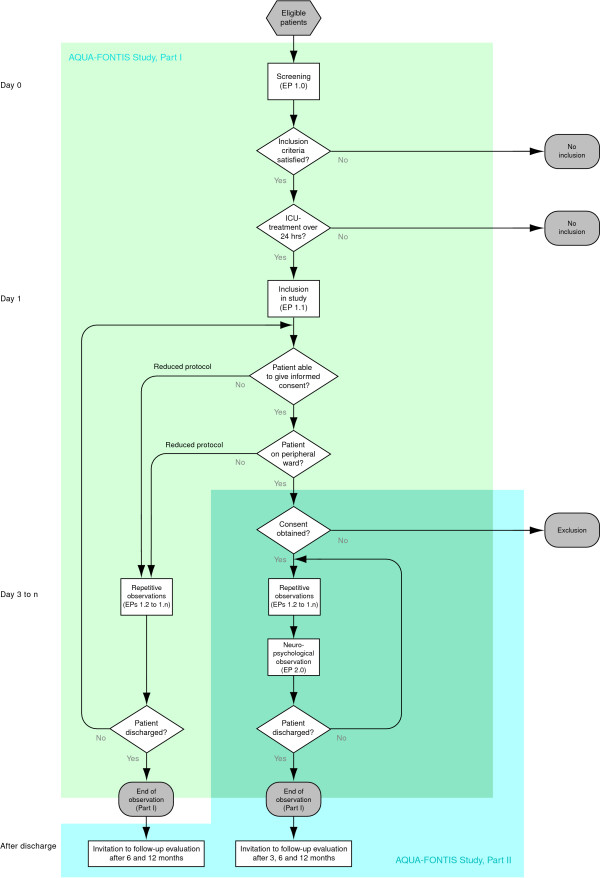
BACKGROUND: Non-thyroidal illness syndrome (NTIS) is a characteristic functional constellation of thyrotropic feedback control that frequently occurs in critically ill patients. Although this condition is associated with significantly increased morbidity and mortality, there is still controversy on whether NTIS is caused by artefacts, is a form of beneficial adaptation, or is a disorder requiring treatment. Trials investigating substitution therapy of NTIS revealed contradictory results. The comparison of heterogeneous patient cohorts may be the cause for those inconsistencies. OBJECTIVES: Primary objective of this study is the identification and differentiation of different functional states of thyrotropic feedback control in order to define relevant evaluation criteria for the prognosis of affected patients. Furthermore, we intend to assess the significance of an innovative physiological index approach (SPINA) in differential diagnosis between NTIS and latent (so-called "sub-clinical") thyrotoxicosis.Secondary objective is observation of variables that quantify distinct components of NTIS in the context of independent predictors of evolution, survival or pathophysiological condition and influencing or disturbing factors like medication. DESIGN: The approach to a quantitative follow-up of non-thyroidal illness syndrome (AQUA FONTIS study) is designed as both a cross-sectional and prospective longitudinal observation trial in critically ill patients. Patients are observed in at least two evaluation points with consecutive assessments of thyroid status, physiological and clinical data in additional weekly observations up to discharge. A second part of the study investigates the neuropsychological impact of NTIS and medium-term outcomes.The study design incorporates a two-module structure that covers a reduced protocol in form of an observation trial before patients give informed consent. Additional investigations are performed if and after patients agree in participation. TRIAL REGISTRATION: ClinicalTrials.gov NCT00591032.
Overview
The claims and statistics of this paper haven’t been checked yet.
Free: it reads the open-access text and checks the first 5 claims that cite a source we can check. Create a free account to check every claim.
Integrity signals
Registry
Cites
Statistics
Figures
Verification
Claims the paper makes
The claims and statistics of this paper haven’t been checked yet.
Free: it reads the open-access text and checks the first 5 claims that cite a source we can check. Create a free account to check every claim.
Self-check
Percentages, sums and reported differences re-computed from the paper’s own numbers.
The self-check needs the paper’s full text.
Citations
Cites
von Elm, E., Altman, D. G., Egger, M., Pocock, S. J., Gøtzsche, P. C., Vandenbroucke, J. P., & Initiative, F. T. S. (2007) · PLoS Medicine · doi:10.1371/journal.pmed.0040296 · Cited by 23,020
Vandenbroucke, J. P., von Elm, E., Altman, D. G., Gøtzsche, P. C., Mulrow, C. D., Pocock, S. J., Poole, C., Schlesselman, J. J., Egger, M., & Initiative, F. T. S. (2007) · PLoS Medicine · doi:10.1371/journal.pmed.0040297 · Cited by 8,613 · cited 1×
“Both significant and insignificant findings from the trial will be published, in accordance with the STROBE statement [31].”
Missing data analysis: making it work in the real world
Graham, J. W. (2009) · Annual Review of Psychology · doi:10.1146/annurev.psych.58.110405.085530 · Cited by 6,163 · cited 1×
“Missing data analysis will be performed with "modern" procedures like EM algorithm and multiple imputation [25], if required.”
Vandenbroucke, J. P., Elm, E. V., Altman, D. G., Gøtzsche, P. C., Mulrow, C. D., Pocock, S. J., Poole, C., Schlesselman, J. J., Egger, M., & initiative, F. T. S. (2007) · Annals of Internal Medicine · doi:10.7326/0003-4819-147-8-200710160-00010-w1 · Cited by 3,543
Life-Threatening Thyrotoxicosis: Thyroid Storm
Burch, H. B., & Wartofsky, L. (1993) · Endocrinology and Metabolism Clinics of North America · doi:10.1016/s0889-8529(18)30165-8 · Cited by 852 · cited 1×
“Decision criteria Latent (so called "subclinical") thyrotoxicosis is defined as suppressed thyrotropin levels with free T4 levels being in their reference intervals and additional clinical evidence for tissue hyperthyroidism (suggestive history or Burch-Wartofsky point scale of more than 45 points [23]).”
Dynamic neuroendocrine responses to critical illness
den Berghe, G. V. (2002) · Frontiers in Neuroendocrinology · doi:10.1016/s0091-3022(02)00006-7 · Cited by 710 · cited 2×
“NTIS is characterised by three components that may occur single or in combination:central hypothyroidism (transient thyrotropic insufficiency), impaired protein binding of thyroid hormones and reduced formation of T3 with simultaneously increased conversion to rT3 (low-T3-syndrome) [1,2].”
Dangerous dogmas in medicine: the nonthyroidal illness syndrome
De Groot, L. J. (1999) · The Journal of Clinical Endocrinology & Metabolism · doi:10.1210/jcem.84.1.5364 · Cited by 505 · cited 4×
“regarding the incidence of atrial fibrillation [2,7,9,10] and hemodynamic parameters [11,12] while others could not observe relevant differences in outcome between treated and untreated patients [13-15].”
InfluentialLow-T3 syndrome: a strong prognostic predictor of death in patients with heart disease
Iervasi, G., Pingitore, A., Landi, P., Raciti, M., Ripoli, A., Scarlattini, M., L’Abbate, A., & Donato, L. (2003) · Circulation · doi:10.1161/01.cir.0000048124.64204.3f · Cited by 472 · cited 2×
“Additional observations could reveal that these alterations are also common in critically ill patients where they form the correlate of endocrine dysregulation with increased morbidity and mortality [5-8].”
Thyroid Hormone Treatment after Coronary-Artery Bypass Surgery
Klemperer, J. D., Klein, I., Gomez, M., Helm, R. E., Ojamaa, K., Thomas, S. J., Isom, O. W., & Krieger, K. (1995) · New England Journal of Medicine · doi:10.1056/nejm199512073332302 · Cited by 460 · cited 1×
“regarding the incidence of atrial fibrillation [2,7,9,10] and hemodynamic parameters [11,12] while others could not observe relevant differences in outcome between treated and untreated patients [13-15].”
BRENT, G. A., & HERSHMAN, J. M. (1986) · The Journal of Clinical Endocrinology & Metabolism · doi:10.1210/jcem-63-1-1 · Cited by 365 · cited 1×
“Several studies even described detrimental effects of substitution therapy ranging from increased risk of hyperthyroidism [16,17] over undesirably high protein catabolism [18] to severe side effects in patients with adrenal insufficiency that may be difficult to identify during critical illness [19].”
Portnay, G. I., O'Brian, J. T., Bush, J., Vagenakis, A. G., Azizi, F., Arky, R. A., Ingbar, S. H., & Braverman, L. E. (1974) · The Journal of Clinical Endocrinology & Metabolism · doi:10.1210/jcem-39-1-191 · Cited by 252 · cited 2×
“In 1973, characteristic alterations of thyroid metabolism have been first described in the starving organism [3,4].”
De Groot, L. J. (2006) · Critical Care Clinics · doi:10.1016/j.ccc.2005.10.001 · Cited by 188 · cited 6×
“In the past, many studies dealt with the impact of severe diseases on thyroid metabolism [ 1-8 ].”
InfluentialA trial of thyroxine in acute renal failure
Acker, C. G., Singh, A. R., Flick, R. P., Bernardini, J., Greenberg, A., & Johnson, J. P. (2000) · Kidney International · doi:10.1046/j.1523-1755.2000.00827.x · Cited by 174 · cited 1×
“Several studies even described detrimental effects of substitution therapy ranging from increased risk of hyperthyroidism [16,17] over undesirably high protein catabolism [18] to severe side effects in patients with adrenal insufficiency that may be difficult to identify during critical illness [19].”
Triiodothyronine therapy lowers the incidence of atrial fibrillation after cardiac operations
Klemperer, J. D., Klein, I. L., Ojama, K., Helm, R. E., Gomez, M., Wayne Isom, O., & Krieger, K. H. (1996) · The Annals of Thoracic Surgery · doi:10.1016/0003-4975(96)00102-6 · Cited by 160 · cited 1×
“regarding the incidence of atrial fibrillation [2,7,9,10] and hemodynamic parameters [11,12] while others could not observe relevant differences in outcome between treated and untreated patients [13-15].”
Altered Thyroid Function in Nonthyroidal Illness and Surgery — To Treat or Not to Treat?
Utiger, R. D. (1995) · New England Journal of Medicine · doi:10.1056/nejm199512073332310 · Cited by 155 · cited 1×
“Several studies even described detrimental effects of substitution therapy ranging from increased risk of hyperthyroidism [16,17] over undesirably high protein catabolism [18] to severe side effects in patients with adrenal insufficiency that may be difficult to identify during critical illness [19].”
Ryff, J. (1993) · Journal of Hepatology · doi:10.1016/s0168-8278(05)80422-2 · Cited by 130
Ranasinghe, A. M., Quinn, D. W., Pagano, D., Edwards, N., Faroqui, M., Graham, T. R., Keogh, B. E., Mascaro, J., Riddington, D. W., Rooney, S. J., et al. (2006) · Circulation · doi:10.1161/circulationaha.105.000786 · Cited by 96 · cited 1×
“regarding the incidence of atrial fibrillation [2,7,9,10] and hemodynamic parameters [ 11 ,12] while others could not observe relevant differences in outcome between treated and untreated patients [13-15].”
Scoscia, E., Baglioni, S., Eslami, A., Iervasi, G., Monti, S., & Todisco, T. (2004) · European Journal of Endocrinology · doi:10.1530/eje.0.1510557 · Cited by 96 · cited 2×
“Additional observations could reveal that these alterations are also common in critically ill patients where they form the correlate of endocrine dysregulation with increased morbidity and mortality [5-8].”
Pohlenz, J. (1999) · Journal of Clinical Endocrinology & Metabolism · doi:10.1210/jc.84.11.3919 · Cited by 87 · cited 1×
“with lu being the upper limit of the reference interval for free T4 [24].”
Jansen, T. C., Kompanje, E. J. O., Druml, C., Menon, D. K., Wiedermann, C. J., & Bakker, J. (2007) · Intensive Care Medicine · doi:10.1007/s00134-007-0580-8 · Cited by 79
Nonthyroidal Illness Syndrome or Euthyroid Sick Syndrome?
CHOPRA, I. J. (1996) · Endocrine Practice · doi:10.4158/ep.2.1.45 · Cited by 68 · cited 2×
“Additional observations could reveal that these alterations are also common in critically ill patients where they form the correlate of endocrine dysregulation with increased morbidity and mortality [5-8].”
Selenium substitution has no direct effect on thyroid hormone metabolism in critically ill patients
Angstwurm, M., Schopohl, J., & Gaertner, R. (2004) · European Journal of Endocrinology · doi:10.1530/eje.0.1510047 · Cited by 51 · cited 1×
“Recently, a small trial investigating the effect of selenium substitution on the development of critically ill patients demonstrated improvements in prognosis, but, in spite of the known selenium-dependency of peripheral deiodinases, this outcome was not caused by a direct effect on thyroid homeostasis [20].”
Informed consent of incapable (ICU) patients in Europe: existing laws and the EU Directive
Druml, C. (2004) · Current Opinion in Critical Care · doi:10.1097/01.ccx.0000144765.73540.89 · Cited by 37 · cited 2×
“These predominantly accrue from the fact that most patients receiving intensive care are not able to give informed consent [26,32].”
Effects of Intravenous Triiodothyronine during Coronary Artery Bypass Surgery
Güden, M., Akpınar, B., Sağbaş, E., Sanisoğlu, İ., Cakalı, E., & Bayındır, O. (2002) · Asian Cardiovascular and Thoracic Annals · doi:10.1177/021849230201000306 · Cited by 28 · cited 1×
“regarding the incidence of atrial fibrillation [2,7,9,10] and hemodynamic parameters [11,12] while others could not observe relevant differences in outcome between treated and untreated patients [13-15].”
Gesetz über den Verkehr mit Arzneimitteln (Arzneimittelgesetz)
Deutsch, E., & Lippert, H.-D. (2001) · Springer eBooks · doi:10.1007/978-3-662-08134-1_1 · Cited by 21
THE INFLUENCE OF TOTAL STARVATION ON THE PITUITARY-THYROID-AXIS IN OBESE INDIVIDUALS
Rothenbuchner, G., Loos, U., Kiessling, W., Birk, J., & Pfeiffer, E. F. (1973) · European Journal of Endocrinology · doi:10.1530/acta.0.072s144 · Cited by 19 · cited 2×
“In 1973, characteristic alterations of thyroid metabolism have been first described in the starving organism [3,4].”
Iwanowski, P. S., Budaj, A., Członkowska, A., Wąsek, W., Kozłowska-Boszko, B., Olędzka, U., & Masełbas, W. (2008) · Trials · doi:10.1186/1745-6215-9-45 · Cited by 17 · cited 1×
“These predominantly accrue from the fact that most patients receiving intensive care are not able to give informed consent [26,32].”
Magalhães, A. P. A., Gus, M., Neto, L. B. D. S., & Schaan, B. D. (2006) · Brazilian Journal of Medical and Biological Research · doi:10.1590/s0100-879x2006000700015 · Cited by 15 · cited 1×
“regarding the incidence of atrial fibrillation [2,7,9,10] and hemodynamic parameters [11,12] while others could not observe relevant differences in outcome between treated and untreated patients [13-15].”
Does perioperative thyroxine have a role during adult cardiac surgery?
Ronald, A., & Dunning, J. (2006) · Interactive Cardiovascular and Thoracic Surgery · doi:10.1510/icvts.2006.128363 · Cited by 13
Comment on Dangerous Dogmas in Medicine: The Nonthyroidal Illness Syndrome
Caplan, R. H. (1999) · The Journal of Clinical Endocrinology & Metabolism · doi:10.1210/jcem.84.6.5809-6 · Cited by 11 · cited 1×
“Several studies even described detrimental effects of substitution therapy ranging from increased risk of hyperthyroidism [16,17] over undesirably high protein catabolism [18] to severe side effects in patients with adrenal insufficiency that may be difficult to identify during critical illness [19].”
The role of thyroid hormone therapy in acutely ill cardiac patients.
Wyne, K. L. (2005) · Critical Care · doi:10.1186/cc3738 · Cited by 9 · cited 1×
“regarding the incidence of atrial fibrillation [2,7,9,10] and hemodynamic parameters [11,12] while others could not observe relevant differences in outcome between treated and untreated patients [13-15].”
Comment on Dangerous Dogmas in Medicine: The Nonthyroidal Illness Syndrome
Caplan, R. H. (1999) · The Journal of Clinical Endocrinology & Metabolism · doi:10.1210/jc.84.6.2261-a · Cited by 6
Research works printed but not linked: 2
- Dietrich JW Fischer MR Jauch J Pantke E Gärtner R Pickardt CR SPINA-THYR: A novel systems theoretic approach to determine the secretion capacity of the thyroid gland European Journal of Internal Medicine 1999 10 S34
- Anonymous Commission Directive 2005/28/EC of 8 April 2005 laying down principles and detailed guidelines for good clinical practice as regards investigational medicinal products for human use, as well as the requirements for authorisation of the manufacturing or importation of such products Off J Eur Union 2005 L 91 13 19
Cited by
Chatzitomaris, A., Hoermann, R., Midgley, J. E., Hering, S., Urban, A., Dietrich, B., Abood, A., Klein, H. H., & Dietrich, J. W. (2017) · Frontiers in Endocrinology · doi:10.3389/fendo.2017.00163 · Cited by 173
Self-citationDietrich, J. W., Landgrafe-Mende, G., Wiora, E., Chatzitomaris, A., Klein, H. H., Midgley, J. E. M., & Hoermann, R. (2016) · Frontiers in Endocrinology · doi:10.3389/fendo.2016.00057 · Cited by 164
Self-citationTSH and thyrotropic agonists: key actors in thyroid homeostasis
Dietrich, J. W., Landgrafe, G., & Fotiadou, E. H. (2012) · Journal of Thyroid Research · doi:10.1155/2012/351864 · Cited by 146
Self-citationRelationship between thyroid function and ICU mortality: a prospective observation study
Wang, F., Pan, W., Wang, H., Wang, S., Pan, S., & Ge, J. (2012) · Critical Care · doi:10.1186/cc11151 · Cited by 142
Hoermann, R., Midgley, J. E. M., Giacobino, A., Eckl, W. A., Wahl, H. G., Dietrich, J. W., & Larisch, R. (2014) · Clinical Endocrinology · doi:10.1111/cen.12527 · Cited by 82
Self-citation
Metadata
- Authors
- Dietrich, J. W., Stachon, A., Antic, B., Klein, H. H., & Hering, S.
- Affiliations
- BG University Hospital Bergmannsheil Bochum (DE)
- Corresponding author
- Dietrich, Johannes W
- ORCID
- Dietrich, Johannes W
- Venue
- BMC Endocrine Disorders
- Published
- 2008-10-13
- Volume
- 8
- Issue
- 1
- Pages
- 13-13
- ISSN
- 1472-6823 (ISSN-L)
- PMC
- PMC2576461
- OpenAlex
- W2017119837
- Cited by
- 44
- References
- 34
- Citations by year
- 2026: 1 · 2025: 4 · 2024: 1 · 2023: 9 · 2022: 1 · 2020: 3 · 2019: 2 · 2018: 4 · 2017: 3 · 2016: 4 · 2015: 3 · 2014: 2 · 2013: 1 · 2012: 5
- FWCI
- 0.24
- Type
- journal article
- Language
- en
- Open access
- gold
- doi.org
- Licence
- cc-by
- creativecommons.org/licenses/by/2.0 (tdm)
- Locations
- BMC Endocrine Disorders (publishedVersion, cc-by)
- PubMed Central (publishedVersion, cc-by)
- PubMed (publishedVersion)
- DOAJ (DOAJ: Directory of Open Access Journals) (submittedVersion, cc-by-sa)
- Topics
- Health Sciences › Medicine › Endocrinology, Diabetes and Metabolism › Thyroid Disorders and Treatments
- Health Sciences › Medicine › Endocrinology, Diabetes and Metabolism › Adrenal Hormones and Disorders
- Health Sciences › Medicine › Critical Care and Intensive Care Medicine › Sepsis Diagnosis and Treatment
- Keywords
- low T3 syndrome, critically ill patients, survival prediction, thyroid function, prognostic factors
About these checks
Registry, retraction, Cites and statistics results are computed, not judged, with one exception: a printed reference that no index lists is read once by a model before it counts as a citation error. Claims are extracted by a model and kept only when their quote appears verbatim in the text; each cited source is then checked, with a model’s help, for whether it says what the claim relies on. Those verdicts can be wrong — read the claim’s quote and the cited source before relying on one.
Statistics and arithmetic are recomputed, not judged.
Confidence bands are shown only for fields calibrated on our annotated test set. None is calibrated yet, so no band is shown.
What counts as a claim ›How we measure confidence ›How we check this ›
Are you an author, or do you see a problem with this page? Request a review
Data sources
Bibliographic data: Semantic Scholar, OpenAlex, Crossref.
Contains information from the Semantic Scholar Academic Graph Datasets, made available under the ODC Attribution License (ODC-BY 1.0).
Semantic Scholar’s data is described in: Kinney, R., et al. (2023). The Semantic Scholar Open Data Platform. arXiv:2301.10140.
