

The DOI matches its Crossref record; 48 of the 48 references it cites were found in a registry or an index.
Effect of an office worksite-based yoga program on heart rate variability: outcomes of a randomized controlled trial
Open accessAbstract
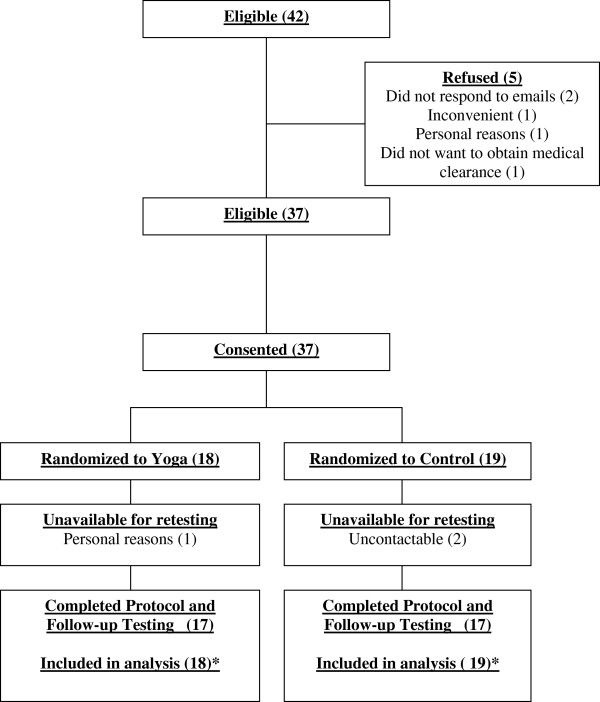
BACKGROUND: Chronic work-related stress is an independent risk factor for cardiometabolic diseases and associated mortality, particularly when compounded by a sedentary work environment. The purpose of this study was to determine if an office worksite-based hatha yoga program could improve physiological stress, evaluated via heart rate variability (HRV), and associated health-related outcomes in a cohort of office workers. METHODS: Thirty-seven adults employed in university-based office positions were randomized upon the completion of baseline testing to an experimental or control group. The experimental group completed a 10-week yoga program prescribed three sessions per week during lunch hour (50 min per session). An experienced instructor led the sessions, which emphasized asanas (postures) and vinyasa (exercises). The primary outcome was the high frequency (HF) power component of HRV. Secondary outcomes included additional HRV parameters, musculoskeletal fitness (i.e. push-up, side-bridge, and sit & reach tests) and psychological indices (i.e. state and trait anxiety, quality of life and job satisfaction). RESULTS: All measures of HRV failed to change in the experimental group versus the control group, except that the experimental group significantly increased LF:HF (p = 0.04) and reduced pNN50 (p = 0.04) versus control, contrary to our hypotheses. Flexibility, evaluated via sit & reach test increased in the experimental group versus the control group (p < 0.001). No other adaptations were noted. Post hoc analysis comparing participants who completed ≥70% of yoga sessions (n = 11) to control (n = 19) yielded the same findings, except that the high adherers also reduced state anxiety (p = 0.02) and RMSSD (p = 0.05), and tended to improve the push-up test (p = 0.07) versus control. CONCLUSIONS: A 10-week hatha yoga intervention delivered at the office worksite during lunch hour did not improve HF power or other HRV parameters. However, improvements in flexibility, state anxiety and musculoskeletal fitness were noted with high adherence. Future investigations should incorporate strategies to promote adherence, involve more frequent and longer durations of yoga training, and enrol cohorts who suffer from higher levels of work-related stress. TRIAL REGISTRATION: ACTRN12611000536965.
Overview
The claims and statistics of this paper haven’t been checked yet.
Run the check — free, no account needed. It reads the open-access text and checks the sources it cites.
Integrity signals
Registry
Cites
Statistics
Figures
Verification
Claims the paper makes
The claims and statistics of this paper haven’t been checked yet.
Run the check — free, no account needed. It reads the open-access text and checks the sources it cites.
Claims other papers make about this one
Each is checked against this paper’s own text: does it say what the citing paper says it does?
The source backs part of the claim, not all of it — or backs it for a different population, condition or comparison.
In the citing paper
“The risk assessment here may be considered more conservative as in Vonderlin et al. (2020), as they did not judge the risk for two domains that usually result in high risks: performance bias and detection bias. These were included here, however, because some of the analyzed studies (e.g., Cheema et al., 2013) aimed at solving the problem of blinding staff and participants.”
From Mindfulness-Based and Mindfulness-Informed Interventions at the Workplace: A Systematic Review and Meta-Regression Analysis of RCTs (2023) · cites this paper as Cheema et al., 2013
Experimental — accuracy not yet measured
Self-check
Percentages, sums and reported differences re-computed from the paper’s own numbers.
The self-check needs the paper’s full text.
Citations
Cites
Heart Rate Variability: Standards of Measurement, Physiological Interpretation, and Clinical Use
Electrophysiology, T. F. O. T. E. S. O. C. T. N. A. (1996) · Circulation · doi:10.1161/01.cir.93.5.1043 · Cited by 17,159
Heart rate variability: Standards of measurement, physiological interpretation, and clinical use
Malik, M., Bigger, J. T., Camm, A. J., Kleiger, R. E., Malliani, A., Moss, A. J., & Schwartz, P. J. (1996) · European Heart Journal · doi:10.1093/oxfordjournals.eurheartj.a014868 · Cited by 15,289
(2014) · Medical Entomology and Zoology · Cited by 9,400
Protective and Damaging Effects of Stress Mediators
McEwen, B. S. (1998) · New England Journal of Medicine · doi:10.1056/nejm199801153380307 · Cited by 6,733 · cited 1×
“This link between stress and disease is influenced by autonomic imbalance [3] implicating an overactive or dysregulated sympathetic nervous system (SNS) and hypothalamuspituitary-adrenal (HPA) axis [4,5].”
BackgroundThe MOS Short-form General Health Survey: Reliability and Validity in a Patient Population
Stewart, A. L., Hays, R. D., & Ware, J. E. (1988) · Medical Care · doi:10.1097/00005650-198807000-00007 · Cited by 3,339
Psychological Stress and Disease
Cohen, S., Janicki-Deverts, D., & Miller, G. E. (2007) · JAMA · doi:10.1001/jama.298.14.1685 · Cited by 3,168
Complementary and Alternative Medicine Use Among Adults and Children: United States, 2007
Barnes, P. M., Bloom, B. E., & Nahin, R. L. (2008) · PsycEXTRA Dataset · doi:10.1037/e623942009-001 · Cited by 3,144
Thayer, J. F., Yamamoto, S. S., & Brosschot, J. F. (2010) · International Journal of Cardiology · doi:10.1016/j.ijcard.2009.09.543 · Cited by 2,276
Impact of Reduced Heart Rate Variability on Risk for Cardiac Events: The Framingham Heart Study
Tsuji, H., Larson, M. G., Venditti, F. J., Manders, E. S., Evans, J. C., Feldman, C. L., & Levy, D. (1996) · Circulation · doi:10.1161/01.cir.94.11.2850 · Cited by 1,762
Research works printed but not linked: 2
- Borg-Oliver S, Machliss B: Applied Anatomy & Physiology of Yoga. 2005, Waverly, NSW: Yoga Synergy
- Kivimaki M, Virtanen M, Elovainio M, Kouvonen A, Vaananen A, Vahtera J: Work stress in the etiology of coronary heart disease: a meta-analysis. Scand J Environ Health. 2006, 32 (6): 431-442. 10.5271/sjweh.1049. · DOI
Cited by
Sorted by citations
Phytochemicals for human disease: An update on plant-derived compounds antibacterial activity
Barbieri, R., Coppo, E., Marchese, A. E., Daglia, M., Sobarzo‐Sánchez, E., Nabavi, S. F., & Nabavi, S. M. (2016) · Microbiological Research · doi:10.1016/j.micres.2016.12.003 · Cited by 696
Ezuruike, U. F., & Prieto, J. M. (2014) · Journal of Ethnopharmacology · doi:10.1016/j.jep.2014.05.055 · Cited by 410
Workplace interventions for reducing sitting at work
Shrestha, N., Kukkonen-Harjula, K. T., Verbeek, J. H. A. M., Ijaz, S., Hermans, V., & Bhaumik, S. (2016) · Cochrane Database of Systematic Reviews · doi:10.1002/14651858.cd010912.pub3 · Cited by 403
A systematic review of randomised control trials on the effects of yoga on stress measures and mood
Pascoe, M. C., & Bauer, I. E. (2015) · Journal of Psychiatric Research · doi:10.1016/j.jpsychires.2015.07.013 · Cited by 366
Solayman, M., Islam, M. A., Paul, S., Ali, Y., Khalil, M. I., Alam, N., & Gan, S. H. (2015) · Comprehensive Reviews in Food Science and Food Safety · doi:10.1111/1541-4337.12182 · Cited by 363
Metadata
- Authors
- Cheema, B. S., Houridis, A., Busch, L., Raschke-Cheema, V., Melville, G. W., Marshall, P. W., Chang, D., Machliss, B., Lonsdale, C., Bowman, J., & Colagiuri, B.
- Affiliations
- Western Sydney University (AU)
- The University of Sydney (AU)
- Corresponding author
- Cheema, Birinder S
- Venue
- BMC Complementary and Alternative Medicine
- Published
- 2013-04-10
- Volume
- 13
- Issue
- 1
- Pages
- 82-82
- ISSN
- 1472-6882 (ISSN-L)
- PMC
- PMC3648394
- OpenAlex
- W2164469254
- Cited by
- 281
- References
- 48
- Citations by year
- 2026: 3 · 2025: 2 · 2024: 7 · 2023: 8 · 2022: 4 · 2021: 41 · 2020: 29 · 2019: 26 · 2018: 21 · 2017: 49 · 2016: 42 · 2015: 29 · 2014: 17 · 2013: 3
- FWCI
- 20.64
- Type
- journal article
- Language
- en
- Open access
- gold
- doi.org
- Licence
- Locations
- BMC Complementary and Alternative Medicine (publishedVersion, cc-by)
- Europe PMC (PubMed Central) (publishedVersion, cc-by)
- PubMed Central (publishedVersion, cc-by)
- PubMed (publishedVersion)
- Research Bank (Australian Catholic University) (submittedVersion)
- Research Online (University of Wollongong) (submittedVersion)
- Figshare (submittedVersion)
- Funders
- University of Western Sydney
- Topics
- Health Sciences › Medicine › Cardiology and Cardiovascular Medicine › Heart Rate Variability and Autonomic Control
- Health Sciences › Medicine › Public Health, Environmental and Occupational Health › Physical Activity and Health
- Health Sciences › Medicine › Public Health, Environmental and Occupational Health › Workplace Health and Well-being
- Keywords
- hatha yoga, heart rate variability, office workers, occupational stress, sedentary work, workplace wellness interventions, flexibility, musculoskeletal fitness, state anxiety, quality of life, job satisfaction, cardiometabolic risk
- MeSH terms
- Adult, Exercise Therapy, Female, Heart Rate, Humans, Male, Middle Aged, Stress, Psychological, Universities, Yoga, Cohort Studies, Treatment Outcome, Workplace, Young Adult
About these checks
Registry, retraction, Cites and statistics results are computed, not judged, with one exception: a printed reference that no index lists is read once by a model before it counts as a citation error. Claims are extracted by a model and kept only when their quote appears verbatim in the text; each cited source is then checked, with a model’s help, for whether it says what the claim relies on. Those verdicts can be wrong — read the claim’s quote and the cited source before relying on one.
Statistics and arithmetic are recomputed, not judged.
Confidence bands are shown only for fields calibrated on our annotated test set. None is calibrated yet, so no band is shown.
What counts as a claim ›How we measure confidence ›How we check this ›
Are you an author, or do you see a problem with this page? Request a review
