

Mindfulness-based cognitive therapy (MBCT) versus the health-enhancement program (HEP) for adults with treatment-resistant depression: a randomized control trial study protocol
Open accessThe DOI matches its Crossref record; 68 of the 68 references it cites were found in a registry or an index.
Abstract
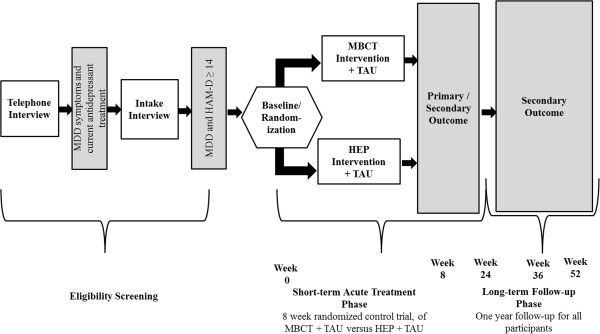
BACKGROUND: Major depressive disorder (MDD) is the leading cause of disability in the developed world, yet broadly effective treatments remain elusive. Up to 40% of patients with depression are unresponsive to at least two trials of antidepressant medication and thus have "treatment-resistant depression" (TRD). There is an urgent need for cost-effective, non-pharmacologic, evidence-based treatments for TRD. Mindfulness-Based Cognitive Therapy (MBCT) is an effective treatment for relapse prevention and residual depression in major depression, but has not been previously studied in patients with TRD in a large randomized trial. METHODS/DESIGN: The purpose of this study was to evaluate whether MBCT is an effective augmentation of antidepressants for adults with MDD who failed to respond to standard pharmacotherapy. MBCT was compared to an active control condition, the Health-Enhancement Program (HEP), which incorporates physical activity, functional movement, music therapy and nutritional advice. HEP was designed as a comparator condition for mindfulness-based interventions to control for non-specific effects. Originally investigated in a non-clinical sample to promote stress reduction, HEP was adapted for a depressed population for this study. Individuals age 18 and older with moderate to severe TRD, who failed to respond to at least two trials of antidepressants in the current episode, were recruited to participate. All participants were taking antidepressants (Treatment as usual; TAU) at the time of enrollment. After signing an informed consent, participants were randomly assigned to either MBCT or HEP condition. Participants were followed for 1 year and assessed at weeks 1-7, 8, 24, 36, and 52. Change in depression severity, rate of treatment response and remission after 8 weeks were the primary outcomes measured by the clinician-rated Hamilton Depression Severity Rating (HAM-D) 17-item scale. The participant-rated Quick Inventory of Depression Symptomology (QIDS-SR) 16-item scale was the secondary outcome measure of depression severity, response, and remission. DISCUSSION: Treatment-resistant depression entails significant morbidity and has few effective treatments. We studied the effect of augmenting antidepressant medication with MBCT, compared with a HEP control, for patients with TRD. Analyses will focus on clinician and patient assessment of depression, participants' clinical global impression change, employment and social functioning scores and quality of life and satisfaction ratings. TRIAL REGISTRATION: ClincalTrials.gov identifier: NCT01021254.
Overview
The claims and statistics of this paper haven’t been checked yet.
Free: it reads the open-access text and checks the first 5 claims that cite a source we can check. Create a free account to check every claim.
Integrity signals
Registry
Cites
Statistics
Figures
Verification
Claims the paper makes
The claims and statistics of this paper haven’t been checked yet.
Free: it reads the open-access text and checks the first 5 claims that cite a source we can check. Create a free account to check every claim.
Claims other papers make about this one
Each is checked against this paper’s own text: does it say what the citing paper says it does?
The source backs part of the claim, not all of it — or backs it for a different population, condition or comparison.
In the citing paper
“The study found that MBCT was more effective at reducing depression and rates of decline and debility when it was enhanced by regular medication than an active comparative disorder”
From Mindfulness in mood and anxiety disorders: A review of the literature (2017) · cites this paper as [20]
Experimental — accuracy not yet measuredThe source backs part of the claim, not all of it — or backs it for a different population, condition or comparison.
In the citing paper
“One randomized controlled trial suggested that MBCT could be an effective additional therapy for patients with treatment-resistant depression having active depressive episodes.”
From Mindfulness in mood and anxiety disorders: A review of the literature (2017) · cites this paper as [20]
Experimental — accuracy not yet measuredThe cited source says what the claim attributes to it.
In the citing paper
“The outcomes of this study have substantial implications for the treatment of depression with targeted, population-based, non-pharmacological intervention approaches.20”
From Mindfulness in mood and anxiety disorders: A review of the literature (2017) · cites this paper as [20]
Self-check
Percentages, sums and reported differences re-computed from the paper’s own numbers.
The self-check needs the paper’s full text.
Citations
Cites
Folstein, M. F., Folstein, S. E., & McHugh, P. R. (1975) · Journal of Psychiatric Research · doi:10.1016/0022-3956(75)90026-6 · Cited by 88,282 · cited 2×
“The SCID personality inventory for Axis II disorders (SCID-II) was used to assess the presence of personality disorders, and the Mini Mental Status Exam (MMSE) [31] was used to assess cognitive function and to rule out cognitive or developmental delays that might interfere with treatment.”
Method(1992) · PubMed · Cited by 33,716
A Global Measure of Perceived Stress
Cohen, S., Kamarck, T., & Mermelstein, R. (1983) · Journal of Health and Social Behavior · doi:10.2307/2136404 · Cited by 32,807 · cited 1×
“Functional status and quality of life were additional secondary outcomes measured using the SF-12 Health Survey [37,38], the Work and Social Adjustment Scale (WSAS) [39], [40] and the Quality of Life, Enjoyment, and Satisfaction Questionnaire (Q-LES-SQ) [41].”
MethodThe MOS 36-ltem Short-Form Health Survey (SF-36): I. Conceptual Framework and Item Selection
Ware, J. E., & Sherbourne, C. D. (1992) · Medical Care · doi:10.1097/00005650-199206000-00002 · Cited by 30,033 · cited 1×
“Functional status and quality of life were additional secondary outcomes measured using the SF-12 Health Survey [37,38], the Work and Social Adjustment Scale (WSAS) [39], [40] and the Quality of Life, Enjoyment, and Satisfaction Questionnaire (Q-LES-SQ) [41].”
MethodHirono, N., Mori, E., Ikejiri, Y., Imamura, T., Shimomura, T., Hashimoto, M., Yamashita, H., & Ikeda, M. (1997) · Brain and nerve · Cited by 21,030
Kok, J. S., Berg, I. J., & Scherder, E. J. A. (2013) · Dementia and Geriatric Cognitive Disorders Extra · doi:10.1159/000353441 · Cited by 20,589
Older Adults' Reasons for Using Technology while Aging in Place
Peek, S. T. M., Luijkx, K. G., Rijnaard, M. D., Nieboer, M. E., van der Voort, C. S., Aarts, S., van Hoof, J., Vrijhoef, H. J. M., & Wouters, E. J. M. (2016) · Gerontology · doi:10.1159/000430949 · Cited by 19,690
Sensitivity and False Alarm Rate of a Fall Sensor in Long-Term Fall Detection in the Elderly
Kangas, M., Korpelainen, R., Vikman, I., Nyberg, L., & Jämsä, T. (2015) · Gerontology · doi:10.1159/000362720 · Cited by 18,909
WARE, J. E., KOSINSKI, M., & KELLER, S. D. (1996) · Medical Care · doi:10.1097/00005650-199603000-00003 · Cited by 17,392 · cited 1×
“Functional status and quality of life were additional secondary outcomes measured using the SF-12 Health Survey [37,38], the Work and Social Adjustment Scale (WSAS) [39], [40] and the Quality of Life, Enjoyment, and Satisfaction Questionnaire (Q-LES-SQ) [41].”
MethodRandom-Effects Models for Longitudinal Data
Laird, N. M., & Ware, J. H. (1982) · Biometrics · doi:10.2307/2529876 · Cited by 8,923 · cited 1×
“The primary outcome measure of the HAM-D will be compared between participants randomized to the MBCT + TAU and the HEP + TAU groups using a mixed-effects statistical model [58,59].”
Method
Research works printed but not linked: 2
- 19. MacCoon DLA Rosenkranz M Davidson R Lessons from an Active Control Condition: "McMindfulness, Shams, and the One-Fold Path Mind Life Summer Research Institute 2007 New York: Garrison
- 29. First MB Spitzer Robert L Gibbon M Williams Janet BW Structured Clinical Interview for DSM-IV-TR Axis I Disorders, Research Version, Patient Edition (SCID-I/P) Biometrics Research, New York State Psychiatric Institute 2002
Cited by
Interventions to improve return to work in depressed people
Nieuwenhuijsen, K., Faber, B., Verbeek, J. H., Neumeyer-Gromen, A., Hees, H. L., Verhoeven, A. C., van der Feltz-Cornelis, C. M., & Bültmann, U. (2014) · Cochrane Database of Systematic Reviews · doi:10.1002/14651858.cd006237.pub3 · Cited by 299
Mindfulness meditation-based pain relief: a mechanistic account
Zeidan, F., & Vago, D. R. (2016) · Annals of the New York Academy of Sciences · doi:10.1111/nyas.13153 · Cited by 300
King, A. P., Block, S. R., Sripada, R. K., Rauch, S., Giardino, N., Favorite, T., Angstadt, M., Kessler, D., Welsh, R., & Liberzon, I. (2016) · Depression and Anxiety · doi:10.1002/da.22481 · Cited by 225
“Several RCTs have found mindfulness-based cognitive therapy (MBCT) to be effective for preventing depression relapse,[11–13] and there is accumulating evidence that MBCT and mindfulness-based stress reduction (MBSR) may be helpful for active depression [14, 15] and generalized anxiety disorder (GAD).”
BackgroundInterventions to improve return to work in depressed people
Nieuwenhuijsen, K., Verbeek, J. H., Neumeyer-Gromen, A., Verhoeven, A. C., Bültmann, U., & Faber, B. (2020) · Cochrane Database of Systematic Reviews · doi:10.1002/14651858.cd006237.pub4 · Cited by 218
Eisendrath, S. J., Gillung, E., Delucchi, K. L., Segal, Z. V., Nelson, J. C., McInnes, L. A., Mathalon, D. H., & Feldman, M. D. (2016) · Psychotherapy and Psychosomatics · doi:10.1159/000442260 · Cited by 187
Self-citationPsychological therapies for treatment-resistant depression in adults
Ijaz, S., Davies, P., Williams, C. J., Kessler, D., Lewis, G., & Wiles, N. (2018) · Cochrane Database of Systematic Reviews · doi:10.1002/14651858.cd010558.pub2 · Cited by 155
The effects of Beta-Endorphin: state change modification
Veening, J. G., & Barendregt, H. P. (2015) · Fluids and Barriers of the CNS · doi:10.1186/2045-8118-12-3 · Cited by 85
“In the last 2 years, more than 100 papers have appeared about the effects of mindfulness-based stress reduction, that is inspired by vipassana meditation coming from Buddhism, on a variety of symptoms related to chronic pain, anxiety disorders, depression versus wellbeing and several other medical symptoms like fatigu…”
BackgroundShallcross, A. J., Gross, J. J., Visvanathan, P. D., Kumar, N., Palfrey, A., Ford, B. Q., Dimidjian, S., Shirk, S., Holm-Denoma, J., Goode, K. M., et al. (2015) · Journal of Consulting and Clinical Psychology · doi:10.1037/ccp0000050 · Cited by 81
“Treatment adherence for the HEP was assessed with the 17-item HEP Adherence Scale (HEP-AS; Eisendrath et al., 2014), a newly developed but not yet validated measure modeled after the MBCT Adherence Scale.”
Neurophysiological Mechanisms Supporting Mindfulness Meditation–Based Pain Relief: an Updated Review
Jinich-Diamant, A., Garland, E., Baumgartner, J., Gonzalez, N., Riegner, G., Birenbaum, J., Case, L., & Zeidan, F. (2020) · Current Pain and Headache Reports · doi:10.1007/s11916-020-00890-8 · Cited by 69
Mindfulness in mood and anxiety disorders: A review of the literature
Rodrigues, M. F., Nardi, A. E., & Levitan, M. (2017) · Trends in Psychiatry and Psychotherapy · doi:10.1590/2237-6089-2016-0051 · Cited by 69
King, A. P., Block, S. R., Sripada, R. K., Rauch, S. A. M., Porter, K. E., Favorite, T. K., Giardino, N., & Liberzon, I. (2016) · Frontiers in Psychiatry · doi:10.3389/fpsyt.2016.00154 · Cited by 64
Blunted amygdala activity is associated with depression severity in treatment-resistant depression
Ferri, J., Eisendrath, S. J., Fryer, S. L., Gillung, E., Roach, B. J., & Mathalon, D. H. (2017) · Cognitive, Affective, & Behavioral Neuroscience · doi:10.3758/s13415-017-0544-6 · Cited by 67
“…trial (RTC) demonstrating that eight weeks of mindfulness-based cognitive therapy (MBCT), relative to a structurally equivalent comparator condition, the healthenhancement program (HEP), produced greater improvements in depressive symptoms (Eisendrath et al., 2014; Eisendrath et al., 2016).”
BackgroundMethodSelf-citationHenje Blom, E., Duncan, L. G., Ho, T. C., Connolly, C. G., LeWinn, K. Z., Chesney, M., Hecht, F. M., & Yang, T. T. (2014) · Frontiers in Human Neuroscience · doi:10.3389/fnhum.2014.00630 · Cited by 61
“Preliminary results from studies applying modified versions of mindfulness based cognitive therapy (MBCT) for the treatment of acute depression have also been published (Eisendrath et al., 2011, 2014; Munshi et al., 2013).”
BackgroundThe effects of app-based mindfulness practice on the well-being of university students and staff
Lahtinen, O., Aaltonen, J., Kaakinen, J., Franklin, L., & Hyönä, J. (2023) · Current Psychology · doi:10.1007/s12144-021-01762-z · Cited by 56
“The best studies in this regard have offered a “placebo” treatment as an active control condition via the same modality as the treatment condition, e.g. the Health Enhancement Program used in many face-to-face MBI studies (Eisendrath et al., 2014; Goleman & Davidson, 2017; MacCoon et al., 2012).”
MethodAzam, M. A., Katz, J. D., Mohabir, V., & Ritvo, P. (2016) · International Journal of Psychophysiology · doi:10.1016/j.ijpsycho.2016.10.011 · Cited by 68
Li, Y., Jakary, A., Gillung, E., Eisendrath, S. J., Nelson, S. J., Mukherjee, P., & Luks, T. L. (2016) · Magnetic Resonance Materials in Physics Biology and Medicine · doi:10.1007/s10334-016-0526-7 · Cited by 59
Self-citationChesin, M. S., Sönmez, C. C., Benjamin-Phillips, C. A., Beeler, B., Brodsky, B. S., & Stanley, B. (2015) · Mindfulness · doi:10.1007/s12671-015-0405-8 · Cited by 54
“In fact, in most trials testing standardMBCT for current depression, suicidal individuals have been excluded (e.g., Eisendrath et al. 2014).”
BackgroundFrancis, S. E. B., Shawyer, F., Cayoun, B., Enticott, J., & Meadows, G. N. (2022) · Frontiers in Psychiatry · doi:10.3389/fpsyt.2022.815170 · Cited by 45
Neuroticism's susceptibility to distress: Moderated with mindfulness
Drake, M. M., Morris, M., & Davis, T. J. (2016) · Personality and Individual Differences · doi:10.1016/j.paid.2016.10.060 · Cited by 43
“Measures of state mindfulness are commonly associated with mindfulness interventions (Eisendrath et al., 2014) while trait mindfulness is indicative of a relatively consistent mindful disposition (Baer, 2011).”
BackgroundShallcross, A. J., Willroth, E. C., Fisher, A., Dimidjian, S., Gross, J. J., Visvanathan, P. D., & Mauss, I. B. (2018) · Behavior Therapy · doi:10.1016/j.beth.2018.02.001 · Cited by 31
Frances, S., Shawyer, F., Cayoun, B., Enticott, J., & Meadows, G. (2020) · BMC Psychiatry · doi:10.1186/s12888-019-2411-1 · Cited by 27
Sepehrmanesh, Z., Omidi, A., & Gholampoor, N. (2016) · Iranian Red Crescent Medical Journal · doi:10.5812/ircmj.33243 · Cited by 19
“Depression is the leading cause of disability in developed countries and has been predicted to become the most significant cause of disability worldwide by 2020 (3).”
BackgroundJeong, J., Hu, Y., Zanuzzi, M., DaCosta, D. R., Sabino‐Carvalho, J. L., Li, S., & Park, J. (2024) · The Journal of Physiology · doi:10.1113/jp287321 · Cited by 15
“An 8 week HEP, a non-meditation intervention, was administered as the gold-standard control intervention for MBSR (Eisendrath et al., 2014, 2016; MacCoon et al., 2012).”
Mindfulness-Based Workplace Interventions for Wellness Promotion
King, A. P. J. (2019) · Integrating psychiatry and primary care · doi:10.1007/978-3-030-04266-0_13 · Cited by 20
Mindfulness-Based Cognitive Therapy for Combat-Related Posttraumatic Stress Disorder
King, A. P. J., & Favorite, T. (2016) · Springer eBooks · doi:10.1007/978-3-319-29866-5_15 · Cited by 9
Lee, B. H., Han, C.-H., Hwang, H. S., Lee, Y. J., Lee, S. N., & Abanes, J. J. (2016) · Neuropsychiatric Disease and Treatment · doi:10.2147/ndt.s107535 · Cited by 7
Luisetto, M., Mashori, G. R., Nili-Ahmadabadi, B., Khan, F. A., & Khan, K. R. (2018) · Insights on the Depression and Anxiety · doi:10.29328/journal.ida.1001008 · Cited by 6
“Mindfulness-Based Cognitive Therapy (MBCT) is an effective treatment for relapse prevention and residual depression in major depression, but has not been previously studied in patients with TRD in a large randomized trial” [3].”
Ladari, R. B., Arani, A. M., Bakhtiari, M., Zarghami, M., Nouri, R., & Hosseini, S. H. (2018) · Iranian Journal of Psychiatry and Behavioral Sciences · doi:10.5812/ijpbs.10742 · Cited by 6
Zammatteo, N., & Botman, M. (2018) · European Journal of Trauma & Dissociation · doi:10.1016/j.ejtd.2018.06.003 · Cited by 5
Jakary, A., Lupo, J., Mackin, S. R., Yin, A., Murray, D. E., Yang, T. T., Mukherjee, P., Larson, P. E. Z., Xu, D., Eisendrath, S. J., et al. (2023) · Journal of Affective Disorders · doi:10.1016/j.jad.2023.05.038 · Cited by 5
Self-citationRodrigues, M. F., Junkes, L., Appolinário, J. C., & Nardi, A. E. (2025) · Personalized Medicine in Psychiatry · doi:10.1016/j.pmip.2025.100148 · Cited by 3
Hoseini, L., & Manshaei, G. (2020) · Quarterly Journal of Child Mental Health · doi:10.29252/jcmh.7.1.21 · Cited by 3
Mindfulness-Based Interventions for Psychiatry
Ivkovic, A., Evans, S., Mirsky, P., Ashar, Y. K., & Muskin, P. R. (2024) · Tasman’s Psychiatry · doi:10.1007/978-3-030-51366-5_159 · Cited by 1
Luisetto, M. (2018) · Journal of pharmacology & clinical research · doi:10.19080/jpcr.2018.05.555680 · Cited by 1
Effectiveness of MBSR and MBCT in Reducing Clinical Symptoms in Adolescents
Statz, A. (2015) · SOPHIA (St. Catherine University) · Cited by 1
Mindfulness-Based Interventions for Psychiatry
Ivkovic, A., Evans, S., Mirsky, P., Ashar, Y. K., & Muskin, P. R. (2023) · Springer eBooks · doi:10.1007/978-3-030-42825-9_159-1 · Cited by 1
L’innovation en psychothérapie cognitive et comportementale
Rengade, C., & Khazaal, Y. (2015) · Journal de Thérapie Comportementale et Cognitive · doi:10.1016/j.jtcc.2015.07.003 · Cited by 1
Influência da musicoterapia no comportamento de animais em desenvolvimento
Sampaio, W. C. M. (2015) · RIUnB Institutional Repository (University of Brasília) · doi:10.26512/2015.05.d.18865 · Cited by 1
Effects of Music and Movement on Mood in Patients with Major Depressive Disorder
Lassiter, D. J. (2016) · Sigma Theta Tau International's 26th International Nursing Research Congress
Mindfulness-Based Cognitive Therapy: Theoretical Background and Use
Chybicki, M. (2016) · Nursing and Public Health · doi:10.17219/pzp/61710
Dalziel, G. A. (2014) · TSpace (University of Toronto) · Cited by 1
Meditation for Major Depressive Disorder: A Systematic Review
Sorbero, M. E. S., Ahluwalia, S. C., Reynolds, K. A., Lovejoy, S. L., Farris, C. A., Sloan, J., Miles, J. N. V., Vaughan, C., Kandrack, R., Apaydin, E. A., et al. (2015) · RAND Corporation eBooks · doi:10.7249/rr1138 · Cited by 1
Wu, X., Wang, W., Wang, Y., Xue, Y., Zhao, H., Liu, J., & Peng, Y. (2026) · Current Psychology · doi:10.1007/s12144-026-09040-6
“Specifically, it helps patients associate unpleasant thoughts and feelings with events that temporarily pass through their minds (Eisendrath et al., 2014).”
Metadata
- Authors
- Eisendrath, S. J., Gillung, E. P., Delucchi, K. L., Chartier, M., Mathalon, D. H., Sullivan, J. C., Segal, Z. V., & Feldman, M. D.
- Affiliations
- University of California, San Francisco (US)
- San Francisco VA Medical Center (US)
- UW Health University Hospital (US)
- University of Toronto (CA)
- Corresponding author
- Eisendrath, Stuart J
- Venue
- BMC Complementary and Alternative Medicine
- Published
- 2014-03-11
- Volume
- 14
- Issue
- 1
- Pages
- 95-95
- ISSN
- 1472-6882 (ISSN-L)
- PMC
- PMC3995768
- OpenAlex
- W2028003028
- Semantic Scholar
- 1e2fc7ebee9f0af4b416809ca953e3a0ee15d1fd
- Cited by
- 43
- References
- 68
- Citations by year
- 2026: 1 · 2025: 1 · 2024: 2 · 2023: 2 · 2022: 1 · 2021: 1 · 2020: 4 · 2019: 1 · 2018: 6 · 2017: 2 · 2016: 12 · 2015: 7 · 2014: 3
- FWCI
- 9.44
- Type
- journal article
- Language
- en
- Open access
- gold
- doi.org
- Licence
- Locations
- BMC Complementary and Alternative Medicine (publishedVersion, cc-by)
- Europe PMC (PubMed Central) (publishedVersion, cc-by)
- PubMed Central (publishedVersion, cc-by)
- PubMed (publishedVersion)
- eScholarship (California Digital Library) (submittedVersion)
- Funders
- National Institutes of Health (5r01at004572-04)
- National Center for Complementary and Alternative Medicine
- National Center for Complementary and Integrative Health (R01AT004572.)
- Topics
- Social Sciences › Psychology › Clinical Psychology › Mindfulness and Compassion Interventions
- Health Sciences › Medicine › Pharmacology (medical) › Treatment of Major Depression
- Social Sciences › Psychology › Clinical Psychology › Psychotherapy Techniques and Applications
- Keywords
- treatment-resistant depression, major depressive disorder, mindfulness-based cognitive therapy, antidepressant augmentation, non-pharmacological treatment, physical activity, music therapy, nutritional advice, relapse prevention, depression remission, quality of life, social functioning, employment, treatment response, cost-effectiveness, quality-adjusted life years, health-related quality of life
- MeSH terms
- Adult, Major Depressive Disorder, Female, Humans, Male, Research Design, Cognitive Behavioral Therapy, Meditation, Depressive Disorder, Treatment-Resistant, Mindfulness
About these checks
Registry, retraction, Cites and statistics results are computed, not judged, with one exception: a printed reference that no index lists is read once by a model before it counts as a citation error. Claims are extracted by a model and kept only when their quote appears verbatim in the text; each cited source is then checked, with a model’s help, for whether it says what the claim relies on. Those verdicts can be wrong — read the claim’s quote and the cited source before relying on one.
Statistics and arithmetic are recomputed, not judged.
Confidence bands are shown only for fields calibrated on our annotated test set. None is calibrated yet, so no band is shown.
What counts as a claim ›How we measure confidence ›How we check this ›
Are you an author, or do you see a problem with this page? Request a review
Data sources
Bibliographic data: Semantic Scholar, OpenAlex, Crossref.
Contains information from the Semantic Scholar Academic Graph Datasets, made available under the ODC Attribution License (ODC-BY 1.0).
Semantic Scholar’s data is described in: Kinney, R., et al. (2023). The Semantic Scholar Open Data Platform. arXiv:2301.10140.
