

Mindfulness-based cognitive therapy (MBCT) versus the health-enhancement program (HEP) for adults with treatment-resistant depression: a randomized control trial study protocol
Open accessThe DOI matches its Crossref record; 68 of the 68 references it cites were found in a registry or an index.
Abstract
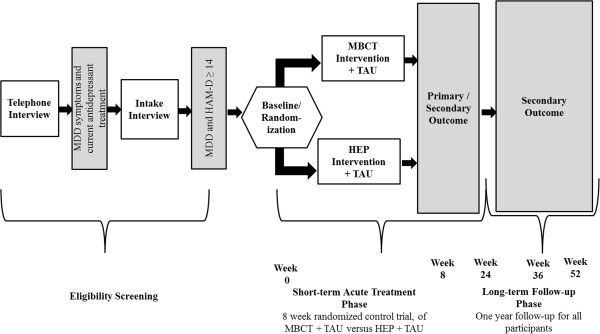
BACKGROUND: Major depressive disorder (MDD) is the leading cause of disability in the developed world, yet broadly effective treatments remain elusive. Up to 40% of patients with depression are unresponsive to at least two trials of antidepressant medication and thus have "treatment-resistant depression" (TRD). There is an urgent need for cost-effective, non-pharmacologic, evidence-based treatments for TRD. Mindfulness-Based Cognitive Therapy (MBCT) is an effective treatment for relapse prevention and residual depression in major depression, but has not been previously studied in patients with TRD in a large randomized trial. METHODS/DESIGN: The purpose of this study was to evaluate whether MBCT is an effective augmentation of antidepressants for adults with MDD who failed to respond to standard pharmacotherapy. MBCT was compared to an active control condition, the Health-Enhancement Program (HEP), which incorporates physical activity, functional movement, music therapy and nutritional advice. HEP was designed as a comparator condition for mindfulness-based interventions to control for non-specific effects. Originally investigated in a non-clinical sample to promote stress reduction, HEP was adapted for a depressed population for this study. Individuals age 18 and older with moderate to severe TRD, who failed to respond to at least two trials of antidepressants in the current episode, were recruited to participate. All participants were taking antidepressants (Treatment as usual; TAU) at the time of enrollment. After signing an informed consent, participants were randomly assigned to either MBCT or HEP condition. Participants were followed for 1 year and assessed at weeks 1-7, 8, 24, 36, and 52. Change in depression severity, rate of treatment response and remission after 8 weeks were the primary outcomes measured by the clinician-rated Hamilton Depression Severity Rating (HAM-D) 17-item scale. The participant-rated Quick Inventory of Depression Symptomology (QIDS-SR) 16-item scale was the secondary outcome measure of depression severity, response, and remission. DISCUSSION: Treatment-resistant depression entails significant morbidity and has few effective treatments. We studied the effect of augmenting antidepressant medication with MBCT, compared with a HEP control, for patients with TRD. Analyses will focus on clinician and patient assessment of depression, participants' clinical global impression change, employment and social functioning scores and quality of life and satisfaction ratings. TRIAL REGISTRATION: ClincalTrials.gov identifier: NCT01021254.
Overview
The claims and statistics of this paper haven’t been checked yet.
Free: it reads the open-access text and checks the first 5 claims that cite a source we can check. Create a free account to check every claim.
Integrity signals
Registry
Cites
Statistics
Figures
Verification
Claims the paper makes
The claims and statistics of this paper haven’t been checked yet.
Free: it reads the open-access text and checks the first 5 claims that cite a source we can check. Create a free account to check every claim.
Claims other papers make about this one
Each is checked against this paper’s own text: does it say what the citing paper says it does?
The source backs part of the claim, not all of it — or backs it for a different population, condition or comparison.
In the citing paper
“The study found that MBCT was more effective at reducing depression and rates of decline and debility when it was enhanced by regular medication than an active comparative disorder”
From Mindfulness in mood and anxiety disorders: A review of the literature (2017) · cites this paper as [20]
Experimental — accuracy not yet measuredThe source backs part of the claim, not all of it — or backs it for a different population, condition or comparison.
In the citing paper
“One randomized controlled trial suggested that MBCT could be an effective additional therapy for patients with treatment-resistant depression having active depressive episodes.”
From Mindfulness in mood and anxiety disorders: A review of the literature (2017) · cites this paper as [20]
Experimental — accuracy not yet measuredThe cited source says what the claim attributes to it.
In the citing paper
“The outcomes of this study have substantial implications for the treatment of depression with targeted, population-based, non-pharmacological intervention approaches.20”
From Mindfulness in mood and anxiety disorders: A review of the literature (2017) · cites this paper as [20]
Self-check
Percentages, sums and reported differences re-computed from the paper’s own numbers.
The self-check needs the paper’s full text.
Citations
Cites
Folstein, M. F., Folstein, S. E., & McHugh, P. R. (1975) · Journal of Psychiatric Research · doi:10.1016/0022-3956(75)90026-6 · Cited by 88,282 · cited 2×
“The SCID personality inventory for Axis II disorders (SCID-II) was used to assess the presence of personality disorders, and the Mini Mental Status Exam (MMSE) [31] was used to assess cognitive function and to rule out cognitive or developmental delays that might interfere with treatment.”
Method(1992) · PubMed · Cited by 33,716
A Global Measure of Perceived Stress
Cohen, S., Kamarck, T., & Mermelstein, R. (1983) · Journal of Health and Social Behavior · doi:10.2307/2136404 · Cited by 32,807 · cited 1×
“Functional status and quality of life were additional secondary outcomes measured using the SF-12 Health Survey [37,38], the Work and Social Adjustment Scale (WSAS) [39], [40] and the Quality of Life, Enjoyment, and Satisfaction Questionnaire (Q-LES-SQ) [41].”
MethodThe MOS 36-ltem Short-Form Health Survey (SF-36): I. Conceptual Framework and Item Selection
Ware, J. E., & Sherbourne, C. D. (1992) · Medical Care · doi:10.1097/00005650-199206000-00002 · Cited by 30,033 · cited 1×
“Functional status and quality of life were additional secondary outcomes measured using the SF-12 Health Survey [37,38], the Work and Social Adjustment Scale (WSAS) [39], [40] and the Quality of Life, Enjoyment, and Satisfaction Questionnaire (Q-LES-SQ) [41].”
MethodHirono, N., Mori, E., Ikejiri, Y., Imamura, T., Shimomura, T., Hashimoto, M., Yamashita, H., & Ikeda, M. (1997) · Brain and nerve · Cited by 21,039
Kok, J. S., Berg, I. J., & Scherder, E. J. A. (2013) · Dementia and Geriatric Cognitive Disorders Extra · doi:10.1159/000353441 · Cited by 20,589
Older Adults' Reasons for Using Technology while Aging in Place
Peek, S. T. M., Luijkx, K. G., Rijnaard, M. D., Nieboer, M. E., van der Voort, C. S., Aarts, S., van Hoof, J., Vrijhoef, H. J. M., & Wouters, E. J. M. (2016) · Gerontology · doi:10.1159/000430949 · Cited by 19,690
Sensitivity and False Alarm Rate of a Fall Sensor in Long-Term Fall Detection in the Elderly
Kangas, M., Korpelainen, R., Vikman, I., Nyberg, L., & Jämsä, T. (2015) · Gerontology · doi:10.1159/000362720 · Cited by 18,909
WARE, J. E., KOSINSKI, M., & KELLER, S. D. (1996) · Medical Care · doi:10.1097/00005650-199603000-00003 · Cited by 17,392 · cited 1×
“Functional status and quality of life were additional secondary outcomes measured using the SF-12 Health Survey [37,38], the Work and Social Adjustment Scale (WSAS) [39], [40] and the Quality of Life, Enjoyment, and Satisfaction Questionnaire (Q-LES-SQ) [41].”
MethodRandom-Effects Models for Longitudinal Data
Laird, N. M., & Ware, J. H. (1982) · Biometrics · doi:10.2307/2529876 · Cited by 8,923 · cited 1×
“The primary outcome measure of the HAM-D will be compared between participants randomized to the MBCT + TAU and the HEP + TAU groups using a mixed-effects statistical model [58,59].”
Method(1976) · Medical Entomology and Zoology · Cited by 8,899
Development of a Rating Scale for Primary Depressive Illness
HAMILTON, M. (1967) · British Journal of Social and Clinical Psychology · doi:10.1111/j.2044-8260.1967.tb00530.x · Cited by 8,410 · cited 12×
“The primary outcome measure of the HAM-D will be compared between participants randomized to the MBCT + TAU and the HEP + TAU groups using a mixed-effects statistical model [58,59].”
MethodInfluentialKessler, R. C., Berglund, P., Demler, O., Jin, R., Koretz, D., Merikangas, K. R., Rush, A. J., Walters, E. E., & Wang, P. S. (2003) · JAMA · doi:10.1001/jama.289.23.3095 · Cited by 7,988 · cited 2×
“Through decreased workforce productivity and disability, the economic burden caused by refractory depression is enormous [10,61]; hence the importance of finding effective treatment modalities for this population is clear and of vital public health interest.”
BackgroundUsing Self-Report Assessment Methods to Explore Facets of Mindfulness
Baer, R. A., Smith, G. T., Hopkins, J., Krietemeyer, J., & Toney, L. (2006) · Assessment · doi:10.1177/1073191105283504 · Cited by 7,511 · cited 1×
“The following potential mediators related to MBCT were measured: mindfulness with the Five Facet Mindfulness Questionnaire [42]; experiential avoidance with the Acceptance and Action Questionnaire (AAQ) [43]; rumination with the Ruminative Response Scale (RRS) [44,45]; and self-compassion with the Self-Compassion Scal…”
MethodThe Development and Validation of a Scale to Measure Self-Compassion
NEFF, K. D. (2003) · Self and Identity · doi:10.1080/15298860309027 · Cited by 6,436 · cited 3×
“Putative mediators, enhanced mindfulness (FFMQ), enhanced selfcompassion (SCS), diminished rumination (RRS) and decreased experiential avoidance (AAQ) will be assessed at weeks 4, 8, 24, 36, and 52.”
MethodPermutation tests for joinpoint regression with applications to cancer rates
Kim, H.-J., Fay, M. P., Feuer, E. J., & Midthune, D. N. (2000) · Statistics in Medicine · doi:10.1002/(sici)1097-0258(20000215)19:3<335::aid-sim336>3.0.co;2-z · Cited by 6,318
Mindfulness training as a clinical intervention: a conceptual and empirical review
Baer, R. A. (2003) · Clinical Psychology: Science and Practice · doi:10.1093/clipsy.bpg015 · Cited by 4,577 · cited 5×
“In a review of 21 mindfulness-meditation interventions, Baer [23] found an average effect size of .90 for depressive symptom reduction.”
BackgroundMethodInfluentialRush, A. J., Trivedi, M. H., Ibrahim, H. M., Carmody, T. J., Arnow, B., Klein, D. N., Markowitz, J. C., Ninan, P. T., Kornstein, S., Manber, R., et al. (2003) · Biological Psychiatry · doi:10.1016/s0006-3223(02)01866-8 · Cited by 3,829 · cited 6×
“The secondary outcome measures of the QIDS-SR and CGI will be compared using the same methodology but replacing the HAM-D with the QIDS-SR and CGI severity measures.”
MethodInfluentialNolen-Hoeksema, S., & Morrow, J. (1991) · Journal of Personality and Social Psychology · doi:10.1037/0022-3514.61.1.115 · Cited by 3,276
Prevention of relapse/recurrence in major depression by mindfulness-based cognitive therapy.
Teasdale, J. D., Segal, Z. V., Williams, J. M. G., Ridgeway, V. A., Soulsby, J. M., & Lau, M. A. (2000) · Journal of Consulting and Clinical Psychology · doi:10.1037/0022-006x.68.4.615 · Cited by 3,236 · cited 2×
“, MBCT augmentation was more efficacious than antidepressant management alone in reducing the residual symptoms of chronic depression [14,15] and improved outcomes in dysthymia compared to imipramine monotreatment [16].”
BackgroundSelf-citationThe Work and Social Adjustment Scale: a simple measure of impairment in functioning
Mundt, J. C., Marks, I. M., Shear, M. K., & Greist, J. M. (2002) · British Journal of Psychiatry · doi:10.1192/bjp.180.5.461 · Cited by 2,515 · cited 3×
“Functional status and quality of life were additional secondary outcomes measured using the SF-12 Health Survey [37,38], the Work and Social Adjustment Scale (WSAS) [39], [40] and the Quality of Life, Enjoyment, and Satisfaction Questionnaire (Q-LES-SQ) [41].”
MethodCUMULATIVE ILLNESS RATING SCALE
LINN, B. S., LINN, M. W., & GUREL, L. (1968) · Journal of the American Geriatrics Society · doi:10.1111/j.1532-5415.1968.tb02103.x · Cited by 2,304 · cited 1×
“[33,34] to assess health status.”
Psychometric properties of the credibility/expectancy questionnaire
Devilly, G. J., & Borkovec, T. D. (2000) · Journal of Behavior Therapy and Experimental Psychiatry · doi:10.1016/s0005-7916(00)00012-4 · Cited by 2,295 · cited 1×
“Treatment expectancy to assess potential moderating effects of positive expectancy was measured through the Treatment Rationale Scale [54-56], which participants completed after the first and final sessions (weeks 2 and 8).”
MethodEvidence-based health policy—lessons from the Global Burden of Disease Study
Murray, C. J. L., & Lopez, A. D. (1996) · Science · doi:10.1126/science.274.5288.740 · Cited by 2,178 · cited 1×
“Background Major depressive disorder (MDD) is the number one cause of disability in developed countries and is projected to become the number two cause of disability worldwide by 2020 [1,2], yet broadly effective treatments remain elusive.”
BackgroundMeasuring experiential avoidance: A preliminary test of a working model
Hayes, S. C., Strosahl, K., Wilson, K. G., Bissett, R. T., Pistorello, J., Toarmino, D., Polusny, M. A., Dykstra, T. A., Batten, S. V., Bergan, J., et al. (2004) · The Psychological Record · doi:10.1007/bf03395492 · Cited by 2,140
Miller, M. D., Paradis, C. F., Houck, P. R., Mazumdar, S., Stack, J. A., Rifai, A. H., Mulsant, B., & Reynolds, C. F. (1992) · Psychiatry Research · doi:10.1016/0165-1781(92)90005-n · Cited by 1,990
(1993) · PubMed · Cited by 1,900
Keller, M. B. (1987) · Archives of General Psychiatry · doi:10.1001/archpsyc.1987.01800180050009 · Cited by 1,643 · cited 2×
“We will also assess relapse occurrence in both arms using the LIFE interview at weeks 24, 36 and 52.”
MethodCredibility of analogue therapy rationales
Borkovec, T. D., & Nau, S. D. (1972) · Journal of Behavior Therapy and Experimental Psychiatry · doi:10.1016/0005-7916(72)90045-6 · Cited by 1,553
Ma, S. H., & Teasdale, J. D. (2004) · Journal of Consulting and Clinical Psychology · doi:10.1037/0022-006x.72.1.31 · Cited by 1,390 · cited 3×
“, MBCT augmentation was more efficacious than antidepressant management alone in reducing the residual symptoms of chronic depression [14,15] and improved outcomes in dysthymia compared to imipramine monotreatment [16].”
BackgroundMethodDiagnosis and definition of treatment-resistant depression
Fava, M. (2003) · Biological Psychiatry · doi:10.1016/s0006-3223(03)00231-2 · Cited by 1,380 · cited 1×
“Treatment-resistant depression (TRD), the term used to describe cases of MDD that do not remit with adequate courses of at least two antidepressant trials [3,4], is unfortunately quite common [3,5-8].”
BackgroundTeasdale, J. D., Segal, Z., & Williams, J. M. G. (1995) · Behaviour Research and Therapy · doi:10.1016/0005-7967(94)e0011-7 · Cited by 1,349 · cited 1×
“Through guided meditation practices and activities, participants are taught to develop more present-focused, non-judgmental awareness of their thoughts and feelings instead of focusing on the content of them [11,14,15,18].”
BackgroundSelf-citationWang, P. S., Berglund, P., Olfson, M., Pincus, H. A., Wells, K. B., & Kessler, R. C. (2005) · Archives of General Psychiatry · doi:10.1001/archpsyc.62.6.603 · Cited by 1,325 · cited 1×
“TRD is associated with greater disability, mortality, morbidity, somatic symptoms, risk of relapse and societal cost than those who suffer from non-resistant forms of depression [4,9,10].”
BackgroundMindfulness-based cognitive therapy for depression
(2006) · Buddhist Thought and Applied Psychological Research · doi:10.4324/9780203098899-33 · Cited by 1,324
Using the general linear mixed model to analyse unbalanced repeated measures and longitudinal data
Cnaan, A., Laird, N. M., & Slasor, P. (1997) · Statistics in Medicine · doi:10.1002/(sici)1097-0258(19971030)16:20<2349::aid-sim667>3.0.co;2-e · Cited by 1,222
Bupropion-SR, Sertraline, or Venlafaxine-XR after Failure of SSRIs for Depression
Rush, A. J., Trivedi, M. H., Wisniewski, S. R., Stewart, J. W., Nierenberg, A. A., Thase, M. E., Ritz, L., Biggs, M. M., Warden, D., Luther, J. F., et al. (2006) · New England Journal of Medicine · doi:10.1056/nejmoa052963 · Cited by 1,033
Mindfulness-Based Cognitive Therapy for Depression
Segal, Z. (2023) · PsycTHERAPY Dataset · doi:10.1037/v00751-001 · Cited by 1,029
Self-citationMedication Augmentation after the Failure of SSRIs for Depression
Trivedi, M. H., Fava, M., Wisniewski, S. R., Thase, M. E., Quitkin, F., Warden, D., Ritz, L., Nierenberg, A. A., Lebowitz, B. D., Biggs, M. M., et al. (2006) · New England Journal of Medicine · doi:10.1056/nejmoa052964 · Cited by 1,002 · cited 4×
“Discussion Treatment-resistant depression is a condition associated with high rates of disability, chronicity, reoccurrence and failed response to antidepressant treatment [3,8].”
BackgroundMethodInfluentialMindfulness-based cognitive therapy for depression
Kumari, D., & Satyapal, N. (2025) · Industrial Psychiatry Journal · doi:10.4103/ipj.ipj_127_24 · Cited by 997
Ruminative coping with depressed mood following loss.
Nolen-Hoeksema, S., Parker, L. E., & Larson, J. (1994) · Journal of Personality and Social Psychology · doi:10.1037/0022-3514.67.1.92 · Cited by 932 · cited 3×
“Putative mediators, enhanced mindfulness (FFMQ), enhanced selfcompassion (SCS), diminished rumination (RRS) and decreased experiential avoidance (AAQ) will be assessed at weeks 4, 8, 24, 36, and 52.”
MethodNemeroff, C. B., Heim, C. M., Thase, M. E., Klein, D. N., Rush, A. J., Schatzberg, A. F., Ninan, P. T., McCullough, J. P., Weiss, P. M., Dunner, D. L., et al. (2003) · Proceedings of the National Academy of Sciences · doi:10.1073/pnas.2336126100 · Cited by 829 · cited 1×
“These include demographic factors such as minority status, ethnicity and lower socio-economic status [50] and stress, both current [51,52] and a childhood history of stress [53] (trauma, abuse, neglect) which were collected during the baseline assessment.”
BackgroundKessler, R. C., Soukup, J., Davis, R. B., Foster, D. F., Wilkey, S. A., Van Rompay, M. I., & Eisenberg, D. M. (2001) · American Journal of Psychiatry · doi:10.1176/appi.ajp.158.2.289 · Cited by 656 · cited 1×
“National self-report surveys have found complementary and alternative techniques such as mindfulness, are being used by 41% to 54% [63] of individuals with depression, indicating that there is substantial public demand for mindfulness-based treatment interventions.”
Souery, D., Oswald, P., Massat, I., Bailer, U., Bollen, J., Demyttenaere, K., Kasper, S., Lecrubier, Y., Montgomery, S., Serretti, A., et al. (2007) · The Journal of Clinical Psychiatry · doi:10.4088/jcp.v68n0713 · Cited by 521 · cited 1×
“anxiety disorders [47] or personality disorders [48]), will be included in the analysis as covariates [49].”
BackgroundCognitive reactivity to sad mood provocation and the prediction of depressive relapse
Segal, Z. V., Kennedy, S., Gemar, M., Hood, K., Pedersen, R., & Buis, T. (2006) · Archives of General Psychiatry · doi:10.1001/archpsyc.63.7.749 · Cited by 470 · cited 2×
“, MBCT augmentation was more efficacious than antidepressant management alone in reducing the residual symptoms of chronic depression [14,15] and improved outcomes in dysthymia compared to imipramine monotreatment [16].”
BackgroundSelf-citationMynors-Wallis, L. M. (2000) · BMJ · doi:10.1136/bmj.320.7226.26 · Cited by 453
Segal, Z. V., Teasdale, J. D., Williams, J. M., & Gemar, M. C. (2002) · Clinical Psychology & Psychotherapy · doi:10.1002/cpp.320 · Cited by 432 · cited 2×
“The HEP Adherence Scale is a newly developed scale and is modeled after the MBCT Adherence Scale.”
MethodSelf-citationTreatment-resistant depressed patients show a good response to Mindfulness-based Cognitive Therapy
Kenny, M. A., & Williams, J. M. G. (2007) · Behaviour Research and Therapy · doi:10.1016/j.brat.2006.04.008 · Cited by 364 · cited 7×
“0 (Cohen’s D) in studies by both Kenny and Williams [12] and Eisendrath et al.”
BackgroundMethodResultInfluentialThe validation of an active control intervention for Mindfulness Based Stress Reduction (MBSR)
MacCoon, D. G., Imel, Z. E., Rosenkranz, M. A., Sheftel, J. G., Weng, H. Y., Sullivan, J. C., Bonus, K. A., Stoney, C. M., Salomons, T. V., Davidson, R. J., et al. (2012) · Behaviour Research and Therapy · doi:10.1016/j.brat.2011.10.011 · Cited by 335 · cited 5×
“With this limitation in mind, an active control condition, originally developed to be a structurally equivalent, comparison condition for studies Mindfulness-Based Stress Reduction MBSR) – the Health-Enhancement Program (HEP) was selected for this trial.”
BackgroundMethodInfluentialSelf-citationFinucane, A., & Mercer, S. W. (2006) · BMC Psychiatry · doi:10.1186/1471-244x-6-14 · Cited by 308 · cited 1×
“54 [25].”
The burden of disease for treatment-resistant depression.
Greden, J. F. (2001) · PubMed · Cited by 279
Comorbid psychiatric disorders in depressed outpatients: Demographic and clinical features
Rush, A. J., Zimmerman, M., Wisniewski, S. R., Fava, M., Hollon, S. D., Warden, D., Biggs, M. M., Shores-Wilson, K., Shelton, R. C., Luther, J. F., et al. (2005) · Journal of Affective Disorders · doi:10.1016/j.jad.2005.03.005 · Cited by 254 · cited 1×
“anxiety disorders [47] or personality disorders [48]), will be included in the analysis as covariates [49].”
Background(2005) · PubMed · Cited by 221
Kingston, J., Chadwick, P., Meron, D., & Skinner, T. C. (2007) · Journal of Psychosomatic Research · doi:10.1016/j.jpsychores.2006.10.007 · Cited by 218 · cited 1×
“depression in psychiatric outpatients [26].”
Venlafaxine for Treatment-Resistant Unipolar Depression
NIERENBERG, A. A., FEIGHNER, J. P., RUDOLPH, R., COLE, J. O., & SULLIVAN, J. (1994) · Journal of Clinical Psychopharmacology · doi:10.1097/00004714-199412000-00008 · Cited by 198 · cited 1×
“Treatment-resistant depression (TRD), the term used to describe cases of MDD that do not remit with adequate courses of at least two antidepressant trials [3,4], is unfortunately quite common [3,5-8].”
BackgroundSelf-citationRavindran, A. V., Matheson, K., Griffiths, J., Merali, Z., & Anisman, H. (2002) · Journal of Affective Disorders · doi:10.1016/s0165-0327(01)00389-5 · Cited by 179 · cited 1×
“These include demographic factors such as minority status, ethnicity and lower socio-economic status [50] and stress, both current [51,52] and a childhood history of stress [53] (trauma, abuse, neglect) which were collected during the baseline assessment.”
BackgroundTrivedi, M. H., Rush, A. J., Wisniewski, S. R., Warden, D., McKinney, W., Downing, M., Berman, S. R., Farabaugh, A., Luther, J. F., Nierenberg, A. A., et al. (2006) · The Journal of Clinical Psychiatry · doi:10.4088/jcp.v67n0203 · Cited by 160 · cited 1×
“These include demographic factors such as minority status, ethnicity and lower socio-economic status [50] and stress, both current [51,52] and a childhood history of stress [53] (trauma, abuse, neglect) which were collected during the baseline assessment.”
BackgroundBorkovec, T. D. (1972) · Behavior Therapy · doi:10.1016/s0005-7894(72)80049-2 · Cited by 155 · cited 1×
“Treatment expectancy to assess potential moderating effects of positive expectancy was measured through the Treatment Rationale Scale [54-56], which participants completed after the first and final sessions (weeks 2 and 8).”
MethodPlacebos, Drug Effects, and Study Design: A Clinician’s Guide
Quitkin, F. M. (1999) · American Journal of Psychiatry · doi:10.1176/ajp.156.6.829 · Cited by 149
Mindfulness-Based Cognitive Therapy for Treatment-Resistant Depression: A Pilot Study
Eisendrath, S. J., Delucchi, K., Bitner, R., Fenimore, P., Smit, M., & McLane, M. (2008) · Psychotherapy and Psychosomatics · doi:10.1159/000142525 · Cited by 148 · cited 9×
“Mindfulness-Based Cognitive Therapy (MBCT) is a group-based, 8-week, mind-body intervention that integrates mindfulness meditation with concepts of cognitive behavioral therapy (CBT) and was specifically developed as a relapse prevention intervention for MDD [11].”
BackgroundMethodResultInfluentialSelf-citationThe economic burden of depression with painful symptoms.
Greenberg, P. E., Leong, S. A., Birnbaum, H. G., & Robinson, R. L. (2003) · PubMed · Cited by 137
Testing the equality of two dependent kappa statistics
Donner, A. P., Shoukri, M. M., Klar, N. S., & Bartfay, E. (2000) · Statistics in Medicine · doi:10.1002/(sici)1097-0258(20000215)19:3<373::aid-sim337>3.0.co;2-y · Cited by 96 · cited 2×
“Using the formula provided by Donner and Klar [27], we estimated sample sizes to detect response to the intervention (MBCT+TAU would be superior to HEP +TAU on depression outcomes).”
MethodInterpersonal psychotherapy delivered over the telephone to recurrent depressives. A pilot study
Miller, L., & Weissman, M. (2002) · Depression and Anxiety · doi:10.1002/da.10047 · Cited by 72 · cited 1×
“To estimate sample size, effect sizes were based on outcomes from previous studies and our pilot data [15,21-24].”
MethodDepression in Primary Care: Volume 2.: Treatment of Major Depression
(1993) · PsycEXTRA Dataset · doi:10.1037/e530172011-001 · Cited by 54
Omidi, A., Mohammadkhani, P., Mohammadi, A., & Zargar, F. (2013) · Iranian Red Crescent Medical Journal · doi:10.5812/ircmj.8018 · Cited by 52 · cited 1×
“Individuals with TRD may be excellent candidates for MBCT [12,17], yet previous RCTs evaluating MBCT for depression failed to include an active comparator condition, limiting the results by not controlling for the non-specific factors (e.”
BackgroundRemission Rates With 3 Consecutive Antidepressant Trials: Effectiveness for Depressed Outpatients
Quitkin, F. M., McGrath, P. J., Stewart, J. W., Deliyannides, D., Taylor, B. P., Davies, C. A., & Klein, D. F. (2005) · The Journal of Clinical Psychiatry · doi:10.4088/jcp.v66n0601 · Cited by 40 · cited 1×
“Treatment-resistant depression (TRD), the term used to describe cases of MDD that do not remit with adequate courses of at least two antidepressant trials [3,4], is unfortunately quite common [3,5-8].”
BackgroundDew, R. E. (2005) · Academic Psychiatry · doi:10.1176/appi.ap.29.3.283 · Cited by 28
Little, J. M. (1987) · Australian and New Zealand Journal of Surgery · doi:10.1111/j.1445-2197.1987.tb01389.x · Cited by 4 · cited 2×
“Our primary method for dealing with missing predictor values will be multiple imputation using a regression modeling approach [60].”
BackgroundMethodBertschy, G. (2007) · PubMed · Cited by 1
Research works printed but not linked: 2
- 19. MacCoon DLA Rosenkranz M Davidson R Lessons from an Active Control Condition: "McMindfulness, Shams, and the One-Fold Path Mind Life Summer Research Institute 2007 New York: Garrison
- 29. First MB Spitzer Robert L Gibbon M Williams Janet BW Structured Clinical Interview for DSM-IV-TR Axis I Disorders, Research Version, Patient Edition (SCID-I/P) Biometrics Research, New York State Psychiatric Institute 2002
Cited by
Interventions to improve return to work in depressed people
Nieuwenhuijsen, K., Faber, B., Verbeek, J. H., Neumeyer-Gromen, A., Hees, H. L., Verhoeven, A. C., van der Feltz-Cornelis, C. M., & Bültmann, U. (2014) · Cochrane Database of Systematic Reviews · doi:10.1002/14651858.cd006237.pub3 · Cited by 299
Mindfulness meditation-based pain relief: a mechanistic account
Zeidan, F., & Vago, D. R. (2016) · Annals of the New York Academy of Sciences · doi:10.1111/nyas.13153 · Cited by 300
King, A. P., Block, S. R., Sripada, R. K., Rauch, S., Giardino, N., Favorite, T., Angstadt, M., Kessler, D., Welsh, R., & Liberzon, I. (2016) · Depression and Anxiety · doi:10.1002/da.22481 · Cited by 225
“Several RCTs have found mindfulness-based cognitive therapy (MBCT) to be effective for preventing depression relapse,[11–13] and there is accumulating evidence that MBCT and mindfulness-based stress reduction (MBSR) may be helpful for active depression [14, 15] and generalized anxiety disorder (GAD).”
BackgroundInterventions to improve return to work in depressed people
Nieuwenhuijsen, K., Verbeek, J. H., Neumeyer-Gromen, A., Verhoeven, A. C., Bültmann, U., & Faber, B. (2020) · Cochrane Database of Systematic Reviews · doi:10.1002/14651858.cd006237.pub4 · Cited by 218
Eisendrath, S. J., Gillung, E., Delucchi, K. L., Segal, Z. V., Nelson, J. C., McInnes, L. A., Mathalon, D. H., & Feldman, M. D. (2016) · Psychotherapy and Psychosomatics · doi:10.1159/000442260 · Cited by 187
Self-citation
Metadata
- Authors
- Eisendrath, S. J., Gillung, E. P., Delucchi, K. L., Chartier, M., Mathalon, D. H., Sullivan, J. C., Segal, Z. V., & Feldman, M. D.
- Affiliations
- University of California, San Francisco (US)
- San Francisco VA Medical Center (US)
- UW Health University Hospital (US)
- University of Toronto (CA)
- Corresponding author
- Eisendrath, Stuart J
- Venue
- BMC Complementary and Alternative Medicine
- Published
- 2014-03-11
- Volume
- 14
- Issue
- 1
- Pages
- 95-95
- ISSN
- 1472-6882 (ISSN-L)
- PMC
- PMC3995768
- OpenAlex
- W2028003028
- Semantic Scholar
- 1e2fc7ebee9f0af4b416809ca953e3a0ee15d1fd
- Cited by
- 43
- References
- 68
- Citations by year
- 2026: 1 · 2025: 1 · 2024: 2 · 2023: 2 · 2022: 1 · 2021: 1 · 2020: 4 · 2019: 1 · 2018: 6 · 2017: 2 · 2016: 12 · 2015: 7 · 2014: 3
- FWCI
- 9.44
- Type
- journal article
- Language
- en
- Open access
- gold
- doi.org
- Licence
- Locations
- BMC Complementary and Alternative Medicine (publishedVersion, cc-by)
- Europe PMC (PubMed Central) (publishedVersion, cc-by)
- PubMed Central (publishedVersion, cc-by)
- PubMed (publishedVersion)
- eScholarship (California Digital Library) (submittedVersion)
- Funders
- National Institutes of Health (5r01at004572-04)
- National Center for Complementary and Alternative Medicine
- National Center for Complementary and Integrative Health (R01AT004572.)
- Topics
- Social Sciences › Psychology › Clinical Psychology › Mindfulness and Compassion Interventions
- Health Sciences › Medicine › Pharmacology (medical) › Treatment of Major Depression
- Social Sciences › Psychology › Clinical Psychology › Psychotherapy Techniques and Applications
- Keywords
- treatment-resistant depression, major depressive disorder, mindfulness-based cognitive therapy, antidepressant augmentation, non-pharmacological treatment, physical activity, music therapy, nutritional advice, relapse prevention, depression remission, quality of life, social functioning, employment, treatment response, cost-effectiveness, quality-adjusted life years, health-related quality of life
- MeSH terms
- Adult, Major Depressive Disorder, Female, Humans, Male, Research Design, Cognitive Behavioral Therapy, Meditation, Depressive Disorder, Treatment-Resistant, Mindfulness
About these checks
Registry, retraction, Cites and statistics results are computed, not judged, with one exception: a printed reference that no index lists is read once by a model before it counts as a citation error. Claims are extracted by a model and kept only when their quote appears verbatim in the text; each cited source is then checked, with a model’s help, for whether it says what the claim relies on. Those verdicts can be wrong — read the claim’s quote and the cited source before relying on one.
Statistics and arithmetic are recomputed, not judged.
Confidence bands are shown only for fields calibrated on our annotated test set. None is calibrated yet, so no band is shown.
What counts as a claim ›How we measure confidence ›How we check this ›
Are you an author, or do you see a problem with this page? Request a review
Data sources
Bibliographic data: Semantic Scholar, OpenAlex, Crossref.
Contains information from the Semantic Scholar Academic Graph Datasets, made available under the ODC Attribution License (ODC-BY 1.0).
Semantic Scholar’s data is described in: Kinney, R., et al. (2023). The Semantic Scholar Open Data Platform. arXiv:2301.10140.
