

A systematic development process for patient decision aids
Open accessThe DOI matches its Crossref record; 29 of the 29 references it cites were found in a registry or an index.
Abstract
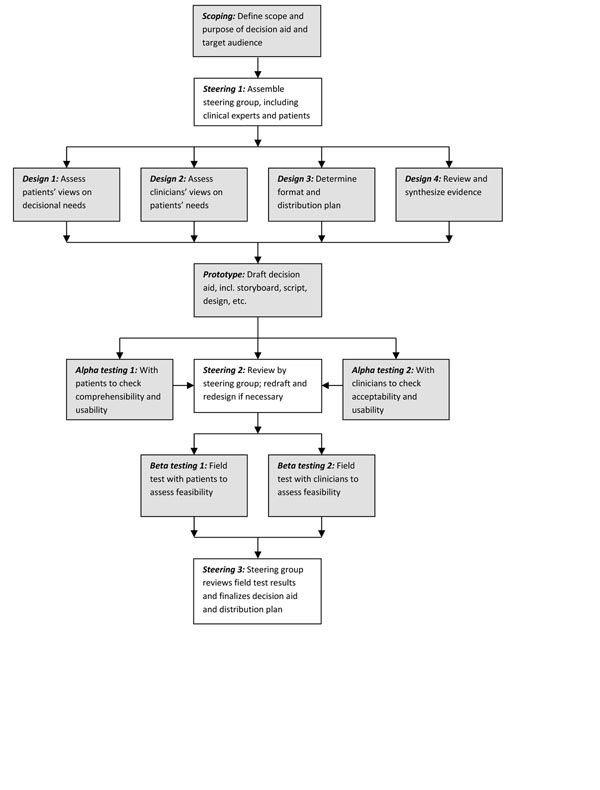
BACKGROUND: The original version of the International Patient Decision Aid Standards (IPDAS) recommended that patient decision aids (PtDAs) should be carefully developed, user-tested and open to scrutiny, with a well-documented and systematically applied development process. We carried out a review to check the relevance and scope of this quality dimension and, if necessary, to update it. METHODS: Our review drew on three sources: a) published papers describing PtDAs evaluated in randomised controlled trials and included in the most recent Cochrane Collaboration review; b) linked papers cited in the trial reports that described how the PtDAs had been developed; and c) papers and web reports outlining the development process used by organisations experienced in developing multiple PtDAs. We then developed an extended model of the development process indicating the various steps on which documentation is required, as well as a checklist to assess the frequency with which each of the elements was publicly reported. RESULTS: Key features common to all patient decision aid (PtDA) development processes include: scoping and design; development of a prototype; 'alpha' testing with patients and clinicians in an iterative process; 'beta' testing in 'real life' conditions (field tests); and production of a final version for use and/or further evaluation. Only about half of the published reports on the development of PtDAs that we reviewed appear to have been field tested with patients, and even fewer had been reviewed or tested by clinicians not involved in the development process. Very few described a distribution strategy, and surprisingly few (17%) described a method for reviewing and synthesizing the clinical evidence. We describe a model development process that includes all the original elements of the original IPDAS criterion, expanded to include consideration of format and distribution plans as well as prototype development. CONCLUSIONS: The case for including each of the elements outlined in our model development process is pragmatic rather than evidence-based. Optimal methods for ensuring that each stage of the process is carried out effectively require further development and testing.
Overview
The claims and statistics of this paper haven’t been checked yet.
Free: it reads the open-access text and checks the first 5 claims that cite a source we can check. Create a free account to check every claim.
Integrity signals
Registry
Cites
Statistics
Figures
Verification
Claims the paper makes
The claims and statistics of this paper haven’t been checked yet.
Free: it reads the open-access text and checks the first 5 claims that cite a source we can check. Create a free account to check every claim.
Claims other papers make about this one
Each is checked against this paper’s own text: does it say what the citing paper says it does?
The source backs part of the claim, not all of it — or backs it for a different population, condition or comparison.
In the citing paper
“Although DA development is often presented as a linear process [19], the separate development phases are better described as an ongoing cyclical process [14, 32].”
From Development of a decision guide to support the elderly in decision making about location of care: an iterative, user-centered design (2016) · cites this paper as [19]
Experimental — accuracy not yet measured
Self-check
Percentages, sums and reported differences re-computed from the paper’s own numbers.
The self-check needs the paper’s full text.
Citations
Cites
Decision aids for people facing health treatment or screening decisions
Stacey, D., Légaré, F., Lewis, K., Barry, M. J., Bennett, C. L., Eden, K. B., Holmes-Rovner, M., Llewellyn-Thomas, H., Lyddiatt, A., Thomson, R., et al. (2017) · Cochrane Database of Systematic Reviews · doi:10.1002/14651858.cd001431.pub5 · Cited by 6,685
Elwyn, G. (2006) · BMJ · doi:10.1136/bmj.38926.629329.ae · Cited by 1,824 · cited 8×
“In many cases it was difficult to gauge from the trial reports whether a development process along the lines recommended in IPDAS had been followed or not.”
BackgroundInfluential(2003) · Quality and Safety in Health Care · doi:10.1136/qhc.12.1.18 · Cited by 1,446
Decision aids for people facing health treatment or screening decisions
Stacey, D., Bennett, C. L., Barry, M. J., Col, N. F., Eden, K. B., Holmes-Rovner, M., Llewellyn-Thomas, H., Lyddiatt, A., Légaré, F., & Thomson, R. (2011) · Cochrane Database of Systematic Reviews · doi:10.1002/14651858.cd001431.pub3 · Cited by 849
Decision aids for people facing health treatment or screening decisions
O'Connor, A. M., Bennett, C. L., Stacey, D., Barry, M., Col, N. F., Eden, K. B., Entwistle, V. A., Fiset, V., Holmes-Rovner, M., Khangura, S., et al. (2009) · Cochrane Database of Systematic Reviews · doi:10.1002/14651858.cd001431.pub2 · Cited by 693
O'Connor, A. M., Tugwell, P., Wells, G. A., Elmslie, T., Jolly, E., Hollingworth, G., McPherson, R., Bunn, H., Graham, I., & Drake, E. (1998) · Patient Education and Counseling · doi:10.1016/s0738-3991(98)00026-3 · Cited by 638
Toward Minimum Standards for Certifying Patient Decision Aids: A Modified Delphi Consensus Process
Joseph-Williams, N., Newcombe, R., Politi, M., Durand, M.-A., Sivell, S., Stacey, D., O’Connor, A., Volk, R. J., Edwards, A., Bennett, C., et al. (2014) · Medical Decision Making · doi:10.1177/0272989x13501721 · Cited by 532
Elwyn, G., Scholl, I., Tietbohl, C., Mann, M., Edwards, A. G., Clay, C., Légaré, F., Weijden, T. V. D., Lewis, C. L., Wexler, R. M., et al. (2013) · BMC Medical Informatics and Decision Making · doi:10.1186/1472-6947-13-s2-s14 · Cited by 502
Barry, M. J., Fowler, F. J., Mulley, A. G., Henderson, J. V., & Wennberg, J. E. (1995) · Medical Care · doi:10.1097/00005650-199508000-00003 · Cited by 383
Option Grids: Shared decision making made easier
Elwyn, G., Lloyd, A., Joseph-Williams, N., Cording, E., Thomson, R., Durand, M.-A., & Edwards, A. (2013) · Patient Education and Counseling · doi:10.1016/j.pec.2012.06.036 · Cited by 314
Research works printed but not linked: 1
- McGee J: Toolkit for making written material clear and effective. 2010, US Department of Health and Human Services, Center for Medicare and Medicaid Services
Cited by
Items 601–615 of 615
Gendler, Y., Stoin, H., Volberstein, T., Ofri, L., & Stacey, D. (2026) · MDM Policy & Practice · doi:10.1177/23814683261446325
Patient experiences of Dupuytren’s contracture and its treatment
Leighton, P. A., Armaou, M., Arundel, C., Tharmanathan, P., & Dias, J. (2026) · Bone & Joint Open · doi:10.1302/2633-1462.76.bjo-2026-0002.r1
Capturing the Work of Nurses in General Practice: Development and Testing of the OCEAN ‐ GPN Tools
Halcomb, E., Mursa, R., Randall, S., Gordon, J., Lu, Y., Henderson, J., Beattie, A., & Harrison, C. M. (2026) · Journal of Advanced Nursing · doi:10.1111/jan.70660
Wang, L.-J., Wang, Y.-J., Chao, T.-F., & Zheng, M.-C. (2026) · Computers in Human Behavior Reports · doi:10.1016/j.chbr.2026.101202
Nalavenkata, S. B., Bergengren, O., Lynch, K., Emard, N., Austria, M. D., Martin, S., Ogbennaya, G., Dualeh, K., Stevanović, K., Patel, M. I., et al. (2026) · BMJ Open · doi:10.1136/bmjopen-2024-095951 · Cited by 1
Helbach, J., Peper, J., Jarchow, A.-M., Bourry, R., Hofner, L., Frielitz, F., Zapf, A., Suling, A. I., Thomalla, G., Hoffmann, F., et al. (2026) · BMJ Open · doi:10.1136/bmjopen-2026-116718
Acceptability of a decision aid for the treatment of symptomatic carotid artery disease
Eklund, K., Wallace, B. C., Columbo, J. A., Krafcik, B. M., Fullard, M. E., Matlock, D. D., & Knoepke, C. E. (2026) · Seminars in Vascular Surgery · doi:10.1053/j.semvascsurg.2026.07.010
Kinney, A. R., Brenner, L. A., Nance, M., Forster, J. E., King, S. E., Deka, R., Yan, X.-D., Ulmer, C. S., Nakase‐Richardson, R., & Bahraini, N. H. (2026) · Brain Injury · doi:10.1080/02699052.2026.2705353
Veerhuis, N., Randle, M., & Traynor, V. (2026) · CoDesign · doi:10.1080/15710882.2026.2705853
Harada, K., Kaneko, M., Kosugi, S., & Kawame, H. (2026) · Pediatrics International · doi:10.1111/ped.70485
Pickersgill, N. A., Tin, A. L., Nalavenkata, S. B., Austria, M. D., Stevanović, K., Bergengren, O., Gonsky, J. P., Hamilton, J. G., Hay, J. L., Vickers, A. J., et al. (2026) · Medical Decision Making · doi:10.1177/0272989x261473303
Jackson, L. R., Matlock, D., & Thomas, K. L. (2026) · Health Science Reports · doi:10.1002/hsr2.73087
Han, J., Jang, M., Kim, S. K., & Park, J. (2026) · Asia-Pacific Journal of Oncology Nursing · doi:10.1016/j.apjon.2026.101020
Bussink-Voorend, D., Vandeberg, L., Hautvast, J. L. A., Elwyn, G. J., & Hulscher, M. (2026) · Journal of Participatory Medicine · doi:10.2196/90729
Pregnancy after caesarean : current care, clinical prediction and risk counselling
Schoorel, E. (2015) · Research Publications (Maastricht University) · doi:10.26481/dis.20150623es
Metadata
- Authors
- Coulter, A., Stilwell, D., Kryworuchko, J., Mullen, P. D., Ng, C. J., & van der Weijden, T.
- Affiliations
- University of Oxford (GB)
- Informed Medical Decisions Foundation (US)
- University of Saskatchewan (CA)
- The University of Texas Health Science Center at Houston (US)
- University of Malaya (MY)
- Corresponding author
- Coulter, Angela
- Venue
- BMC Medical Informatics and Decision Making
- Published
- 2013-11
- Volume
- 13
- Issue
- S2
- Pages
- S2-S2
- ISSN
- 1472-6947 (ISSN-L)
- PMC
- PMC4044159
- OpenAlex
- W2037394322
- Semantic Scholar
- 9b3f4cd261d1430b40994e751e8f1bf4860fde06
- Cited by
- 615
- References
- 28
- Citations by year
- 2026: 36 · 2025: 56 · 2024: 68 · 2023: 64 · 2022: 85 · 2021: 75 · 2020: 56 · 2019: 47 · 2018: 33 · 2017: 30 · 2016: 30 · 2015: 18 · 2014: 13 · 2013: 3
- FWCI
- 38.44
- Type
- journal article
- Language
- en
- Open access
- gold
- doi.org
- Licence
- cc-by
- creativecommons.org/licenses/by/2.0 (tdm)
- Locations
- BMC Medical Informatics and Decision Making (publishedVersion, cc-by)
- PubMed Central (publishedVersion, cc-by)
- PubMed (publishedVersion)
- Research Publications (Maastricht University) (publishedVersion, cc-by)
- Research Publications (Maastricht University) (publishedVersion, other-oa)
- Topics
- Health Sciences › Health Professions › General Health Professions › Patient-Provider Communication in Healthcare
- Health Sciences › Health Professions › General Health Professions › Health Literacy and Information Accessibility
- Health Sciences › Health Professions › General Health Professions › Health Policy Implementation Science
- Keywords
- patient decision aids, development process, International Patient Decision Aid Standards, quality standards, prototype development, field testing, user testing, distribution strategy, clinical evidence synthesis, reporting checklist
- MeSH terms
- Decision Support Techniques, Humans, Patient Participation, Program Development
About these checks
Registry, retraction, Cites and statistics results are computed, not judged, with one exception: a printed reference that no index lists is read once by a model before it counts as a citation error. Claims are extracted by a model and kept only when their quote appears verbatim in the text; each cited source is then checked, with a model’s help, for whether it says what the claim relies on. Those verdicts can be wrong — read the claim’s quote and the cited source before relying on one.
Statistics and arithmetic are recomputed, not judged.
Confidence bands are shown only for fields calibrated on our annotated test set. None is calibrated yet, so no band is shown.
What counts as a claim ›How we measure confidence ›How we check this ›
Are you an author, or do you see a problem with this page? Request a review
Data sources
Bibliographic data: Semantic Scholar, OpenAlex, Crossref.
Contains information from the Semantic Scholar Academic Graph Datasets, made available under the ODC Attribution License (ODC-BY 1.0).
Semantic Scholar’s data is described in: Kinney, R., et al. (2023). The Semantic Scholar Open Data Platform. arXiv:2301.10140.
