

The DOI matches its Crossref record; 39 of the 39 references it cites were found in a registry or an index.
IT-adoption and the interaction of task, technology and individuals: a fit framework and a case study
Open accessAbstract
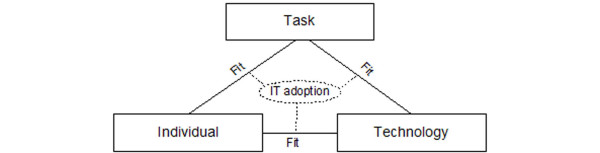
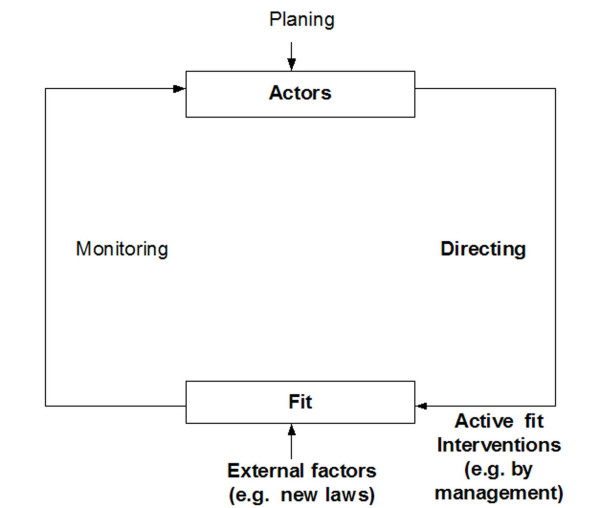
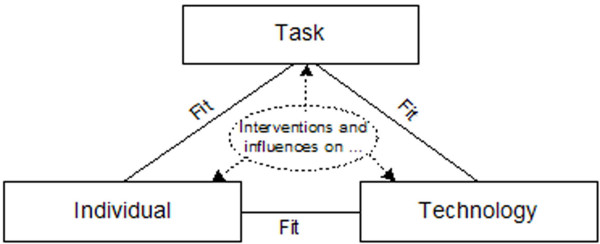
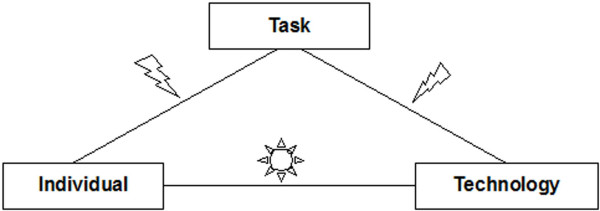
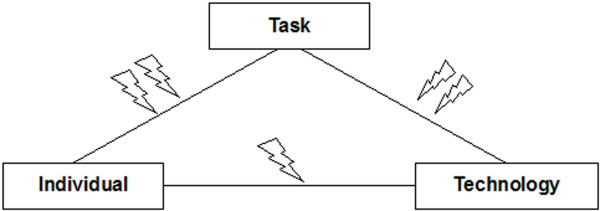
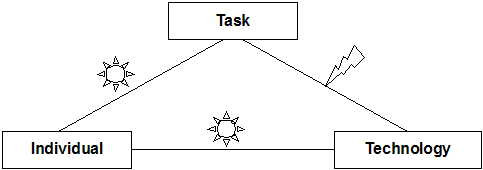
Background: Factors of IT adoption have largely been discussed in the literature. However, existing frameworks (such as TAM or TTF) are failing to include one important aspect, the interaction between user and task. Method: Based on a literature study and a case study, we developed the FITT framework to help analyse the socio-organisational-technical factors that influence IT adoption in a health care setting. Results: Our FITT framework (" F it between I ndividuals, T ask and T echnology") is based on the idea that IT adoption in a clinical environment depends on the fit between the attributes of the individual users (e.g. computer anxiety, motivation), attributes of the technology (e.g. usability, functionality, performance), and attributes of the clinical tasks and processes (e.g. organisation, task complexity). We used this framework in the retrospective analysis of a three-year case study, describing the adoption of a nursing documentation system in various departments in a German University Hospital. We will show how the FITT framework helped analyzing the process of IT adoption during an IT implementation: we were able to describe every found IT adoption problem with regard to the three fit dimensions, and any intervention on the fit can be described with regard to the three objects of the FITT framework (individual, task, technology). We also derive facilitators and barriers to IT adoption of clinical information systems. Conclusion: This work should support a better understanding of the reasons for IT adoption failures and therefore enable better prepared and more successful IT introduction projects. We will discuss, however, that from a more epistemological point of view, it may be difficult or even impossible to analyse the complex and interacting factors that predict success or failure of IT projects in a socio-technical environment.
Overview
The claims and statistics of this paper haven’t been checked yet.
Run the check — free, no account needed. It reads the open-access text and checks the sources it cites.
Integrity signals
Registry
Cites
Statistics
Figures
Verification
Claims the paper makes
The claims and statistics of this paper haven’t been checked yet.
Run the check — free, no account needed. It reads the open-access text and checks the sources it cites.
Claims other papers make about this one
Each is checked against this paper’s own text: does it say what the citing paper says it does?
The check wasn’t confident either way, so it gives no verdict — never disputed.
In the citing paper
“The complex supply chains and convoluted communication processes between hospitals, local service providers, software suppliers, and NHS Connecting for Health that we previously described, persisted over time.38”
From Implementation and adoption of nationwide electronic health records in secondary care in England: final qualitative results from prospective national evaluation in early adopter hospitals (2011) · cites this paper as [38]
Experimental — accuracy not yet measuredIn the citing paper
“Although a purely theory-based approach—which might for instance add the compatibility variable from Rogers’ Innovation Diffusion Theory [63]—can be useful, empirical work may still be necessary to (a) determine whether those variables are relevant to health care, and (b) contextualize these new variables in order to determine, for example, what “compatibility” means in health care [57, 135].”
From The Technology Acceptance Model: Its past and its future in health care (2010) · cites this paper as [57]
In the citing paper
“FITT postulates that the introduction of new technology leads to positive changes in care system only if the attributes of the user group, the characteristics of the implemented technology, and the affected tasks match each other”
From Demystifying theory and its use in improvement (2015) · cites this paper as [68]
Self-check
Percentages, sums and reported differences re-computed from the paper’s own numbers.
The self-check needs the paper’s full text.
Citations
Cites
User Acceptance of Information Technology: Toward A Unified View1
Venkatesh, V., Morris, M. G., Davis, G. B., & Davis, F. D. (2003) · MIS Quarterly · doi:10.2307/30036540 · Cited by 45,035
A Theoretical Extension of the Technology Acceptance Model: Four Longitudinal Field Studies
Venkatesh, V., & Davis, F. D. (2000) · Management Science · doi:10.1287/mnsc.46.2.186.11926 · Cited by 23,066
Institute of Medicine (2000) · National Academies Press eBooks · doi:10.17226/9728 · Cited by 14,390
Crossing the Quality Chasm: A New Health System for the 21st Century
Baker, A. (2001) · BMJ · doi:10.1136/bmj.323.7322.1192 · Cited by 10,779
Information Systems Success: The Quest for the Dependent Variable
DeLone, W. H., & McLean, E. R. (1992) · Information Systems Research · doi:10.1287/isre.3.1.60 · Cited by 10,697
To Err is Human: Building a Safer Health System
Hendee, W. R. (2001) · Journal of Vascular and Interventional Radiology · doi:10.1016/s1051-0443(01)70072-3 · Cited by 10,129
Crossing the Quality Chasm: A New Health System for the 21st Century
Committee on Quality of Health Care in America (2002) · Journal for Healthcare Quality · doi:10.1111/j.1945-1474.2002.tb00463.x · Cited by 8,508
Task-Technology Fit and Individual Performance
Goodhue, D. L., & Thompson, R. L. (1995) · MIS Quarterly · doi:10.2307/249689 · Cited by 6,006
Wall, A. (2000) · British Journal of Healthcare Management · doi:10.12968/bjhc.2000.6.9.19311 · Cited by 5,912
Davis, F. D. (1993) · International Journal of Man-Machine Studies · doi:10.1006/imms.1993.1022 · Cited by 4,754
Research works printed but not linked: 7
- Ammenwerth E, Eichstädter R, Happek T, Haux R, Hoppe B, Kandert M, Kutscha A, Luther G, Mahler C, Mansmann U, Pohl U: Evaluation of computer-based documentation on four wards - final report (in German). 2001, Heidelberg , Dept. of Medical Informatics
- Ammenwerth E, Iller C, Mahler C, Kandert M, Luther G, Hoppe B, Eichstädter R: Factors influencing acceptance and adoption of a nursing documentation system: study report (in German). 2003, Innsbruck , University for Health Informatics and Technology Tyrol (UMIT)
- Mahler C, Ammenwerth E, Eichstädter R, Hoppe B, Mansmann U, Tautz A, Wagner A: Evaluation of computer-based nursing documentation - final report - part: documentation analysis (in German). 2002, University Hospitals of Heidelberg
- Ammenwerth E: Die Bewertung von Informationssystemen des Gesundheitswesens [The evaluation of health information systems]. Publication Series No 1 of UMIT. Edited by: University for Health Sciences MITHTA. 2004, Aachen , Shaker
- Ornstein C: California; Hospital Heeds Doctors, Suspends Use of Software: Cedars-Sinai physicians entered prescriptions and other orders in it, but called it unsafe. The Los Angeles Times. 2003, Jan 22nd, 2003:
- von Förster H: Prinzipien der Selbstorganisation im sozialen und betriebswirtschaftlichen Bereich. Wissen und Gewissen - Versuch einer Brücke. 1993, Frankfurt a.M. , Suhrkamp, 233-269.
- Ammenwerth E, Iller C, Mahler C: The interaction of task, technology and individuals - a theory of FITT. Oral Presentation at the Information Technology in Health Care Conference (ITHC 2004), Sept 13 - 14 2004, Portland Published on Proceedings CD. 2004
Cited by
Sorted by citations
The Technology Acceptance Model: Its past and its future in health care
Holden, R. J., & Karsh, B.-T. (2010) · Journal of Biomedical Informatics · doi:10.1016/j.jbi.2009.07.002 · Cited by 2,669
Demystifying theory and its use in improvement
Davidoff, F., Dixon-Woods, M., Leviton, L., & Michie, S. (2015) · BMJ Quality & Safety · doi:10.1136/bmjqs-2014-003627 · Cited by 714
Cresswell, K., & Sheikh, A. (2013) · International Journal of Medical Informatics · doi:10.1016/j.ijmedinf.2012.10.007 · Cited by 690
Gagnon, M.-P., Desmartis, M., Labrecque, M., Car, J., Pagliari, C., Pluye, P., Frémont, P., Gagnon, J., Tremblay, N., & Légaré, F. (2012) · Journal of Medical Systems · doi:10.1007/s10916-010-9473-4 · Cited by 637
Brown, B. C., Gude, W. T., Blakeman, T., van der Veer, S. N., Ivers, N. M., Francis, J., Lorencatto, F., Presseau, J., Peek, N. B., & Daker‐White, G. (2019) · Implementation Science · doi:10.1186/s13012-019-0883-5 · Cited by 409
Metadata
- Authors
- Ammenwerth, E., Iller, C., & Mahler, C.
- Affiliations
- UMIT TIROL - Private University for Health Sciences and Health Technology (AT)
- Heidelberg University (DE)
- University Hospital Heidelberg (DE)
- Corresponding author
- Ammenwerth, Elske
- Venue
- BMC Medical Informatics and Decision Making
- Published
- 2006-01-09
- Volume
- 6
- Issue
- 1
- Pages
- 3-3
- ISSN
- 1472-6947 (ISSN-L)
- PMC
- PMC1352353
- OpenAlex
- W1480033610
- Cited by
- 459
- References
- 39
- Citations by year
- 2026: 22 · 2025: 22 · 2024: 27 · 2023: 27 · 2022: 25 · 2021: 45 · 2020: 23 · 2019: 35 · 2018: 26 · 2017: 19 · 2016: 23 · 2015: 20 · 2014: 22 · 2013: 17 · 2012: 23
- FWCI
- 29.18
- Type
- journal article
- Language
- en
- Open access
- gold
- doi.org
- Licence
- Locations
- BMC Medical Informatics and Decision Making (publishedVersion, cc-by)
- Europe PMC (PubMed Central) (publishedVersion, cc-by)
- PubMed Central (publishedVersion, cc-by)
- PubMed (publishedVersion)
- DOAJ (DOAJ: Directory of Open Access Journals) (submittedVersion)
- Topics
- Health Sciences › Health Professions › Health Information Management › Electronic Health Records Systems
- Social Sciences › Decision Sciences › Information Systems and Management › Technology Adoption and User Behaviour
- Social Sciences › Business, Management and Accounting › Management Information Systems › Information Systems Theories and Implementation
- Keywords
- information technology adoption, clinical information systems, computer anxiety, usability, task complexity, socio-technical factors, university hospital
- MeSH terms
- Anxiety, Attitude of Health Personnel, Attitude to Computers, Decision Making, Diffusion of Innovation, Germany, Hospital Information Systems, Hospitals, University, Humans, Medical Informatics Computing, Motivation, Task Performance and Analysis, Technology, User-Computer Interface, Organizational Culture, Organizational Case Studies, Nursing Informatics
About these checks
Registry, retraction, Cites and statistics results are computed, not judged, with one exception: a printed reference that no index lists is read once by a model before it counts as a citation error. Claims are extracted by a model and kept only when their quote appears verbatim in the text; each cited source is then checked, with a model’s help, for whether it says what the claim relies on. Those verdicts can be wrong — read the claim’s quote and the cited source before relying on one.
Statistics and arithmetic are recomputed, not judged.
Confidence bands are shown only for fields calibrated on our annotated test set. None is calibrated yet, so no band is shown.
What counts as a claim ›How we measure confidence ›How we check this ›
Are you an author, or do you see a problem with this page? Request a review
