

The DOI matches its Crossref record; 22 of the 23 references it cites were found in a registry or an index.
Public health communications and alert fatigue
Open accessAbstract
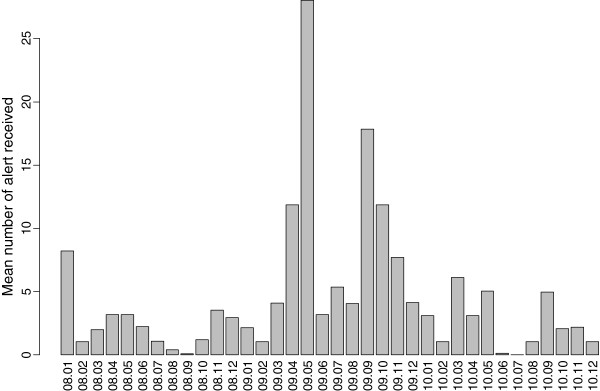
BACKGROUND: Health care providers play a significant role in large scale health emergency planning, detection, response, recovery and communication with the public. The effectiveness of health care providers in emergency preparedness and response roles depends, in part, on public health agencies communicating information in a way that maximizes the likelihood that the message is delivered, received, deemed credible and, when appropriate, acted on. However, during an emergency, health care providers can become inundated with alerts and advisories through numerous national, state, local and professional communication channels. We conducted an alert fatigue study as a sub-study of a larger randomized controlled trial which aimed to identify the most effective methods of communicating public health messages between public health agencies and providers. We report an analysis of the effects of public health message volume/frequency on recall of specific message content and effect of rate of message communications on health care provider alert fatigue. METHODS: Health care providers enrolled in the larger study (n=528) were randomized to receive public health messages via email, fax, short message service (SMS or cell phone text messaging) or to a control group that did not receive messages. For 12 months, study messages based on real events of public health significance were sent quarterly with follow-up telephone interviews regarding message receipt and topic recall conducted 5-10 days after the message delivery date. During a pandemic when numerous messages are sent, alert fatigue may impact ability to recall whether a specific message has been received due to the "noise" created by the higher number of messages. To determine the impact of "noise" when study messages were sent, we compared health care provider recall of the study message topic to the number of local public health messages sent to health care providers. RESULTS: We calculated the mean number of messages that each provider received from local public health during the time period around each study message and provider recall of study message content. We found that recall rates were inversely proportional to the mean number of messages received per week: Every increase of one local public health message per week resulted in a statistically significant 41.2% decrease (p < 0.01), 95% CI [0.39, .87] in the odds of recalling the content of the study message. CONCLUSIONS: To our knowledge, this is the first study to document the effects of alert fatigue on health care providers' recall of information. Our results suggest that information delivered too frequently and/or repetitively through numerous communication channels may have a negative effect on the ability of health care providers to effectively recall emergency information. Keeping health care providers and other first-line responders informed during an emergency is critical. Better coordination between organizations disseminating alerts, advisories and other messages may improve the ability of health care providers to recall public health emergency messages, potentially impacting effective response to public health emergency messages.
Overview
The claims and statistics of this paper haven’t been checked yet.
Run the check — free, no account needed. It reads the open-access text and checks the sources it cites.
Integrity signals
Registry
Cites
Statistics
Figures
Verification
Claims the paper makes
The claims and statistics of this paper haven’t been checked yet.
Run the check — free, no account needed. It reads the open-access text and checks the sources it cites.
Claims other papers make about this one
Each is checked against this paper’s own text: does it say what the citing paper says it does?
The cited source says what the claim attributes to it.
In the citing paper
“Baseman and colleagues demonstrated that for each 1-message-per-week increase, the odds of recalling message content dropped by 41% [22].”
From Effects of workload, work complexity, and repeated alerts on alert fatigue in a clinical decision support system (2017) · cites this paper as [22]
Self-check
Percentages, sums and reported differences re-computed from the paper’s own numbers.
The self-check needs the paper’s full text.
Citations
Cites
Bates, D. W., Kuperman, G. J., Wang, S., Gandhi, T., Kittler, A., Volk, L., Spurr, C., Khorasani, R., Tanasijevic, M., & Middleton, B. (2003) · Journal of the American Medical Informatics Association · doi:10.1197/jamia.m1370 · Cited by 1,346
Overriding of Drug Safety Alerts in Computerized Physician Order Entry
van der Sijs, H., Aarts, J., Vulto, A., & Berg, M. (2006) · Journal of the American Medical Informatics Association · doi:10.1197/jamia.m1809 · Cited by 1,117
Bioterrorism-Related Inhalational Anthrax: The First 10 Cases Reported in the United States
Jernigan, J. A., Stephens, D. S., Ashford, D. A., Omeñaca, C., Topiel, M. S., Galbraith, M., Tapper, M. L., Fisk, T. L., Zaki, S. R., Popović, T., et al. (2001) · Emerging infectious diseases · doi:10.3201/eid0706.010604 · Cited by 995
Physicians' Decisions to Override Computerized Drug Alerts in Primary Care
Weingart, S. N., Toth, M., Sands, D. Z., Aronson, M. D., Davis, R. B., & Phillips, R. S. (2003) · Archives of Internal Medicine · doi:10.1001/archinte.163.21.2625 · Cited by 487
Some unintended consequences of clinical decision support systems.
Ash, J. S., Sittig, D. F., Campbell, E. M., Guappone, K. P., & Dykstra, R. H. (2007) · PubMed Central · Cited by 298
Schedlbauer, A., Prasad, V., Mulvaney, C., Phansalkar, S., Stanton, W., Bates, D. W., & Avery, A. J. (2009) · Journal of the American Medical Informatics Association · doi:10.1197/jamia.m2910 · Cited by 262
Information Chaos in Primary Care: Implications for Physician Performance and Patient Safety
Beasley, J. W., Wetterneck, T. B., Temte, J. L., Lapin, J. A., Smith, P. D., Rivera-Rodriguez, A. J., & Karsh, B.-T. (2011) · The Journal of the American Board of Family Medicine · doi:10.3122/jabfm.2011.06.100255 · Cited by 241
Phansalkar, S., Edworthy, J., Hellier, E., Seger, D. L., Schedlbauer, A., Avery, A. J., & Bates, D. W. (2010) · Journal of the American Medical Informatics Association · doi:10.1136/jamia.2010.005264 · Cited by 226
The Pediatrician and Disaster Preparedness
Markenson, D. S., & REYNOLDS, S. L. (2006) · PEDIATRICS · doi:10.1542/peds.2005-2752 · Cited by 152
Lessons Learned during Dengue Outbreaks in the United States, 2001–2011
Adalja, A. A., Sell, T. K., Bouri, N., & Franco, C. (2012) · Emerging infectious diseases · doi:10.3201/eid1804.110968 · Cited by 125
Research works printed but not linked: 1
- U.S. Census Bureau: State and County QuickFacts: Population Estimates, Counties. 2011, U.S: Census Bureau
Cited by
Sorted by citations
with the HITEC Investigators, Ancker, J. S., Edwards, A., Nosal, S., Hauser, D., Mauer, E., & Kaushal, R. (2017) · BMC Medical Informatics and Decision Making · doi:10.1186/s12911-017-0430-8 · Cited by 709
“Examples of quantitative research supporting the overload explanation include studies finding that override rates decreased overall after irrelevant alerts were discontinued [21], that ability to remember alerts declined as number of different alerts rose [22], and that inappropriate overrides were associated with num…”
BackgroundMessage fatigue: Conceptual definition, operationalization, and correlates
So, J., Kim, S., & Cohen, H. (2016) · Communication Monographs · doi:10.1080/03637751.2016.1250429 · Cited by 219
Kim, S., & So, J. (2017) · Journal of Health Communication · doi:10.1080/10810730.2017.1414900 · Cited by 164
Muench, F. J., & Baumel, A. (2017) · Journal of Medical Internet Research · doi:10.2196/jmir.7463 · Cited by 148
Kisa, S., & Kisa, A. (2024) · Journal of Medical Internet Research · doi:10.2196/56931 · Cited by 132
Metadata
- Authors
- Baseman, J. G., Revere, D., Painter, I., Toyoji, M., Thiede, H., & Duchin, J.
- Affiliations
- University of Washington (US)
- Public Health – Seattle & King County (US)
- Corresponding author
- Baseman, Janet G
- Venue
- BMC Health Services Research
- Published
- 2013-08-05
- Volume
- 13
- Issue
- 1
- Pages
- 295-295
- ISSN
- 1472-6963 (ISSN-L)
- PMC
- PMC3751004
- OpenAlex
- W2089648885
- Cited by
- 105
- References
- 22
- Citations by year
- 2026: 7 · 2025: 7 · 2024: 11 · 2023: 3 · 2022: 7 · 2021: 19 · 2020: 15 · 2019: 6 · 2018: 8 · 2017: 9 · 2016: 6 · 2015: 3 · 2014: 4
- FWCI
- 12.83
- Type
- journal article
- Language
- en
- Open access
- gold
- doi.org
- Licence
- Locations
- BMC Health Services Research (publishedVersion, cc-by)
- Europe PMC (PubMed Central) (publishedVersion, cc-by)
- PubMed Central (publishedVersion, cc-by)
- PubMed (publishedVersion)
- Funders
- University of Washington
- Centers for Disease Control and Prevention (5P01TP000297)
- Office of Public Health Preparedness and Response
- Topics
- Social Sciences › Communication › Public Relations and Crisis Communication
- Health Sciences › Health Professions › Emergency Medical Services › Disaster Response and Management
- Health Sciences › Medicine › Public Health, Environmental and Occupational Health › Public Health Policies and Education
- Keywords
- alarm fatigue, public health communication, healthcare workers, message recall, message frequency, message volume, disaster preparedness, emergency response, public health alerts, text messaging, email, fax, pandemic communication, information overload, message credibility, message tailoring, message framing, message timing, message repetition
- MeSH terms
- Adult, Communication, Disasters, Mental Fatigue, Female, Health Personnel, Humans, Male, Middle Aged, Public Health, Mental Recall, Washington, Confidence Intervals, Electronic Mail, Qualitative Research, Text Messaging
About these checks
Registry, retraction, Cites and statistics results are computed, not judged, with one exception: a printed reference that no index lists is read once by a model before it counts as a citation error. Claims are extracted by a model and kept only when their quote appears verbatim in the text; each cited source is then checked, with a model’s help, for whether it says what the claim relies on. Those verdicts can be wrong — read the claim’s quote and the cited source before relying on one.
Statistics and arithmetic are recomputed, not judged.
Confidence bands are shown only for fields calibrated on our annotated test set. None is calibrated yet, so no band is shown.
What counts as a claim ›How we measure confidence ›How we check this ›
Are you an author, or do you see a problem with this page? Request a review
