

The DOI matches its Crossref record; 27 of the 27 references it cites were found in a registry or an index.
Portrait of a lengthy vaccination trajectory in Burkina Faso: from cultural acceptance of vaccines to actual immunization
Open accessAbstract
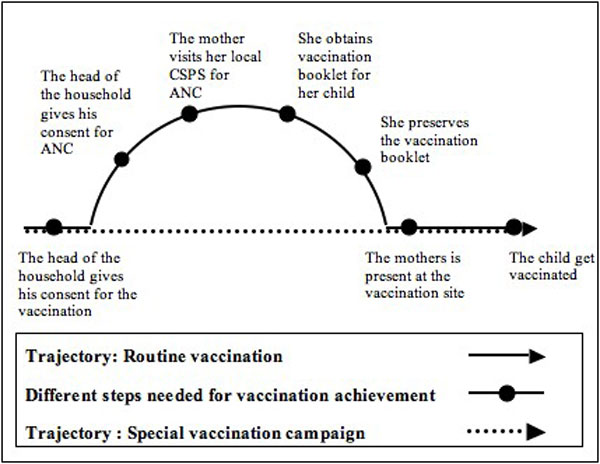
Background: The global recognition of vaccination is strongly related to the fact that it has proved in the past able to dramatically reduce the incidence of certain diseases. Nevertheless, reactions regarding the practice of vaccination still vary among communities, affecting the worldwide vaccination coverage. Numerous studies, conducted from varying perspectives, have focused on explaining this active refusal or resistance to vaccination. Although in some cases low immunization coverage has been well explained by active refusal or resistance to vaccination, little is known about the reasons for low coverage where those reactions are absent or play a minor role, especially outside an epidemic context. This study attempts to explain this situation, which is found in the health district of Nouna in Burkina Faso. Methods: An in-depth ethnographic study was undertaken in the health district of Nouna in an effort to understand, from an anthropological point of view, the logic behind the parental decision-making process regarding the vaccination or non-vaccination of children, in a context where rejection of, and reservations concerning vaccination are not major obstacles. Results: Three elements emerged from the analysis: the empirical conceptions of childhood diseases, the perceived efficacy of vaccine and the knowledge of appropriate age for vaccination uptake; the gap between the decision-making process and the actual achievement of vaccination; and the vaccination procedure leading to vaccination uptake in the particular context of the health district of Nouna. Conclusion: The procedures parents must follow in order to obtain vaccination for their children appear complex and constraining, and on certain points discord with the traditional systems of meaning and idioms of distress related to pregnancy, the prevention of childhood diseases and with the cultural matrix shaping decision-making and behaviour. Attention needs to be directed at certain promotional, logistical and structural elements, and at the procedure that must currently be followed to obtain vaccination for a child during routine vaccination sessions, which are currently limiting the active demand for vaccination. Abstract in French: See the full article online for a translation of this abstract in French.
Overview
The claims and statistics of this paper haven’t been checked yet.
Run the check — free, no account needed. It reads the open-access text and checks the sources it cites.
Integrity signals
Registry
Cites
Statistics
Figures
Verification
Claims the paper makes
The claims and statistics of this paper haven’t been checked yet.
Run the check — free, no account needed. It reads the open-access text and checks the sources it cites.
Claims other papers make about this one
Each is checked against this paper’s own text: does it say what the citing paper says it does?
In the citing paper
“Additionally, many studies have shown how distance to health facility is a major determinant of maternal care utilisation, including likeliness to seek ANC and to deliver in a health facility, in rural Burkina Faso [51, 78, 79].”
From Situating mobile health: a qualitative study of mHealth expectations in the rural health district of Nouna, Burkina Faso (2017) · cites this paper as [79]
Self-check
Percentages, sums and reported differences re-computed from the paper’s own numbers.
The self-check needs the paper’s full text.
Citations
Cites
Social Learning Theory and the Health Belief Model
Rosenstock, I. M., Strecher, V. J., & Becker, M. H. (1988) · Health Education Quarterly · doi:10.1177/109019818801500203 · Cited by 5,564
Why People Use Health Services
Rosenstock, I. M. (2005) · Milbank Quarterly · doi:10.1111/j.1468-0009.2005.00425.x · Cited by 2,329
Why People Use Health Services
Rosenstock, I. M. (1966) · The Milbank Memorial Fund Quarterly · doi:10.2307/3348967 · Cited by 2,305
Patterns of vaccination acceptance
Streefland, P. H., Chowdhury, R., & Ramos-Jimenez, P. (1999) · Social Science & Medicine · doi:10.1016/s0277-9536(99)00239-7 · Cited by 339
State of the world's vaccines and immunization
Brewer, J. M. (2003) · Transactions of the Royal Society of Tropical Medicine and Hygiene · doi:10.1016/s0035-9203(03)90113-1 · Cited by 321
The History Of Vaccines And Immunization: Familiar Patterns, New Challenges
Stern, A. M., & Markel, H. (2005) · Health Affairs · doi:10.1377/hlthaff.24.3.611 · Cited by 301
Vaccinations in the third world: A consideration of community demand
Nichter, M. (1995) · Social Science & Medicine · doi:10.1016/0277-9536(95)00034-5 · Cited by 225
(2003) · Collection Histoire africaine · doi:10.3917/kart.jaffr.2003.01 · Cited by 184
Antenatal care and perinatal outcomes in Kwale district, Kenya
Brown, C., Sohani, S., Khan, K. S., Lilford, R. J., & Mukhwana, W. (2008) · BMC Pregnancy and Childbirth · doi:10.1186/1471-2393-8-2 · Cited by 106
Kiwuwa, M. S., & Mufubenga, P. (2008) · Malaria Journal · doi:10.1186/1475-2875-7-44 · Cited by 92
Research works printed but not linked: 8
- Millimouno D, Diallo AA, Fairhead J, Leach M: The Social Dynamics of Infant Immunization in Africa. The Case of the Republic of Guinea. IDS Working Paper 262. 2006
- Ralisy O, Radanielina I: Madagascar: vaincre la rougeole en chassant les préjugés. Education Santé février. 2005, 198-
- Dugas M: Rapport ETUVAC, deuxième rapport pour le CRDI du volet de l'anthropologie médicale. 2006, unpublished.
- Boa A: Perceptions du Programme élargi de vaccinations (PEV) et de ses dysfonctionnements dans le district sanitaire de Bouna (Nord-Est de la Côte d'Ivoire). Bull Soc Pathol Exot. 2006, 99 (5): 386-390.
- Kargougou R, Yé M, Somé F: Rapport de l'enquête sur le fonctionnement des services de vaccination, étude ETUVAC. Centre de recherche en Santé de Nouna. 2004, unpublished.
- Ministère de la santé du Burkina Faso: Revue approfondie du PEV, Rapport final. 2003, Ministère de la santé du Burkina Faso
- Dabiré B: Enfants d'aujourd'hui diversité des contextes, pluralité des parcours: concepts, sources et mesures. 2006, Association internationale des démographes de langue française. Colloque (11: 2002: Dakar), Publié par INED, Dakar
- Tremblay J: Mères, pouvoir et santé en Haïti, Éditions Karthala, Paris. 2000
Cited by
Sorted by citations
Duclos, V., Yé, M., Moubassira, K., Sanou, H., Sawadogo, N. H., Bibeau, G., & Sié, A. (2017) · Health Research Policy and Systems · doi:10.1186/s12961-017-0211-y · Cited by 59
Self-citation
Metadata
- Authors
- Dugas, M., Dubé, E., Kouyaté, B., Sanou, A., & Bibeau, G.
- Affiliations
- Dalhousie University (CA)
- Centre National de Recherche et de Formation sur le Paludisme (BF)
- Université de Montréal (CA)
- Corresponding author
- Bibeau, Gilles
- Venue
- BMC International Health and Human Rights
- Published
- 2009-10
- Volume
- 9
- Issue
- S1
- Pages
- S9-S9
- ISSN
- 1472-698X (ISSN-L)
- PMC
- PMC3226241
- OpenAlex
- W2090013035
- Cited by
- 30
- References
- 27
- Citations by year
- 2025: 2 · 2024: 1 · 2023: 2 · 2021: 2 · 2020: 1 · 2019: 3 · 2018: 1 · 2017: 3 · 2015: 2 · 2014: 3 · 2013: 2 · 2012: 1
- FWCI
- 2.76
- Type
- journal article
- Language
- en
- Open access
- gold
- doi.org
- Licence
- cc-by
- Locations
- BMC International Health and Human Rights (publishedVersion, cc-by)
- PubMed Central (publishedVersion, cc-by)
- PubMed (publishedVersion)
- Funders
- International Development Research Centre
- Topics
- Social Sciences › Health › Vaccine Coverage and Hesitancy
- Health Sciences › Medicine › Pediatrics, Perinatology and Child Health › Global Maternal and Child Health
- Health Sciences › Medicine › Emergency Medicine › Intramuscular injections and effects
- Keywords
- childhood immunization, vaccination coverage, parental decision-making, vaccine acceptance, perceived vaccine efficacy, vaccination practices, routine immunization, Burkina Faso
About these checks
Registry, retraction, Cites and statistics results are computed, not judged, with one exception: a printed reference that no index lists is read once by a model before it counts as a citation error. Claims are extracted by a model and kept only when their quote appears verbatim in the text; each cited source is then checked, with a model’s help, for whether it says what the claim relies on. Those verdicts can be wrong — read the claim’s quote and the cited source before relying on one.
Statistics and arithmetic are recomputed, not judged.
Confidence bands are shown only for fields calibrated on our annotated test set. None is calibrated yet, so no band is shown.
What counts as a claim ›How we measure confidence ›How we check this ›
Are you an author, or do you see a problem with this page? Request a review
How to cite
Cite CoChat for the checks on this page, and the paper for its own findings.
- This page
- CoChat. (2026). Citation check: Portrait of a lengthy vaccination trajectory in Burkina Faso: from cultural acceptance of vaccines to actual immunization. https://app.cochat.ai/papers/10.1186/1472-698x-9-s1-s9
- The paper
- Dugas, M., Dubé, E., Kouyaté, B., Sanou, A., & Bibeau, G. (2009). Portrait of a lengthy vaccination trajectory in Burkina Faso: from cultural acceptance of vaccines to actual immunization. BMC International Health and Human Rights. https://doi.org/10.1186/1472-698x-9-s1-s9
