

The DOI matches its Crossref record; 59 of the 61 references it cites were found in a registry or an index.
An internal deletion in MTH1 enables growth on glucose of pyruvate-decarboxylase negative, non-fermentative Saccharomyces cerevisiae
Open accessAbstract
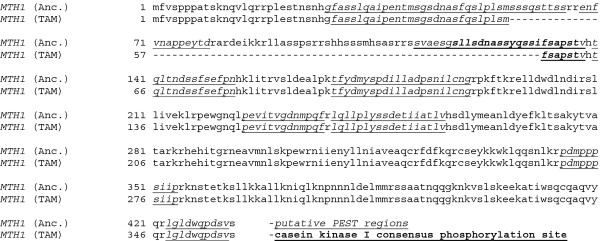
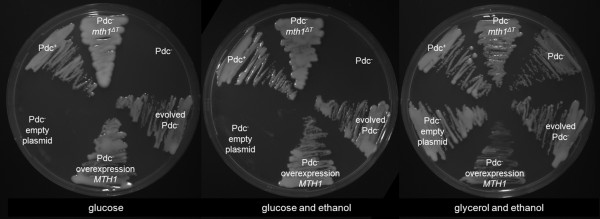
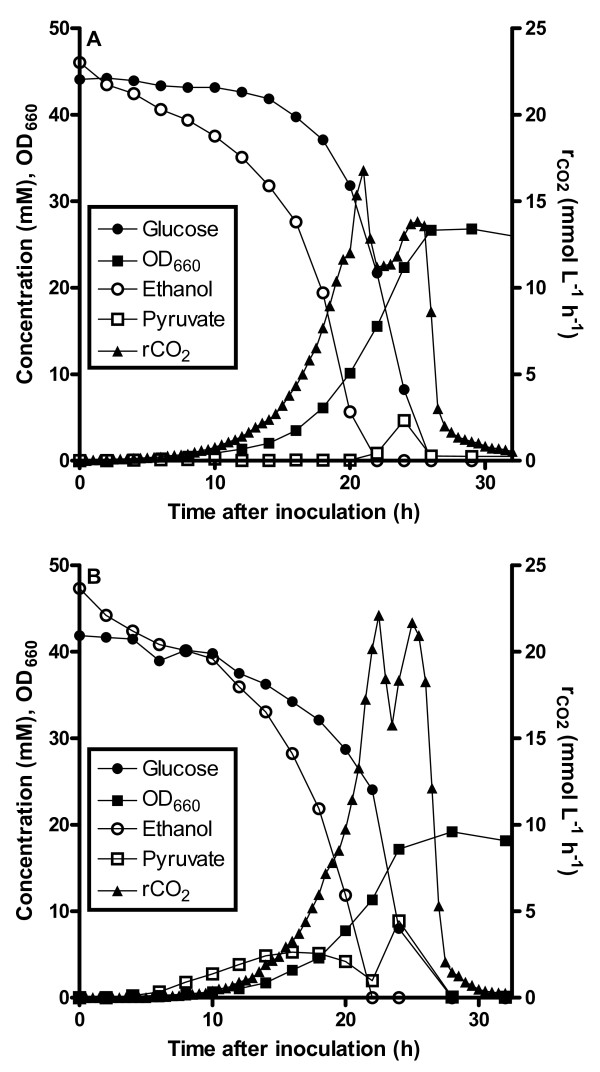
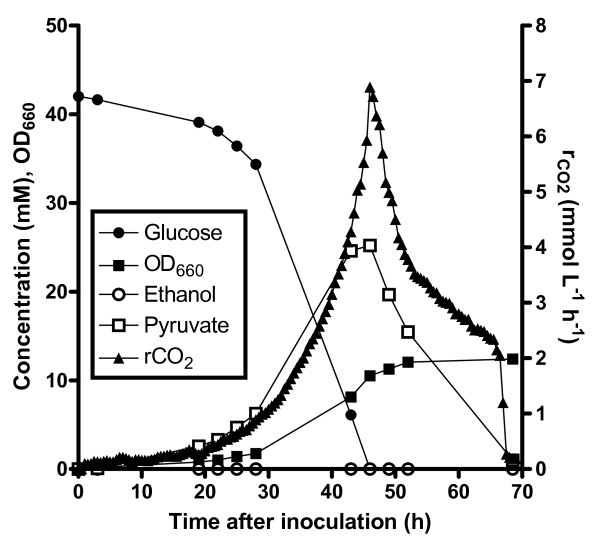
Background: Pyruvate-decarboxylase negative (Pdc-) strains of Saccharomyces cerevisiae combine the robustness and high glycolytic capacity of this yeast with the absence of alcoholic fermentation. This makes Pdc- S. cerevisiae an interesting platform for efficient conversion of glucose towards pyruvate-derived products without formation of ethanol as a by-product. However, Pdc- strains cannot grow on high glucose concentrations and require C 2-compounds (ethanol or acetate) for growth under conditions with low glucose concentrations, which hitherto has limited application in industry. Results: Genetic analysis of a Pdc- strain previously evolved to overcome these deficiencies revealed a 225bp in-frame internal deletion in MTH1, encoding a transcriptional regulator involved in glucose sensing. This internal deletion contains a phosphorylation site required for degradation, thereby hypothetically resulting in increased stability of the protein. Reverse engineering of this alternative MTH1 allele into a non-evolved Pdc- strain enabled growth on 20 g l-1 glucose and 0.3% (v/v) ethanol at a maximum specific growth rate (0.24 h-1) similar to that of the evolved Pdc- strain (0.23 h-1). Furthermore, the reverse engineered Pdc- strain grew on glucose as sole carbon source, albeit at a lower specific growth rate (0.10 h-1) than the evolved strain (0.20 h-1). The observation that overexpression of the wild-type MTH1 allele also restored growth of Pdc- S. cerevisiae on glucose is consistent with the hypothesis that the internal deletion results in decreased degradation of Mth1. Reduced degradation of Mth1 has been shown to result in deregulation of hexose transport. In Pdc- strains, reduced glucose uptake may prevent intracellular accumulation of pyruvate and/or redox problems, while release of glucose repression due to the MTH1 internal deletion may contribute to alleviation of the C 2-compound auxotrophy. Conclusions: In this study we have discovered and characterised a mutation in MTH1 enabling Pdc- strains to grow on glucose as the sole carbon source. This successful example of reverse engineering not only increases the understanding of the glucose tolerance of evolved Pdc- S. cerevisiae, but also allows introduction of this portable genetic element into various industrial yeast strains, thereby simplifying metabolic engineering strategies.
Overview
The claims and statistics of this paper haven’t been checked yet.
Run the check — free, no account needed. It reads the open-access text and checks the sources it cites.
Integrity signals
Registry
Cites
Statistics
Figures
Verification
Claims the paper makes
The claims and statistics of this paper haven’t been checked yet.
Run the check — free, no account needed. It reads the open-access text and checks the sources it cites.
Claims other papers make about this one
Each is checked against this paper’s own text: does it say what the citing paper says it does?
In the citing paper
“they are a prerequisite for the development of novel molecular functions [129-131].”
From Adaptive laboratory evolution—Principles and applications for biotechnology (2013) · cites this paper as [131]
Self-check
Percentages, sums and reported differences re-computed from the paper’s own numbers.
The self-check needs the paper’s full text.
Citations
Cites
Sikorski, R. S., & Hieter, P. (1989) · Genetics · doi:10.1093/genetics/122.1.19 · Cited by 8,590
Transformation of yeast by lithium acetate/single-stranded carrier DNA/polyethylene glycol method
Gietz, R. D., & Woods, R. A. (2002) · Methods in enzymology on CD-ROM/Methods in enzymology · doi:10.1016/s0076-6879(02)50957-5 · Cited by 2,855
Amino Acid Sequences Common to Rapidly Degraded Proteins: The PEST Hypothesis
Rogers, S. W., Wells, R., & Rechsteiner, M. (1986) · Science · doi:10.1126/science.2876518 · Cited by 2,541
PEST sequences and regulation by proteolysis
Rechsteiner, M., & Rogers, S. W. (1996) · Trends in Biochemical Sciences · doi:10.1016/s0968-0004(96)10031-1 · Cited by 1,707
Verduyn, C., Postma, E., Scheffers, W. A., & van Dijken, J. P. (1992) · Yeast · doi:10.1002/yea.320080703 · Cited by 1,510
Targeting, disruption, replacement, and allele rescue: integrative DNA transformation in yeast.
Rothstein, R. (1991) · Methods in Enzymology · doi:10.1016/0076-6879(91)94022-5 · Cited by 1,283
Wach, A. (1996) · Yeast · doi:10.1002/(sici)1097-0061(19960315)12:3 · Cited by 848
Self-citationWestfall, P. J., Pitera, D. J., Lenihan, J. R., Eng, D., Woolard, F. X., Regentin, R., Horning, T., Tsuruta, H., Melis, D. J., Owens, A. E., et al. (2012) · Proceedings of the National Academy of Sciences · doi:10.1073/pnas.1110740109 · Cited by 726
van Dijken, J. P., Bauer, J., Brambilla, L., Duboc, P., Francois, J. M., Gancedo, C., Giuseppin, M. L. F., Heijnen, J. J., Hoare, M., Lange, H. C., et al. (2000) · Enzyme and Microbial Technology · doi:10.1016/s0141-0229(00)00162-9 · Cited by 598
Self-citationProgress in Metabolic Engineering of Saccharomyces cerevisiae
Nevoigt, E. (2008) · Microbiology and Molecular Biology Reviews · doi:10.1128/mmbr.00025-07 · Cited by 597
Research works printed but not linked: 1
- Schulte F, Ciriacy M: HTR1/MTH1 encodes a repressor for HXT genes. Yeast. 1995, 11: S239-
Cited by
Sorted by citations
Items 101–104 of 104
Nicolaï, T., Deparis, Q., Foulquié-Moreno, M. R., & Thevelein, J. M. (2021) · Figshare · doi:10.6084/m9.figshare.14746491
Nicolaï, T., Deparis, Q., Foulquié-Moreno, M. R., & Thevelein, J. M. (2021) · Figshare · doi:10.6084/m9.figshare.14746479
Nicolaï, T., Deparis, Q., Foulquié-Moreno, M. R., & Thevelein, J. M. (2021) · Figshare · doi:10.6084/m9.figshare.14746482
Promoting low-temperature lager beer production by redox potential-controlled fermentation
Huang, Z., Yin, H., Liu, S., Zhang, J.-J., Zhang, C., Xing, L., Huang, X., Bai, F.-W., & Liu, C. (2026) · Biocatalysis and Agricultural Biotechnology · doi:10.1016/j.bcab.2026.103966
Metadata
- Authors
- Oud, B., Flores, C.-L., Gancedo, C., Zhang, X., Trueheart, J., Daran, J.-M., Pronk, J. T., & van Maris, A. J.
- Affiliations
- Delft University of Technology (NL)
- Instituto de Investigaciones Biomédicas Sols-Morreale (ES)
- Venue
- Microbial Cell Factories
- Published
- 2012-09-15
- Volume
- 11
- Issue
- 1
- Pages
- 131-131
- ISSN
- 1475-2859 (ISSN-L)
- PMC
- PMC3503853
- OpenAlex
- W2127470474
- Cited by
- 104
- References
- 61
- Citations by year
- 2026: 2 · 2025: 3 · 2024: 5 · 2023: 2 · 2022: 5 · 2021: 24 · 2020: 9 · 2019: 4 · 2018: 7 · 2017: 8 · 2016: 11 · 2015: 7 · 2014: 10 · 2013: 6
- FWCI
- 2.96
- Type
- journal article
- Language
- en
- Open access
- gold
- doi.org
- Licence
- cc-by
- Locations
- Microbial Cell Factories (publishedVersion, cc-by)
- PubMed Central (publishedVersion, cc-by)
- PubMed (publishedVersion)
- DIGITAL.CSIC (Spanish National Research Council (CSIC)) (submittedVersion, cc-by)
- DOAJ (DOAJ: Directory of Open Access Journals) (submittedVersion)
- Research Repository (Delft University of Technology) (submittedVersion, other-oa)
- Data Archiving and Networked Services (DANS) (submittedVersion, cc-by)
- Funders
- Ministerio de Ciencia e Innovación
- Topics
- Life Sciences › Biochemistry, Genetics and Molecular Biology › Molecular Biology › Fungal and yeast genetics research
- Life Sciences › Biochemistry, Genetics and Molecular Biology › Molecular Biology › Microbial Metabolic Engineering and Bioproduction
- Physical Sciences › Engineering › Biomedical Engineering › Biofuel production and bioconversion
- Keywords
- MTH1, Saccharomyces cerevisiae, glucose tolerance, glucose detection, transcription factors, protein stability, phosphorylation sites, reverse engineering, glucose repression, ethanol tolerance, glucose uptake, hexose transport, metabolic engineering
- MeSH terms
- Alleles, Amino Acid Sequence, Fermentation, Glucose, Molecular Sequence Data, Mutation, Pyruvate Decarboxylase, Saccharomyces cerevisiae, Sequence Alignment, Saccharomyces cerevisiae Proteins, Adaptor Proteins, Signal Transducing, Metabolic Engineering
About these checks
Registry, retraction, Cites and statistics results are computed, not judged, with one exception: a printed reference that no index lists is read once by a model before it counts as a citation error. Claims are extracted by a model and kept only when their quote appears verbatim in the text; each cited source is then checked, with a model’s help, for whether it says what the claim relies on. Those verdicts can be wrong — read the claim’s quote and the cited source before relying on one.
Statistics and arithmetic are recomputed, not judged.
Confidence bands are shown only for fields calibrated on our annotated test set. None is calibrated yet, so no band is shown.
What counts as a claim ›How we measure confidence ›How we check this ›
Are you an author, or do you see a problem with this page? Request a review
