

The DOI matches its Crossref record; 59 of the 61 references it cites were found in a registry or an index.
An internal deletion in MTH1 enables growth on glucose of pyruvate-decarboxylase negative, non-fermentative Saccharomyces cerevisiae
Open accessAbstract
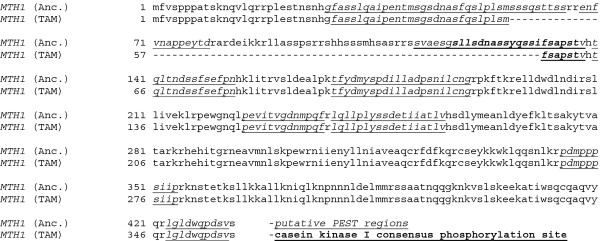
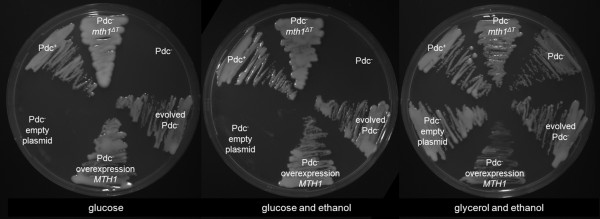
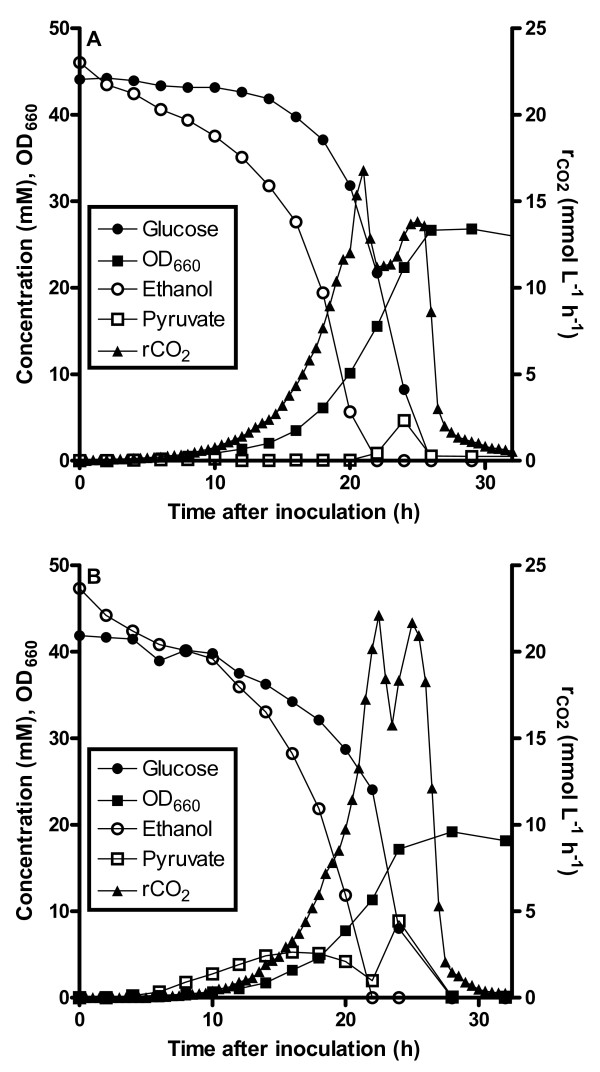
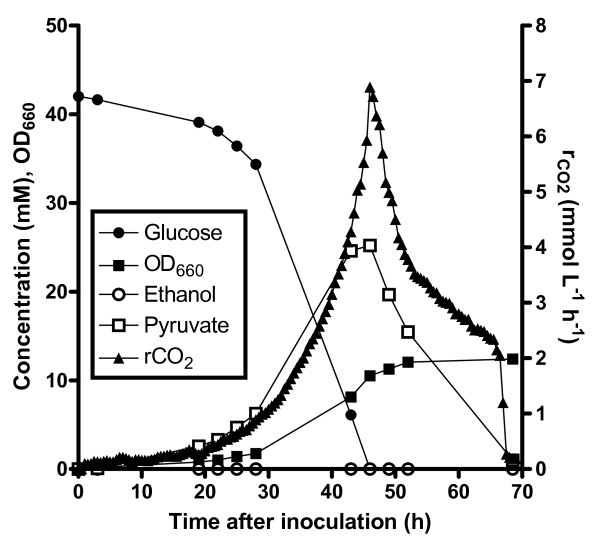
Background: Pyruvate-decarboxylase negative (Pdc-) strains of Saccharomyces cerevisiae combine the robustness and high glycolytic capacity of this yeast with the absence of alcoholic fermentation. This makes Pdc- S. cerevisiae an interesting platform for efficient conversion of glucose towards pyruvate-derived products without formation of ethanol as a by-product. However, Pdc- strains cannot grow on high glucose concentrations and require C 2-compounds (ethanol or acetate) for growth under conditions with low glucose concentrations, which hitherto has limited application in industry. Results: Genetic analysis of a Pdc- strain previously evolved to overcome these deficiencies revealed a 225bp in-frame internal deletion in MTH1, encoding a transcriptional regulator involved in glucose sensing. This internal deletion contains a phosphorylation site required for degradation, thereby hypothetically resulting in increased stability of the protein. Reverse engineering of this alternative MTH1 allele into a non-evolved Pdc- strain enabled growth on 20 g l-1 glucose and 0.3% (v/v) ethanol at a maximum specific growth rate (0.24 h-1) similar to that of the evolved Pdc- strain (0.23 h-1). Furthermore, the reverse engineered Pdc- strain grew on glucose as sole carbon source, albeit at a lower specific growth rate (0.10 h-1) than the evolved strain (0.20 h-1). The observation that overexpression of the wild-type MTH1 allele also restored growth of Pdc- S. cerevisiae on glucose is consistent with the hypothesis that the internal deletion results in decreased degradation of Mth1. Reduced degradation of Mth1 has been shown to result in deregulation of hexose transport. In Pdc- strains, reduced glucose uptake may prevent intracellular accumulation of pyruvate and/or redox problems, while release of glucose repression due to the MTH1 internal deletion may contribute to alleviation of the C 2-compound auxotrophy. Conclusions: In this study we have discovered and characterised a mutation in MTH1 enabling Pdc- strains to grow on glucose as the sole carbon source. This successful example of reverse engineering not only increases the understanding of the glucose tolerance of evolved Pdc- S. cerevisiae, but also allows introduction of this portable genetic element into various industrial yeast strains, thereby simplifying metabolic engineering strategies.
Overview
The claims and statistics of this paper haven’t been checked yet.
Run the check — free, no account needed. It reads the open-access text and checks the sources it cites.
Integrity signals
Registry
Cites
Statistics
Figures
Verification
Claims the paper makes
The claims and statistics of this paper haven’t been checked yet.
Run the check — free, no account needed. It reads the open-access text and checks the sources it cites.
Claims other papers make about this one
Each is checked against this paper’s own text: does it say what the citing paper says it does?
In the citing paper
“they are a prerequisite for the development of novel molecular functions [129-131].”
From Adaptive laboratory evolution—Principles and applications for biotechnology (2013) · cites this paper as [131]
Self-check
Percentages, sums and reported differences re-computed from the paper’s own numbers.
The self-check needs the paper’s full text.
Citations
Cites
Sikorski, R. S., & Hieter, P. (1989) · Genetics · doi:10.1093/genetics/122.1.19 · Cited by 8,590
Transformation of yeast by lithium acetate/single-stranded carrier DNA/polyethylene glycol method
Gietz, R. D., & Woods, R. A. (2002) · Methods in enzymology on CD-ROM/Methods in enzymology · doi:10.1016/s0076-6879(02)50957-5 · Cited by 2,855
Amino Acid Sequences Common to Rapidly Degraded Proteins: The PEST Hypothesis
Rogers, S. W., Wells, R., & Rechsteiner, M. (1986) · Science · doi:10.1126/science.2876518 · Cited by 2,541
PEST sequences and regulation by proteolysis
Rechsteiner, M., & Rogers, S. W. (1996) · Trends in Biochemical Sciences · doi:10.1016/s0968-0004(96)10031-1 · Cited by 1,707
Verduyn, C., Postma, E., Scheffers, W. A., & van Dijken, J. P. (1992) · Yeast · doi:10.1002/yea.320080703 · Cited by 1,510
Targeting, disruption, replacement, and allele rescue: integrative DNA transformation in yeast.
Rothstein, R. (1991) · Methods in Enzymology · doi:10.1016/0076-6879(91)94022-5 · Cited by 1,283
Wach, A. (1996) · Yeast · doi:10.1002/(sici)1097-0061(19960315)12:3 · Cited by 848
Self-citationWestfall, P. J., Pitera, D. J., Lenihan, J. R., Eng, D., Woolard, F. X., Regentin, R., Horning, T., Tsuruta, H., Melis, D. J., Owens, A. E., et al. (2012) · Proceedings of the National Academy of Sciences · doi:10.1073/pnas.1110740109 · Cited by 726
van Dijken, J. P., Bauer, J., Brambilla, L., Duboc, P., Francois, J. M., Gancedo, C., Giuseppin, M. L. F., Heijnen, J. J., Hoare, M., Lange, H. C., et al. (2000) · Enzyme and Microbial Technology · doi:10.1016/s0141-0229(00)00162-9 · Cited by 598
Self-citationProgress in Metabolic Engineering of Saccharomyces cerevisiae
Nevoigt, E. (2008) · Microbiology and Molecular Biology Reviews · doi:10.1128/mmbr.00025-07 · Cited by 597
van Maris, A. J. A., Abbott, D. A., Bellissimi, E., van den Brink, J., Kuyper, M., Luttik, M. A. H., Wisselink, H. W., Scheffers, W. A., van Dijken, J. P., & Pronk, J. T. (2006) · Antonie van Leeuwenhoek · doi:10.1007/s10482-006-9085-7 · Cited by 546
Self-citationHow did Saccharomyces evolve to become a good brewer?
Piškur, J., Rozpędowska, E., Poláková, S., Merico, A., & Compagno, C. (2006) · Trends in Genetics · doi:10.1016/j.tig.2006.02.002 · Cited by 514
Hong, K.-K., & Nielsen, J. (2012) · Cellular and Molecular Life Sciences · doi:10.1007/s00018-012-0945-1 · Cited by 451
Özcan, S., & Johnston, M. (1995) · Molecular and Cellular Biology · doi:10.1128/mcb.15.3.1564 · Cited by 382
Glucose sensing and signaling by two glucose receptors in the yeast Saccharomyces cerevisiae
Özcan, S., Dover, J., & Johnston, M. (1998) · The EMBO Journal · doi:10.1093/emboj/17.9.2566 · Cited by 359
Resurrecting ancestral alcohol dehydrogenases from yeast
Thomson, J. M., Gaucher, E. A., Burgan, M. F., De Kee, D. W., Li, T., Aris, J. P., & Benner, S. A. (2005) · Nature Genetics · doi:10.1038/ng1553 · Cited by 341
Trends and challenges in the microbial production of lignocellulosic bioalcohol fuels
Weber, C., Farwick, A., Benisch, F., Brat, D., Dietz, H., Subtil, T., & Boles, E. (2010) · Applied Microbiology and Biotechnology · doi:10.1007/s00253-010-2707-z · Cited by 335
25 Yeast Genetic Strain and Plasmid Collections
Entian, K., & Kötter, P. (2007) · Methods in microbiology · doi:10.1016/s0580-9517(06)36025-4 · Cited by 321
The early steps of glucose signalling in yeast.
Gancedo, J. (2008) · FEMS Microbiology Reviews · doi:10.1111/j.1574-6976.2008.00117.x · Cited by 249
van Maris, A. J. A., Winkler, A. A., Kuyper, M., de Laat, W. T. A. M., van Dijken, J. P., & Pronk, J. T. (2007) · Advances in biochemical engineering, biotechnology · doi:10.1007/10_2007_057 · Cited by 245
Self-citationMoriya, H., & Johnston, M. (2004) · Proceedings of the National Academy of Sciences · doi:10.1073/pnas.0305901101 · Cited by 242
van Maris, A. J. A., Geertman, J.-M. A., Vermeulen, A., Groothuizen, M. K., Winkler, A. A., Piper, M. D. W., van Dijken, J. P., & Pronk, J. T. (2004) · Applied and Environmental Microbiology · doi:10.1128/aem.70.1.159-166.2004 · Cited by 227 · cited 1×
“The goal of the present study was to identify the mutation(s) responsible for the ability of the evolved Pdc- strain isolated by Van Maris et al. (2004) to grow on high concentrations of glucose as sole carbon source.”
BackgroundSelf-citationYeast Protein Serine/Threonine Phosphatases: Multiple Roles and Diverse Regulation
Stark, M. J. R. (1996) · Yeast · doi:10.1002/(sici)1097-0061(199612)12:16 · Cited by 201
van Maris, A. J. A., Konings, W. N., van Dijken, J. P., & Pronk, J. T. (2004) · Metabolic Engineering · doi:10.1016/j.ymben.2004.05.001 · Cited by 190
Self-citationHohmann, S. (1991) · Journal of Bacteriology · doi:10.1128/jb.173.24.7963-7969.1991 · Cited by 189
Parallel evolution of the make–accumulate–consume strategy in Saccharomyces and Dekkera yeasts
Rozpędowska, E., Hellborg, L., Ishchuk, O. P., Orhan, F., Galafassi, S., Merico, A., Woolfit, M., Compagno, C., & Piškur, J. (2011) · Nature Communications · doi:10.1038/ncomms1305 · Cited by 188
Regulatory Network Connecting Two Glucose Signal Transduction Pathways in Saccharomyces cerevisiae
Kaniak, A., Xue, Z., Macool, D. J., Kim, J., & Johnston, M. (2004) · Eukaryotic Cell · doi:10.1128/ec.3.1.221-231.2004 · Cited by 166
Flick, K. M., Spielewoy, N., Kalashnikova, T. I., Guaderrama, M., Zhu, Q., Chang, H.-C., & Wittenberg, C. (2003) · Molecular Biology of the Cell · doi:10.1091/mbc.e03-03-0135 · Cited by 164
Abbott, D. A., Zelle, R. M., Pronk, J. T., & van Maris, A. J. A. (2009) · FEMS Yeast Research · doi:10.1111/j.1567-1364.2009.00537.x · Cited by 164
Self-citationÖzcan, S., Leong, T., & Johnston, M. (1996) · Molecular and Cellular Biology · doi:10.1128/mcb.16.11.6419 · Cited by 157
Wang, Y., Halls, C. E., Zhang, J., Matsuno, M., Zhang, Y., & Yu, O. S. (2011) · Metabolic Engineering · doi:10.1016/j.ymben.2011.04.005 · Cited by 135
Specificity and Regulation of DNA Binding by the Yeast Glucose Transporter Gene Repressor Rgt1
Kim, J., Polish, J. A., & Johnston, M. (2003) · Molecular and Cellular Biology · doi:10.1128/mcb.23.15.5208-5216.2003 · Cited by 129
van Maris, A. J. A., Winkler, A. A., Porro, D., van Dijken, J. P., & Pronk, J. T. (2004) · Applied and Environmental Microbiology · doi:10.1128/aem.70.5.2898-2905.2004 · Cited by 123
Self-citationMetabolic Engineering to Produce Sesquiterpenes in Yeast
Jackson, B. E., Hart-Wells, E. A., & Matsuda, S. P. T. (2003) · Organic Letters · doi:10.1021/ol034231x · Cited by 118
Growth requirements of pyruvate-decarboxylase-negative Saccharomyces cerevisiae
Flikweert, M. T., de Swaaf, M. E., van Dijken, J. P., & Pronk, J. T. (1999) · FEMS Microbiology Letters · doi:10.1111/j.1574-6968.1999.tb13551.x · Cited by 108
Self-citationRepression of transcription by Rgt1 in the absence of glucose requires Std1 and Mth1
Lakshmanan, J., Mosley, A. L., & �zcan, S. (2003) · Current Genetics · doi:10.1007/s00294-003-0423-2 · Cited by 106
Mth1 receives the signal given by the glucose sensors Snf3 and Rgt2 in Saccharomyces cerevisiae ‡
Lafuente, M. J., Gancedo, C., Jauniaux, J. C., & Gancedo, J. M. (2000) · Molecular Microbiology · doi:10.1046/j.1365-2958.2000.01688.x · Cited by 102
Self-citationHow the Rgt1 Transcription Factor of Saccharomyces cerevisiae Is Regulated by Glucose
Polish, J. A., Kim, J., & Johnston, M. (2004) · Genetics · doi:10.1534/genetics.104.034512 · Cited by 99
Blom, J., de Mattos, M. J. T., & Grivell, L. A. (2000) · Applied and Environmental Microbiology · doi:10.1128/aem.66.5.1970-1973.2000 · Cited by 94
de Jong, B. W., Siewers, V., & Nielsen, J. (2011) · Current Opinion in Biotechnology · doi:10.1016/j.copbio.2011.11.021 · Cited by 93
Oud, B., Maris, A. J. A., Daran, J.-M., & Pronk, J. T. (2012) · FEMS Yeast Research · doi:10.1111/j.1567-1364.2011.00776.x · Cited by 82
Self-citationRecent Advances in Artemisinin Production Through Heterologous Expression
Arsenault, P. R., Wobbe, K. K., & Weathers, P. J. (2008) · Current Medicinal Chemistry · doi:10.2174/092986708786242813 · Cited by 79
Chemostat-Based Micro-Array Analysis in Baker's Yeast
Daran-Lapujade, P. A. S., Daran, J.-M. G., van Maris, A. J. A., de Winde, J. H., & Pronk, J. T. (2008) · Advances in microbial physiology/Advances in Microbial Physiology · doi:10.1016/s0065-2911(08)00004-0 · Cited by 74
Self-citationInvestigation of the impact of 1 and 2 on the physiology of
KLEIN, C., RASMUSSEN, J., Rønnow, B., Lisbeth Olsson, A., & Nielsen, J. (1999) · Journal of Biotechnology · doi:10.1016/s0168-1656(98)00205-3 · Cited by 73
Tomás‐Cobos, L., & Sanz, P. (2002) · Biochemical Journal · doi:10.1042/bj20020984 · Cited by 71
Zelle, R. M., de Hulster, E. A. F., Kloezen, W., Pronk, J. T., & van Maris, A. J. A. (2009) · Applied and Environmental Microbiology · doi:10.1128/aem.02396-09 · Cited by 69
Self-citationGlucose uptake and catabolite repression in dominant HTR1 mutants of Saccharomyces cerevisiae
Özcan, S., Freidel, K., Leuker, A., & Ciriacy, M. (1993) · Journal of Bacteriology · doi:10.1128/jb.175.17.5520-5528.1993 · Cited by 66
Kok, S., Nijkamp, J. F., Oud, B., Roque, F. C., Ridder, D., Daran, J.-M., Pronk, J. T., & Maris, A. J. A. (2012) · FEMS Yeast Research · doi:10.1111/j.1567-1364.2011.00787.x · Cited by 65
Self-citationAnaplerotic Role for Cytosolic Malic Enzyme in Engineered Saccharomyces cerevisiae Strains
Zelle, R. M., Harrison, J. C., Pronk, J. T., & van Maris, A. J. A. (2011) · Applied and Environmental Microbiology · doi:10.1128/aem.02132-10 · Cited by 58
Self-citationGamo, F., Lafuente, M. J., & Gancedo, C. (1994) · Journal of Bacteriology · doi:10.1128/jb.176.24.7423-7429.1994 · Cited by 56
Self-citationConstruction of a set of Saccharomyces cerevisiae vectors designed for recombinational cloning
Mullem, V. V., Wéry, M., Bolle, X. D., & Vandenhaute, J. (2003) · Yeast · doi:10.1002/yea.999 · Cited by 55
Schulte, F., Wieczorke, R., Hollenberg, C. P., & Boles, E. (2000) · Journal of Bacteriology · doi:10.1128/jb.182.2.540-542.2000 · Cited by 47
Jouandot, D. J., Roy, A., & Kim, J. (2011) · Journal of Cellular Biochemistry · doi:10.1002/jcb.23253 · Cited by 44
Kuttykrishnan, S., Sabina, J., Langton, L., Johnston, M., & Brent, M. R. (2010) · Proceedings of the National Academy of Sciences · doi:10.1073/pnas.0912483107 · Cited by 40
Sabina, J., & Johnston, M. (2009) · Journal of Biological Chemistry · doi:10.1074/jbc.m109.032102 · Cited by 31
Blázquez, M. A., Gamo, F., & Gancedo, C. (1995) · FEBS Letters · doi:10.1016/0014-5793(95)01337-7 · Cited by 30
Self-citationDNA-binding properties of the yeast Rgt1 repressor
Kim, J. (2008) · Biochimie · doi:10.1016/j.biochi.2008.09.002 · Cited by 27
Diderich, J. A., Raamsdonk, L. M., Kuiper, A., Kruckeberg, A. L., BERDEN, J. A., de Mattos, M. J. T., & DAM, K. V. (2002) · FEMS Yeast Research · doi:10.1111/j.1567-1364.2002.tb00081.x · Cited by 17
Research works printed but not linked: 1
- Schulte F, Ciriacy M: HTR1/MTH1 encodes a repressor for HXT genes. Yeast. 1995, 11: S239-
Cited by
Sorted by citations
Adaptive laboratory evolution—Principles and applications for biotechnology
Dragosits, M., & Mattanovich, D. (2013) · Microbial Cell Factories · doi:10.1186/1475-2859-12-64 · Cited by 827
Production of fatty acid-derived oleochemicals and biofuels by synthetic yeast cell factories
Zhou, Y. J., Buijs, N. A. A., Zhu, Z., Qin, J., Siewers, V., & Nielsen, J. (2016) · Nature Communications · doi:10.1038/ncomms11709 · Cited by 422
Microbial acetyl-CoA metabolism and metabolic engineering
Krivoruchko, A., Zhang, Y., Siewers, V., Chen, Y., & Nielsen, J. (2014) · Metabolic Engineering · doi:10.1016/j.ymben.2014.11.009 · Cited by 347
Lian, J., Mishra, S., & Zhao, H. (2018) · Metabolic Engineering · doi:10.1016/j.ymben.2018.04.011 · Cited by 342
Metabolic engineering of yeast for production of fuels and chemicals
Nielsen, J., Larsson, C., van Maris, A. J. A., & Pronk, J. T. (2013) · Current Opinion in Biotechnology · doi:10.1016/j.copbio.2013.03.023 · Cited by 321
Self-citation
Metadata
- Authors
- Oud, B., Flores, C.-L., Gancedo, C., Zhang, X., Trueheart, J., Daran, J.-M., Pronk, J. T., & van Maris, A. J.
- Affiliations
- Delft University of Technology (NL)
- Instituto de Investigaciones Biomédicas Sols-Morreale (ES)
- Venue
- Microbial Cell Factories
- Published
- 2012-09-15
- Volume
- 11
- Issue
- 1
- Pages
- 131-131
- ISSN
- 1475-2859 (ISSN-L)
- PMC
- PMC3503853
- OpenAlex
- W2127470474
- Cited by
- 104
- References
- 61
- Citations by year
- 2026: 2 · 2025: 3 · 2024: 5 · 2023: 2 · 2022: 5 · 2021: 24 · 2020: 9 · 2019: 4 · 2018: 7 · 2017: 8 · 2016: 11 · 2015: 7 · 2014: 10 · 2013: 6
- FWCI
- 2.96
- Type
- journal article
- Language
- en
- Open access
- gold
- doi.org
- Licence
- cc-by
- Locations
- Microbial Cell Factories (publishedVersion, cc-by)
- PubMed Central (publishedVersion, cc-by)
- PubMed (publishedVersion)
- DIGITAL.CSIC (Spanish National Research Council (CSIC)) (submittedVersion, cc-by)
- DOAJ (DOAJ: Directory of Open Access Journals) (submittedVersion)
- Research Repository (Delft University of Technology) (submittedVersion, other-oa)
- Data Archiving and Networked Services (DANS) (submittedVersion, cc-by)
- Funders
- Ministerio de Ciencia e Innovación
- Topics
- Life Sciences › Biochemistry, Genetics and Molecular Biology › Molecular Biology › Fungal and yeast genetics research
- Life Sciences › Biochemistry, Genetics and Molecular Biology › Molecular Biology › Microbial Metabolic Engineering and Bioproduction
- Physical Sciences › Engineering › Biomedical Engineering › Biofuel production and bioconversion
- Keywords
- MTH1, Saccharomyces cerevisiae, glucose tolerance, glucose detection, transcription factors, protein stability, phosphorylation sites, reverse engineering, glucose repression, ethanol tolerance, glucose uptake, hexose transport, metabolic engineering
- MeSH terms
- Alleles, Amino Acid Sequence, Fermentation, Glucose, Molecular Sequence Data, Mutation, Pyruvate Decarboxylase, Saccharomyces cerevisiae, Sequence Alignment, Saccharomyces cerevisiae Proteins, Adaptor Proteins, Signal Transducing, Metabolic Engineering
About these checks
Registry, retraction, Cites and statistics results are computed, not judged, with one exception: a printed reference that no index lists is read once by a model before it counts as a citation error. Claims are extracted by a model and kept only when their quote appears verbatim in the text; each cited source is then checked, with a model’s help, for whether it says what the claim relies on. Those verdicts can be wrong — read the claim’s quote and the cited source before relying on one.
Statistics and arithmetic are recomputed, not judged.
Confidence bands are shown only for fields calibrated on our annotated test set. None is calibrated yet, so no band is shown.
What counts as a claim ›How we measure confidence ›How we check this ›
Are you an author, or do you see a problem with this page? Request a review
