

The DOI matches its Crossref record; 81 of the 83 references it cites were found in a registry or an index.
Soluble expression of recombinant proteins in the cytoplasm of Escherichia coli
Open accessAbstract
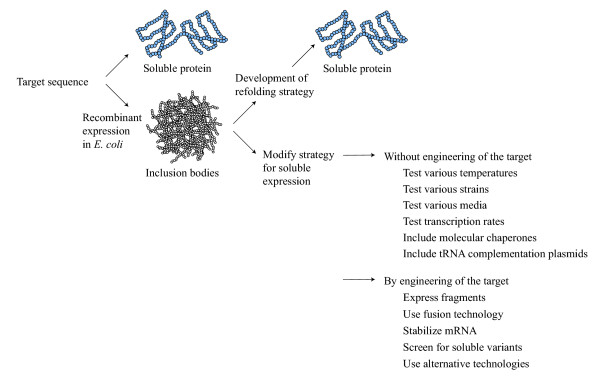
Pure, soluble and functional proteins are of high demand in modern biotechnology. Natural protein sources rarely meet the requirements for quantity, ease of isolation or price and hence recombinant technology is often the method of choice. Recombinant cell factories are constantly employed for the production of protein preparations bound for downstream purification and processing. Eschericia coli is a frequently used host, since it facilitates protein expression by its relative simplicity, its inexpensive and fast high density cultivation, the well known genetics and the large number of compatible molecular tools available. In spite of all these qualities, expression of recombinant proteins with E. coli as the host often results in insoluble and/or nonfunctional proteins. Here we review new approaches to overcome these obstacles by strategies that focus on either controlled expression of target protein in an unmodified form or by applying modifications using expressivity and solubility tags.
Overview
The claims and statistics of this paper haven’t been checked yet.
Run the check — free, no account needed. It reads the open-access text and checks the sources it cites.
Integrity signals
Registry
Cites
Statistics
Figures
Verification
Claims the paper makes
The claims and statistics of this paper haven’t been checked yet.
Run the check — free, no account needed. It reads the open-access text and checks the sources it cites.
Claims other papers make about this one
Each is checked against this paper’s own text: does it say what the citing paper says it does?
In the citing paper
“Several reports have reviewed cyanobacterial species capable of producing H2 (Abed et al. 2009; Das and Veziroglu 2001; Dutta et al. 2005) including at least 14 genera cultivated under different growth conditions.”
From Renewable energy from Cyanobacteria: energy production optimization by metabolic pathway engineering (2011) · cites this paper as Dutta et al. 2005
In the citing paper
“Among these genera it was shown that Anabaena spp. were able to produce the highest amount of H2 (68 μmol mg−1 chl a h−1).”
From Renewable energy from Cyanobacteria: energy production optimization by metabolic pathway engineering (2011) · cites this paper as Dutta et al. 2005
Self-check
Percentages, sums and reported differences re-computed from the paper’s own numbers.
The self-check needs the paper’s full text.
Citations
Cites
Principles that Govern the Folding of Protein Chains
Anfinsen, C. B. (1973) · Science · doi:10.1126/science.181.4096.223 · Cited by 7,096
Molecular Chaperones in the Cytosol: from Nascent Chain to Folded Protein
Hartl, F. U., & Hayer-Hartl, M. K. (2002) · Science · doi:10.1126/science.1068408 · Cited by 3,335
Miroux, B., & Walker, J. E. (1996) · Journal of Molecular Biology · doi:10.1006/jmbi.1996.0399 · Cited by 1,964
Strategies for achieving high-level expression of genes in Escherichia coli
Makrides, S. C. (1996) · Microbiological Reviews · doi:10.1128/mr.60.3.512-538.1996 · Cited by 1,287
Advanced genetic strategies for recombinant protein expression in Escherichia coli
Sørensen, H. P., & Mortensen, K. K. (2004) · Journal of Biotechnology · doi:10.1016/j.jbiotec.2004.08.004 · Cited by 994
Self-citationKapust, R. B., & Waugh, D. S. (1999) · Protein Science · doi:10.1110/ps.8.8.1668 · Cited by 960
Rapid protein-folding assay using green fluorescent protein
Waldo, G. S., Standish, B. M., Berendzen, J., & Terwilliger, T. C. (1999) · Nature Biotechnology · doi:10.1038/10904 · Cited by 906
Efficient folding of proteins with multiple disulfide bonds in the Escherichia coli cytoplasm
Bessette, P. H., Åslund, F., Beckwith, J., & Georgiou, G. (1999) · Proceedings of the National Academy of Sciences · doi:10.1073/pnas.96.24.13703 · Cited by 636
Stewart, E. J., Åslund, F., & Beckwith, J. (1998) · The EMBO Journal · doi:10.1093/emboj/17.19.5543 · Cited by 445
Kiefhaber, T., Rudolph, R., Kohler, H., & Büchner, J. (1991) · Nature Biotechnology · doi:10.1038/nbt0991-825 · Cited by 442
Nishihara, K., Kanemori, M., Kitagawa, M., Yanagi, H., & Yura, T. (1998) · Applied and Environmental Microbiology · doi:10.1128/aem.64.5.1694-1699.1998 · Cited by 440
Production of Soluble Recombinant Proteins in Bacteria
Schein, C. H. (1989) · Nature Biotechnology · doi:10.1038/nbt1189-1141 · Cited by 435
Middelberg, A. P. J. (2002) · Trends in biotechnology · doi:10.1016/s0167-7799(02)02047-4 · Cited by 370
Protein aggregation in recombinant bacteria: biological role of inclusion bodies
Villaverde, A., & Carrió, M. (2003) · Biotechnology Letters · doi:10.1023/a:1025024104862 · Cited by 359
Hammarström, M., Hellgren, N., van den Berg, S., Berglund, H., & Härd, T. (2002) · Protein Science · doi:10.1110/ps.22102 · Cited by 333
Overexpression of Trigger Factor Prevents Aggregation of Recombinant Proteins in Escherichia coli
Nishihara, K., Kanemori, M., Yanagi, H., & Yura, T. (2000) · Applied and Environmental Microbiology · doi:10.1128/aem.66.3.884-889.2000 · Cited by 306
Farinas, E. T., Bülter, T., & Arnold, F. H. (2001) · Current Opinion in Biotechnology · doi:10.1016/s0958-1669(01)00261-0 · Cited by 304
Chaperonins govern growth of Escherichia coli at low temperatures
Ferrer, M., Chernikova, T. N., Yakimov, M. M., Golyshin, P. N., & Timmis, K. N. (2003) · Nature Biotechnology · doi:10.1038/nbt1103-1266 · Cited by 266
Crystal structures of fusion proteins with large‐affinity tags
Smyth, D. R., Mrozkiewicz, M. K., McGrath, W. J., Listwan, P., & Kobe, B. (2003) · Protein Science · doi:10.1110/ps.0243403 · Cited by 254
Dumon-Seignovert, L., Cariot, G., & Vuillard, L. M. (2004) · Protein Expression and Purification · doi:10.1016/j.pep.2004.04.025 · Cited by 251
Predicting the Solubility of Recombinant Proteins in Escherichia coli
Wilkinson, D. L., & Harrison, R. G. (1991) · Nature Biotechnology · doi:10.1038/nbt0591-443 · Cited by 250
Predicting the Solubility of Recombinant Proteins in Escherichia coli
Harrison, R. G., & Bagajewicz, M. J. (2014) · Methods in molecular biology · doi:10.1007/978-1-4939-2205-5_23 · Cited by 241
Trigger Factor and DnaK possess overlapping substrate pools and binding specificities.
Deuerling, E., Patzelt, H., Vorderwülbecke, S., Rauch, T., Kramer, G., Schaffitzel, E., Mogk, A., Schulze‐Specking, A., Langen, H., & Bukau, B. (2003) · Molecular Microbiology · doi:10.1046/j.1365-2958.2003.03370.x · Cited by 203
Tsp: a tail-specific protease that selectively degrades proteins with nonpolar C termini.
Silber, K. R., Keiler, K. C., & Sauer, R. T. (1992) · Proceedings of the National Academy of Sciences · doi:10.1073/pnas.89.1.295 · Cited by 201
Bach, H., Mazor, Y., Shaky, S., Shoham-Lev, A., Berdichevsky, Y., Gutnick, D. L., & Benhar, I. (2001) · Journal of Molecular Biology · doi:10.1006/jmbi.2001.4914 · Cited by 178
Engineering soluble proteins for structural genomics
Pédelacq, J. D., Piltch, E. M., Liong, E. C., Berendzen, J., Kim, C., Rho, B., Park, M. S., Terwilliger, T. C., & Waldo, G. S. (2002) · Nature Biotechnology · doi:10.1038/nbt732 · Cited by 177
Vasina, J. A., & Baneyx, F. (1997) · Protein Expression and Purification · doi:10.1006/prep.1996.0678 · Cited by 175
High‐throughput screening of soluble recombinant proteins
Shih, Y., Kung, W., Chen, J., Yeh, C.-H., Wang, A. H. ‐., & Wang, T. (2002) · Protein Science · doi:10.1110/ps.0205202 · Cited by 170
Amrein, K. E., Takács, B., Stieger, M., Molnos, J., Flint, N. A., & Burn, P. (1995) · Proceedings of the National Academy of Sciences · doi:10.1073/pnas.92.4.1048 · Cited by 167
Aréchaga, I., Miroux, B., Karrasch, S., Huijbregts, R. P. H., KRUIJFF, B. D., Runswick, M. J., & Walker, J. E. (2000) · FEBS Letters · doi:10.1016/s0014-5793(00)02054-8 · Cited by 161
Wigley, W. C., Stidham, R. D., Smith, N. M., Hunt, J. F., & Thomas, P. (2001) · Nature Biotechnology · doi:10.1038/84389 · Cited by 160
Schlieker, C. D., Bukau, B., & Mogk, A. (2002) · Journal of Biotechnology · doi:10.1016/s0168-1656(02)00033-0 · Cited by 159
Optimization of heterologous protein production in Escherichia coli
Weickert, M. J., Doherty, D. H., Best, E. A., & Olins, P. O. (1996) · Current Opinion in Biotechnology · doi:10.1016/s0958-1669(96)80051-6 · Cited by 157
A simple in vivo assay for increased protein solubility
Maxwell, K. L., Mittermaier, A., Forman-Kay, J. D., & Davidson, A. R. (1999) · Protein Science · doi:10.1110/ps.8.9.1908 · Cited by 154
Fox, J. D., Kapust, R. B., & Waugh, D. S. (2001) · Protein Science · doi:10.1110/ps.45201 · Cited by 142
Genetic screens and directed evolution for protein solubility
Waldo, G. S. (2003) · Current Opinion in Chemical Biology · doi:10.1016/s1367-5931(02)00017-0 · Cited by 138
Zhang, Y., Howitt, J. A., McCorkle, S., Lawrence, P., Springer, K., & Freimuth, P. (2004) · Protein Expression and Purification · doi:10.1016/j.pep.2004.04.020 · Cited by 130
Maltodextrin‐binding proteins from diverse bacteria and archaea are potent solubility enhancers
Fox, J. D., Routzahn, K. M., Bucher, M. H., & Waugh, D. S. (2003) · FEBS Letters · doi:10.1016/s0014-5793(03)00070-x · Cited by 123
Kitagawa, M., 宮川, 瑞., Matsumura, Y., & Tsuchido, T. (2002) · European Journal of Biochemistry · doi:10.1046/j.1432-1033.2002.02958.x · Cited by 119
Kuczyńska‐Wiśnik, D., Kędzierska‐Mieszkowska, S., Matuszewska, E., Lund, P. A., Taylor, A., Lipińska, B., & Laskowska, E. (2002) · Microbiology · doi:10.1099/00221287-148-6-1757 · Cited by 113
Gene expression response to misfolded protein as a screen for soluble recombinant protein
Lesley, S. A., Graziano, J., Cho, C. Y., Knuth, M. W., & Klock, H. E. (2002) · Protein Engineering Design and Selection · doi:10.1093/protein/15.2.153 · Cited by 113
Expression of Eukaryotic Proteins in Soluble Form inEscherichia coli
Zhang, Y., Olsen, D. R., Nguyen, K. B., Olson, P. S., Rhodes, E. T., & Mascarenhas, D. D. (1998) · Protein Expression and Purification · doi:10.1006/prep.1997.0834 · Cited by 106
Nominé, Y., Ristriani, T., Laurent, C., Lefèvre, J., Weiss, É., & Travé, G. (2001) · Protein Engineering Design and Selection · doi:10.1093/protein/14.4.297 · Cited by 104
Mechanisms of Protein Folding: Molecular Chaperones and Their Application in Biotechnology
Mogk, A., Mayer, M. P., & Deuerling, E. (2002) · ChemBioChem · doi:10.1002/1439-7633(20020902)3:9 · Cited by 92
Expression of a Temperature-Sensitive Esterase in a Novel Chaperone-Based Escherichia coli Strain
Ferrer, M., Chernikova, T. N., Timmis, K. N., & Golyshin, P. N. (2004) · Applied and Environmental Microbiology · doi:10.1128/aem.70.8.4499-4504.2004 · Cited by 87
Dale, G. E., Broger, C., Langen, H., Arcy, A. D., & Stüber, D. (1994) · Protein Engineering Design and Selection · doi:10.1093/protein/7.7.933 · Cited by 78
Identification of C-terminal extensions that protect proteins from intracellular proteolysis
Bowie, J. U., & Sauer, R. T. (1989) · Journal of Biological Chemistry · doi:10.1016/s0021-9258(18)83276-8 · Cited by 78
Vasina, J. A., & Baneyx, F. (1996) · Applied and Environmental Microbiology · doi:10.1128/aem.62.4.1444-1447.1996 · Cited by 76
Chesshyre, J. A., & Hipkiss, A. R. (1989) · Applied Microbiology and Biotechnology · doi:10.1007/bf00262455 · Cited by 72
Differential effects of supplementary affinity tags on the solubility of MBP fusion proteins
Routzahn, K. M., & Waugh, D. S. (2002) · Journal of Structural and Functional Genomics · doi:10.1023/a:1020424023207 · Cited by 71
Synthesis of Macromolecules by Escherichia coli near the Minimal Temperature for Growth
Shaw, M. K., & Ingraham, J. L. (1967) · Journal of Bacteriology · doi:10.1128/jb.94.1.157-164.1967 · Cited by 68
A favorable solubility partner for the recombinant expression of streptavidin
Sørensen, H. P., Petersen, H. U., & Mortensen, K. K. (2003) · Protein Expression and Purification · doi:10.1016/j.pep.2003.07.001 · Cited by 67
Self-citationMujacic, M., Cooper, K. W., & Baneyx, F. (1999) · Gene · doi:10.1016/s0378-1119(99)00328-5 · Cited by 60
Lehmann, K., Hoffmann, S., Neudecker, P., Suhr, M., Becker, W., & Rösch, P. (2003) · Protein Expression and Purification · doi:10.1016/s1046-5928(03)00190-6 · Cited by 57
Sørensen, H. P., Sperling‐Petersen, H. U., & Mortensen, K. K. (2003) · Journal of Chromatography B · doi:10.1016/s1570-0232(02)00689-x · Cited by 55
Self-citationSteinfels, E., Orelle, C., Dalmas, O., Pénin, F., Miroux, B., Pietro, A. D., & Jault, J. (2002) · Biochimica et Biophysica Acta (BBA) - Biomembranes · doi:10.1016/s0005-2736(02)00515-1 · Cited by 52
Peng, C., Chen, J. C. F., Shyu, D. J. H., Chen, M.-J., & Tzen, J. T. C. (2004) · Journal of Biotechnology · doi:10.1016/j.jbiotec.2004.03.013 · Cited by 49
Weickert, M. J., Pagratis, M., Glascock, C. B., & Blackmore, R. S. (1999) · Applied and Environmental Microbiology · doi:10.1128/aem.65.2.640-647.1999 · Cited by 48
Lewis, G., Taylor, I. W., Nienow, A. W., & Hewitt, C. J. (2004) · Journal of Industrial Microbiology & Biotechnology · doi:10.1007/s10295-004-0151-8 · Cited by 47
Jacquet, A., Daminet, V., Haumont, M., Garcia, L., Chaudoir, S., Bollen, A., & Biemans, R. (1999) · Protein Expression and Purification · doi:10.1006/prep.1999.1150 · Cited by 46
Production of a Functional Catalytic Antibody ScFv-NusA Fusion Protein in Bacterial Cytoplasm
Zheng, L. (2003) · The Journal of Biochemistry · doi:10.1093/jb/mvg074 · Cited by 43
Premkumar, L., Bageshwar, U. K., Gokhman, I., Zamir, A., & Sussman, J. L. (2003) · Protein Expression and Purification · doi:10.1016/s1046-5928(02)00683-6 · Cited by 39
Ikura, K., Kokubu, T., Natsuka, S., Ichikawa, A., Adachi, M., Nishihara, K., Yanagi, H., & Utsumi, S. (2002) · Preparative Biochemistry & Biotechnology · doi:10.1081/pb-120004130 · Cited by 38
Aréchaga, I., Miroux, B., Runswick, M. J., & Walker, J. E. (2003) · FEBS Letters · doi:10.1016/s0014-5793(03)00677-x · Cited by 37
Wang, H., & Chong, S. (2003) · Proceedings of the National Academy of Sciences · doi:10.1073/pnas.0236088100 · Cited by 37
Sati, S. P., Singh, S. K., Kumar, N., & Sharma, A. K. (2002) · European Journal of Biochemistry · doi:10.1046/j.1432-1033.2002.03237.x · Cited by 35
Optimal Induction of Protein Synthesis in Recombinant Bacterial Culturesa
Bentley, W. E., & Kompala, D. S. (1990) · Annals of the New York Academy of Sciences · doi:10.1111/j.1749-6632.1990.tb24239.x · Cited by 35
The effect of molecular chaperones on in vivo and in vitro folding processes.
Schwarz, E., Lilie, H., & Rudolph, R. (1997) · PubMed · Cited by 35
Yang, Q. K., Xu, J., Li, M., Lei, X., & An, L. (2003) · Biotechnology Letters · doi:10.1023/a:1023067626846 · Cited by 31
Martsev, S. P., Tsybovsky, Y., Stremovskiy, O. A., Odintsov, S. G., Balandin, T. G., Arosio, P., Kravchuk, Z. I., & Deyev, S. M. (2004) · Protein Engineering Design and Selection · doi:10.1093/protein/gzh011 · Cited by 31
Expression of foreign proteins in Escherichia coli by fusing with an archaeal FK506 binding protein
Ideno, A., Furutani, M., Iwabuchi, T., Iida, T., Iba, Y., Kurosawa, Y., Sakuraba, H., Ohshima, T., Kawarabayashi, Y., & Maruyama, T. (2004) · Applied Microbiology and Biotechnology · doi:10.1007/s00253-003-1459-4 · Cited by 30
Soluble expression of aggregating proteins by covalent coupling to the ribosome
Sørensen, H. P., Kristensen, J. E., Petersen, H. U., & Mortensen, K. K. (2004) · Biochemical and Biophysical Research Communications · doi:10.1016/j.bbrc.2004.05.081 · Cited by 26
Self-citationGoh, L. L., Loke, P., Singh, M., & Sim, T. S. (2003) · Protein Expression and Purification · doi:10.1016/s1046-5928(03)00225-0 · Cited by 22
Ermolova, N. V., Cushman, M. A., Taybi, T., Condon, S. A., Cushman, J. C., & Chollet, R. (2003) · Protein Expression and Purification · doi:10.1016/s1046-5928(03)00014-7 · Cited by 21
Smith, V. R. P., & Walker, J. E. (2003) · Protein Expression and Purification · doi:10.1016/s1046-5928(03)00064-0 · Cited by 19
Nakayama, M., & Ohara, O. (2003) · Biochemical and Biophysical Research Communications · doi:10.1016/j.bbrc.2003.10.193 · Cited by 19
High-yield expression and purification of p18 form of Bax as an MBP-fusion protein
Eliseev, R. A., Alexandrov, A., & Gunter, T. E. (2004) · Protein Expression and Purification · doi:10.1016/j.pep.2004.01.015 · Cited by 13
Novel approach to obtain biologically active recombinant heterodimeric proteins in Escherichia coli
Austin, C. A. (2003) · Journal of Chromatography B · doi:10.1016/s1570-0232(02)00720-1 · Cited by 12
Fouchet, P., Manin, C., Richard, H. B., Frelat, G., & Barbotin, J. N. (1994) · Applied Microbiology and Biotechnology · doi:10.1007/bf00178494 · Cited by 12
Co-expression of gene 31 and 23 products of bacteriophage T4.
Kurochkina, L. P., & Mesyanzhinov, V. V. (1999) · PubMed · Cited by 2
Davis (1999) · doi:10.1002/(sici)1097-0290(19991120)65:4
Research works printed but not linked: 1
- Held D, Yaeger K, Novy R: New coexpression vectors for expanded compatibilities in E. coli. InNovations. 2003, 18: 4-6.
Cited by
Sorted by citations
The CamSol method of rational design of protein mutants with enhanced solubility
Sormanni, P., Aprile, F. A., & Vendruscolo, M. (2015) · Journal of Molecular Biology · doi:10.1016/j.jmb.2014.09.026 · Cited by 494
“Effective experimental approaches to improve protein solubility during recombinant expression include the use of weak promoters, modified growth media, low temperatures, and solubility-enhancing tags [23–25] or large-scale screening and random mutagenesis [26,27].”
Microbial factories for recombinant pharmaceuticals
Ferrer‐Miralles, N., Domingo‐Espín, J., Corchero, J. L., Vázquez, E., & Villaverde, A. (2009) · Microbial Cell Factories · doi:10.1186/1475-2859-8-17 · Cited by 465
“By adjusting media composition, growth temperature, inducer concentration, promoter strength and plasmid copy number, variable amounts of the target protein can be forced to appear in the soluble form [26,27], although unfortunately, many eukaryotic proteins are exclusively found trapped in IBs and seem to be resistan…”
Costa, S. M., ALMEIDA, A. A., CASTRO, A. O., & Domingues, L. (2014) · Frontiers in Microbiology · doi:10.3389/fmicb.2014.00063 · Cited by 455
“…also boosted the biopharmaceutical industry: 30% of the recombinant biopharmaceuticals licensed up to 2011 by the U.S. Food and Drug Administration (FDA) and European Medicines Agency (EMEA) were obtained using this host cell (Ferrer-Miralles et al., 2009; Walsh, 2010; Berlec and Strukelj, 2013).”
Bacteriocins Produced by Lactic Acid Bacteria a Review Article
Zacharof, M., & Lovitt, R. W. (2012) · APCBEE Procedia · doi:10.1016/j.apcbee.2012.06.010 · Cited by 431
Kaur, J., Kumar, A., & Kaur, J. (2017) · International Journal of Biological Macromolecules · doi:10.1016/j.ijbiomac.2017.08.080 · Cited by 433
Metadata
- Authors
- Sørensen, H. P., & Mortensen, K. K.
- Affiliations
- Aarhus University (DK)
- Corresponding author
- Mortensen, Kim Kusk
- Venue
- Microbial Cell Factories
- Published
- 2005-01-04
- Volume
- 4
- Issue
- 1
- Pages
- 1-1
- ISSN
- 1475-2859 (ISSN-L)
- PMC
- PMC544838
- OpenAlex
- W1931534490
- Cited by
- 841
- References
- 83
- Citations by year
- 2026: 20 · 2025: 20 · 2024: 35 · 2023: 30 · 2022: 37 · 2021: 50 · 2020: 45 · 2019: 49 · 2018: 49 · 2017: 44 · 2016: 41 · 2015: 43 · 2014: 63 · 2013: 52 · 2012: 53
- FWCI
- 11.96
- Type
- journal article
- Language
- en
- Open access
- gold
- doi.org
- Locations
- Microbial Cell Factories (publishedVersion, cc-by)
- PubMed Central (publishedVersion)
- PubMed (publishedVersion)
- DOAJ (DOAJ: Directory of Open Access Journals) (submittedVersion)
- Research at the University of Copenhagen (University of Copenhagen) (submittedVersion)
- Topics
- Life Sciences › Biochemistry, Genetics and Molecular Biology › Molecular Biology › Protein purification and stability
- Life Sciences › Biochemistry, Genetics and Molecular Biology › Genetics › Bacterial Genetics and Biotechnology
- Life Sciences › Biochemistry, Genetics and Molecular Biology › Molecular Biology › Fungal and yeast genetics research
- Keywords
- recombinant protein expression, soluble protein production, Escherichia coli, cytoplasmic expression, protein solubility, protein purification
About these checks
Registry, retraction, Cites and statistics results are computed, not judged, with one exception: a printed reference that no index lists is read once by a model before it counts as a citation error. Claims are extracted by a model and kept only when their quote appears verbatim in the text; each cited source is then checked, with a model’s help, for whether it says what the claim relies on. Those verdicts can be wrong — read the claim’s quote and the cited source before relying on one.
Statistics and arithmetic are recomputed, not judged.
Confidence bands are shown only for fields calibrated on our annotated test set. None is calibrated yet, so no band is shown.
What counts as a claim ›How we measure confidence ›How we check this ›
Are you an author, or do you see a problem with this page? Request a review
