

Variations of insecticide residual bio-efficacy on different types of walls: results from a community-based trial in south Cameroon
Open accessThe DOI matches its Crossref record; 31 of the 31 references it cites were found in a registry or an index.
Abstract
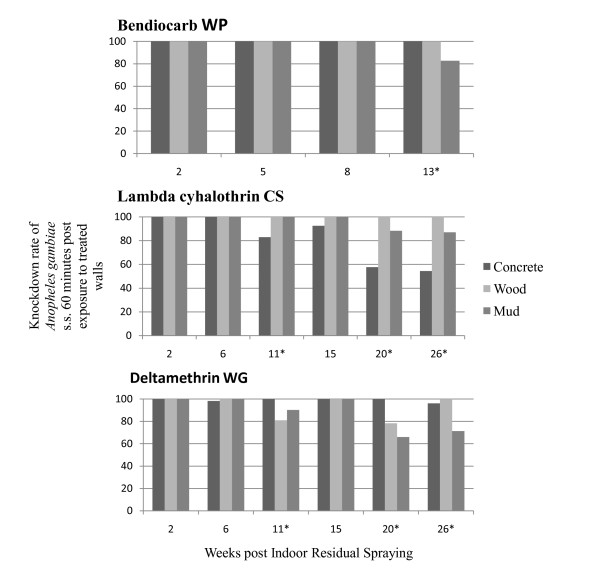
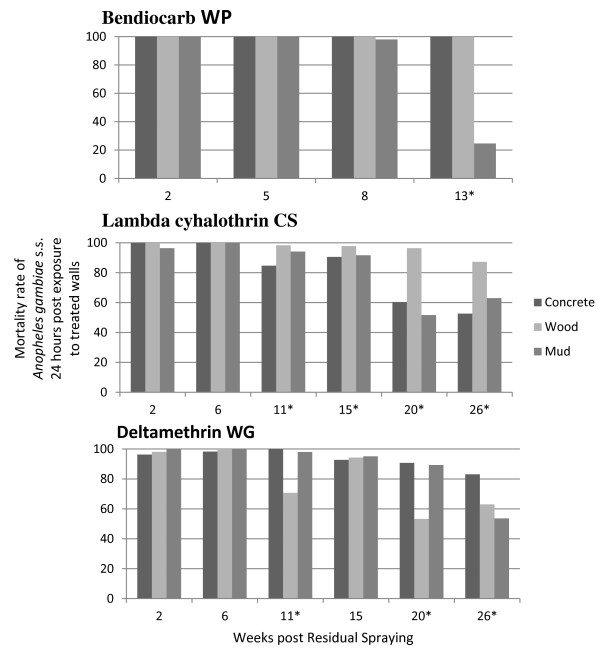
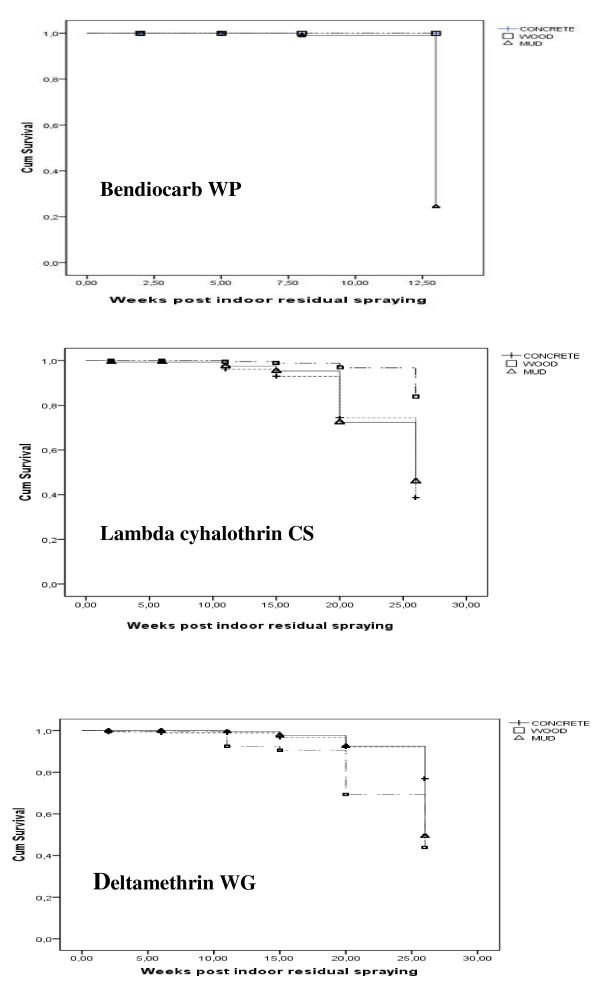
BACKGROUND: Determination of residual activity of insecticides is essential information for the selection of appropriate indoor spraying operation. The present study was undertaken to evaluate the residual effect of three candidate insecticide formulations on different indoor surfaces in order to guide future interventions, in the context of Cameroon and other African countries. METHODS: The study was conducted in the Ntougou neighbourhood in Yaoundé (capital city of Cameroon). Bendiocarb WP, lambda-cyhalothrin CS and deltamethrin WG were sprayed on the indoor wall surfaces of local cement, wood and mud houses. Their effects on the knockdown and mortality of the Kisumu susceptible strain of Anopheles gambiae s.s were assessed each month from March to September 2009, using the WHO plastic cones test. Knockdown and mortality rates were compared between different surfaces using Chi-square test. A Kaplan-Meir model was used to estimate the time of treatment failure. RESULTS: With bendiocarb WP, the knockdown rates were frequently above 98% during 13 weeks after spraying, except on mud walls where it significantly decreased at the 13th week (P < 0.05). With lambda cyhalothrin CS, the knockdown rates remained 100% on wood surfaces during the 26 weeks trial. However, it significantly decreased on concrete and mud surfaces from the 11th (83%) and the 20th (88%) weeks respectively (P < 0.05). With deltamethrin WG, it remained high on concrete surfaces during 26 weeks (> 98%); while it varied between 60 and 100% on wood or mud surfaces. The survival estimates of bendiocarb WP treatments remaining effective in killing An. gambiae s.s. (mortality rate ≥ 80%) was > 13 weeks on cement and wood surfaces and 13 weeks on mud surfaces. Those of lambda-cyhalothrin CS were > 26 weeks on wood surfaces, and 20 weeks on concrete and mud surfaces. By contrast, those of deltamethrin WG were 26 weeks on concrete, 20 weeks on mud surfaces and 15 weeks on wood surfaces. CONCLUSION: Current data suggest variable durations of spray cycles for each product, according to the type of wall surfaces, highlighting the importance of testing candidate products in local context before using them in large scale.
Overview
The claims and statistics of this paper haven’t been checked yet.
Free: it reads the open-access text and checks the first 5 claims that cite a source we can check. Create a free account to check every claim.
Integrity signals
Registry
Cites
Statistics
Figures
Verification
Claims the paper makes
The claims and statistics of this paper haven’t been checked yet.
Free: it reads the open-access text and checks the first 5 claims that cite a source we can check. Create a free account to check every claim.
Self-check
Percentages, sums and reported differences re-computed from the paper’s own numbers.
The self-check needs the paper’s full text.
Citations
Cites
Weltgesundheitsorganisation (2005) · Cited by 3,799
Some Lessons for the Future from the Global Malaria Eradication Programme (1955–1969)
Nájera, J. A., González-Silva, M., & Alonso, P. L. (2011) · PLoS Medicine · doi:10.1371/journal.pmed.1000412 · Cited by 406
Modifications of pyrethroid effects associated with kdr mutation in Anopheles gambiae
Chandre, F., Darriet, F., Duchon, S., Finot, L., Manguin, S., Carnevale, P., & Guillet, P. (2000) · Medical and Veterinary Entomology · doi:10.1046/j.1365-2915.2000.00212.x · Cited by 209 · cited 1×
“Extrinsic factors which include physical and biological factors mostly affect the development and survival of the mosquito (behavior, resistance to insecticides, temperature, humidity, etc) [6,7], while human activities, behavior and living conditions (acceptability, accessibility, rate of coverage) may provide an add…”
BackgroundCurtis, C. F., Maxwell, C. A., Maxwell, C. A., Finch, R. J., Finch, R. J., & Njunwa, K. J. (1998) · Tropical Medicine & International Health · doi:10.1046/j.1365-3156.1998.00281.x · Cited by 141
Etang, J., Manga, L., Chandre, F., Guillet, P., Fondjo, E., Mimpfoundi, R., Toto, J.-C., & Fontenille, D. (2003) · Journal of Medical Entomology · doi:10.1603/0022-2585-40.4.491 · Cited by 122 · cited 1×
“has developed resistance to pyrethroids [10,11].”
Self-citationBifenthrin: A Useful Pyrethroid Insecticide for Treatment of Mosquito Nets
Hougard, J.-M., Duchon, S., Zaim, M., & Guillet, P. (2002) · Journal of Medical Entomology · doi:10.1603/0022-2585-39.3.526 · Cited by 92 · cited 2×
“As for vector control insecticide-based interventions, intrinsic factors include insecticide formulation, mode of action, dosage, properties (including knockdown, killing, exito-repellent effects) and type of treatment (IRS, LLINs, Sheets) [4,5].”
Akogbéto, M. C., Padonou, G. G., Gbénou, D., Irish, S., & Yadouleton, A. (2010) · Malaria Journal · doi:10.1186/1475-2875-9-204 · Cited by 86 · cited 1×
“After four months experiment of indoor residual spraying treatments in experimental huts in Benin, bendiocarb was shown to be effective in controlling pyrethroid-resistant Anopheles, as well as fenitrothion and chlorpyriphosdeltamethrin mixture [22].”
MethodEtang, J., Chandre, F., Guillet, P., & Manga, L. (2004) · Malaria Journal · doi:10.1186/1475-2875-3-46 · Cited by 65
Self-citationde Árias, A. R., Lehane, M., Schofield, C. J., & Fournet, A. (2003) · Memórias do Instituto Oswaldo Cruz · doi:10.1590/s0074-02762003000700020 · Cited by 56 · cited 1×
“Variation in the residual efficacy of insecticide treated surfaces against Triatoma infestans was also noticed by other authors [18,19].”
Yates, A., N'Guessan, R., Kaur, H., Akogbéto, M., & Rowland, M. (2005) · Malaria Journal · doi:10.1186/1475-2875-4-52 · Cited by 55
Research works printed but not linked: 4
- World Health Organization Tests procedures for insecticide resistance monitoring in malaria vectors, bio-efficacy and persistence of insecticides on treated surfaces Report of the WHO Informal Consultation, Geneva, Switzerland 1998 43
- Cavalié P Mouchet J Les campagnes expérimentales d'e radication du paludisme dans le Nord de la république du Cameroun Med Trop 1961 21 847 870
- Carnevale P Mouchet J La lutte antivectorielle au Cameroun. Passé-présent-avenir. Réflexions Bull Soc Pathol Exot 2001 94 202 209 16579079
- Santos RLC Fayal AS Aguiar AEF Vieira DBR Povoa MM Evaluation of the residual effect of pyrethroids on Anopheles in Brazilian Amazon Rev Saude Publica 2007 41 1 7 17384805
Cited by
Nwane, P., Etang, J., Chouaїbou, M., Toto, J. C., Koffi, A., Mimpfoundi, R., & Simard, F. (2013) · Parasites & Vectors · doi:10.1186/1756-3305-6-41 · Cited by 124
“In Cameroon, apart from a few laboratory and field trials carried out in certain locations [10], IRS is not implemented as a large scale malaria vector control measure.”
BackgroundSelf-citationAntonio-Nkondjio, C., Sonhafouo-Chiana, N., Ngadjeu, C. S., Doumbe-Belisse, P., Talipouo, A., Djamouko-Djonkam, L., Kopya, E., Bamou, R., Awono-Ambene, P., & Wondji, C. S. (2017) · Parasites & Vectors · doi:10.1186/s13071-017-2417-9 · Cited by 124
Self-citationAndriessen, R., Snetselaar, J., Suer, R. A., Osinga, A. J., Deschietere, J., Lyimo, I. N., Mnyone, L. L., Brooke, B. D., Ranson, H., Knols, B. G. J., et al. (2015) · Proceedings of the National Academy of Sciences · doi:10.1073/pnas.1510801112 · Cited by 86
“Studies show that insecticide absorption in porous mud walls significantly decreases the long-lasting efficacy of IRS applications (22).”
BackgroundDengela, D., Seyoum, A., Lucas, B., Johns, B., George, K., Belemvire, A., Caranci, A., Norris, L. C., & Fornadel, C. M. (2018) · Parasites & Vectors · doi:10.1186/s13071-017-2608-4 · Cited by 80
Glunt, K. D., Paaijmans, K. P., Read, A. F., & Thomas, M. B. (2014) · Malaria Journal · doi:10.1186/1475-2875-13-350 · Cited by 80
“temperature, mosquitoes exposed to permethrin were moved to 26°C for 1 to decaying spray residues (or possibly very transient contact), as must happen in the field [23,24].”
BackgroundNgufor, C., Fongnikin, A., Rowland, M., & N’Guessan, R. (2017) · PLoS ONE · doi:10.1371/journal.pone.0189575 · Cited by 78
Pollutants and Insecticides Drive Local Adaptation in African Malaria Mosquitoes
Kamdem, C., Fouet, C., Gamez, S., & White, B. J. (2017) · Molecular Biology and Evolution · doi:10.1093/molbev/msx087 · Cited by 80
“tested in a few pilot locations, but this measure is not yet applied on a large scale (Etang et al. 2011; Bowen 2013).”
BackgroundRek, J. C., Alegana, V., Arinaitwe, E., Cameron, E., Kamya, M. R., Katureebe, A., Lindsay, S. W., Kilama, M., Staedke, S. G., Todd, J., et al. (2018) · The Lancet Planetary Health · doi:10.1016/s2542-5196(18)30010-x · Cited by 70
Bamou, R., Mbakop, L. R., Kopya, E., Ndo, C., Awono-Ambene, P., Tchuinkam, T., Rono, M. K., Mwangangi, J., & Antonio-Nkondjio, C. (2018) · Parasites & Vectors · doi:10.1186/s13071-018-3049-4 · Cited by 65
Self-citationOkumu, F. O., Chipwaza, B., Madumla, E. P., Mbeyela, E., Lingamba, G., Moore, J., Ntamatungro, A. J., Kavishe, D. R., & Moore, S. (2012) · Malaria Journal · doi:10.1186/1475-2875-11-378 · Cited by 68
“That is to say, efficacy of active ingredients on mosquitoes is modulated by type of substrate onto which the compound is applied [36].”
BackgroundResultInfluentialParedes‐Esquivel, C., Lenhart, A. E., del Río, R., Leza, M., Estrugo, M., Chalco, E., Casanova, W., & Chueca, M. Á. M. (2015) · Acta Tropica · doi:10.1016/j.actatropica.2015.10.020 · Cited by 57
Nardini, L., Hunt, R. H., Dahan-Moss, Y., Christie, N., Christian, R. N., Coetzee, M., & Koekemoer, L. L. (2017) · Malaria Journal · doi:10.1186/s12936-017-2099-y · Cited by 57
Glunt, K. D., Blanford, J. I., & Paaijmans, K. P. (2013) · PLoS Pathogens · doi:10.1371/journal.ppat.1003602 · Cited by 58
“The activity of IRS compounds can decline significantly within the first few months after spraying due to, for example, variation in building materials [22,23] or in the spraying technique of individual applicators [24].”
BackgroundNgwej, L. M., Hattingh, I., Mlambo, G., Mashat, E. M., Kashala, J.-C. K., Malonga, F. K., & Bangs, M. J. (2019) · Malaria Journal · doi:10.1186/s12936-019-2710-5 · Cited by 39
Agossa, F. R., Aïkpon, R. Y., Azondékon, R., Govoétchan, R., Padonou, G. G., Oussou, O., Oké-Agbo, F., & Akogbeto, M. C. (2014) · Transactions of the Royal Society of Tropical Medicine and Hygiene · doi:10.1093/trstmh/trt117 · Cited by 38
Corrêa, A. P. S. D. A., Galardo, A. K. R., Lima, L. A., Câmara, D. C. P., Müller, J. N., Barroso, J. F. D. S., Lapouble, O. M., Rodovalho, C. D. M., Ribeiro, K. A. N., & Lima, J. B. P. (2019) · Malaria Journal · doi:10.1186/s12936-019-2969-6 · Cited by 40
Lees, R. S., Ambrose, P., Williams, J., Morgan, J. C., Praulins, G., Ingham, V. A., Williams, C. T., Logan, R. A. E., Ismail, H. M., & Malone, D. J. (2020) · Malaria Journal · doi:10.1186/s12936-020-03466-4 · Cited by 37
Rumbos, C. I., Dutton, A. C., & Athanassiou, C. G. (2014) · Journal of Pest Science · doi:10.1007/s10340-014-0599-x · Cited by 36
“However, very few data are available on the efficacy of encapsulated formulations, despite the fact that CS formulations differ substantially in their efficacy in comparison with older (e.g., EC) formulations (Arthur 1999; Strong et al. 2000; Stejskal et al. 2007; Etang et al. 2011).”
BackgroundSalako, A. S., Dagnon, F., Sovi, A., Padonou, G. G., Aïkpon, R., Ahogni, I., Syme, T., Govoétchan, R., Sagbohan, H., Sominahouin, A. A., et al. (2019) · Parasites & Vectors · doi:10.1186/s13071-019-3865-1 · Cited by 32
Djènontin, A., Aïmihouè, O., Sèzonlin, M., Damien, G. B., Osse, R. A., Soukou, B. K., Padonou, G. G., Chandre, F., & Akogbeto, M. C. (2013) · BMC Research Notes · doi:10.1186/1756-0500-6-458 · Cited by 29
“The variation of the residual life of the bendiocarb according to the surfaces treated observed in the present study confirms previous observations [14,15].”
BackgroundResultDesalegn, Z., Wegayehu, T., & Massebo, F. (2018) · Malaria Journal · doi:10.1186/s12936-018-2458-3 · Cited by 27
Suman, D. S., Wang, Y., Dong, L., & Gaugler, R. R. (2013) · Journal of Medical Entomology · doi:10.1603/me13068 · Cited by 27
“Different substrates of adult mosquito resting habitats reduced residual efÞcacy of various adulticides variably, including organophosphates and synthetic pyrethroids, against different Anopheles, Culex, and Aedes species (Dorta et al. 1993, Etang et al. 2011).”
BackgroundYe-Ebiyo, Y., Dengela, D., Tesfaye, A. G., Anshebo, G. Y., Kolyada, L., Wirtz, R. A., Chibsa, S., Fornadel, C. M., George, K., Belemvire, A., et al. (2016) · Parasites & Vectors · doi:10.1186/s13071-016-1549-7 · Cited by 28
“Similarly, in trials in Cameroon, bendiocarb had a knock-down effect for longer periods on wood and cement surfaces than on mud walls [19].”
ResultYewhalaw, D., Balkew, M., SHILILU, J. I., Suleman, S., Tesfaye, A. G., Ashenbo, G., Chibsa, S., Dissanayake, G., George, K., Dengela, D. O., et al. (2017) · Malaria Journal · doi:10.1186/s12936-017-2122-3 · Cited by 22
“[9] found nearly 100% mortality for 13 weeks when bendiocarb WP (target dose 400 mg/m2) was applied to concrete and wood, but mortality was only 20% after 13 weeks on mud.”
MethodMoyou‐Somo, R., Essomba, P., Songue, E., Tchoubou, N. N., Ntambo, A., Hiol, H. N., Kemajou, J. P., Essi, M.-J., & Millet, P. G. (2013) · BMC Public Health · doi:10.1186/1471-2458-13-1023 · Cited by 19
“The majority of walls were of earth blocks which do not permit the retention of insecticides usually used [15,16].”
BackgroundThawer, N. G., Ngondi, J., Mugalura, F. E., Emmanuel, I., Mwalimu, C. D., Morou, E., VONTAS, J. G., Protopopoff, N., Rowland, M., Mutagahywa, J., et al. (2015) · Parasites & Vectors · doi:10.1186/s13071-015-0859-5 · Cited by 18
“Etang J, Nwane P, Mbida J, Piameu M, Manga B, Souop D, et al. Variations of insecticide residual bio-efficacy on different types of walls: results from a community-based trial in south Cameroon.”
ResultMoiroux, N., Djènontin, A., Zogo, B., Bouraïma, A., Sidick, I., Pigeon, O., & Pennetier, C. (2018) · Parasites & Vectors · doi:10.1186/s13071-018-3071-6 · Cited by 20
Saran, R. K., Hoppé, M., Mayor, S., Long, C., Blakely, B. N., Eppler, L., Cartwright, B., & Scherer, C. W. (2024) · Pest Management Science · doi:10.1002/ps.8497 · Cited by 13
Lees, R. S., Praulins, G., Lissenden, N., South, A., Carson, J., Brown, F., Lucas, J., & Malone, D. J. (2022) · Insects · doi:10.3390/insects13020112 · Cited by 13
Yalwala, S., Kollars, J. W., Kasembeli, G., Barasa, C., Senessie, C., Kollars, P. G., & Kollars, T. M. (2016) · Journal of Medical Entomology · doi:10.1093/jme/tjw075 · Cited by 13
Mandal, R., Kumar, V., Kesari, S., & Das, P. K. (2019) · Parasites & Vectors · doi:10.1186/s13071-019-3670-x · Cited by 18
“Our findings support the results of several other studies which dealt with the residual efficacy of insecticide-treated surfaces against the vectors of different diseases [45, 46, 50, 51].”
ResultGueye, M., Dia, I., Diédhiou, S. M., Samb, B., Dia, A. K., Diagne, M. M., Faye, O., & Konaté, L. (2022) · Tropical Medicine and Infectious Disease · doi:10.3390/tropicalmed7100316 · Cited by 14
Etang, J., Nwane, P. B., Piameu, M., Manga, B., Souop, D., & Awono‐Ambene, P. (2013) · PLoS ONE · doi:10.1371/journal.pone.0074929 · Cited by 13
“For IRS products, data on residual activity of 3/7 tested formulations were already published [11].”
BackgroundMethodInfluentialSelf-citationShikano, I., Bellicanta, G. S., Principato, S., & Jenkins, N. E. (2021) · Insects · doi:10.3390/insects12030214 · Cited by 12
Dunford, J. C., Estep, A. S., Waits, C. M., Richardson, A. G., Hoel, D. F., Horn, K., Walker, T. W., Blersch, J. S., Kerce, J. D., & Wirtz, R. A. (2018) · Malaria Journal · doi:10.1186/s12936-018-2239-z · Cited by 13
“Aïkpon R, Agossa F, Ossè R, Oussou O, Aïzoun N, Oké-Agbo F, et al. Bendiocarb resistance in Anopheles gambiae s.l. populations from Atacora department in Benin, West Africa: a threat for malaria vector control.”
InfluentialResidual efficacy of Fludora Fusion against Anopheles arabiensis in simple huts in Ethiopia
Animut, A., & Horstmann, S. (2022) · PLoS ONE · doi:10.1371/journal.pone.0263840 · Cited by 10
“s exposed to FICAM treated mud surfaces was observed to be over 80% on mud surfaces for three months [22].”
Residual efficacy of SumiShield™ 50WG for indoor residual spraying in Ethiopia
Yewhalaw, D., Simma, E. A., Zemene, E., Kassahun, Z., & Degefa, T. (2022) · Malaria Journal · doi:10.1186/s12936-022-04395-0 · Cited by 10
“found nearly 100% mortality for 13 weeks when Ficam WP (target dose 400 mg ai/m2) was applied to concrete and wood, but mortality was only 20% after 13 weeks on mud surfaces [29].”
MethodIbrahim, K. T., Popoola, K. O. K., & Akure, K. O. (2017) · International Journal of Insect Science · doi:10.1177/1179543317732989 · Cited by 13
Baseline susceptibility of Anopheles gambiae to clothianidin in northern Ghana
Pambit Zong, C. M., Coleman, S., Mohammed, A. R., Owusu-Asenso, C. M., Akuamoah-Boateng, Y., Sraku, I. K., Attah, S. K., Cui, L., & Afrane, Y. A. (2024) · Malaria Journal · doi:10.1186/s12936-023-04769-y · Cited by 9
“Previous studies [23, 30, 31] in determining factors that affect residual efficacy of insecticides revealed that, insecticides sprayed on cement wall surfaces have a high residual activity, but a short residual life as compared to mud wall surfaces, which also gives a relatively low residual…”
BackgroundMaharaj, R., Seocharan, I., Lakan, V., Nyawo, Z., Mkhabela, M., & Balakrishna, Y. (2024) · Malaria Journal · doi:10.1186/s12936-024-04963-6 · Cited by 9
“A study in South Cameroon found that bendiocarb is very effective on cement and wood whilst lambda-cyhalothrin was effective on wood [24].”
BackgroundKavallieratos, N. G., Nika, E. P., Skourti, A., & Virvidaki, A. J. V. (2022) · Journal of Stored Products Research · doi:10.1016/j.jspr.2022.102036 · Cited by 8
Hien, A. S., Soma, D. D., Somé, F. A., Namountougou, M., Poda, S. B., Ouédraogo, G. A., Diabaté, A., & Dabiré, R. K. (2021) · Journal of Medical Entomology · doi:10.1093/jme/tjaa240 · Cited by 7
Randriamaherijaona, S., Velonirina, H. J., & Boyer, S. (2016) · Malaria Journal · doi:10.1186/s12936-016-1406-3 · Cited by 9
“Previous studies have reported that insecticide residual life depends on the substrate to which it is applied [20, 21].”
BackgroundSnetselaar, J., Rowland, M., Azizi, S., Mawa, B., Malone, D. J., & Kirby, M. J. (2023) · Frontiers in Tropical Diseases · doi:10.3389/fitd.2023.1097189 · Cited by 5
Journal of Health & Medical Informatics
(2019) · Journal of Health & Medical Informatics · doi:10.4172/2157-7420 · Cited by 5
Kassem, H. A., Zayed, A. B., Watany, N., Fawaz, E. Y., Hoel, D. F., & Zollner, G. E. (2019) · Journal of Medical Entomology · doi:10.1093/jme/tjy243 · Cited by 5
Tientche, B., Fru-Cho, J., Anong, D. N., Ngouakam, H., & Nkuo-Akenji, T. K. (2020) · doi:10.37421/jhmi.2020.11.344 · Cited by 4
“The indoor residual spraying (IRS) is not implemented because of high transaction costs and lack of data for proper planning and decision, except few pilot operation [10,11].”
BackgroundAbai, M. R., Vatandoost, H., Dorzadeh, H., Shayeghi, M., Hanafi‐Bojd, A. A., & Raeisi, A. (2021) · Toxicology Research · doi:10.1093/toxres/tfab070 · Cited by 3
Knockdown effect of crude ethanol extracts of Phytolacca dodecandra on Anopheles gambiae adults
Yugi, J. O., Okeyo-Owour, J. B., Atieli, F., Amito, R. O., & VULULE, J. M. (2014) · Journal of Mosquito Research · doi:10.5376/jmr.2014.04.0018 · Cited by 3
Dhiman, S., Yadav, K., Acharya, B. N., Ahirwar, R., Ghorpade, R., & Tikar, S. N. (2024) · Scientific Reports · doi:10.1038/s41598-024-80554-4 · Cited by 5
First evaluation of bendiocarb in experimental huts using different substrates in Madagascar
Randriamaherijaona, S., Nepomichene, T., Assoukpa, J., Madec, Y., & Boyer, S. (2016) · Malaria Journal · doi:10.1186/s12936-016-1345-z · Cited by 2
“For instance, mud surfaces can be highly porous and adsorptive to insecticides, and substrates containing alkaline substances may degrade the candidate insecticide faster than substrates without alkaline contents [12].”
BackgroundResultInfluentialBecker, N., Petrić, D. V., Zgomba, M., Boase, C., Madon, M. B., Dahl, C., & Kaiser, A. (2020) · Fascinating life sciences · doi:10.1007/978-3-030-11623-1_18 · Cited by 2
Climate change and malaria: an old enemy of Africa is back
Filho, W. L., Gbaguidi, G. J., Zúñiga, R. A. A., & Ibrahim, U. (2025) · BMC Public Health · doi:10.1186/s12889-025-24555-6 · Cited by 2
“Cameroon and Benin targeted indoor residual sprays campaigns [10, 23].”
Genetic components of insecticide resistance in Anopheles arabiensis
Howell, P. I. (2018) · University of Liverpool · doi:10.17638/03027687 · Cited by 2
Mushtaq, S., Mukhtar, M. U., Arslan, A., Zaki, A. B., Hammad, M. Y., & Bhatti, A. (2015) · Journal of Entomology and Zoology Studies · Cited by 1
Adulticidal Effect of Crude Ethanol Extract of Phytolacca dodecandra on Anopheles gambiae
Yugi, J. O., Okeyo-Owour, J. B., & Omondi, D. (2016) · Journal of Mosquito Research · doi:10.5376/jmr.2016.06.0001
“This finding was contrary to an earlier finding that found plain wooden surfaces to absorb more toxic components of bendiocarb WP, than either mud smeared or cement modeled surfaces but similar in the order of activity when deltamethrin WG was used (Etang et al., 2011).”
ResultThawer, G., Ngondi, J., Mugalura, F. E., Emmanuel, I., Mwalimu, C. D., Morou, E., VONTAS, J. G., Protopopoff, N., Rowland, M., Mutagahywa, J., et al. (2015)
Mohammad, R. A., Hassan, V., Dorzadeh, H., Shayeghi, M., Ahmad, A. H.-B., & Ahmad, R. (2019) · Journal of Entomology and Nematology · doi:10.5897/jen2018.0205 · Cited by 1
Cáceres, L., Ramirez, J. L., & Torres-Cosme, R. (2020) · doi:10.21203/rs.3.rs-70802/v1
Effective residual life of bendiocarb insecticide on sprayed surfaces
Abate, A., Getu, E., Wale, M., Hadis, M., & Mekonen, W. (2022) · Ethiopian Journal of Science and Technology · doi:10.4314/ejst.v15i1.1
“This is in line with the results of other studies reported from different countries including Ethiopia (Etang et al., 2011; Sibanda et al., 2011; Djènontin et al., 2013; Tangena et al, 2013; Yemane Yeebiyo et al., 2016).”
ResultDhiman, S. K., Yadav, K., Acharya, B. N., Ahirwar, R., Ghorpade, R., & Tikar, S. N. (2024) · SSRN Electronic Journal · doi:10.2139/ssrn.4812494
Lees, R. S., Ambrose, P., Williams, J., Morgan, J. C., Praulins, G., Ingham, V. A., Williams, C. T., Logan, R. A. E., Ismail, H. M., & Malone, D. J. (2020) · Figshare · doi:10.6084/m9.figshare.13212284
Résistances aux insecticides chez les Culicidae vecteurs en territoires insulaires
Pocquet, N. (2014) · theses.fr (ABES) · doi:10.70675/e6ba6a1ez65d1z4682z8e10z76702b3315ce
Eukubay, A., Kinde, S., Tarekegn, M., Lelisa, K., Gemechu, F., Wuletaw, Y., Assefa, G., Kebede, T., Mekuriaw, W., Abdulatif, B., et al. (2026) · Research Square · doi:10.21203/rs.3.rs-9176872/v1
Metadata
- Authors
- Etang, J., Nwane, P., Mbida, J. A., Piameu, M., Manga, B., Souop, D., & Awono-Ambene, P.
- Affiliations
- Organisation de Coordination pour la lutte contre les Endémies en Afrique Centrale (CM)
- Université de Yaoundé I (CM)
- University of Douala (CM)
- Ministry of Public Health (CM)
- Corresponding author
- Etang, Josiane
- Venue
- Malaria Journal
- Published
- 2011-11-02
- Volume
- 10
- Issue
- 1
- Pages
- 333-333
- ISSN
- 1475-2875 (ISSN-L)
- PMC
- PMC3233609
- OpenAlex
- W2128860203
- Cited by
- 65
- References
- 31
- Citations by year
- 2026: 1 · 2025: 1 · 2024: 5 · 2023: 1 · 2022: 6 · 2021: 2 · 2020: 7 · 2019: 7 · 2018: 7 · 2017: 6 · 2016: 5 · 2015: 5 · 2014: 5 · 2013: 6 · 2012: 1
- FWCI
- 3.77
- Type
- journal article
- Language
- en
- Open access
- gold
- doi.org
- Licence
- cc-by
- creativecommons.org/licenses/by/2.0 (tdm)
- Locations
- Malaria Journal (publishedVersion, cc-by)
- Europe PMC (PubMed Central) (publishedVersion, cc-by)
- PubMed Central (publishedVersion, cc-by)
- PubMed (publishedVersion)
- DOAJ (DOAJ: Directory of Open Access Journals) (submittedVersion)
- Topics
- Health Sciences › Medicine › Public Health, Environmental and Occupational Health › Malaria Research and Control
- Life Sciences › Agricultural and Biological Sciences › Plant Science › Insect Pest Control Strategies
- Health Sciences › Medicine › Public Health, Environmental and Occupational Health › Dengue and Mosquito Control Research
- Keywords
- indoor residual spraying, Anopheles gambiae s.s., bendiocarb, lambda-cyhalothrin, deltamethrin, mud walls, wood walls, knockdown, insecticide mortality, malaria vector control, community-based trial
- MeSH terms
- Animals, Anopheles, Cameroon, Construction Materials, Female, Insect Vectors, Insecticides, Longitudinal Studies, Mosquito Control, Nitriles, Pyrethrins, Time Factors, Survival Analysis, Phenylcarbamates
About these checks
Registry, retraction, Cites and statistics results are computed, not judged, with one exception: a printed reference that no index lists is read once by a model before it counts as a citation error. Claims are extracted by a model and kept only when their quote appears verbatim in the text; each cited source is then checked, with a model’s help, for whether it says what the claim relies on. Those verdicts can be wrong — read the claim’s quote and the cited source before relying on one.
Statistics and arithmetic are recomputed, not judged.
Confidence bands are shown only for fields calibrated on our annotated test set. None is calibrated yet, so no band is shown.
What counts as a claim ›How we measure confidence ›How we check this ›
Are you an author, or do you see a problem with this page? Request a review
Data sources
Bibliographic data: Semantic Scholar, OpenAlex, Crossref.
Contains information from the Semantic Scholar Academic Graph Datasets, made available under the ODC Attribution License (ODC-BY 1.0).
Semantic Scholar’s data is described in: Kinney, R., et al. (2023). The Semantic Scholar Open Data Platform. arXiv:2301.10140.
