

The DOI matches its Crossref record; 40 of the 40 references it cites were found in a registry or an index.
Epidemiology of subpatent Plasmodium falciparum infection: implications for detection of hotspots with imperfect diagnostics
Open accessAbstract
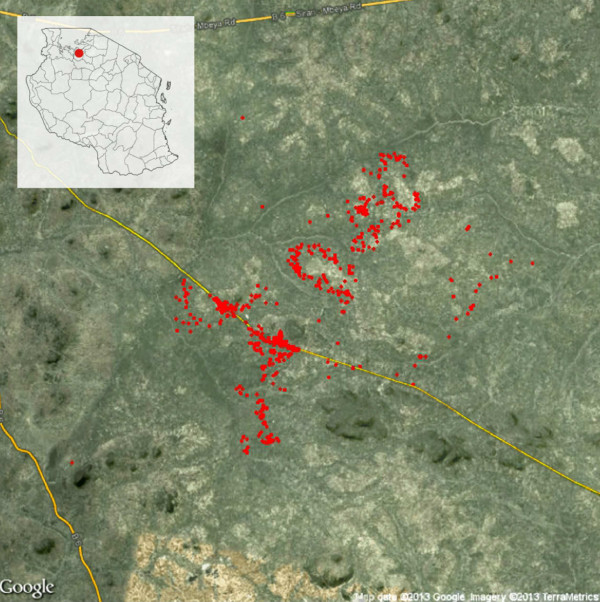
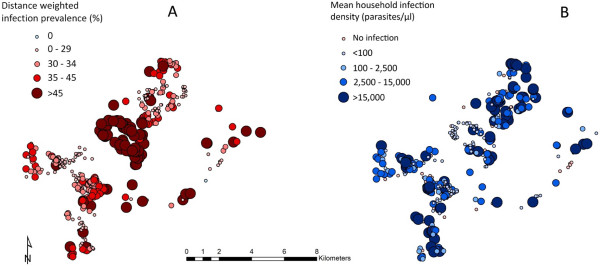
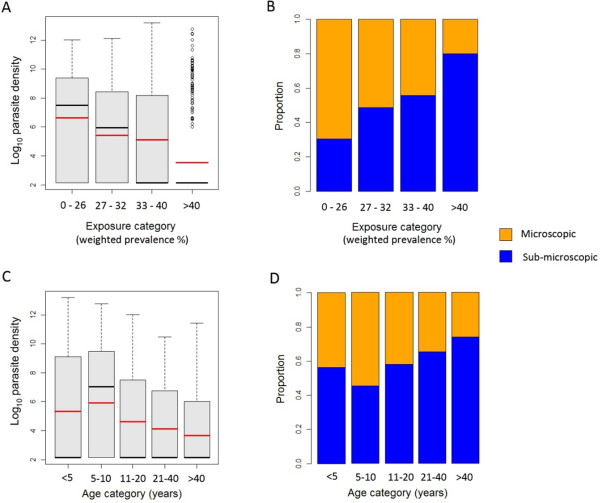
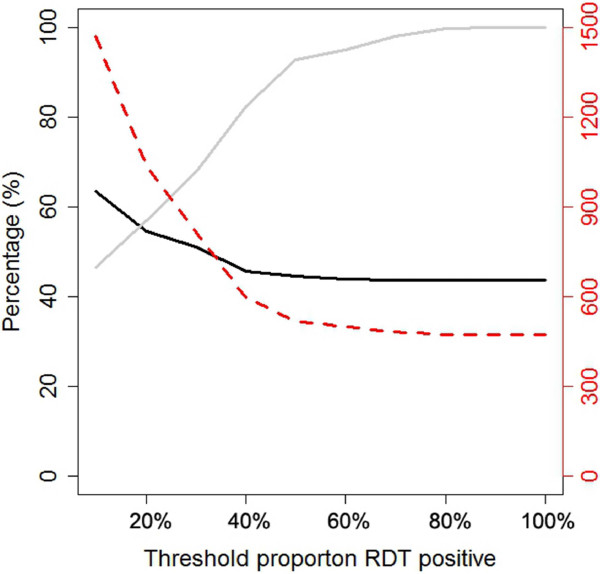
BACKGROUND: At the local level, malaria transmission clusters in hotspots, which may be a group of households that experience higher than average exposure to infectious mosquitoes. Active case detection often relying on rapid diagnostic tests for mass screen and treat campaigns has been proposed as a method to detect and treat individuals in hotspots. Data from a cross-sectional survey conducted in north-western Tanzania were used to examine the spatial distribution of Plasmodium falciparum and the relationship between household exposure and parasite density. METHODS: Dried blood spots were collected from consenting individuals from four villages during a survey conducted in 2010. These were analysed by PCR for the presence of P. falciparum, with the parasite density of positive samples being estimated by quantitative PCR. Household exposure was estimated using the distance-weighted PCR prevalence of infection. Parasite density simulations were used to estimate the proportion of infections that would be treated using a screen and treat approach with rapid diagnostic tests (RDT) compared to targeted mass drug administration (tMDA) and Mass Drug Administration (MDA). RESULTS: Polymerase chain reaction PCR analysis revealed that of the 3,057 blood samples analysed, 1,078 were positive. Mean distance-weighted PCR prevalence per household was 34.5%. Parasite density was negatively associated with transmission intensity with the odds of an infection being subpatent increasing with household exposure (OR 1.09 per 1% increase in exposure). Parasite density was also related to age, being highest in children five to ten years old and lowest in those > 40 years. Simulations of different tMDA strategies showed that treating all individuals in households where RDT prevalence was above 20% increased the number of infections that would have been treated from 43 to 55%. However, even with this strategy, 45% of infections remained untreated. CONCLUSION: The negative relationship between household exposure and parasite density suggests that DNA-based detection of parasites is needed to provide adequate sensitivity in hotspots. Targeting MDA only to households with RDT-positive individuals may allow a larger fraction of infections to be treated. These results suggest that community-wide MDA, instead of screen and treat strategies, may be needed to successfully treat the asymptomatic, subpatent parasite reservoir and reduce transmission in similar settings.
Overview
The claims and statistics of this paper haven’t been checked yet.
Run the check — free, no account needed. It reads the open-access text and checks the sources it cites.
Integrity signals
Registry
Cites
Statistics
Figures
Verification
Claims the paper makes
The claims and statistics of this paper haven’t been checked yet.
Run the check — free, no account needed. It reads the open-access text and checks the sources it cites.
Claims other papers make about this one
Each is checked against this paper’s own text: does it say what the citing paper says it does?
In the citing paper
“Pregnancy poses a unique challenge for falciparum malaria diagnosis, as parasites sequester in the placenta and the circulating parasitaemia is very low and therefore undetectable by peripheral blood smear microscopy or rapid diagnostic test [7–10].”
From Intermittent preventive treatment with Sulphadoxine-Pyrimethamine (IPTp-SP) is associated with protection against sub-microscopic P. falciparum infection in pregnant women during the low transmission dry season in southwestern Cameroon: A Semi - longitudinal study (2022) · cites this paper as [10]
In the citing paper
“Such submicroscopic infections may negatively affect health and constitute reservoirs for continued disease transmission [10] since they are usually asymptomatic and therefore remain untreated during pregnancy.”
From Intermittent preventive treatment with Sulphadoxine-Pyrimethamine (IPTp-SP) is associated with protection against sub-microscopic P. falciparum infection in pregnant women during the low transmission dry season in southwestern Cameroon: A Semi - longitudinal study (2022) · cites this paper as [10]
In the citing paper
“The possibility of overestimating ITNs use due to self-reporting cannot be excluded as the participant may try to please the interviewer [10].”
From Intermittent preventive treatment with Sulphadoxine-Pyrimethamine (IPTp-SP) is associated with protection against sub-microscopic P. falciparum infection in pregnant women during the low transmission dry season in southwestern Cameroon: A Semi - longitudinal study (2022) · cites this paper as [10]
In the citing paper
“and could, therefore, become an emergency [10] or evolve to severe disease if undetected or diagnosis was delayed.”
From Intermittent preventive treatment with Sulphadoxine-Pyrimethamine (IPTp-SP) is associated with protection against sub-microscopic P. falciparum infection in pregnant women during the low transmission dry season in southwestern Cameroon: A Semi - longitudinal study (2022) · cites this paper as [10]
In the citing paper
“These low-density parasitemias serve as a reservoir for continued transmission of the disease and may contribute to negative health. 9-11”
From What is the burden of submicroscopic malaria in pregnancy in central India? (2015) · cites this paper as [10]
Self-check
Percentages, sums and reported differences re-computed from the paper’s own numbers.
The self-check needs the paper’s full text.
Citations
Cites
A new world malaria map: Plasmodium falciparum endemicity in 2010
Gething, P. W., Patil, A. P., Smith, D. L., Guerra, C. A., Elyazar, I., Johnston, G. L., Tatem, A. J., & Hay, S. I. (2011) · Malaria Journal · doi:10.1186/1475-2875-10-378 · Cited by 1,169
Plowe, C. V., DJIMDÉ, A. A., Bouaré, M., Doumbo, O. K., & Wellems, T. E. (1995) · American Journal of Tropical Medicine and Hygiene · doi:10.4269/ajtmh.1995.52.565 · Cited by 675
Okell, L., Bousema, T., Griffin, J. T., Ouédraogo, A. L., Ghani, A. C., & DRAKELEY, C. J. (2012) · Nature Communications · doi:10.1038/ncomms2241 · Cited by 659
Self-citationHitting Hotspots: Spatial Targeting of Malaria for Control and Elimination
Bousema, T., Griffin, J. T., Sauerwein, R. W., Smith, D. L., Churcher, T. S., Takken, W., Ghani, A. C., DRAKELEY, C. J., & Gosling, R. D. (2012) · PLoS Medicine · doi:10.1371/journal.pmed.1001165 · Cited by 566
Self-citationOkell, L. C., Ghani, A. C., Lyons, E., & Drakeley, C. J. (2009) · The Journal of Infectious Diseases · doi:10.1086/644781 · Cited by 532
Self-citationTargeting Asymptomatic Malaria Infections: Active Surveillance in Control and Elimination
Sturrock, H. J. W., Hsiang, M. S., Cohen, J. M., Smith, D. L., Greenhouse, B., Bousema, T., & Gosling, R. D. (2013) · PLoS Medicine · doi:10.1371/journal.pmed.1001467 · Cited by 341
Self-citationHarris, I. E., Sharrock, W. W., Bain, L., Gray, K.-A., Bobogare, A., Boaz, L., Lilley, K., Krause, D., Vallely, A. J., Johnson, M., et al. (2010) · Malaria Journal · doi:10.1186/1475-2875-9-254 · Cited by 288
Nested PCR Analysis of Plasmodium Parasites
Snounou, G., & Singh, B. B. (2003) · Humana Press eBooks · doi:10.1385/1-59259-271-6:189 · Cited by 285
Stable and Unstable Malaria Hotspots in Longitudinal Cohort Studies in Kenya
Bejon, P., Williams, T. N., Liljander, A., Noor, A. M., Wambua, J., Ogada, E. A., Olotu, A., Osier, F. H. A., Hay, S. I., Färnert, A., et al. (2010) · PLoS Medicine · doi:10.1371/journal.pmed.1000304 · Cited by 269
Alonso, P. L., Lindsay, S. W., Schellenberg, J., Gomez, P., Hill, A. G., David, P. H., Fegan, G., Cham, K., & Greenwood, B. M. (1993) · Transactions of the Royal Society of Tropical Medicine and Hygiene · doi:10.1016/0035-9203(93)90170-u · Cited by 253
Self-citationBrooker, S., Clarke, S., Njagi, J. K., Polack, S., Mugo, B., Estambale, B., Muchiri, E., Magnussen, P., & Cox, J. (2004) · Tropical Medicine & International Health · doi:10.1111/j.1365-3156.2004.01272.x · Cited by 231
Human red blood cell polymorphisms and malaria
Williams, T. N. (2006) · Current Opinion in Microbiology · doi:10.1016/j.mib.2006.06.009 · Cited by 231
Ochola, L. B., Vounatsou, P., Smith, T. A., Mabaso, M., & Newton, C. (2006) · The Lancet Infectious Diseases · doi:10.1016/s1473-3099(06)70579-5 · Cited by 227
Household risk factors for malaria among children in the Ethiopian highlands
Ghebreyesus, T. A., Haile, M. T., Witten, K. H., Getachew, A., Yohannes, M., Lindsay, S. W., & Byass, P. (2000) · Transactions of the Royal Society of Tropical Medicine and Hygiene · doi:10.1016/s0035-9203(00)90424-3 · Cited by 212
Arnot, D. E. (1998) · Transactions of the Royal Society of Tropical Medicine and Hygiene · doi:10.1016/s0035-9203(98)90773-8 · Cited by 175
Gamage-Mendis, A. C., Carter, R., Mendis, C., Zoysa, A. P. K. D., Herath, P. R. J., & Mendis, K. (1991) · American Journal of Tropical Medicine and Hygiene · doi:10.4269/ajtmh.1991.45.77 · Cited by 172
ter Kuile, F. O., Terlouw, D. J., Phillips‐Howard, P. A., HAWLEY, W. A., Friedman, J. F., KOLCZAK, M. S., Kariuki, S., Shi, Y. P., KWENA, A. M., VULULE, J. M., et al. (2003) · American Journal of Tropical Medicine and Hygiene · doi:10.4269/ajtmh.2003.68.100 · Cited by 166
Spatial and temporal variation in malaria transmission in a low endemicity area in northern Tanzania
Oesterholt, M., Bousema, J., Mwerinde, O., Harris, C., Lushino, P., Masokoto, A., Mwerinde, H., Mosha, F., & Drakeley, C. (2006) · Malaria Journal · doi:10.1186/1475-2875-5-98 · Cited by 163
Self-citationKonaté, L., Zwetyenga, J. S. L. G., Rogier, C., Bischoff, E., Fontenille, D., Tall, A., Spiegel, A., Trape, J., & Mercereau‐Puijalon, O. (1999) · Transactions of the Royal Society of Tropical Medicine and Hygiene · doi:10.1016/s0035-9203(99)90323-1 · Cited by 156
Alonso, P. L., Lindsay, S. W., Schellenberg, J., Keita, K., Gomez, P., Shenton, F. C., Hill, A. G., David, P. H., Fegan, G., Cham, K., et al. (1993) · Transactions of the Royal Society of Tropical Medicine and Hygiene · doi:10.1016/0035-9203(93)90174-o · Cited by 153
Self-citationStresman, G. H., Kamanga, A., Moono, P., Hamapumbu, H., Mharakurwa, S., Kobayashi, T., Moss, W. J., & Shiff, C. (2010) · Malaria Journal · doi:10.1186/1475-2875-9-265 · Cited by 150
Factors Determining the Heterogeneity of Malaria Incidence in Children in Kampala, Uganda
Clark, T. D., Greenhouse, B., Njama‐Meya, D., Nzarubara, B., Maiteki‐Sebuguzi, C., Staedke, S. G., Seto, E., Kamya, M. R., Rosenthal, P. J., & Dorsey, G. (2008) · The Journal of Infectious Diseases · doi:10.1086/589778 · Cited by 139
Self-citationSturrock, H. J. W., Novotny, J., Kunene, S., Dlamini, S. N., Zulu, Z., Cohen, J. M., Hsiang, M. S., Greenhouse, B., & Gosling, R. D. (2013) · PLoS ONE · doi:10.1371/journal.pone.0063830 · Cited by 126
Self-citationTham, J. M., Lee, S. H., Tan, T. M. C., Ting, R. C. Y., & Kara, U. A. K. (1999) · Journal of Clinical Microbiology · doi:10.1128/jcm.37.5.1269-1273.1999 · Cited by 118
Risk of malaria attacks in Gambian children is greater away from malaria vector breeding sites
Clarke, S. E., Bøgh, C., Brown, R. C. D., Walraven, G. E. L., Thomas, C., & Lindsay, S. W. (2002) · Transactions of the Royal Society of Tropical Medicine and Hygiene · doi:10.1016/s0035-9203(02)90419-0 · Cited by 80
Manjurano, A. M., Okell, L., Lukindo, T., Reyburn, H., Olomi, R. M., Roper, C., Clark, T. G., Joseph, S., Riley, E. M., & DRAKELEY, C. J. (2011) · Malaria Journal · doi:10.1186/1475-2875-10-370 · Cited by 77
Self-citationthe Collaborative Study Group, Padley, D. J., Heath, A., Sutherland, C. J., Chiodini, P. L., & Baylis, S. A. (2008) · Malaria Journal · doi:10.1186/1475-2875-7-139 · Cited by 72
Self-citationZhou, G., Githeko, A. K., Minakawa, N., & Yan, G. (2010) · Malaria Journal · doi:10.1186/1475-2875-9-67 · Cited by 69
EVALUATION OF THREE RAPID TESTS FOR DIAGNOSIS OF P. FALCIPARUM AND P. VIVAX MALARIA IN COLOMBIA
van den Broek, I., HILL, O., Gomez, F. G., ANGARITA, B., Hamade, P., Counihan, H., & Guthmann, J. (2006) · American Journal of Tropical Medicine and Hygiene · doi:10.4269/ajtmh.2006.75.1209 · Cited by 66
Pre-elimination of malaria on the island of Príncipe
Lee, P.-W., Liu, C.-T., Rampao, H. S., do Rosario, V. E., & Shaio, M.-F. (2010) · Malaria Journal · doi:10.1186/1475-2875-9-26 · Cited by 63
Bødker, R., Msangeni, H. A., Kisinza, W. N., & Lindsay, S. W. (2006) · American Journal of Tropical Medicine and Hygiene · doi:10.4269/ajtmh.2006.74.716 · Cited by 58
Githeko, A. K., Ototo, E. N., & Guiyun, Y. (2011) · Acta Tropica · doi:10.1016/j.actatropica.2011.10.002 · Cited by 54
Stow, N. W., Torrens, J. K., & Walker, J. C. (1999) · Transactions of the Royal Society of Tropical Medicine and Hygiene · doi:10.1016/s0035-9203(99)90359-0 · Cited by 48
Estimating Individual Exposure to Malaria Using Local Prevalence of Malaria Infection in the Field
Olotu, A., Fegan, G., Wambua, J., Nyangweso, G. M., Ogada, E. A., DRAKELEY, C. J., Marsh, K., & Bejon, P. (2012) · PLoS ONE · doi:10.1371/journal.pone.0032929 · Cited by 40
Self-citationGreenhouse, B., Slater, M., Njama‐Meya, D., Nzarubara, B., Maiteki‐Sebuguzi, C., Clark, T. D., Staedke, S. G., Kamya, M. R., Hubbard, A., Rosenthal, P. J., et al. (2009) · The Journal of Infectious Diseases · doi:10.1086/596741 · Cited by 38
Self-citationProgress towards malaria elimination in Sabang Municipality, Aceh, Indonesia
Herdiana, H., Fuad, A., Asih, P. B. S., Zubaedah, S. Y., Arisanti, R. R., Syafruddin, D., Kusnanto, H., Sumiwi, M. E., Yuniarti, T., Imran, M. A., et al. (2013) · Malaria Journal · doi:10.1186/1475-2875-12-42 · Cited by 33
Bojang, K. (1999) · Annals of Tropical Medicine and Parasitology · doi:10.1080/00034989957925 · Cited by 29
Banchongaksorn, T., Prajakwong, S., Rooney, W., & Vickers, P. (1997) · PubMed · Cited by 29
Greenhouse, B., Sturrock, H., Novotný, J., Kunene, S., Dlamini, S. V., Zulu, Z., Jm, C., Hsiang, & Gosling, R. D. (2013) · Cited by 21
Self-citationComparison of Active and Passive Case Detection Systems in Jepara District, Indonesia
Utarini, A., Chandramohan, D., & Nyström, L. (2007) · Asia Pacific Journal of Public Health · doi:10.1177/10105395070190010401 · Cited by 7
Self-citation
Research works printed but not linked: 1
- FIND: Malaria rapid diagnostic test performance. 2012, Geneva, Switzerland: Results of WHO product testing of malaria RDTs: Round 4
Cited by
Sorted by citations
Asymptomatic malaria infections: detectability, transmissibility and public health relevance
Bousema, T., Okell, L., Felger, I., & DRAKELEY, C. J. (2014) · Nature Reviews Microbiology · doi:10.1038/nrmicro3364 · Cited by 685
Self-citationHofmann, N., Mwingira, F., Shekalaghe, S., Robinson, L. J., Mueller, I., & Felger, I. (2015) · PLOS Medicine · doi:10.1371/journal.pmed.1001788 · Cited by 413
Robinson, L. J., Wampfler, R., Betuela, I., Karl, S., White, M. T., Suen, C. S. N. L. W., Hofmann, N., Kinboro, B., Waltmann, A., Brewster, J., et al. (2015) · PLoS Medicine · doi:10.1371/journal.pmed.1001891 · Cited by 274
The role of submicroscopic parasitemia in malaria transmission: What is the evidence?
Lin, J. T., Saunders, D. L., & Meshnick, S. R. (2014) · Trends in Parasitology · doi:10.1016/j.pt.2014.02.004 · Cited by 271
Slater, H., Ross, A. J., Felger, I., Hofmann, N., Robinson, L. J., Cook, J. A., Gonçalves, B. P., Björkman, A., Ouédraogo, A. L., Morris, U., et al. (2019) · Nature Communications · doi:10.1038/s41467-019-09441-1 · Cited by 198
Self-citation
Metadata
- Authors
- Mosha, J. F., Sturrock, H. J., Greenhouse, B., Greenwood, B., Sutherland, C. J., Gadalla, N., Atwal, S., Drakeley, C., Kibiki, G., Bousema, T., Chandramohan, D., & Gosling, R.
- Affiliations
- National Institute for Medical Research (TZ)
- University of California, San Francisco (US)
- London School of Hygiene & Tropical Medicine (GB)
- Kilimanjaro Christian Medical Centre (TZ)
- Radboud University Medical Center (NL)
- Corresponding author
- Mosha, Jacklin F
- ORCID
- Venue
- Malaria Journal
- Published
- 2013-07-01
- Volume
- 12
- Issue
- 1
- Pages
- 221-221
- ISSN
- 1475-2875 (ISSN-L)
- PMC
- PMC3701503
- OpenAlex
- W2144009871
- Cited by
- 114
- References
- 40
- Citations by year
- 2026: 2 · 2025: 1 · 2024: 5 · 2023: 5 · 2022: 6 · 2021: 12 · 2020: 6 · 2019: 5 · 2018: 14 · 2017: 11 · 2016: 18 · 2015: 14 · 2014: 14 · 2013: 1
- FWCI
- 15.98
- Type
- journal article
- Language
- en
- Open access
- gold
- doi.org
- Licence
- Locations
- Malaria Journal (publishedVersion, cc-by)
- Europe PMC (PubMed Central) (publishedVersion, cc-by)
- PubMed Central (publishedVersion, cc-by)
- PubMed (publishedVersion)
- IHI Repository (acceptedVersion)
- LSHTM Research Online (London School of Hygiene and Tropical Medicine) (acceptedVersion)
- eScholarship (California Digital Library) (submittedVersion)
- Radboud Repository (Radboud University) (submittedVersion)
- Radboud Repository (Radboud University) (submittedVersion, other-oa)
- Funders
- Bill and Melinda Gates Foundation (OPP1013170)
- Wellcome Trust (084289MA)
- Topics
- Health Sciences › Medicine › Public Health, Environmental and Occupational Health › Malaria Research and Control
- Life Sciences › Immunology and Microbiology › Parasitology › Bird parasitology and diseases
- Health Sciences › Medicine › Public Health, Environmental and Occupational Health › Travel-related health issues
- Keywords
- Plasmodium falciparum, malaria hotspots, parasite density, household exposure, spatial distribution of infection, rapid diagnostic tests, mass drug administration, screen-and-treat, asymptomatic malaria, parasite reservoir, transmission intensity, northwestern Tanzania
- MeSH terms
- Adolescent, Adult, Blood, Child, Child, Preschool, Female, Humans, Infant, Male, Middle Aged, Plasmodium falciparum, Tanzania, DNA, Protozoan, Polymerase Chain Reaction, Malaria, Falciparum, Young Adult, Asymptomatic Infections, Parasite Load
About these checks
Registry, retraction, Cites and statistics results are computed, not judged, with one exception: a printed reference that no index lists is read once by a model before it counts as a citation error. Claims are extracted by a model and kept only when their quote appears verbatim in the text; each cited source is then checked, with a model’s help, for whether it says what the claim relies on. Those verdicts can be wrong — read the claim’s quote and the cited source before relying on one.
Statistics and arithmetic are recomputed, not judged.
Confidence bands are shown only for fields calibrated on our annotated test set. None is calibrated yet, so no band is shown.
What counts as a claim ›How we measure confidence ›How we check this ›
Are you an author, or do you see a problem with this page? Request a review
