

The DOI matches its Crossref record; 38 of the 39 references it cites were found in a registry or an index.
Levels of plasma circulating cell free nuclear and mitochondrial DNA as potential biomarkers for breast tumors
Open accessAbstract
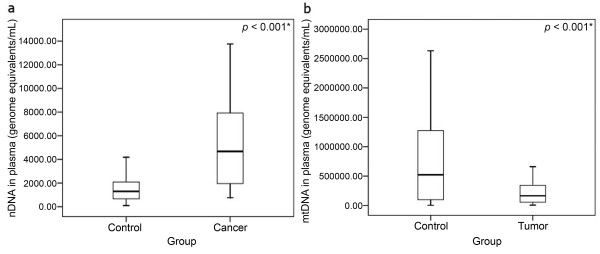
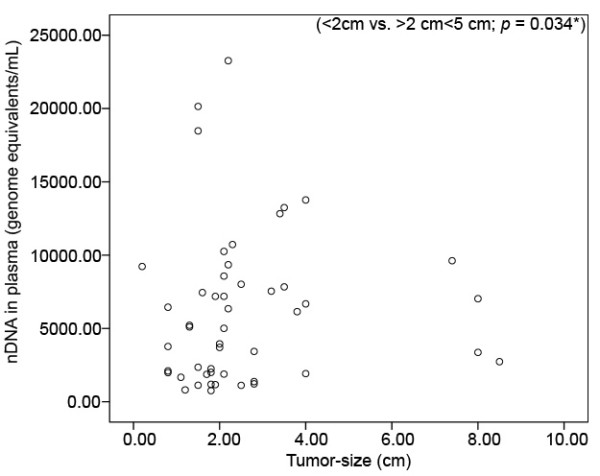
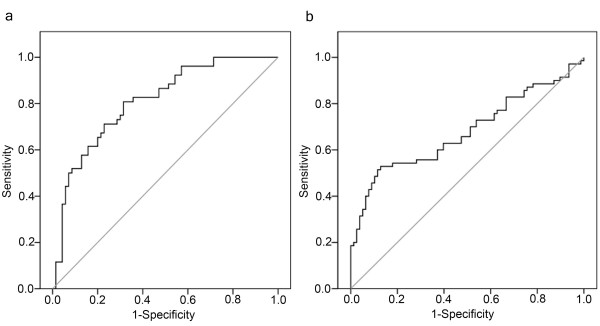
Background: With the aim to simplify cancer management, cancer research lately dedicated itself more and more to discover and develop non-invasive biomarkers. In this connection, circulating cell-free DNA (ccf DNA) seems to be a promising candidate. Altered levels of ccf nuclear DNA (nDNA) and mitochondrial DNA (mtDNA) have been found in several cancer types and might have a diagnostic value. Methods: Using multiplex real-time PCR we investigated the levels of ccf nDNA and mtDNA in plasma samples from patients with malignant and benign breast tumors, and from healthy controls. To evaluate the applicability of plasma ccf nDNA and mtDNA as a biomarker for distinguishing between the three study-groups we performed ROC (Receiver Operating Characteristic) curve analysis. We also compared the levels of both species in the cancer group with clinicopathological parameters. Results: While the levels of ccf nDNA in the cancer group were significantly higher in comparison with the benign tumor group (P < 0.001) and the healthy control group (P < 0.001), the level of ccf mtDNA was found to be significantly lower in the two tumor-groups (benign: P < 0.001; malignant: P = 0.022). The level of ccf nDNA was also associated with tumor-size (<2 cm vs. >2 cm<5 cm; 2250 vs. 6658; Mann-Whitney-U-Test: P = 0.034). Using ROC curve analysis, we were able to distinguish between the breast cancer cases and the healthy controls using ccf nDNA as marker (cut-off: 1866 GE/ml; sensitivity: 81%; specificity: 69%; P < 0.001) and between the tumor group and the healthy controls using ccf mtDNA as marker (cut-off: 463282 GE/ml; sensitivity: 53%; specificity: 87%; P < 0.001). Conclusion: Our data suggests that nuclear and mitochondrial ccf DNA have potential as biomarkers in breast tumor management. However, ccf nDNA shows greater promise regarding sensitivity and specificity.
Overview
The claims and statistics of this paper haven’t been checked yet.
Run the check — free, no account needed. It reads the open-access text and checks the sources it cites.
Integrity signals
Registry
Cites
Statistics
Figures
Verification
Claims the paper makes
The claims and statistics of this paper haven’t been checked yet.
Run the check — free, no account needed. It reads the open-access text and checks the sources it cites.
Claims other papers make about this one
Each is checked against this paper’s own text: does it say what the citing paper says it does?
The cited source says what the claim attributes to it.
In the citing paper
“As extracellular mtDNA is reportedly associated with various pathologies, including trauma25,26, burn injury27, cancer28 and rheumatoid arthritis17,29”
From Anti-mitochondrial autoantibodies in systemic lupus erythematosus and their association with disease manifestations (2019) · cites this paper as [28]
Self-check
Percentages, sums and reported differences re-computed from the paper’s own numbers.
The self-check needs the paper’s full text.
Citations
Cites
Circulating mutant DNA to assess tumor dynamics
Diehl, F., Schmidt, K., Choti, M. A., Romans, K. E., Goodman, S. N., Li, M., Thornton, K. A., Agrawal, N., Sokoll, L. J., Szabo, S., et al. (2008) · Nature Medicine · doi:10.1038/nm.1789 · Cited by 2,746
Understanding diagnostic tests 3: receiver operating characteristic curves
Akobeng, A. K. (2007) · Acta Paediatrica · doi:10.1111/j.1651-2227.2006.00178.x · Cited by 1,882
Berg, W. A. (2008) · JAMA · doi:10.1001/jama.299.18.2151 · Cited by 1,527
Multiple Biomarkers for the Prediction of First Major Cardiovascular Events and Death
Wang, T. J., Gona, P. N., Larson, M. G., Tofler, G. H., Levy, D. A., Newton‐Cheh, C., Jacques, P. F., Rifai, N., Selhub, J., Robins, S. J., et al. (2006) · New England Journal of Medicine · doi:10.1056/nejmoa055373 · Cited by 1,337
Mitochondrial DNA mutations and mitochondrial DNA depletion in gastric cancer
Wu, C., Yin, P., Hung, W., Li, A. F., Li, S., Chi, C., Wei, Y., & Lee, H. (2005) · Genes Chromosomes and Cancer · doi:10.1002/gcc.20213 · Cited by 381
Tumor Markers in Breast Cancer – European Group on Tumor Markers Recommendations
Molina, R., Barak, V., van Dalen, A., Duffy, M. J., EINARSSON, R., Gion, M., Goike, H. M., Lamerz, R., Nap, M., tormos, G. O. R. S. O. L. E., et al. (2005) · Tumor Biology · doi:10.1159/000089260 · Cited by 345
Mitochondrial DNA mutations and mitochondrial DNA depletion in breast cancer
Tseng, L., Yin, P., Chi, C., Hsu, C., Wu, C.-W., Lee, L.-M., Wei, Y., & Lee, H. (2006) · Genes Chromosomes and Cancer · doi:10.1002/gcc.20326 · Cited by 244
Cell-free DNA: measurement in various carcinomas and establishment of normal reference range
Wu, T., Zhang, D., Chia, J., Tsao, K., Sun, C., & Wu, J. T. (2002) · Clinica Chimica Acta · doi:10.1016/s0009-8981(02)00091-8 · Cited by 231
Cancer biomarkers: a systems approach
Hartwell, L., Mankoff, D. A., Paulovich, A. G., Ramsey, S. D., & Swisher, E. M. (2006) · Nature Biotechnology · doi:10.1038/nbt0806-905 · Cited by 202
Tumor‐specific changes in mtDNA content in human cancer
Mambo, E., Chatterjee, A., Xing, M., Tallini, G., Haugen, B. R., Yeung, S. J., Sukumar, S. V., & Sidransky, D. (2005) · International Journal of Cancer · doi:10.1002/ijc.21110 · Cited by 177
Cited by
Sorted by citations
Items 201–215 of 215
Berger, I. (2021) · eDiss (Georg-August-Universität Göttingen) · doi:10.53846/goediss-8947
Clinical Significance of Circulating Cell-Free Mitochondrial DNA in Breast Cancer Patients
Hassanin, S. M., Shaaban, M. A. A., & Saleh, S. A. E. R. (2023) · The Egyptian Journal of Hospital Medicine · doi:10.21608/ejhm.2023.288375
Sørensen, P. D., Andersen, R. F., Pallisgaard, N., Madsen, J. S., Jakobsen, E. H., & Brandslund, I. (2015) · Journal of Circulating Biomarkers · doi:10.33393/jcb.2015.2059
Cheng, J. C., Hu, Y., Wong, D. T., & Patel, A. A. (2023) · Current cancer research · doi:10.1007/978-3-031-22903-9_20
Is the Cell-Free Circulating Mitochondrial DNA a Potential Biomarker for Atrial Fibrillation?
Rahmanian, M., Khaheshi, I., Khani, M. M., Bayati, R., Ataee, M., & Sohrabifar, N. (2023) · International Journal of Cardiovascular Practice · doi:10.5812/intjcardiovascpract-141066
Kim, S. H., Sim, U.-R., Kim, M. N., Ri, R. G., Pak, H.-M., Ri, C.-W., Kim, S. H., & Jang, S. H. (2024) · International Journal of Clinical and Experimental Physiology · doi:10.5530/ijcep.2023.10.3.22
ECM-Lamin Crosstalk in the Regulation of Genomic Stability
Mandal, B., Banerjee, I., Hazari, M. W. A. D., Mondal, A., & Das, C. (2025) · Sub-cellular biochemistry/Subcellular biochemistry · doi:10.1007/978-3-032-00537-3_7
Sanka, K., Rapolu, K., Boyina, H. K., Chakraborty, S., & Muvvala, S. (2025) · Elsevier eBooks · doi:10.1016/b978-0-443-33459-7.00008-9
Cell-free DNA: history, applications, and promises
Thompson, L. M., Ibrahim, A. E., & Stein, R. A. (2025) · Elsevier eBooks · doi:10.1016/b978-0-443-33947-9.00007-4
Integrated DNA examination with fluorescent biomarker analysis
Czarnomska, M., Gruszczyńska, E., Koczur, J., Laudadio, E., Malinowska, M., & Lewkowicz, A. (2026) · Spectrochimica Acta Part A Molecular and Biomolecular Spectroscopy · doi:10.1016/j.saa.2026.127648
ADN circulant nucléaire et mitochondrial et étude de l'influence de l'hypoxie sur leur libération
Cherone, A. (2019) · theses.fr (ABES) · doi:10.70675/35b2e61fz1d02z485cz8e73zce1599d078b8
Wael, N., Owid, A.-Z., & Fadlalla, H. (2026) · Expert Review of Molecular Diagnostics · doi:10.1080/14737159.2026.2687512
Metadata
- Authors
- Kohler, C., Radpour, R., Barekati, Z., Asadollahi, R., Bitzer, J., Wight, E., Bürki, N., Diesch, C., Holzgreve, W., & Zhong, X. Y.
- Affiliations
- University of Basel (CH)
- Kantonsspital Baselland (CH)
- University Medical Center Freiburg (DE)
- Corresponding author
- Zhong, Xiao Yan
- Venue
- Molecular Cancer
- Published
- 2009-11-17
- Volume
- 8
- Issue
- 1
- Pages
- 105-105
- ISSN
- 1476-4598 (ISSN-L)
- PMC
- PMC2780981
- OpenAlex
- W2171143590
- Cited by
- 215
- References
- 39
- Citations by year
- 2026: 3 · 2025: 8 · 2024: 12 · 2023: 15 · 2022: 11 · 2021: 14 · 2020: 15 · 2019: 18 · 2018: 14 · 2017: 11 · 2016: 13 · 2015: 25 · 2014: 9 · 2013: 15 · 2012: 11
- FWCI
- 3.46
- Type
- journal article
- Language
- en
- Open access
- gold
- doi.org
- Licence
- cc-by
- Locations
- Molecular Cancer (publishedVersion, cc-by)
- PubMed Central (publishedVersion, cc-by)
- PubMed (publishedVersion)
- DOAJ (DOAJ: Directory of Open Access Journals) (submittedVersion)
- Funders
- National Science Foundation
- Schweizerischer Nationalfonds zur Förderung der Wissenschaftlichen Forschung (320000, 119722)
- Krebsliga Beider Basel
- Topics
- Life Sciences › Biochemistry, Genetics and Molecular Biology › Cancer Research › Cancer Genomics and Diagnostics
- Life Sciences › Biochemistry, Genetics and Molecular Biology › Molecular Biology › Advanced biosensing and bioanalysis techniques
- Health Sciences › Medicine › Pediatrics, Perinatology and Child Health › Prenatal Screening and Diagnostics
- Keywords
- cell-free DNA, cell-free mitochondrial DNA, breast cancer, benign breast tumors, plasma biomarkers, tumor size, sensitivity and specificity
- MeSH terms
- Breast Neoplasms, Cell Nucleus, Cell-Free System, Diagnosis, Differential, DNA, Mitochondrial, Female, Health, Humans, Lymph Nodes, Neoplasm Metastasis, Receptors, Estrogen, Receptors, Progesterone, ROC Curve, Biomarkers, Tumor, Cohort Studies, Case-Control Studies, Erb-b2 Receptor Tyrosine Kinases
About these checks
Registry, retraction, Cites and statistics results are computed, not judged, with one exception: a printed reference that no index lists is read once by a model before it counts as a citation error. Claims are extracted by a model and kept only when their quote appears verbatim in the text; each cited source is then checked, with a model’s help, for whether it says what the claim relies on. Those verdicts can be wrong — read the claim’s quote and the cited source before relying on one.
Statistics and arithmetic are recomputed, not judged.
Confidence bands are shown only for fields calibrated on our annotated test set. None is calibrated yet, so no band is shown.
What counts as a claim ›How we measure confidence ›How we check this ›
Are you an author, or do you see a problem with this page? Request a review
