

The DOI matches its Crossref record; 33 of the 33 references it cites were found in a registry or an index.
Validity and responsiveness of EuroQol-5 dimension (EQ-5D) versus Short Form-6 dimension (SF-6D) questionnaire in chronic pain
Open accessAbstract
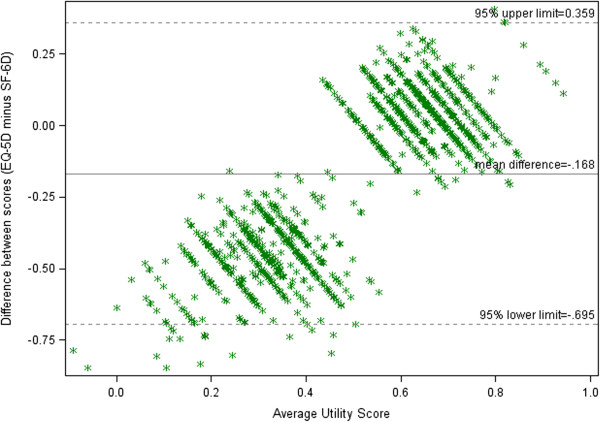
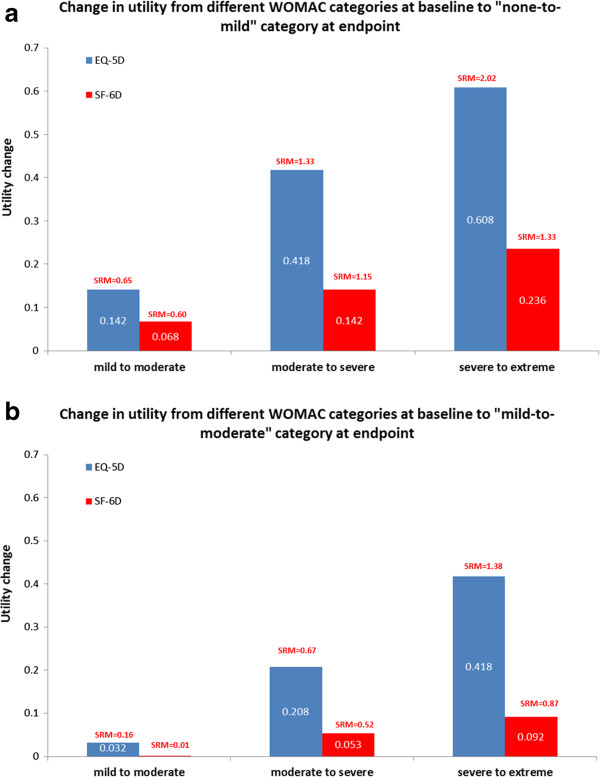
BACKGROUND: Assessments of health-related quality of life and particularly utility values are important components of health economic analyses. Several instruments have been developed to measure utilities. However no consensus has emerged regarding the most appropriate instrument within a therapeutic area such as chronic pain. The study compared two instruments - EQ-5D and SF-6D - for their performance and validity in patients with chronic pain. METHODS: Pooled data from three randomised, controlled clinical trials with two active treatment groups were used. The included patients suffered from osteoarthritis knee pain or low back pain. Differences between the utility measures were compared in terms of mean values at baseline and endpoint, Bland-Altman analysis, correlation between the dimensions, construct validity, and responsiveness. RESULTS: The analysis included 1977 patients, most with severe pain on the Numeric Rating Scale. The EQ-5D showed a greater mean change from baseline to endpoint compared with the SF-6D (0.43 to 0.58 versus 0.59 to 0.64). Bland-Altman analysis suggested the difference between two measures depended on the health status of a patient. Spearmans rank correlation showed moderate correlation between EQ-5D and SF-6D dimensions. Construct validity showed both instruments could differentiate between patient subgroups with different severities of adverse events and analgesic efficacies but larger differences were detected with the EQ-5D. Similarly, when anchoring the measures to a disease-specific questionnaire - Western Ontario and McMaster Universities Osteoarthritis Index (WOMAC) - both questionnaires could differentiate between WOMAC severity levels but the EQ-5D showed greater differences. Responsiveness was also higher with the EQ-5D and for the subgroups in which improvements in health status were expected or when WOMAC severity level was reduced the improvements with EQ-5D were higher than with SF-6D. CONCLUSIONS: This analysis showed that the mean EQ-5D scores were lower than mean SF-6D scores in patients with chronic pain. EQ-5D seemed to have higher construct validity and responsiveness in these patients.
Overview
The claims and statistics of this paper haven’t been checked yet.
Run the check — free, no account needed. It reads the open-access text and checks the sources it cites.
Integrity signals
Registry
Cites
Statistics
Figures
Verification
Claims the paper makes
The claims and statistics of this paper haven’t been checked yet.
Run the check — free, no account needed. It reads the open-access text and checks the sources it cites.
Claims other papers make about this one
Each is checked against this paper’s own text: does it say what the citing paper says it does?
The source backs part of the claim, not all of it — or backs it for a different population, condition or comparison.
In the citing paper
“The EQ-5D-5 L has been shown to have good construct validity and responsiveness in a chronic pain cohort [43].”
From Exercise combined with Acceptance and Commitment Therapy (ExACT) compared to a supervised exercise programme for adults with chronic pain: study protocol for a randomised controlled trial. (2018) · cites this paper as [43]
Experimental — accuracy not yet measuredThe cited source says what the claim attributes to it.
In the citing paper
“The EQ-5D has been shown to have good construct validity and responsiveness among people with chronic pain.56”
The cited source says what the claim attributes to it.
In the citing paper
“The EQ-5D-3L has been validated in chronic pain samples [62], and the Swedish version of the EQ-5D-3L has been validated in several Swedish samples [63–65].”
From ACTsmart: Guided Smartphone-Delivered Acceptance and Commitment Therapy for Chronic Pain—A Pilot Trial. (2021) · cites this paper as [62]
The check wasn’t confident either way, so it gives no verdict — never disputed.
In the citing paper
“Uncertainty in the analysis will be explored using a combination of univariate and multivariate analyses, and decision uncertainty will be addressed using cost-effectiveness acceptability curves.56”
From Comparing the clinical-effectiveness and cost-effectiveness of an internet-delivered Acceptance and Commitment Therapy (ACT) intervention with a waiting list control among adults with chronic pain: study protocol for a randomised controlled trial (2014) · cites this paper as [56]
Experimental — accuracy not yet measured
Self-check
Percentages, sums and reported differences re-computed from the paper’s own numbers.
The self-check needs the paper’s full text.
Citations
Cites
STATISTICAL METHODS FOR ASSESSING AGREEMENT BETWEEN TWO METHODS OF CLINICAL MEASUREMENT
Martin Bland, J., & Altman, D. (1986) · The Lancet · doi:10.1016/s0140-6736(86)90837-8 · Cited by 47,965
Beckett, A. H., Rowland, M., & TURNER, P. (1965) · The Lancet · doi:10.1016/s0140-6736(65)91037-8 · Cited by 16,917
EuroQol: a new facility for the measurement of health-related quality of life
(1990) · Health Policy · doi:10.1016/0168-8510(90)90421-9 · Cited by 15,736
Methods for the Economic Evaluation of Health Care Programmes
Drummond, M. E., Sculpher, M. J., Torrance, G. W., O’Brien, B. J., & Stoddart, G. L. (2005) · doi:10.1093/oso/9780198529446.001.0001 · Cited by 13,648
Development and preliminary testing of the new five-level version of EQ-5D (EQ-5D-5L)
Herdman, M., Gudex, C., Lloyd, A., Janssen, M., Kind, P., Parkin, D., Bonsel, G., & Badia, X. (2011) · Quality of Life Research · doi:10.1007/s11136-011-9903-x · Cited by 9,795 · cited 3×
“A new 5-level version of the EQ-5D has recently been launched, the EQ-5D-5L [31] where the labels for each of the dimensions are: no problems, slight problems, moderate problems, severe problems and unable to/extreme problems.”
BackgroundInfluentialSurvey of chronic pain in Europe: Prevalence, impact on daily life, and treatment
Breivik, H., Collett, B., Ventafridda, V., Cohen, R., & Gallacher, D. (2006) · European Journal of Pain · doi:10.1016/j.ejpain.2005.06.009 · Cited by 5,486
(1997) · doi:10.1097/00005650-199711000-00002 · Cited by 4,544
The estimation of a preference-based measure of health from the SF-36.
Brazier, J., Roberts, J., & Deverill, M. (2002) · Journal of Health Economics · doi:10.1016/s0167-6296(01)00130-8 · Cited by 3,164
Health outcomes in economic evaluation: the QALY and utilities
Whitehead, S. J., & Ali, S. (2010) · British Medical Bulletin · doi:10.1093/bmb/ldq033 · Cited by 1,184
A comparison of the EQ‐5D and SF‐6D across seven patient groups
Brazier, J., Roberts, J., Tsuchiya, A., & Busschbach, J. (2004) · Health Economics · doi:10.1002/hec.866 · Cited by 797
The burden of neuropathic pain: results from a cross‐sectional survey
McDermott, A. M., Toelle, T. R., Rowbotham, D. J., Schaefer, C. P., & Dukes, E. M. (2005) · European Journal of Pain · doi:10.1016/j.ejpain.2005.01.014 · Cited by 378
Bellamy, N. (2002) · PubMed · Cited by 289
Prevalence and characteristics of chronic pain in the general Norwegian population
Rustøen, T., Wahl, A. K., Hanestad, B. R., Lerdal, A., Paul, S. M., & Miaskowski, C. A. (2004) · European Journal of Pain · doi:10.1016/j.ejpain.2004.02.002 · Cited by 263
Buynak, R. J., Shapiro, D. Y., Okamoto, A., Hove, I. V., Rauschkolb, C., Steup, A., Lange, B., Lange, C., & Etropolski, M. S. (2010) · Expert Opinion on Pharmacotherapy · doi:10.1517/14656566.2010.497720 · Cited by 255
Afilalo, M., Etropolski, M. S., Kuperwasser, B., Kelly, K., Okamoto, A., Hove, I. V., Steup, A., Lange, B., Rauschkolb, C., & Häeussler, J. (2010) · Clinical Drug Investigation · doi:10.2165/11533440-000000000-00000 · Cited by 228
Epidemiology of chronic pain in Denmark: An update
Sjøgren, P., Ekholm, O., Peuckmann, V., & Grønbæk, M. (2009) · European Journal of Pain · doi:10.1016/j.ejpain.2008.04.007 · Cited by 203
The prevalence, correlates and treatment of pain in the European Union
Langley, P. C. (2011) · Current Medical Research and Opinion · doi:10.1185/03007995.2010.542136 · Cited by 184
An empirical comparison of EQ‐5D and SF‐6D in liver transplant patients
Longworth, L., & Bryan, S. (2003) · Health Economics · doi:10.1002/hec.787 · Cited by 184
Vergel, Y. B., & Sculpher, M. (2008) · Practical Neurology · doi:10.1136/pn.2007.140186 · Cited by 183
Lange, B., Kuperwasser, B., Okamoto, A., Steup, A., Häufel, T., Ashworth, J., & Etropolski, M. S. (2010) · Advances in Therapy · doi:10.1007/s12325-010-0036-3 · Cited by 171
The impact of pain on labor force participation, absenteeism and presenteeism in the European Union
Langley, P. C., Müller-Schwefe, G. H. H., Nicolaou, A., Liedgens, H., Pergolizzi, J. V., & Varrassi, G. (2010) · Journal of Medical Economics · doi:10.3111/13696998.2010.529379 · Cited by 128
Self-citationLangley, P. C., Müller-Schwefe, G. H. H., Nicolaou, A., Liedgens, H., Pergolizzi, J. V., & Varrassi, G. (2010) · Journal of Medical Economics · doi:10.3111/13696998.2010.516709 · Cited by 123
Self-citationMeasuring Preferences for Cost-Utility Analysis
McDonough, C. M., & Tosteson, A. N. A. (2007) · PharmacoEconomics · doi:10.2165/00019053-200725020-00003 · Cited by 113
Not all “quality-adjusted life years” are equal
Marra, C. A., Marion, S. A., Guh, D. P., Najafzadeh, M., Wolfe, F., Esdaile, J. M., Clarke, A. E., Gignac, M. A. M., & Anis, A. H. (2006) · Journal of Clinical Epidemiology · doi:10.1016/j.jclinepi.2006.09.006 · Cited by 103
SF-6D versus EQ-5D: reasons for differences in utility scores and impact on reported cost-utility
Grieve, R., Grishchenko, M., & Cairns, J. (2008) · The European Journal of Health Economics · doi:10.1007/s10198-008-0097-2 · Cited by 99
Measuring health-related utility:
Bryan, S., & Longworth, L. (2005) · The European Journal of Health Economics · doi:10.1007/s10198-005-0299-9 · Cited by 71
Comparison of valuation methods used to generate the EQ-5D and the SF-6D value sets
Tsuchiya, A., Brazier, J., & Roberts, J. (2005) · Journal of Health Economics · doi:10.1016/j.jhealeco.2005.09.003 · Cited by 69
Whitehurst, D. G. T., & Bryan, S. (2011) · Value in Health · doi:10.1016/j.jval.2010.09.002 · Cited by 57
Harrison, M. J., Davies, L. M., Bansback, N. J., McCoy, M. J., Verstappen, S. M. M., Watson, K. D., & Symmons, D. P. M. (2009) · Quality of Life Research · doi:10.1007/s11136-009-9539-2 · Cited by 55
Interchangeability of the EQ-5D and the SF-6D in Long-Lasting Low Back Pain
Søgaard, R., Christensen, F. B., Videbæk, T. S., Bünger, C. E., & Christiansen, T. (2008) · Value in Health · doi:10.1111/j.1524-4733.2008.00466.x · Cited by 50
Barton, G., Sach, T., Avery, A. J., Doherty, M., Jenkinson, C., & Muir, K. R. (2009) · Cost Effectiveness and Resource Allocation · doi:10.1186/1478-7547-7-12 · Cited by 45
Brazier, J. E., & Longworth, L. (2011) · Europe PMC (PubMed Central) · Cited by 29
(1988) · PubMed
Cited by
Sorted by citations
Buchholz, I., Janssen, M. F., Kohlmann, T., & Feng, Y. (2018) · PharmacoEconomics · doi:10.1007/s40273-018-0642-5 · Cited by 357
Patient-reported outcome measures in arthroplasty registries
Rolfson, O., Bohm, É., Franklin, P. D., Lyman, S. L., Denissen, G., Dawson, J., Dunn, J. A., Chenok, K. E., Dunbar, M., Overgaard, S., et al. (2016) · Acta Orthopaedica · doi:10.1080/17453674.2016.1181816 · Cited by 339
Fuke, R., Hifumi, T., Kondo, Y., Hatakeyama, J., Takei, T., Yamakawa, K., Inoue, S., & Nishida, O. (2018) · BMJ Open · doi:10.1136/bmjopen-2017-019998 · Cited by 279
Can The EQ-5D Detect Meaningful Change? A Systematic Review
Payakachat, N., Ali, M. M., & Tilford, J. M. (2015) · PharmacoEconomics · doi:10.1007/s40273-015-0295-6 · Cited by 250
Chen, P., Lin, K.-C., Liing, R.-J., Wu, C.-Y., Chen, C.-L., & Chang, K.-C. (2016) · Quality of Life Research · doi:10.1007/s11136-015-1196-z · Cited by 220
Metadata
- Authors
- Obradovic, M., Lal, A., & Liedgens, H.
- Affiliations
- Grünenthal Group (Germany) (DE)
- Corresponding author
- Liedgens, Hiltrud
- ORCID
- Liedgens, Hiltrud
- Venue
- Health and Quality of Life Outcomes
- Published
- 2013-07-01
- Volume
- 11
- Issue
- 1
- Pages
- 110-110
- ISSN
- 1477-7525 (ISSN-L)
- PMC
- PMC3722016
- OpenAlex
- W2105957182
- Cited by
- 233
- References
- 33
- Citations by year
- 2026: 6 · 2025: 15 · 2024: 18 · 2023: 18 · 2022: 11 · 2021: 19 · 2020: 22 · 2019: 29 · 2018: 29 · 2017: 19 · 2016: 16 · 2015: 15 · 2014: 13 · 2013: 3
- FWCI
- 5.15
- Type
- journal article
- Language
- en
- Open access
- gold
- doi.org
- Licence
- cc-by
- Locations
- Health and Quality of Life Outcomes (publishedVersion, cc-by)
- Europe PMC (PubMed Central) (publishedVersion, cc-by)
- PubMed Central (publishedVersion, cc-by)
- PubMed (publishedVersion)
- Topics
- Social Sciences › Economics, Econometrics and Finance › Economics and Econometrics › Health Systems, Economic Evaluations, Quality of Life
- Health Sciences › Health Professions › Physical Therapy, Sports Therapy and Rehabilitation › Musculoskeletal pain and rehabilitation
- Health Sciences › Medicine › Anesthesiology and Pain Medicine › Pain Management and Opioid Use
- Keywords
- EQ-5D, SF-6D, chronic pain, health-related quality of life, health utility, construct validity, responsiveness, knee osteoarthritis, low back pain, WOMAC, questionnaire comparison
- MeSH terms
- Aged, Female, Health Status Indicators, Humans, Male, Middle Aged, Quality of Life, Surveys and Questionnaires, Reproducibility of Results, Randomized Controlled Trials as Topic, Low Back Pain, Statistics, Nonparametric, Osteoarthritis, Knee, Chronic Pain
About these checks
Registry, retraction, Cites and statistics results are computed, not judged, with one exception: a printed reference that no index lists is read once by a model before it counts as a citation error. Claims are extracted by a model and kept only when their quote appears verbatim in the text; each cited source is then checked, with a model’s help, for whether it says what the claim relies on. Those verdicts can be wrong — read the claim’s quote and the cited source before relying on one.
Statistics and arithmetic are recomputed, not judged.
Confidence bands are shown only for fields calibrated on our annotated test set. None is calibrated yet, so no band is shown.
What counts as a claim ›How we measure confidence ›How we check this ›
Are you an author, or do you see a problem with this page? Request a review
