

The DOI matches its Crossref record; 74 of the 74 references it cites were found in a registry or an index; 21 of the 66 sources its claims cite were checked for support.
Exercise combined with Acceptance and Commitment Therapy (ExACT) compared to a supervised exercise programme for adults with chronic pain: study protocol for a randomised controlled trial.
Open accessAbstract
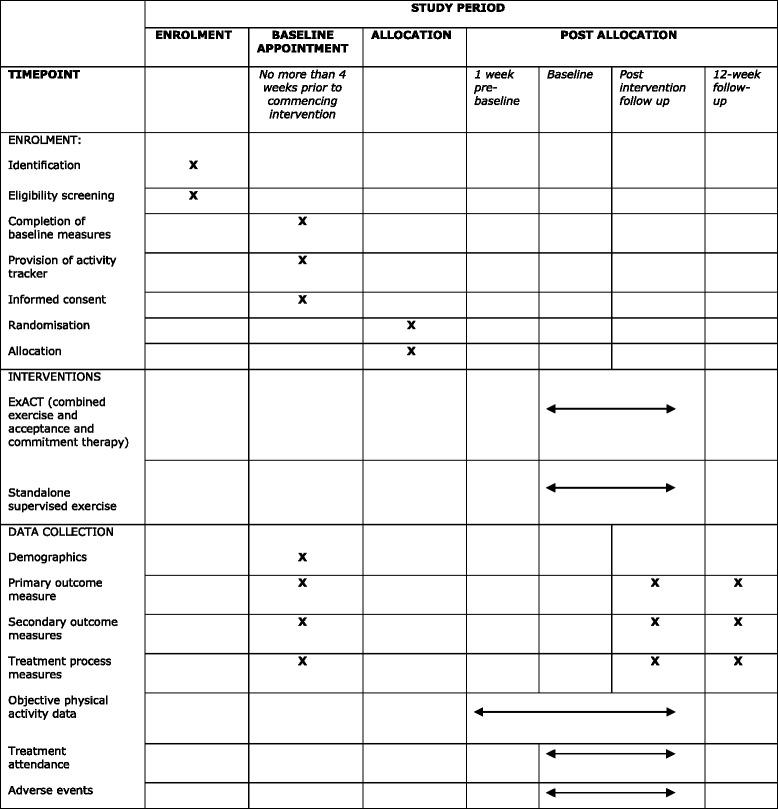
Background: Acceptance and Commitment Therapy (ACT) is a form of cognitive behavioural therapy, which may be beneficial for people with chronic pain. The approach aims to enhance daily functioning through increased psychological flexibility. Whilst the therapeutic model behind ACT appears well suited to chronic pain, there is a need for further research to test its effectiveness in clinical practice, particularly with regards to combining ACT with physical exercise.Methods/design: This prospective, two-armed, parallel-group, single-centre randomised controlled trial (RCT) will assess the effectiveness of a combined Exercise and ACT programme, in comparison to supervised exercise for chronic pain. One hundred and sixty patients, aged 18 years and over, who have been diagnosed with a chronic pain condition by a physician will be recruited to the trial. Participants will be individually randomised to one of two 8-week, group interventions. The combined group will take part in weekly psychology sessions based on the ACT approach, in addition to supervised exercise classes led by a physiotherapist. The control group will attend weekly supervised exercise classes but will not take part in an ACT programme. The primary outcome will be pain interference at 12-week follow-up, measured using the Brief Pain Inventory-Interference Scale. Secondary outcomes will include self-reported pain severity, self-perception of change, patient satisfaction, quality of life, depression, anxiety and healthcare utilisation. Treatment process measures will include self-efficacy, pain catastrophising, fear avoidance, pain acceptance and committed action. Physical activity will be measured using Fitbit ZipTM activity trackers. Both groups will be followed up post intervention and again after 12 weeks. Estimates of treatment effects at follow-up will be based on an intention-to-treat framework, implemented using a linear mixed-effects model. Individual and focus group qualitative interviews will be undertaken with a purposeful sample of participants to explore patient experiences of both treatments.Discussion: To our knowledge, this will be the first RCT to examine whether combining exercise with ACT produces greater benefit for patients with chronic pain, compared to a standalone supervised exercise programme.Trial Registration: www.ClinicalTrials.gov, ID: NCT03050528 . Registered on 13 February 2017.
Overview
CoChat Summary
## TL;DR
This is a study protocol for a two-armed randomized controlled trial testing whether an 8-week group program combining exercise with Acceptance and Commitment Therapy (ExACT) reduces pain interference more than supervised exercise alone in adults with chronic pain. The trial will enroll 160 adults and use pain interference at 12 weeks as the primary outcome, with secondary outcomes including pain severity, quality of life, mood, healthcare use, and objectively measured physical activity.
## Key findings
- Not stated in the paper.
- The trial is designed to recruit 160 participants randomized to ExACT or supervised exercise, with 80 per group after allowing for 20% attrition.
- The primary outcome is pain interference at 12-week follow-up, measured by the Brief Pain Inventory-Interference Scale (BPIIS).
- Secondary outcomes include pain severity, self-perception of change, patient satisfaction, quality of life, depression, anxiety, healthcare costs, and treatment process measures such as self-efficacy, pain catastrophising, fear avoidance, pain acceptance, and committed action.
## Methods
- Design: Two-armed, single-centre, parallel-group, randomised controlled superiority trial.
- Sample/setting: Adults 18 years and older with physician-diagnosed chronic pain persisting >12 weeks, recruited from a consultant-led pain clinic and musculoskeletal outpatient clinics in a large academic teaching hospital in Dublin, Ireland; key inclusion required BPIIS ≥ 2 and English-language communication.
- Intervention and analysis: ExACT consists of eight weekly 3.5-hour group sessions combining ACT-based psychology and supervised exercise; control is eight weekly 1.5-hour supervised exercise sessions. Outcomes will be analyzed on an intention-to-treat basis using linear mixed models, with physical activity assessed via Fitbit Zip trackers and an embedded qualitative study using focus groups and interviews.
## Limitations
- The paper explicitly states that blinding of patients and treating health professionals will not be possible because of the nature of the interventions.
- The paper also notes the challenge of studying “complex interventions” and emphasizes efforts to reduce bias through randomization, allocation concealment, fidelity assessment, and handling missing data.
- Evident from the text: this is a protocol, so it reports planned methods and outcomes rather than trial results.
Model-written summary. Check it against the paper before relying on it.
Integrity signals
Registry
Cites
Statistics
Figures
Verification
Claims the paper makes
18 Valid · 2 Not valid · 30 Not checked · 42 Own results and interpretations
The cited sources support only part of this claim — read each source’s verdict below.
In the paper
“Furthermore, in the RCTs published to date, ACT as a standalone therapy has not been shown to be effective in enhancing physical activity [26, 27].”
§ Exercise combined with Acceptance and Commitment Therapy (ExACT) compared to a supervised exercise programme for adults with chronic pain: study protocol for a randomised controlled trial > Background
What the sources say
- Partly supportedcites [26] Kangasniemi AM, Lappalainen R, Kankaanpaa A, Tolvanen A, Tammelin T. Towards a physically more active lifestyle based on one’s own values: the results of a randomized controlled trial among physically inactive adults. BMC Public Health. 2015;15(1):260. sourceExperimental — accuracy not yet measured
The Discussion (page unavailable) reports no greater increase in mean physical activity for the ACT-based group than for the feedback-only group. But the Methods describe an ACT intervention combined with feedback and self-monitoring, not standalone ACT. This trial therefore does not establish the broader claim about standalone ACT across published RCTs. (LLM, conf=0.86)
- Not checked — no full text of the sourcecites [27] VanBuskirk K, Roesch S, Afari N, Wetherell JL. Physical activity of patients with chronic pain receiving Acceptance and Commitment Therapy or Cognitive Behavioural Therapy: 1. Behav Chang. 2014;31(2):131. source
plain- Asserted: passes — The authors put it forward as true.
- Checkable: passes — It can be checked against evidence.
- Load-bearing: passes — The paper’s conclusions depend on it.
- Based: passes — The paper gives a reason why it holds.
- Partly supported
The cited sources support only part of this claim — read each source’s verdict below.
In the paper
“No particular type of exercise has been shown to be superior to another [5, 18]”
§ Exercise combined with Acceptance and Commitment Therapy (ExACT) compared to a supervised exercise programme for adults with chronic pain: study protocol for a randomised controlled trial > Background
What the sources say
- Not checked — no full text of the sourcecites [5] van Middelkoop M, Rubinstein SM, Verhagen AP, Ostelo RW, Koes BW, van Tulder MW. Exercise therapy for chronic nonspecific low-back pain. Best Pract Res Clin Rheumatol. 2010;24(2):193–204. source
- Partly supportedcites [18] Smith BE, Littlewood C, May S. An update of stabilisation exercises for low back pain: a systematic review with meta-analysis. BMC Musculoskelet Disord. 2014;15:416. sourceExperimental — accuracy not yet measured
The Results > Pain section reports no clinically significant difference between stabilisation and other exercises, and the Discussion > Summary of main findings says stabilisation offers no long-term benefit over other exercise forms (page numbers unavailable). But the review concerns low back pain, not chronic pain generally, and it found a statistically significant short- and medium-term pain benefit for stabilisation exercises, albeit one it judged clinically insignificant. (LLM, conf=0.86)
plain- Asserted: passes — The authors put it forward as true.
- Checkable: passes — It can be checked against evidence.
- Load-bearing: passes — The paper’s conclusions depend on it.
- Based: passes — The paper gives a reason why it holds.
Every source the paper cites for this claim was checked and supports it.
In the paper
“A recent study comparing the reliability and validity of ten consumer activity trackers reported excellent test-retest reliability of the Fitbit ZipTM”
§ Exercise combined with Acceptance and Commitment Therapy (ExACT) compared to a supervised exercise programme for adults with chronic pain: study protocol for a randomised controlled trial > Methods/design > Physical activity outcomes
What the sources say
- Supportedcites [61] Kooiman TJ, Dontje ML, Sprenger SR, Krijnen WP, van der Schans CP, de Groot M. Reliability and validity of ten consumer activity trackers. BMC Sports Sci Med Rehabi. 2015;7(24). source
The Results section (Test-retest reliability; page unavailable) explicitly calls the Fitbit Zip’s test-retest reliability excellent. Table 1 reports an ICC of 0.90 for the Fitbit Zip in the treadmill retest. (LLM, conf=0.95)
plain- Asserted: passes — The authors put it forward as true.
- Checkable: passes — It can be checked against evidence.
- Load-bearing: unclear — It is unclear whether the paper’s conclusions depend on it.
- Based: passes — The paper gives a reason why it holds.
- Supported
Every source the paper cites for this claim was checked and supports it.
In the paper
“The Fitbit ZipTM has been found to be a valid measure of free-living physical activity in healthy adults [60].”
§ Exercise combined with Acceptance and Commitment Therapy (ExACT) compared to a supervised exercise programme for adults with chronic pain: study protocol for a randomised controlled trial > Methods/design > Physical activity outcomes
What the sources say
- Supportedcites [60] Tully MA, McBride C, Heron L, Hunter RF. The validation of Fitbit Zip™ physical activity monitor as a measure of free-living physical activity. BMC Res Notes. 2014;7(1):952. source
The Findings conclusion explicitly calls the Fitbit Zip™ a valid measure of free-living physical activity in healthy adults. The Methods describe participants as eligible if they reported no disease or injury preventing regular physical activity. (LLM, conf=0.95)
plain- Asserted: passes — The authors put it forward as true.
- Checkable: passes — It can be checked against evidence.
- Load-bearing: passes — The paper’s conclusions depend on it.
- Based: passes — The paper gives a reason why it holds.
- Supported
The sources with a verdict support this claim; the rest weren’t checked yet, have no full text we could read, or their verdicts aren’t rated yet.
In the paper
“These baseline covariates have been selected based on studies that have examined predictors of outcome of multidisciplinary treatment in chronic pain [62, 63] .”
§ Exercise combined with Acceptance and Commitment Therapy (ExACT) compared to a supervised exercise programme for adults with chronic pain: study protocol for a randomised controlled trial > Methods/design > Statistical analysis
What the sources say
- Supportedcites [62] de Rooij A, van der Leeden M, Roorda LD, Steultjens MP, Dekker J. Predictors of outcome of multidisciplinary treatment in chronic widespread pain: an observational study. BMC Musculoskelet Disord. 2013;14:133. source
The Abstract (Methods) identifies this as a study testing whether baseline variables predict outcomes of multidisciplinary treatment in chronic widespread pain. The Methods (Design and Statistical analyses) confirm that predictors were measured before treatment and evaluated against later outcomes, so the paper fits the kind of study cited. (LLM, conf=0.93)
- Not checked — no full text of the sourcecites [63] Boonstra AM, Reneman MF, Waaksma BR, Schiphorst Preuper HR, Stewart RE. Predictors of multidisciplinary treatment outcome in patients with chronic musculoskeletal pain. Disabil Rehabil. 2015;37(14):1242–50. source
plain- Asserted: passes — The authors put it forward as true.
- Checkable: passes — It can be checked against evidence.
- Load-bearing: unclear — It is unclear whether the paper’s conclusions depend on it.
- Based: passes — The paper gives a reason why it holds.
- Supported
15 more claims
Create a free account to see all 92 claims and to verify the 1 reference still open.
- Probably not a substantial claim. 57
- It may state two separate claims as one. 28
Claims other papers make about this one
Each is checked against this paper’s own text: does it say what the citing paper says it does?
The cited source doesn’t support the claim as written.
In the citing paper
“To detect a medium effect size on the primary outcome (Brief Pain Inventory-Interference Scale, BPI-IS) 42 for either ACT or BATD versus TAU, a total of 63 participants were required for α = .05(2-tailed) and 1β = .80.Considering a possible attrition rate of 20%, 14,43 the stipulated minimum sample size was approximately 78 patients per group.”
From Efficacy of Videoconference Group Acceptance and Commitment Therapy (ACT) and Behavioral Activation Therapy for Depression (BATD) for Chronic Low Back Pain (CLBP) Plus Comorbid Depressive Symptoms: A Randomized Controlled Trial (IMPACT Study) (2023) · cites this paper as [42]
Checked by a reasoning model — may be wrong.
Experimental — accuracy not yet measuredThe source backs part of the claim, not all of it — or backs it for a different population, condition or comparison.
In the citing paper
“Sample size was estimated considering a target power of 80%, an alpha level of 0.05 and was calculated taking the primary outcome measure into account (Brief Pain Inventory-Interference Scale (BPI-IS)). The estimate was based on a one-way analysis of variance (followed by Dunn–Bonferroni post-hoc tests) for between-group differences in the change from baseline to subsequent assessment, assuming no”
From Efficacy, cost-utility and physiological effects of Acceptance and Commitment Therapy (ACT) and Behavioural Activation Treatment for Depression (BATD) in patients with chronic low back pain and depression: study protocol of a randomised, controlled trial including mobile-technology-based ecological momentary assessment (IMPACT study) (2020) · cites this paper as [34]
Experimental — accuracy not yet measuredIn the citing paper
“A reduction of 1 point on the BPI-IS is considered as a clinically meaningful change.”
From Efficacy, cost-utility and physiological effects of Acceptance and Commitment Therapy (ACT) and Behavioural Activation Treatment for Depression (BATD) in patients with chronic low back pain and depression: study protocol of a randomised, controlled trial including mobile-technology-based ecological momentary assessment (IMPACT study) (2020) · cites this paper as [34]
Self-check
Percentages, sums and reported differences re-computed from the paper’s own numbers.
Each contradiction between two passages listed here was confirmed by an independent check.
Rated minor: it would not touch a result — a value no result rests on, a p-value that stays on the same side of the significance level, or a conflict that is clerical, resolved elsewhere in the paper, or outside its own findings.
In the paper
§ Exercise combined with Acceptance and Commitment Therapy (ExACT) compared to a supervised exercise programme for adults with chronic pain: study protocol for a randomised controlled trial > Background > Research objectives
“The primary objective is to determine whether a combined Exercise and ACT group-based intervention is effective for reducing pain interference at 12-week follow-up, in patients with chronic pain, compared to a physiotherapy-led supervised exercise programme.”
§ Exercise combined with Acceptance and Commitment Therapy (ExACT) compared to a supervised exercise programme for adults with chronic pain: study protocol for a randomised controlled trial > Methods/design > Sample size
“Sample size was estimated using a target power of 80%, at a type I error rate of 0.05 and was calculated relative to the primary outcome measure; Pain severity subscale of the BPI.”
Citations
Cites
The PHQ-9: Validity of a brief depression severity measure
Kroenke, K., Spitzer, R. L., & Williams, J. B. W. (2001) · Journal of General Internal Medicine · doi:10.1046/j.1525-1497.2001.016009606.x · Cited by 44,910
Self-efficacy: Toward a unifying theory of behavioral change
Bandura, A. (1977) · Psychological Review · doi:10.1037/0033-295x.84.2.191 · Cited by 43,925
A Brief Measure for Assessing Generalized Anxiety Disorder: The GAD-7
Spitzer, R. L., Kroenke, K., Williams, J. B. W., & Löwe, B. (2006) · Archives of Internal Medicine · doi:10.1001/archinte.166.10.1092 · Cited by 31,765
CONSORT 2010 Statement: updated guidelines for reporting parallel group randomised trials
the CONSORT Group, Schulz, K. F., Altman, D. G., & Moher, D. (2010) · BMC Medicine · doi:10.1186/1741-7015-8-18 · Cited by 13,371
Developing and evaluating complex interventions: the new Medical Research Council guidance
Craig, P., Dieppe, P., Macintyre, S., Michie, S., Nazareth, I., & Petticrew, M. (2008) · BMJ · doi:10.1136/bmj.a1655 · Cited by 10,995
Self-efficacy: Toward a unifying theory of behavioral change
Bandura, A. (1978) · Advances in Behaviour Research and Therapy · doi:10.1016/0146-6402(78)90002-4 · Cited by 10,586
Hoffmann, T. C., Glasziou, P. P., Boutron, I., Milne, R., Perera, R., Moher, D., Altman, D. G., Barbour, V., Macdonald, H., Johnston, M., et al. (2014) · BMJ · doi:10.1136/bmj.g1687 · Cited by 10,548
The Pain Catastrophizing Scale: Development and validation.
Sullivan, M. J. L., Bishop, S. R., & Pivik, J. (1995) · Psychological Assessment · doi:10.1037//1040-3590.7.4.524 · Cited by 8,227
Interpretative Phenomenological Analysis: Theory, Method and Research
(2010) · QMiP Bulletin · doi:10.53841/bpsqmip.2010.1.10.44 · Cited by 8,189
SPIRIT 2013 Statement: Defining Standard Protocol Items for Clinical Trials
Chan, A.-W., Tetzlaff, J. M., Altman, D. G., Laupacis, A., Gøtzsche, P. C., Krleža-Jerić, K., Hróbjartsson, A., Mann, H., Dickersin, K., Berlin, J. A., et al. (2013) · Annals of Internal Medicine · doi:10.7326/0003-4819-158-3-201302050-00583 · Cited by 7,363 · cited 2×
“This protocol has been written in accordance with the Standard Protocol Items: Recommendations for Interventional Trials (SPIRIT) Statement [35] (See Additional file 1: ExACT Trial SPIRIT 2013 Checklist).”
Research works printed but not linked: 2
- World Health Organisation. Global recommendations on physical activity for health. 2010.
- Creswell J. Qualitative inquiry and research design. Thousand Oaks: Sage; 1998.
Cited by
The Role of Exercise in Management of Mental Health Disorders: An Integrative Review
Smith, P. J., & Merwin, R. M. (2021) · Annual Review of Medicine · doi:10.1146/annurev-med-060619-022943 · Cited by 360
“, exerting cognitive control over behavior, sustaining attention, and flexibly shifting attention and behavioral responses to match environmental demands) (76), which could influence mental health directly and through increased selfefficacy (77).”
BackgroundInfluentialIdentifying the factors affecting ‘patient engagement’ in exercise rehabilitation
Teo, J. L., Zheng, Z., & Bird, S. R. (2022) · BMC Sports Science, Medicine and Rehabilitation · doi:10.1186/s13102-022-00407-3 · Cited by 96
Leaviss, J., Davis, S., Ren, S., Hamilton, J., Scope, A., Booth, A., Sutton, A., Parry, G. D., Buszewicz, M., Moss-Morris, R. E., et al. (2020) · Health Technology Assessment · doi:10.3310/hta24460 · Cited by 86
Sanabria-Mazo, J. P., Colomer-Carbonell, A., Borràs, X., Castaño-Asins, J. R., McCracken, L. M., Montero-Marin, J., Pérez-Aranda, A., Edo, S., Sanz, A., Feliu-Soler, A., et al. (2023) · The Journal of Pain · doi:10.1016/j.jpain.2023.04.008 · Cited by 40
Self-citationXu, W., Shen, W., & Wang, S. (2021) · Children and Youth Services Review · doi:10.1016/j.childyouth.2021.105960 · Cited by 22
Metadata
- Authors
- Casey, M.-B., Smart, K., Segurado, R., Hearty, C., Gopal, H., Lowry, D., Flanagan, D., McCracken, L., & Doody, C.
- Affiliations
- University College Dublin (IE)
- St. Vincent's University Hospital (IE)
- Mater Misericordiae University Hospital (IE)
- King's College London (GB)
- Corresponding author
- Casey, Máire-Bríd
- Venue
- Trials
- Published
- 2018-03-22
- Volume
- 19
- Issue
- 1
- Pages
- 194-194
- ISSN
- 1745-6215 (ISSN-L)
- PMC
- PMC5865382
- OpenAlex
- W2804108496
- Cited by
- 25
- References
- 74
- Citations by year
- 2026: 1 · 2025: 1 · 2024: 2 · 2023: 3 · 2022: 3 · 2021: 5 · 2020: 5 · 2019: 3 · 2018: 2
- FWCI
- 2.42
- Type
- journal article
- Language
- en
- Open access
- gold
- doi.org
- Licence
- cc-by
- creativecommons.org/licenses/by/4.0/ (tdm)
- Locations
- Trials (publishedVersion, cc-by)
- Europe PMC (PubMed Central) (publishedVersion, cc-by)
- PubMed Central (publishedVersion, cc-by)
- PubMed (publishedVersion)
- KTH Publication Database DiVA (KTH Royal Institute of Technology) (submittedVersion, other-oa)
- DOAJ (DOAJ: Directory of Open Access Journals) (submittedVersion, cc-by-sa)
- Research Portal (King's College London) (submittedVersion, other-oa)
- Funders
- Health Research Board (HPF 2016-1685)
- Topics
- Health Sciences › Health Professions › Physical Therapy, Sports Therapy and Rehabilitation › Musculoskeletal pain and rehabilitation
- Social Sciences › Psychology › Clinical Psychology › Mindfulness and Compassion Interventions
- Health Sciences › Medicine › Anesthesiology and Pain Medicine › Pain Management and Treatment
- Keywords
- acceptance and commitment therapy, chronic pain, supervised exercise, pain interference, psychological flexibility, pain catastrophizing, fear avoidance, self-efficacy, physical activity, quality of life, anxiety and depression, health care utilization, patient experience
- MeSH terms
- Adult, Data Collection, Data Interpretation, Statistical, Exercise Therapy, Humans, Quality of Life, Exercise, Cognitive Behavioral Therapy, Randomized Controlled Trials as Topic, Patient Satisfaction, Outcome Assessment, Health Care, Sample Size, Chronic Pain
About these checks
Registry, retraction, Cites and statistics results are computed, not judged, with one exception: a printed reference that no index lists is read once by a model before it counts as a citation error. Claims are extracted by a model and kept only when their quote appears verbatim in the text; each cited source is then checked, with a model’s help, for whether it says what the claim relies on. Those verdicts can be wrong — read the claim’s quote and the cited source before relying on one.
The claim verdicts this report counts are experimental: their accuracy is not yet measured.
A language model drew the claims from the paper on 2026-10-11, under version 3 of the claim definition (model deepseek-v4.1-flash, prompt extract-v3).
A second model labelled each claim on 2026-10-11 (model jev-1.13-20260917, definition revision gold-guideline-v0.2).
Cited sources are checked with a language model’s help (gpt-6-sol).
Statistics and arithmetic are recomputed, not judged.
Confidence bands are shown only for fields calibrated on our annotated test set. None is calibrated yet, so no band is shown.
What counts as a claim ›How we measure confidence ›How we check this ›
Are you an author, or do you see a problem with this page? Request a review
How to cite
Cite CoChat for the checks on this page, and the paper for its own findings.
- This page
- CoChat. (2026). Citation check: Exercise combined with Acceptance and Commitment Therapy (ExACT) compared to a supervised exercise programme for adults with chronic pain: study protocol for a randomised controlled trial. https://app.cochat.ai/papers/10.1186/s13063-018-2543-5
- The paper
- Casey, M.-B., Smart, K., Segurado, R., Hearty, C., Gopal, H., Lowry, D., Flanagan, D., McCracken, L., & Doody, C. (2018). Exercise combined with Acceptance and Commitment Therapy (ExACT) compared to a supervised exercise programme for adults with chronic pain: study protocol for a randomised controlled trial. Trials. https://doi.org/10.1186/s13063-018-2543-5
Data sources
Bibliographic data: Semantic Scholar, OpenAlex, Crossref.
Contains information from the Semantic Scholar Academic Graph Datasets, made available under the ODC Attribution License (ODC-BY 1.0).
Semantic Scholar’s data is described in: Kinney, R., et al. (2023). The Semantic Scholar Open Data Platform. arXiv:2301.10140.
