

The DOI matches its Crossref record; 32 of the 32 references it cites were found in a registry or an index.
Cultural adaptation into Spanish of the generalized anxiety disorder-7 (GAD-7) scale as a screening tool
Open accessAbstract
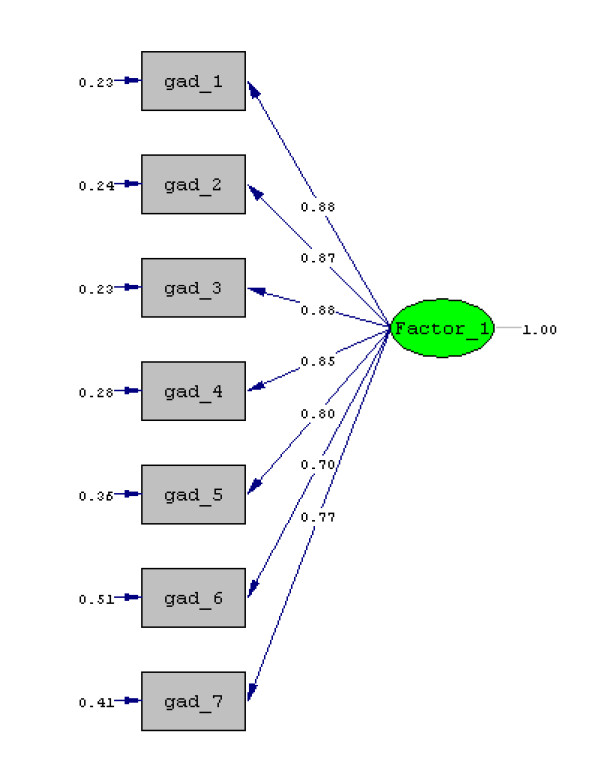
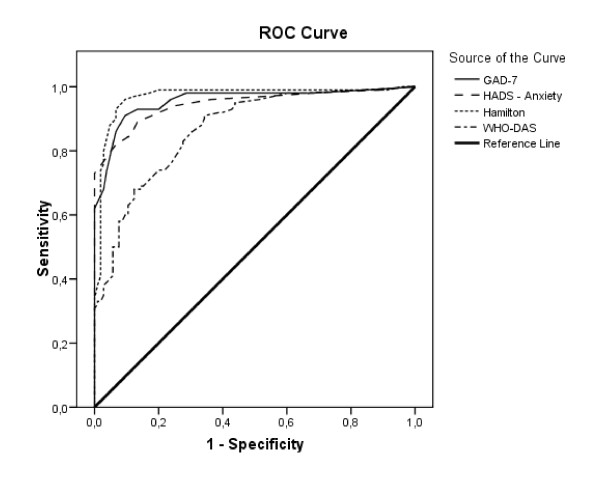
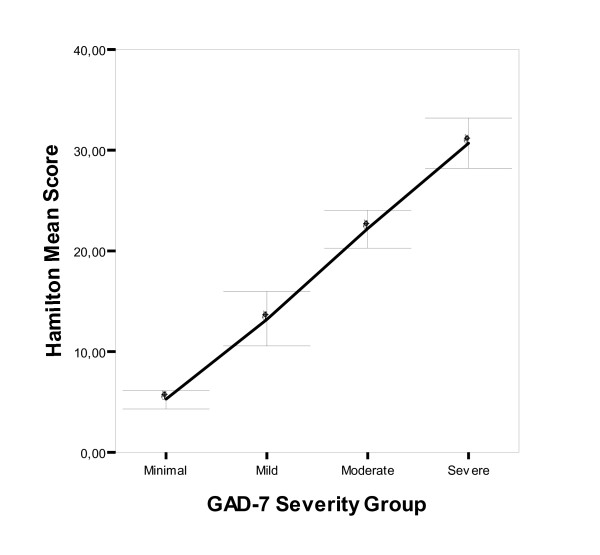
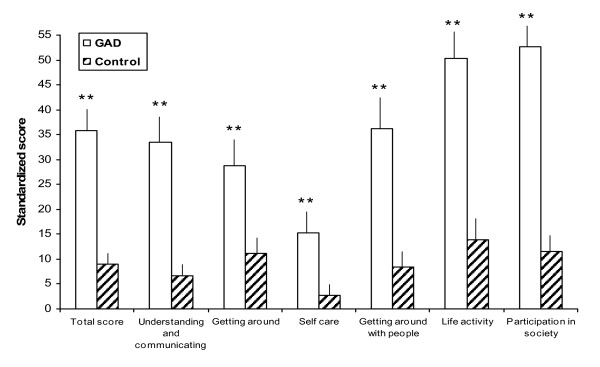
BACKGROUND: Generalized anxiety disorder (GAD) is a prevalent mental health condition which is underestimated worldwide. This study carried out the cultural adaptation into Spanish of the 7-item self-administered GAD-7 scale, which is used to identify probable patients with GAD. METHODS: The adaptation was performed by an expert panel using a conceptual equivalence process, including forward and backward translations in duplicate. Content validity was assessed by interrater agreement. Criteria validity was explored using ROC curve analysis, and sensitivity, specificity, predictive positive value and negative value for different cut-off values were determined. Concurrent validity was also explored using the HAM-A, HADS, and WHO-DAS-II scales. RESULTS: The study sample consisted of 212 subjects (106 patients with GAD) with a mean age of 50.38 years (SD = 16.76). Average completion time was 2'30''. No items of the scale were left blank. Floor and ceiling effects were negligible. No patients with GAD had to be assisted to fill in the questionnaire. The scale was shown to be one-dimensional through factor analysis (explained variance = 72%). A cut-off point of 10 showed adequate values of sensitivity (86.8%) and specificity (93.4%), with AUC being statistically significant [AUC = 0.957-0.985); p < 0.001]. The scale significantly correlated with HAM-A (0.852, p < 0.001), HADS (anxiety domain, 0.903, p < 0.001), and WHO-DAS II (0.696, p > 0.001). LIMITATIONS: Elderly people, particularly those very old, may need some help to complete the scale. CONCLUSION: After the cultural adaptation process, a Spanish version of the GAD-7 scale was obtained. The validity of its content and the relevance and adequacy of items in the Spanish cultural context were confirmed.
Overview
The claims and statistics of this paper haven’t been checked yet.
Run the check — free, no account needed. It reads the open-access text and checks the sources it cites.
Integrity signals
Registry
Cites
Statistics
Figures
Verification
Claims the paper makes
The claims and statistics of this paper haven’t been checked yet.
Run the check — free, no account needed. It reads the open-access text and checks the sources it cites.
Claims other papers make about this one
Each is checked against this paper’s own text: does it say what the citing paper says it does?
The cited source says what the claim attributes to it.
In the citing paper
“The version by Garcia-Campayo et al [62] was used for this study, which shows adequate concurrent validity (r≥0.70) and reliability (Cronbach α=0.93) coefficients.”
The cited source says what the claim attributes to it.
In the citing paper
“The Spanish version of the GAD-7 [45] was used for this study, and excellent psychometric properties were observed in our sample (αT1=0.89, αT2=0.92, αT3=0.90, αT4=0.92, and αT5=0.91).”
The cited source says what the claim attributes to it.
In the citing paper
“GAD-7 has good reliability and validity in its versions in English (Spitzer et al., 2006), Spanish (Garcia-Campayo et al., 2010), Brazilian-Portuguese (Moreno et al., 2016), and Dutch (Donker et al., 2011).”
From Internet-based self-administered intervention to reduce anxiety and depression symptomatology and improve well-being in 7 countries: protocol of a randomized control trial (2024) · cites this paper as Garcia-Campayo et al., 2010
The cited source says what the claim attributes to it.
In the citing paper
“The Spanish version (Garcia-Campayo et al., 2010) has obtained excellent reliability (Cronbach's Alpha = 0.94) and high stability of the measure (Test-retest correlation of 0.84).”
From Mindfulness Parenting and Childish Play: A Clinical Trial With Parents of Children With Autism Spectrum Disorders (2023) · cites this paper as Garcia-Campayo et al., 2010
Self-check
Percentages, sums and reported differences re-computed from the paper’s own numbers.
The self-check needs the paper’s full text.
Citations
Cites
The Hospital Anxiety and Depression Scale
Zigmond, A. S., & Snaith, R. P. (1983) · Acta Psychiatrica Scandinavica · doi:10.1111/j.1600-0447.1983.tb09716.x · Cited by 47,139
Coefficient Alpha and the Internal Structure of Tests
Cronbach, L. J. (1951) · Psychometrika · doi:10.1007/bf02310555 · Cited by 43,931
Herne, H., Cooley, W. W., & Lohnes, P. R. (1973) · Journal of the Royal Statistical Society Series A (General) · doi:10.2307/2344428 · Cited by 35,801
A Brief Measure for Assessing Generalized Anxiety Disorder: The GAD-7
Spitzer, R. L., Kroenke, K., Williams, J. B. W., & Löwe, B. (2006) · Archives of Internal Medicine · doi:10.1001/archinte.166.10.1092 · Cited by 31,765
(1970) · Cited by 24,983
Qu, X. (2007) · Technometrics · doi:10.1198/tech.2007.s455 · Cited by 14,759
Guillemin, F., Bombardier, C., & Beaton, D. (1993) · Journal of Clinical Epidemiology · doi:10.1016/0895-4356(93)90142-n · Cited by 6,060
The ESEMeD/MHEDEA 2000 Investigators, Alonso, J., Angermeyer, M. C., Bernert, S., Bruffaerts, R., Brugha, T. S., Bryson, H., de Girolamo, G., de Graaf, R., Demyttenaere, K., et al. (2004) · Acta Psychiatrica Scandinavica · doi:10.1111/j.1600-0047.2004.00327.x · Cited by 1,825
Exploratory Factor Analysis: Its Role in Item Analysis
Gorsuch, R. L. (1997) · Journal of Personality Assessment · doi:10.1207/s15327752jpa6803_5 · Cited by 1,062
Generalized anxiety disorder: prevalence, burden, and cost to society
Wittchen, H.-U. (2002) · Depression and Anxiety · doi:10.1002/da.10065 · Cited by 733
Mental illness in general health care : an international study
Üstün, T. B., & Sartorius, N. (1995) · Medical Entomology and Zoology · Cited by 610
On the Use of Content Specialists in the Assessment of Criterion-Referenced Test Item Validity.
Rovinelli, R. J., & Hambleton, R. K. (1977) · Tijdschrift voor Onderwijsresearch · Cited by 541
Textbook in Psychiatric Epidemiology
(2002) · Wiley eBooks · doi:10.1002/0471234311 · Cited by 510
The epidemiology of anxiety disorders: prevalence and societal costs.
Lépine, J. (2002) · PubMed · Cited by 309
The Clinical Anxiety Scale: An Instrument Derived from the Hamilton Anxiety Scale
Snaith, R. P., Baugh, S. J., Clayden, A., Husain, A., & Sipple, M. A. (1982) · The British Journal of Psychiatry · doi:10.1192/bjp.141.5.518 · Cited by 271
Batista‐Foguet, J. M., Coenders, G., & Alonso, J. (2004) · Medicina Clínica · doi:10.1157/13057542 · Cited by 252
Judd, L. L., Kessler, R. C., PauIus, M. P., Zeller, P. V., Wittchen, H. ‐., & Kunovac, J. L. (1998) · Acta Psychiatrica Scandinavica · doi:10.1111/j.1600-0447.1998.tb05960.x · Cited by 222
Cost of anxiety disorders: Impact of comorbidity
Souêtre, E., Lozet, H., Cimarosti, I., Martin, P., CHIGNON, J. M., Adès, J., Tignol, J.-P., & DARCOURT, G. (1994) · Journal of Psychosomatic Research · doi:10.1016/0022-3999(94)90145-7 · Cited by 101
Vázquez‐Barquero, J. L., Bourgón, E. V., Castanedo, S. H., Sáiz, J., Uriarte, M., Morales, F., Gaite, L., Herrán, A., & Ustün, T. B. (2000) · PubMed · Cited by 90
Comorbidity in generalized anxiety disorder: impact and implications.
Stein, D. J. (2001) · PubMed · Cited by 88
Screening for anxiety disorders
Wïttchen, H., & Boyer, P. (1998) · The British Journal of Psychiatry · doi:10.1192/s000712500029346x · Cited by 82
Epidemiology of Depression and Anxiety Disorders
Pélissolo, A., & Lépine, J. (2001) · Wiley eBooks · doi:10.1002/0470846518.ch1 · Cited by 81
Outpatient treatment of neurotic depression: medication and group psychotherapy.
Lipman, R. S., & Covi, L. (1976) · PubMed · Cited by 73
Cost of affective disorders in Europe
Andlin‐Sobocki, P., & Wïttchen, H. (2005) · European Journal of Neurology · doi:10.1111/j.1468-1331.2005.01195.x · Cited by 64
Long-term pharmacological treatment of generalized anxiety disorder
Mahé, V., & Balogh, A. T. (2000) · International Clinical Psychopharmacology · doi:10.1097/00004850-200015020-00006 · Cited by 43
[Prevalence of psychopathology at a primary care center].
Bentata, L. C., Franch, J. V., Rodríguez, L., Auquer, K., & Franch, L. (1995) · PubMed · Cited by 38
Marrero, R. R., & Rivero, E. (2019) · Medicine - Programa de Formación Médica Continuada Acreditado · doi:10.1016/j.med.2019.07.001 · Cited by 22
The Hidden Costs of Untreated Anxiety Disorders
Candilis, P. J., & Pollack, M. H. (1997) · Harvard Review of Psychiatry · doi:10.3109/10673229709034724 · Cited by 19
Trastornos de ansiedad en atención primaria
Barrondo, S. M., Sáiz, P. A., & García‐Portilla, M. P. (2008) · Jano: Medicina y humanidades · Cited by 14
Calidad de vida y otras medidas de salud informadas por el paciente
Díaz, M. Á. R., & Gutiérrez, J. R. (2001) · Monografías de la Real Academia Nacional de Farmacia · Cited by 13
Introducción a los modelos de ecuaciones estructurales
Díaz, M. M. A. R. (2000) · Dialnet (Universidad de la Rioja) · Cited by 11
Bobes, J., García-Calvo, C., Prieto, R., García-García, M., & Rico‐Villademoros, F. (2006) · PubMed · Cited by 11
Research works printed but not linked: 3
- Chocrón Bentata L Vilalta Franch J Legazpi Rodríguez I Auquer Ky Franch L Prevalencia de Psicopatología en un centro de atención primaria Aten Primaria 1995 16 586 590 8555389
- Bobes J Garcia-Calvo C Prieto R Garcia-Garcia M Rico-Villademoros F Propiedades psicométricas de la versión española de la Escala de Detección del Generalized anxiety disorder según DSM-IV de Carroll y Davidson Actas Esp Psiquiatr 2006 34 2 83 93 16552636
- Nunnally JCy Bernstein IJ Teoría Psicométrica México: McGraw-Hill 1995 3
Cited by
Sorted by citations
Plummer, F., Manea, L., Trepel, D., & McMillan, D. (2016) · General Hospital Psychiatry · doi:10.1016/j.genhosppsych.2015.11.005 · Cited by 1,882
The prevalence of depression, anxiety, and sleep disturbances in COVID-19 patients: a meta-analysis
Deng, J., Zhou, F., Hou, W., Silver, Z., Wong, C. Y., Chang, O., Huang, E., & Zuo, Q. K. (2021) · Annals of the New York Academy of Sciences · doi:10.1111/nyas.14506 · Cited by 771
World Health Organization disability assessment schedule 2.0: An international systematic review
Federici, S., Bracalenti, M., Meloni, F., & Luciano, J. V. (2016) · Disability and Rehabilitation · doi:10.1080/09638288.2016.1223177 · Cited by 542
Mossman, S. A., Luft, M. J., Schroeder, H. K., Varney, S. T., Fleck, D. E., Barzman, D. H., Gilman, R., DelBello, M. P., & Strawn, J. R. (2017) · Annals of Clinical Psychiatry · doi:10.1177/104012371702900404 · Cited by 471
Sawaya, H., Atoui, M., Hamadeh, A., Zeinoun, P., & Nahas, Z. (2016) · Psychiatry Research · doi:10.1016/j.psychres.2016.03.030 · Cited by 450
Metadata
- Authors
- Garcia-Campayo, J., Zamorano, E., Ruiz, M. A., Pardo, A., Perez-Paramo, M., Lopez-Gomez, V., Freire, O., & Rejas, J.
- Affiliations
- Universidad Autónoma de Madrid (ES)
- Pfizer (Spain) (ES)
- Venue
- Health and Quality of Life Outcomes
- Published
- 2010
- Volume
- 8
- Issue
- 1
- Pages
- 8
- ISSN
- 1477-7525 (ISSN-L)
- PMC
- PMC2831043
- OpenAlex
- W2169677418
- Cited by
- 673
- References
- 32
- Citations by year
- 2026: 67 · 2025: 93 · 2024: 73 · 2023: 84 · 2022: 108 · 2021: 86 · 2020: 60 · 2019: 29 · 2018: 13 · 2017: 15 · 2016: 16 · 2015: 10 · 2014: 7 · 2013: 3 · 2012: 5
- FWCI
- 4.99
- Type
- journal article
- Language
- en
- Open access
- gold
- doi.org
- Licence
- cc-by
- Locations
- Health and Quality of Life Outcomes (publishedVersion, cc-by)
- Europe PMC (PubMed Central) (publishedVersion, cc-by)
- PubMed Central (publishedVersion, cc-by)
- PubMed (publishedVersion)
- DOAJ (DOAJ: Directory of Open Access Journals) (submittedVersion, cc-by-sa)
- Topics
- Social Sciences › Psychology › Experimental and Cognitive Psychology › Anxiety, Depression, Psychometrics, Treatment, Cognitive Processes
- Social Sciences › Decision Sciences › Management Science and Operations Research › Psychometric Methodologies and Testing
- Health Sciences › Nursing › Research and Theory › Health Education and Validation
- Keywords
- generalized anxiety disorder, Spanish translation, cross-cultural adaptation, screening tool, content validity, criterion validity, concurrent validity, cut-off values, anxiety assessment
- MeSH terms
- Acculturation, Adult, Aged, Aged, 80 and over, Anxiety Disorders, Female, Humans, Language, Male, Mass Screening, Middle Aged, Psychometrics, Surveys and Questionnaires, ROC Curve, Spain
About these checks
Registry, retraction, Cites and statistics results are computed, not judged, with one exception: a printed reference that no index lists is read once by a model before it counts as a citation error. Claims are extracted by a model and kept only when their quote appears verbatim in the text; each cited source is then checked, with a model’s help, for whether it says what the claim relies on. Those verdicts can be wrong — read the claim’s quote and the cited source before relying on one.
Statistics and arithmetic are recomputed, not judged.
Confidence bands are shown only for fields calibrated on our annotated test set. None is calibrated yet, so no band is shown.
What counts as a claim ›How we measure confidence ›How we check this ›
Are you an author, or do you see a problem with this page? Request a review
