

The DOI matches its Crossref record; 42 of the 42 references it cites were found in a registry or an index.
Correlation between adherence rates measured by MEMS and self-reported questionnaires: a meta-analysis
Open accessAbstract
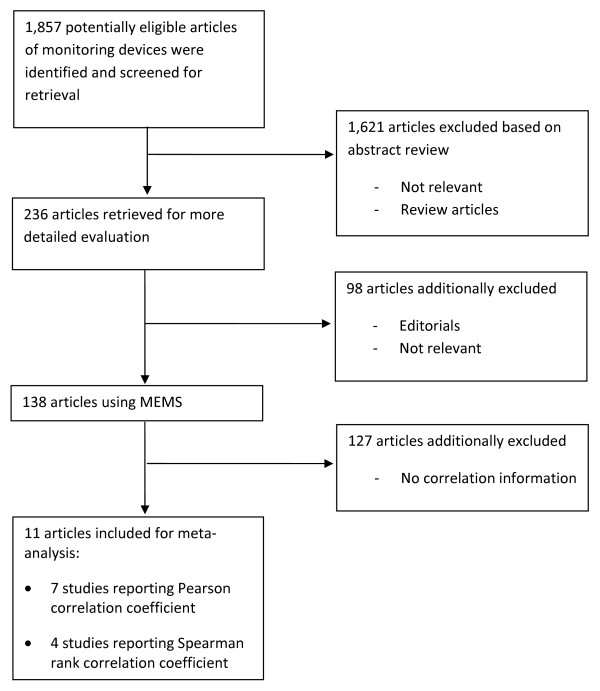
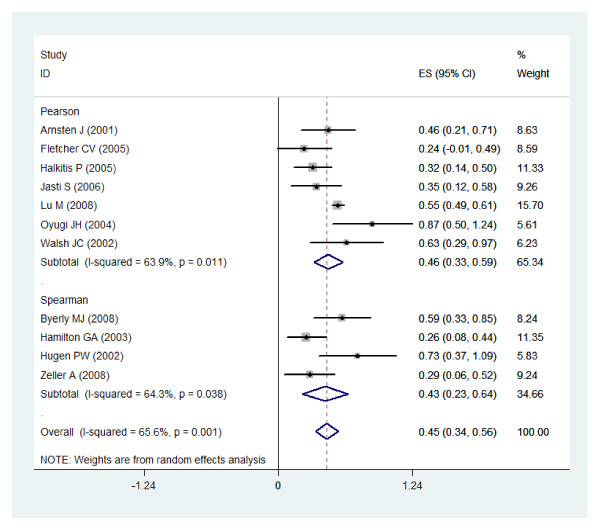
PURPOSE: It is vital to understand the associations between the medication event monitoring systems (MEMS) and self-reported questionnaires (SRQs) because both are often used to measure medication adherence and can produce different results. In addition, the economic implication of using alternative measures is important as the cost of electronic monitoring devices is not covered by insurance, while self-reports are the most practical and cost-effective method in the clinical settings. This meta-analysis examined the correlations of two measurements of medication adherence: MEMS and SRQs. METHODS: The literature search (1980-2009) used PubMed, OVID MEDLINE, PsycINFO (EBSCO), CINAHL (EBSCO), OVID HealthStar, EMBASE (Elsevier), and Cochrane Databases. Studies were included if the correlation coefficients [Pearson (rp) or Spearman (rs)] between adherences measured by both MEMS and SRQs were available or could be calculated from other statistics in the articles. Data were independently abstracted in duplicate with standardized protocol and abstraction form including 1) first author's name; 2) year of publication; 3) disease status of participants; 4) sample size; 5) mean age (year); 6) duration of trials (month); 7) SRQ names if available; 8) adherence (%) measured by MEMS; 9) adherence (%) measured by SRQ; 10) correlation coefficient and relative information, including p-value, 95% confidence interval (CI). A meta-analysis was conducted to pool the correlation coefficients using random-effect model. RESULTS: Eleven studies (N = 1,684 patients) met the inclusion criteria. The mean of adherence measured by MEMS was 74.9% (range 53.4%-92.9%), versus 84.0% by SRQ (range 68.35%-95%). The correlation between adherence measured by MEMS and SRQs ranged from 0.24 to 0.87. The pooled correlation coefficient for 11 studies was 0.45 (p = 0.001, 95% confidence interval [95% CI]: 0.34-0.56). The subgroup meta-analysis on the seven studies reporting rp and four studies reporting rs reported the pooled correlation coefficient: 0.46 (p = 0.011, 95% CI: 0.33-0.59) and 0.43 (p = 0.0038, 95% CI: 0.23-0.64), respectively. No differences were found for other subgroup analyses. CONCLUSION: Medication adherence measured by MEMS and SRQs tends to be at least moderately correlated, suggesting that SRQs give a good estimate of medication adherence.
Overview
The claims and statistics of this paper haven’t been checked yet.
Run the check — free, no account needed. It reads the open-access text and checks the sources it cites.
Integrity signals
Registry
Cites
Statistics
Figures
Verification
Claims the paper makes
The claims and statistics of this paper haven’t been checked yet.
Run the check — free, no account needed. It reads the open-access text and checks the sources it cites.
Claims other papers make about this one
Each is checked against this paper’s own text: does it say what the citing paper says it does?
The source backs part of the claim, not all of it — or backs it for a different population, condition or comparison.
In the citing paper
“MEMS results have been compared to patients’ and clinicians’ reports with weak to moderate correlation[28–30].”
From Adherence is associated with a favorable outcome after lung transplantation (2019) · cites this paper as [28]
Experimental — accuracy not yet measured
Self-check
Percentages, sums and reported differences re-computed from the paper’s own numbers.
The self-check needs the paper’s full text.
Citations
Cites
1 retracted
Retracted: Predictive Validity of a Medication Adherence Measure in an Outpatient Setting
Morisky, D. E., Ang, A., Krousel‐Wood, M., & Ward, H. J. (2008) · The Journal of Clinical Hypertension · doi:10.1111/j.1751-7176.2008.07572.x · Cited by 2,877
RetractedMeta-analysis in clinical trials
DerSimonian, R., & Laird, N. (1986) · Controlled Clinical Trials · doi:10.1016/0197-2456(86)90046-2 · Cited by 39,552
Osterberg, L., & Blaschke, T. (2005) · New England Journal of Medicine · doi:10.1056/nejmra050100 · Cited by 7,974
Adherence to Long-Term Therapies: Evidence for Action
Geest, S. D., & Sabate, E. J. (2003) · European Journal of Cardiovascular Nursing · doi:10.1016/s1474-5151(03)00091-4 · Cited by 6,310
Moher, D., Cook, D. J., Eastwood, S., Olkin, I., Rennie, D., & Stroup, D. F. (1999) · The Lancet · doi:10.1016/s0140-6736(99)04149-5 · Cited by 4,826
The Handbook of Research Synthesis.
Howel, D., Cooper, H., & Hedges, L. V. (1995) · Biometrics · doi:10.2307/2533295 · Cited by 3,657
Mathematical Statistics and Data Analysis
Rabinowitz, L., & Rice, J. A. (1989) · Technometrics · doi:10.2307/3556160 · Cited by 3,142
A systematic review of the associations between dose regimens and medication compliance
Claxton, A. J., Cramer, J., & Pierce, C. (2001) · Clinical Therapeutics · doi:10.1016/s0149-2918(01)80109-0 · Cited by 2,388
DiMatteo, M. R. (2004) · Medical Care · doi:10.1097/01.mlr.0000114908.90348.f9 · Cited by 2,169
Chesney, M. A., Ickovics, J. R., Chambers, D. B., Gifford, A. L., Neidig, J., Zwickl, B., Wu, A. W., & PATIENT CARE COMMITTEE & ADHERENCE (2000) · AIDS Care · doi:10.1080/09540120050042891 · Cited by 1,428
Farmer, K. C. (1999) · Clinical Therapeutics · doi:10.1016/s0149-2918(99)80026-5 · Cited by 889
Statistical Methods in Medical Research
Chan, W. (2013) · Model Assisted Statistics and Applications · doi:10.3233/mas-130255 · Cited by 639
Arnsten, J. H., Demas, P., Farzadegan, H., Grant, R. W., Gourevitch, M. N., Chang, C., Buono, D. L., Eckholdt, H., Howard, A. A., & Schoenbaum, E. E. (2001) · Clinical Infectious Diseases · doi:10.1086/323201 · Cited by 637
Garber, M. C., Nau, D. P., Erickson, S. R., Aikens, J. E., & Lawrence, J. B. (2004) · Medical Care · doi:10.1097/01.mlr.0000129496.05898.02 · Cited by 519
Singh, N., Squier, C. L., Sivek, C., Wagener, M. W., Nguyen, M. H., & Yu, V. L. (1996) · AIDS Care · doi:10.1080/09540129650125696 · Cited by 500
Walsh, J. C., Mandalia, S., & Gazzard, B. (2002) · AIDS · doi:10.1097/00002030-200201250-00017 · Cited by 443
Optimal recall period and response task for self-reported HIV medication adherence
Lu, M., Safren, S. A., Skolnik, P. R., Rogers, W. H., Coady, W., Hardy, H., & Wilson, I. B. (2008) · AIDS and Behavior · doi:10.1007/s10461-007-9261-4 · Cited by 361
Pharmacoepidemiology and Drug Safety
Mucklow, J. C. (1992) · Postgraduate Medical Journal · doi:10.1136/pgmj.68.804.846-b · Cited by 303
Oyugi, J. H., Byakika-Tusiime, J., Charlebois, E. D., Kityo, C. M., Mugerwa, R. D., Mugyenyi, P. N., & Bangsberg, D. R. (2004) · JAIDS Journal of Acquired Immune Deficiency Syndromes · doi:10.1097/00126334-200408150-00014 · Cited by 281
Relationships Among Subjective and Objective Measures of Adherence to Oral Antipsychotic Medications
Velligan, D. I., Wang, M., Diamond, P. M., Glahn, D. C., Castillo, D., Bendle, S., Lam, Y. W. F., Ereshefsky, L., & Miller, A. L. (2007) · Psychiatric Services · doi:10.1176/ps.2007.58.9.1187 · Cited by 254
Scandinavian Journal of Primary Health Care
(1983) · Scandinavian Journal of Primary Health Care · doi:10.3109/02813438309038459 · Cited by 242
Byerly, M., Nakonezny, P. A., & Rush, A. J. (2008) · Schizophrenia Research · doi:10.1016/j.schres.2007.12.470 · Cited by 229
Journal of Pharmacy Practice and Research
Society of Hospital Pharmacists of Australia (2018) · Journal of Pharmacy Practice and Research · doi:10.1002/(issn)2055-2335 · Cited by 203
Medication non-adherence and asthma treatment cost
Bender, B. G., & Rand, C. M. (2004) · Current Opinion in Allergy and Clinical Immunology · doi:10.1097/00130832-200406000-00009 · Cited by 176
Health literacy and anticoagulation-related outcomes among patients taking warfarin
Fang, M. C., Machtinger, E. L., Wang, F. M., & Schillinger, D. (2006) · Journal of General Internal Medicine · doi:10.1111/j.1525-1497.2006.00537.x · Cited by 175
Measuring Adherence in a Hypertension Clinical Trial
Hamilton, G. A. (2003) · European Journal of Cardiovascular Nursing · doi:10.1016/s1474-5151(03)00058-6 · Cited by 144
Hugen, P. W. H., Langebeek, N., Burger, D. M., Zomer, B., van Leusen, R., Schuurman, R., Koopmans, P. P., & Hekster, Y. A. (2002) · JAIDS Journal of Acquired Immune Deficiency Syndromes · doi:10.1097/00042560-200207010-00009 · Cited by 128
Chida, Y., & Hamer, M. (2008) · Diabetologia · doi:10.1007/s00125-008-1154-1 · Cited by 120
Wang, P. S., Benner, J. S., Glynn, R. J., Winkelmayer, W. C., Mogun, H., & Avorn, J. (2003) · Pharmacoepidemiology and Drug Safety · doi:10.1002/pds.819 · Cited by 104
Koneru, S., Shishov, M., Ware, A. E., Farhey, Y., Mongey, A., Graham, T. B., Passo, M. H., Houk, J. L., Higgins, G. C., & Brunner, H. I. (2007) · Arthritis Care & Research · doi:10.1002/art.22898 · Cited by 102
Techniques for Measuring Medication Adherence in Hypertensive Patients in Outpatient Settings
Hawkshead, J. J., & Krousel-Wood, M. A. (2007) · Disease Management & Health Outcomes · doi:10.2165/00115677-200715020-00006 · Cited by 98
Concordance Among Three Self-Reported Measures of Medication Adherence and Pharmacy Refill Records
Cook, C. L., Wade, W. E., Martin, B. C., & Perri, M. (2005) · Journal of the American Pharmacists Association · doi:10.1331/1544345053623573 · Cited by 97
Halkitis, P. N., Kutnick, A. H., & Slater, S. (2005) · Journal of Health Psychology · doi:10.1177/1359105305053422 · Cited by 62
Fletcher, C. V., Testa, M. A., Brundage, R. C., Chesney, M. A., Haubrich, R., Acosta, E. P., Martinez, A. L. S., Jiang, H., & Gulick, R. M. (2005) · JAIDS Journal of Acquired Immune Deficiency Syndromes · doi:10.1097/01.qai.0000180078.53321.6a · Cited by 61
Guilera, M., Fuentes, M., Grifols, M., Ferrer, J. T., Badia, X. C., & OPTIMA study investigators (2005) · Osteoporosis International · doi:10.1007/s00198-005-0031-8 · Cited by 59
Jasti, S., Siega‐Riz, A. M., Cogswell, M. E., & Hartzema, A. G. (2006) · Journal of Nutrition · doi:10.1093/jn/136.2.479 · Cited by 41
Goetghebeur, E. J. T., & Vansteelandt, S. (2005) · Statistical Methods in Medical Research · doi:10.1191/0962280205sm407oa · Cited by 37
Zeller, A., Schroeder, K., & Peters, T. J. (2007) · Scandinavian Journal of Primary Health Care · doi:10.1080/02813430701651954 · Cited by 35
Joshi, A. V., Madhavan, S. S., Ambegaonkar, A. J., Smith, M. J., Scott, V., & Dedhia, H. V. (2006) · Journal of Asthma · doi:10.1080/02770900600857010 · Cited by 35
Reinhard, M. J., Hinkin, C. H., Barclay, T. R., Levine, A. J., Marion, S., Castellon, S. A., Longshore, D. L., Newton, T. F., Durvasula, R., Lam, M. N., et al. (2007) · Addictive Behaviors · doi:10.1016/j.addbeh.2007.04.006 · Cited by 23
Factors Influencing Adherence to Molecular Therapies in Haematology‐Oncology Outpatients
Larizza, M. A., Dooley, M. J., Stewart, K., & Kong, D. C. M. (2006) · Journal of Pharmacy Practice and Research · doi:10.1002/j.2055-2335.2006.tb00584.x · Cited by 19
Holcomb, J. P. (1999) · Statistics in Medicine · doi:10.1002/(sici)1097-0258(19991115)18:21 · Cited by 18
Research works printed but not linked: 1
- Morisky DE Nonadherence to medical recommendations for hypertensive patients: Problems and potential solutions Journal of Compliance in Health Care 1986 1 1 5 20
Cited by
Sorted by citations
Self-report measures of medication adherence behavior: recommendations on optimal use
Stirratt, M. J., Dunbar-Jacob, J., Crane, H. M., Simoni, J. M., Czajkowski, S., Hilliard, M. E., Aikens, J. E., Hunter, C. M., Velligan, D. I., Huntley, K., et al. (2015) · Translational Behavioral Medicine · doi:10.1007/s13142-015-0315-2 · Cited by 824
Interventions to Improve Medication Adherence
Kini, V., & Ho, P. M. (2018) · JAMA · doi:10.1001/jama.2018.19271 · Cited by 638
Adherence to diabetes medication: a systematic review
Krass, I., Schieback, P., & Dhippayom, T. (2014) · Diabetic Medicine · doi:10.1111/dme.12651 · Cited by 489
Langebeek, N., Gisolf, E. H., Reiss, P., Vervoort, S. C. J. M., Hafsteinsdøttir, T. B., Richter, C., Sprangers, M. A. G., & Nieuwkerk, P. T. (2014) · BMC Medicine · doi:10.1186/preaccept-1453408941291432 · Cited by 481
Langebeek, N., Gisolf, E. H., Reiss, P., Vervoort, S. C. J. M., Hafsteinsdøttir, T. B., Richter, C., Sprangers, M. A. G., & Nieuwkerk, P. T. (2014) · BMC Medicine · doi:10.1186/s12916-014-0142-1 · Cited by 394
Metadata
- Authors
- Shi, L., Liu, J., Fonseca, V., Walker, P., Kalsekar, A., & Pawaskar, M.
- Affiliations
- Tulane University (US)
- Eli Lilly (United States) (US)
- Corresponding author
- Shi, Lizheng
- Venue
- Health and Quality of Life Outcomes
- Published
- 2010
- Volume
- 8
- Issue
- 1
- Pages
- 99
- ISSN
- 1477-7525 (ISSN-L)
- PMC
- PMC2944346
- OpenAlex
- W2159285055
- Cited by
- 177
- References
- 42
- Citations by year
- 2026: 4 · 2025: 3 · 2024: 4 · 2023: 6 · 2022: 12 · 2021: 8 · 2020: 10 · 2019: 23 · 2018: 19 · 2017: 10 · 2016: 12 · 2015: 8 · 2014: 22 · 2013: 15 · 2012: 11
- FWCI
- 2.26
- Type
- journal article
- Language
- en
- Open access
- gold
- doi.org
- Licence
- cc-by
- Locations
- Health and Quality of Life Outcomes (publishedVersion, cc-by)
- PubMed Central (publishedVersion, cc-by)
- PubMed (publishedVersion)
- DOAJ (DOAJ: Directory of Open Access Journals) (submittedVersion)
- Topics
- Health Sciences › Medicine › Family Practice › Medication Adherence and Compliance
- Health Sciences › Health Professions › Pharmacy › Pharmacy and Medical Practices
- Social Sciences › Sociology and Political Science › Survey Methodology and Nonresponse
- Keywords
- medication adherence, medication event monitoring system, self-report questionnaire, electronic medication monitoring
- MeSH terms
- Assessment of Medication Adherence, Cost-Benefit Analysis, Humans, Psychometrics, Surveys and Questionnaires, Drug Monitoring, Medication Adherence, Self Report
About these checks
Registry, retraction, Cites and statistics results are computed, not judged, with one exception: a printed reference that no index lists is read once by a model before it counts as a citation error. Claims are extracted by a model and kept only when their quote appears verbatim in the text; each cited source is then checked, with a model’s help, for whether it says what the claim relies on. Those verdicts can be wrong — read the claim’s quote and the cited source before relying on one.
Statistics and arithmetic are recomputed, not judged.
Confidence bands are shown only for fields calibrated on our annotated test set. None is calibrated yet, so no band is shown.
What counts as a claim ›How we measure confidence ›How we check this ›
Are you an author, or do you see a problem with this page? Request a review
