

The DOI matches its Crossref record; 50 of the 51 references it cites were found in a registry or an index.
Relationship amongst teratozoospermia, seminal oxidative stress and male infertility
Open accessAbstract
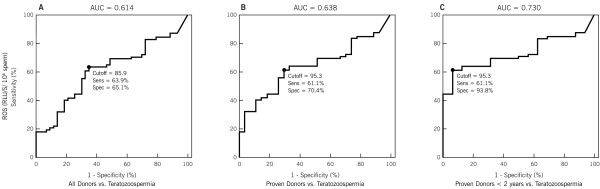
BACKGROUND: Spermatozoa morphology is an important and complex characteristic of the fertilization capacity of male germ cells. Morphological abnormalities have been observed to be accompanied by reactive oxygen species (ROS) overproduction and further damage to spermatozoa, ultimately leading to infertility. Therefore, this study aimed to examine the relationship between seminal ROS production and sperm morphology in infertile teratozoospermic patients as well as in healthy men of proven and unproven fertility. METHODS: Semen samples were collected from 79 patients classified as teratozoospermic and 56 healthy donors (control). Standard semen analysis was performed and spermatozoa morphology was assessed according to the WHO 2010 guidelines. Seminal ROS was measured by chemiluminescence assay. Receiver operating characteristic (ROC) curves were generated, and sensitivity, specificity, cutoff value and area under curve (AUC) were determined. RESULTS: Sperm morphology was significantly poor in the Teratozoospermic Group compared with the 3 Donor Groups (P < 0.05). Significantly higher levels of ROS (RLU/sec/10⁶ sperm) were seen in the Teratozoospermic group (145.4 (41.5; 555.4) compared to the Donor Groups: All Donors (64.8 (21.1; 198.2), Proven Donors (58.8 (14.2; 79.2) and Proven Donors < 2 years (58.8 (14.2; 79.2) (P < 0.05). ROS correlated negatively with sperm concentration in the All Donor group (r = -0.354; P = 0.021) as well as in the Teratozospermic group (r -0.356; P = 0.002). Using ROC analysis, we established the cutoff values for concentration, morphology and ROS. CONCLUSIONS: The incidence of teratozoospermia may be directly related to the overproduction of seminal ROS. Therefore, besides sperm concentration and motility, spermatozoa morphology should receive an equally important consideration in the overall assessment of male fertility.
Overview
The claims and statistics of this paper haven’t been checked yet.
Run the check — free, no account needed. It reads the open-access text and checks the sources it cites.
Integrity signals
Registry
Cites
Statistics
Figures
Verification
Claims the paper makes
The claims and statistics of this paper haven’t been checked yet.
Run the check — free, no account needed. It reads the open-access text and checks the sources it cites.
Claims other papers make about this one
Each is checked against this paper’s own text: does it say what the citing paper says it does?
The source backs part of the claim, not all of it — or backs it for a different population, condition or comparison.
In the citing paper
“Some studies have shown a correlation between sperm morphological defects and nuclear genetic defects, apoptotic alterations, and reactive oxidative stress, which may negatively impact fertility potential (13-15).”
From Isolated teratozoospermia: revisiting its relevance in male infertility: a narrative review (2024) · cites this paper as [15]
Experimental — accuracy not yet measuredThe source backs part of the claim, not all of it — or backs it for a different population, condition or comparison.
In the citing paper
“While some morphological defects are associated with specific functional deficiencies, such as those with tail defects that result in abnormal motility, abnormal sperm morphology, in general, has shown a correlation with changes in genetic materials, increased rate of apoptosis, overproduction of oxidative stress as well as a decrease in antioxidant activities (13-15).”
From Isolated teratozoospermia: revisiting its relevance in male infertility: a narrative review (2024) · cites this paper as [15]
Experimental — accuracy not yet measured
Self-check
Percentages, sums and reported differences re-computed from the paper’s own numbers.
The self-check needs the paper’s full text.
Citations
Cites
Sperm Morphology, Motility, and Concentration in Fertile and Infertile Men
Guzick, D. S., Overstreet, J. W., Factor-Litvak, P., Brazil, C. K., Nakajima, S. T., Coutifaris, C., Carson, S. A., Cisneros, P., Steinkampf, M. P., Hill, J. A., et al. (2001) · New England Journal of Medicine · doi:10.1056/nejmoa003005 · Cited by 1,336
Reactive Oxygen Species and Sperm Function—In Sickness and In Health
Aitken, R. J., Jones, K. T., & Robertson, S. A. (2012) · Journal of Andrology · doi:10.2164/jandrol.112.016535 · Cited by 387
Aitken, R. J., & Curry, B. J. (2010) · Antioxidants and Redox Signaling · doi:10.1089/ars.2010.3186 · Cited by 384
Gómez, E., Buckingham, D. W., Brindle, J., Lanzafame, F., Irvine, D. S., & Aitken, R. J. (1996) · Journal of Andrology · doi:10.1002/j.1939-4640.1996.tb01783.x · Cited by 375
Gil-Guzman, E., Ollero, M., Lopez, M. C., Sharma, R. K., Alvarez, J. G., Thomas, A. J., & Agarwal, A. (2001) · Human Reproduction · doi:10.1093/humrep/16.9.1922 · Cited by 370
Self-citationAziz, N., Saleh, R. A., Sharma, R. K., Lewis‐Jones, I., Esfandiari, N., Thomas, A. J., Jr., & Agarwal, A. K. (2004) · Fertility and Sterility · doi:10.1016/j.fertnstert.2003.06.026 · Cited by 304
Self-citationChemes, H. (2003) · Human Reproduction Update · doi:10.1093/humupd/dmg034 · Cited by 291
Menkveld, R. (2001) · Human Reproduction · doi:10.1093/humrep/16.6.1165 · Cited by 265
Success and failure in human spermatogenesis as revealed by teratozoospermic RNAs
Platts, A. E., Dix, D. J., Chemes, H., Thompson, K. E., Goodrich, R. J., Rockett, J. C., Rawe, V. Y., Quintana, S., Diamond, M. P., Strader, L. F., et al. (2007) · Human Molecular Genetics · doi:10.1093/hmg/ddm012 · Cited by 261
Sperm DNA damage in male infertility: etiologies, assays, and outcomes
Schulte, R. T., Ohl, D. A., Sigman, M., & Smith, G. D. (2009) · Journal of Assisted Reproduction and Genetics · doi:10.1007/s10815-009-9359-x · Cited by 260
Research works printed but not linked: 1
- 10.1056/NEJMoa003005 · DOI · Paper page
Cited by
Sorted by citations
Minhas, S., Bettocchi, C., Boeri, L., Capogrosso, P., Carvalho, J., Çilesiz, N. C., Cocci, A., Corona, G., Dimitropoulos, K., Gül, M., et al. (2021) · European Urology · doi:10.1016/j.eururo.2021.08.014 · Cited by 643
Oxidative stress and sperm function: A systematic review on evaluation and management
Dutta, S., Majzoub, A. A., & Agarwal, A. K. (2019) · Arab Journal of Urology · doi:10.1080/2090598x.2019.1599624 · Cited by 505
Self-citationMale infertility testing: reactive oxygen species and antioxidant capacity
Ko, E., Sabanegh, E. S., & Agarwal, A. K. (2014) · Fertility and Sterility · doi:10.1016/j.fertnstert.2014.10.020 · Cited by 345
Self-citationContemporary evidence on the physiological role of reactive oxygen species in human sperm function
du Plessis, S. S., Agarwal, A. K., Halabi, J., & Tvrdá, E. (2015) · Journal of Assisted Reproduction and Genetics · doi:10.1007/s10815-014-0425-7 · Cited by 301
Self-citationAgarwal, A., Cho, C., & Esteves, S. C. (2015) · Asian Journal of Andrology · doi:10.4103/1008-682x.170441 · Cited by 280
Self-citation
Metadata
- Authors
- Agarwal, A., Tvrda, E., & Sharma, R.
- Affiliations
- Cleveland Clinic (US)
- Corresponding author
- Agarwal, Ashok
- Venue
- Reproductive Biology and Endocrinology
- Published
- 2014
- Volume
- 12
- Issue
- 1
- Pages
- 45
- ISSN
- 1477-7827 (ISSN-L)
- PMC
- PMC4049374
- OpenAlex
- W2129147752
- Cited by
- 176
- References
- 51
- Citations by year
- 2026: 10 · 2025: 8 · 2024: 17 · 2023: 12 · 2022: 14 · 2021: 17 · 2020: 15 · 2019: 15 · 2018: 18 · 2017: 14 · 2016: 18 · 2015: 13 · 2014: 5
- FWCI
- 20.24
- Type
- journal article
- Language
- en
- Open access
- gold
- doi.org
- Licence
- cc-by
- Locations
- Reproductive Biology and Endocrinology (publishedVersion, cc-by)
- PubMed Central (publishedVersion, cc-by)
- PubMed (publishedVersion)
- Topics
- Health Sciences › Medicine › Reproductive Medicine › Sperm and Testicular Function
- Health Sciences › Medicine › Reproductive Medicine › Reproductive Health and Technologies
- Health Sciences › Medicine › Reproductive Medicine › Reproductive Biology and Fertility
- Keywords
- teratozoospermia, seminal oxidative stress, reactive oxygen species, male infertility, sperm morphology, sperm concentration, sperm motility, semen analysis, chemiluminescence, cut-off values
- MeSH terms
- Adult, Fertility, Humans, Infertility, Male, Male, Ohio, ROC Curve, Semen, Sensitivity and Specificity, Spermatozoa, Tissue Donors, Biomarkers, Up-Regulation, Reactive Oxygen Species, Oxidative Stress, Cell Shape, Semen Analysis, Young Adult
About these checks
Registry, retraction, Cites and statistics results are computed, not judged, with one exception: a printed reference that no index lists is read once by a model before it counts as a citation error. Claims are extracted by a model and kept only when their quote appears verbatim in the text; each cited source is then checked, with a model’s help, for whether it says what the claim relies on. Those verdicts can be wrong — read the claim’s quote and the cited source before relying on one.
Statistics and arithmetic are recomputed, not judged.
Confidence bands are shown only for fields calibrated on our annotated test set. None is calibrated yet, so no band is shown.
What counts as a claim ›How we measure confidence ›How we check this ›
Are you an author, or do you see a problem with this page? Request a review
