

The DOI matches its Crossref record; 50 of the 52 references it cites were found in a registry or an index, and 2 are not checked yet.
Measuring physical activity during pregnancy
Open accessAbstract
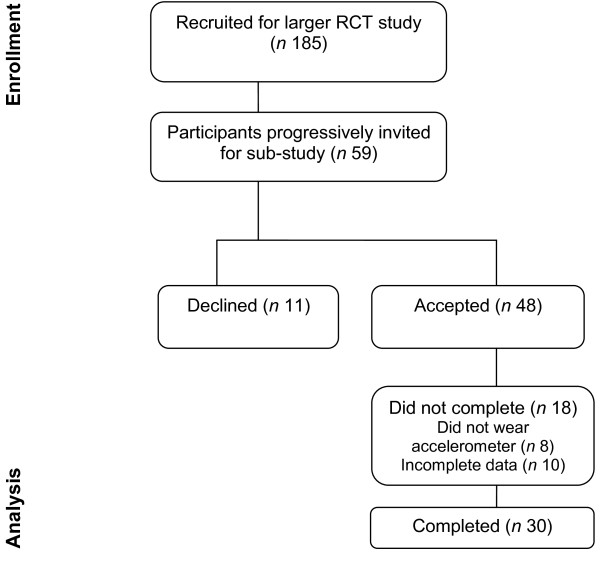
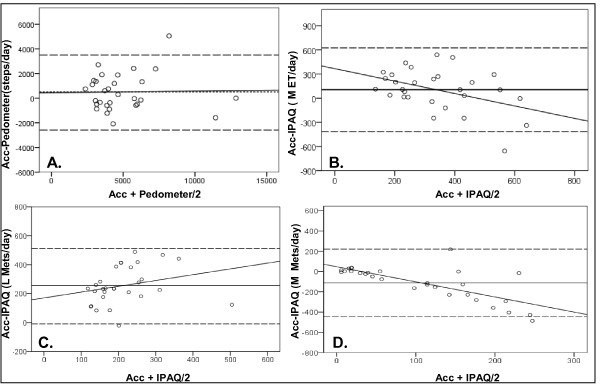
Background: Currently, little is known about physical activity patterns in pregnancy with prior estimates predominantly based on subjective assessment measures that are prone to error. Given the increasing obesity rates and the importance of physical activity in pregnancy, we evaluated the relationship and agreement between subjective and objective physical activity assessment tools to inform researchers and clinicians on optimal assessment of physical activity in pregnancy. Methods: 48 pregnant women between 26-28 weeks gestation were recruited. The Yamax pedometer and Actigraph accelerometer were worn for 5-7 days under free living conditions and thereafter the International Physical Activity Questionnaire (IPAQ) was completed. IPAQ and pedometer estimates of activity were compared to the more robust and accurate accelerometer data. Results: Of 48 women recruited, 30 women completed the study (mean age: 33.6 ± 4.7 years; mean BMI: 31.2 ± 5.1 kg/m 2) and 18 were excluded (failure to wear [n = 8] and incomplete data [n = 10]). The accelerometer and pedometer correlated significantly on estimation of daily steps (ρ = 0.69, p < 0.01) and had good absolute agreement with low systematic error (mean difference: 505 ± 1498 steps/day). Accelerometer and IPAQ estimates of total, light and moderate Metabolic Equivalent minutes/day (MET min-1 day-1) were not significantly correlated and there was poor absolute agreement. Relative to the accelerometer, the IPAQ under predicted daily total METs (105.76 ± 259.13 min-1 day-1) and light METs (255.55 ± 128.41 min-1 day-1) and over predicted moderate METs (-112.25 ± 166.41 min-1 day-1). Conclusion: Compared with the accelerometer, the pedometer appears to provide a reliable estimate of physical activity in pregnancy, whereas the subjective IPAQ measure performed less accurately in this setting. Future research measuring activity in pregnancy should optimally encompass objective measures of physical activity. Trial Registration: Australian New Zealand Clinical Trial Registry Number: ACTRN12608000233325. Registered 7/5/2008.
Overview
The claims and statistics of this paper haven’t been checked yet.
Run the check — free, no account needed. It reads the open-access text and checks the sources it cites.
Integrity signals
Registry
Cites
Statistics
Figures
Verification
Claims the paper makes
The claims and statistics of this paper haven’t been checked yet.
Run the check — free, no account needed. It reads the open-access text and checks the sources it cites.
Claims other papers make about this one
Each is checked against this paper’s own text: does it say what the citing paper says it does?
The source backs part of the claim, not all of it — or backs it for a different population, condition or comparison.
In the citing paper
“Hence, substantial physical activity is required to achieve an energy deficit and weight loss.47,48,49”
From Association of Antenatal Diet and Physical Activity–Based Interventions With Gestational Weight Gain and Pregnancy Outcomes: A Systematic Review and Meta-analysis (2022) · cites this paper as [48]
Experimental — accuracy not yet measured
Self-check
Percentages, sums and reported differences re-computed from the paper’s own numbers.
The self-check needs the paper’s full text.
Citations
Cites
STATISTICAL METHODS FOR ASSESSING AGREEMENT BETWEEN TWO METHODS OF CLINICAL MEASUREMENT
Martin Bland, J., & Altman, D. (1986) · The Lancet · doi:10.1016/s0140-6736(86)90837-8 · Cited by 47,965
International physical activity questionnaire: 12-country reliability and validity
CRAIG, C. L., MARSHALL, A. L., SJ??STR??M, M., BAUMAN, A. E., BOOTH, M. L., AINSWORTH, B. E., PRATT, M., EKELUND, U., YNGVE, A., SALLIS, J. F., et al. (2003) · Medicine & Science in Sports & Exercise · doi:10.1249/01.mss.0000078924.61453.fb · Cited by 21,619
Beckett, A. H., Rowland, M., & TURNER, P. (1965) · The Lancet · doi:10.1016/s0140-6736(65)91037-8 · Cited by 16,917
Measuring agreement in method comparison studies
Bland, J. M., & Altman, D. G. (1999) · Statistical Methods in Medical Research · doi:10.1177/096228029900800204 · Cited by 9,619
Measuring agreement in method comparison studies
Bland, J. M., & Altman, D. G. (1999) · Statistical Methods in Medical Research · doi:10.1191/096228099673819272 · Cited by 9,619
Calibration of the Computer Science and Applications, Inc. accelerometer
FREEDSON, P. S., MELANSON, E., & SIRARD, J. (1998) · Medicine & Science in Sports & Exercise · doi:10.1097/00005768-199805000-00021 · Cited by 3,825
A simple method to assess exercise behavior in the community.
Godin, G., & Shephard, R. J. (1985) · PubMed · Cited by 3,759
Conducting accelerometer-based activity assessments in field-based research
TROST, S. G., MCIVER, K. L., & PATE, R. R. (2005) · Medicine & Science in Sports & Exercise · doi:10.1249/01.mss.0000185657.86065.98 · Cited by 2,033
Healy, G. N., Dunstan, D. W., Salmon, J., Cerin, E., Shaw, J. E., Zimmet, P. Z., & Owen, N. (2008) · Diabetes Care · doi:10.2337/dc07-2046 · Cited by 1,465
Moher, D., Schulz, K. F., Altman, D. G., & for the CONSORT Group* (2001) · Annals of Internal Medicine · doi:10.7326/0003-4819-134-8-200104170-00011 · Cited by 1,426
Cited by
Sorted by citations
Cleland, C., Hunter, R. F., Kee, F., Cupples, M., Sallis, J. F., & Tully, M. A. (2014) · BMC Public Health · doi:10.1186/1471-2458-14-1255 · Cited by 628
Cleland, C., Ferguson, S., Ellis, G., & Hunter, R. F. (2018) · BMC Medical Research Methodology · doi:10.1186/s12874-018-0642-3 · Cited by 425
Teede, H. J., Bailey, C., Moran, L. J., Bahri Khomami, M., Enticott, J., Ranasinha, S., Rogozińska, E., Skouteris, H., Boyle, J. A., Thangaratinam, S., et al. (2022) · JAMA Internal Medicine · doi:10.1001/jamainternmed.2021.6373 · Cited by 329
Self-citationSilsbury, Z., Goldsmith, R. H., & Rushton, A. (2015) · BMJ Open · doi:10.1136/bmjopen-2015-008430 · Cited by 200
Effectiveness of active school transport interventions: a systematic review and update
Larouche, R., Mammen, G., Rowe, D. A., & Faulkner, G. (2018) · BMC Public Health · doi:10.1186/s12889-017-5005-1 · Cited by 198
Metadata
- Authors
- Harrison, C. L., Thompson, R. G., Teede, H. J., & Lombard, C. B.
- Affiliations
- Jean Hailes (AU)
- Monash University (AU)
- Corresponding author
- Lombard, Catherine B
- Venue
- International Journal of Behavioral Nutrition and Physical Activity
- Published
- 2011-03-21
- Volume
- 8
- Issue
- 1
- Pages
- 19-19
- ISSN
- 1479-5868 (ISSN-L)
- PMC
- PMC3069935
- OpenAlex
- W2114726529
- Cited by
- 139
- References
- 50
- Citations by year
- 2026: 6 · 2025: 5 · 2024: 3 · 2023: 11 · 2022: 8 · 2021: 11 · 2020: 11 · 2019: 11 · 2018: 15 · 2017: 11 · 2016: 7 · 2015: 12 · 2014: 8 · 2013: 11 · 2012: 8
- FWCI
- 6.11
- Type
- journal article
- Language
- en
- Open access
- gold
- doi.org
- Licence
- cc-by
- Locations
- International Journal of Behavioral Nutrition and Physical Activity (publishedVersion, cc-by)
- PubMed Central (publishedVersion, cc-by)
- PubMed (publishedVersion)
- Minerva Access (University of Melbourne) (submittedVersion, cc-by)
- DOAJ (DOAJ: Directory of Open Access Journals) (submittedVersion, cc-by-sa)
- Funders
- Eli Lilly and Company
- Jack Brockhoff Foundation
- Topics
- Health Sciences › Medicine › Public Health, Environmental and Occupational Health › Physical Activity and Health
- Physical Sciences › Computer Science › Computer Vision and Pattern Recognition › Context-Aware Activity Recognition Systems
- Health Sciences › Health Professions › General Health Professions › Mobile Health and mHealth Applications
- Keywords
- exercise during pregnancy, accelerometer, pedometers, International Physical Activity Questionnaire, daily step count, metabolic equivalent minutes, gestational obesity
- MeSH terms
- Energy Metabolism, Female, Humans, Motor Activity, Pregnancy, Surveys and Questionnaires, Reproducibility of Results, Exercise, Walking, Monitoring, Ambulatory, Actigraphy, Self Report
About these checks
Registry, retraction, Cites and statistics results are computed, not judged, with one exception: a printed reference that no index lists is read once by a model before it counts as a citation error. Claims are extracted by a model and kept only when their quote appears verbatim in the text; each cited source is then checked, with a model’s help, for whether it says what the claim relies on. Those verdicts can be wrong — read the claim’s quote and the cited source before relying on one.
Statistics and arithmetic are recomputed, not judged.
Confidence bands are shown only for fields calibrated on our annotated test set. None is calibrated yet, so no band is shown.
What counts as a claim ›How we measure confidence ›How we check this ›
Are you an author, or do you see a problem with this page? Request a review
