

Physical activity levels six months after a randomised controlled physical activity intervention for Pakistani immigrant men living in Norway
Open accessThe DOI matches its Crossref record; 54 of the 54 references it cites were found in a registry or an index.
Abstract
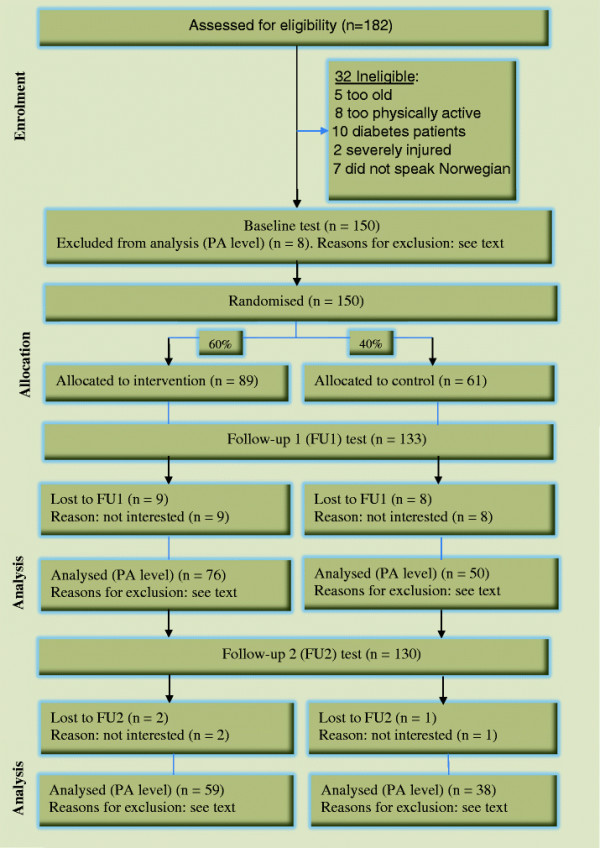
BACKGROUND: To our knowledge, no studies have aimed at improving the PA level in south Asian immigrant men residing in Western countries, and few studies have considered the relevance of SCT constructs to the PA behaviour of this group in the long term. The observed low physical activity (PA) level among south Asian immigrants in Western countries may partly explain the high prevalence of cardiovascular diseases (CVD) and type 2 diabetes (T2D) in this group. We have shown previously in a randomised controlled trial, the Physical Activity and Minority Health study (PAMH) that a social cognitive based intervention can beneficially influence PA level and subsequently reduce waist circumference and insulin resistance in the short-term. In an extended follow-up of the PAMH study: we aimed 1) to determine if the intervention produced long-term positive effects on PA level six months after intervention (follow-up 2 (FU2)), and 2) to identify the social cognitive mediators of any intervention effects. METHODS: Physically inactive Pakistani immigrant men (n = 150) who were free of CVD and T2D were randomly assigned to a five months PA intervention or a control group. Six months after the intervention ended, we telephoned all those who attended FU1 and invited them for a second follow-up test (FU2) (n = 133). PA was measured using ActiGraph accelerometers. Statistical differences between groups were determined by use of ANCOVA. RESULTS: Significant differences (baseline to FU2) between the groups were found for all PA variables (e.g., total PA level, sedentary time, PA intensity). Support from family and outcome expectancies increased more in the intervention group compared with the control group. Self-efficacy did not differ significantly between groups. CONCLUSIONS: Our results show that a multi component PA programme can increase PA over the short and long term in a group of immigrant Pakistani men. However, we could not identify the factors that mediated these changes in PA. PROTOCOL ID: 07112001326, NCT ID: NCT00539903.
Overview
The claims and statistics of this paper haven’t been checked yet.
Free: it reads the open-access text and checks the first 5 claims that cite a source we can check. Create a free account to check every claim.
Integrity signals
Registry
Cites
Statistics
Figures
Verification
Claims the paper makes
The claims and statistics of this paper haven’t been checked yet.
Free: it reads the open-access text and checks the first 5 claims that cite a source we can check. Create a free account to check every claim.
Claims other papers make about this one
Each is checked against this paper’s own text: does it say what the citing paper says it does?
The source backs part of the claim, not all of it — or backs it for a different population, condition or comparison.
In the citing paper
“Most, but not all, studies on physical activity treatment programs have reported small, sustained increases in physical activity levels after termination of the supervised program.20, 21, 22, 23, 24”
From Healthy weight loss maintenance with exercise, GLP-1 receptor agonist, or both combined followed by one year without treatment: a post-treatment analysis of a randomised placebo-controlled trial (2024) · cites this paper as [20]
Experimental — accuracy not yet measuredThe source backs part of the claim, not all of it — or backs it for a different population, condition or comparison.
In the citing paper
“These studies are heterogeneous regarding duration, physical activity intervention, degree of supervision, and study population.”
From Healthy weight loss maintenance with exercise, GLP-1 receptor agonist, or both combined followed by one year without treatment: a post-treatment analysis of a randomised placebo-controlled trial (2024) · cites this paper as [20]
Experimental — accuracy not yet measured
Self-check
Percentages, sums and reported differences re-computed from the paper’s own numbers.
The self-check needs the paper’s full text.
Citations
Cites
Baron, R. M., & Kenny, D. A. (1986) · Journal of Personality and Social Psychology · doi:10.1037/0022-3514.51.6.1173 · Cited by 91,532 · cited 2×
“According to Baron and Kenny (1986), several steps are required to demonstrate a mediation effect [49].”
BackgroundMatthews, D. R., Hosker, J. P., Rudenski, A. S., Naylor, B. A., Treacher, D. F., & Turner, R. C. (1985) · Diabetologia · doi:10.1007/bf00280883 · Cited by 31,502 · cited 1×
“[50]) or had the metabolic syndrome (50%), espe-”
BackgroundReduction in the incidence of type 2 diabetes with lifestyle intervention or metformin
(2002) · New England Journal of Medicine · doi:10.1056/nejmoa012512 · Cited by 19,011 · cited 1×
“A physically active lifestyle seems to be protective [5-11].”
BackgroundTuomilehto, J., Lindström, J., Eriksson, J. G., Valle, T. T., Hämäläinen, H., Ilanne-Parikka, P., Keinänen-Kiukaanniemi, S., Laakso, M., Louheranta, A., Rastas, M., et al. (2001) · New England Journal of Medicine · doi:10.1056/nejm200105033441801 · Cited by 10,873 · cited 1×
“A physically active lifestyle seems to be protective [5-11].”
BackgroundPhysical Activity in the United States Measured by Accelerometer
TROIANO, R. P., BERRIGAN, D., DODD, K. W., MÂSSE, L. C., TILERT, T., & MCDOWELL, M. (2008) · Medicine & Science in Sports & Exercise · doi:10.1249/mss.0b013e31815a51b3 · Cited by 7,638 · cited 1×
“In the analysis of accelerometer data, epoch periods with a value of zero for 60 min (with allowance for two exceptions above zero) or longer were interpreted as “accelerometer not worn” and removed from the analyses [42,44].”
MethodHealth Promotion by Social Cognitive Means
Bandura, A. (2004) · Health Education & Behavior · doi:10.1177/1090198104263660 · Cited by 7,238 · cited 13×
“Also, few interventions have considered the relevance of SCT constructs to the PA behaviour of this group.”
BackgroundInfluentialReliability of the PEDro Scale for Rating Quality of Randomized Controlled Trials
Maher, C. G., Sherrington, C., Herbert, R. D., Moseley, A. M., & Elkins, M. (2003) · Physical Therapy · doi:10.1093/ptj/83.8.713 · Cited by 4,808 · cited 1×
“RCTs that are not blinded tend to show greater intervention effects than RCTs that have this feature [55].”
BackgroundCalibration of the Computer Science and Applications, Inc. accelerometer
FREEDSON, P. S., MELANSON, E., & SIRARD, J. (1998) · Medicine & Science in Sports & Exercise · doi:10.1097/00005768-199805000-00021 · Cited by 3,825
Amount of Time Spent in Sedentary Behaviors in the United States, 2003-2004
Matthews, C. E., Chen, K. Y., Freedson, P. S., Buchowski, M. S., Beech, B. M., Pate, R. R., & Troiano, R. P. (2008) · American Journal of Epidemiology · doi:10.1093/aje/kwm390 · Cited by 2,631
What is meant by intention to treat analysis? Survey of published randomised controlled trials
Hollis, S., & Campbell, F. (1999) · BMJ · doi:10.1136/bmj.319.7211.670 · Cited by 2,160 · cited 1×
“A major limitation is the attrition between baseline and FU2, which may have caused loss of the feature of randomisation [54].”
Background
Research works printed but not linked: 3
- Luszczynska A Schwarzer R Conner M, Norman P Social cognitive theory Prediciting health behaviour 2008 2 Open University Press, Buckingham, England 127 169
- Netto G Bhopal R Khatoon J Lederle N Jackson A A Health promotion and prevention interventions in Pakistani, Chines and Indian communiities related to CVD and Cancer, review of the published evidence in the UK, other parts of Europe and the United States 2008 A report commisioned by the NHS Health Scotland, http://www.healthscotland.com/uploads/documents/8886-HealthPromotionAndPreventionInterventions20080801.pdf
- Davey GJG Roberts JD Patel S Pierpoint T Godsland IF Davies B Mckeigue PM Effects of exercise on insulin resistance in South Asians and Europeans Journal of Exercise Physiology 2000 3
Cited by
Prince, S. A., Saunders, T. J., Gresty, K., & Reid, R. D. (2014) · Obesity Reviews · doi:10.1111/obr.12215 · Cited by 382
Interventions with potential to reduce sedentary time in adults: systematic review and meta-analysis
Martin, A., Fitzsimons, C., Jepson, R., Saunders, D. H., van der Ploeg, H. P., Teixeira, P. J., Gray, C. M., & Mutrie, N. (2015) · British Journal of Sports Medicine · doi:10.1136/bjsports-2014-094524 · Cited by 326
Jensen, S. B. K., Blond, M. B., Sandsdal, R. M., Olsen, L. M., Juhl, C. R., Lundgren, J. R., Janus, C., Stallknecht, B. M., Holst, J. J., Madsbad, S., et al. (2024) · eClinicalMedicine · doi:10.1016/j.eclinm.2024.102475 · Cited by 207
Remote and web 2.0 interventions for promoting physical activity
Foster, C. E., Richards, J. A., Thorogood, M., & Hillsdon, M. M. (2013) · Cochrane Database of Systematic Reviews · doi:10.1002/14651858.cd010395.pub2 · Cited by 186
Rhodes, R. E., Boudreau, P., Josefsson, K. W., & Ivarsson, A. (2021) · Health Psychology Review · doi:10.1080/17437199.2019.1706614 · Cited by 172
Face-to-face interventions for promoting physical activity
Richards, J. A., Hillsdon, M. M., Thorogood, M., & Foster, C. E. (2013) · Cochrane Database of Systematic Reviews · doi:10.1002/14651858.cd010392.pub2 · Cited by 110
An Updated Review of Interventions that Include Promotion of Physical Activity for Adult Men
Bottorff, J. L., Seaton, C. L., Johnson, S. T., Caperchione, C. M., Oliffe, J. L., More, K. R., Jaffer-Hirji, H., & Tillotson, S. M. (2014) · Sports Medicine · doi:10.1007/s40279-014-0286-3 · Cited by 144
“Among the studies meeting the inclusion criteria ( n = 35), 24 reported significant increases in men’s physical activity [ 34– 57 ] and Because some of the included articles were separate studies based on the same program (e.g., Healthy Dads, Healthy Kids), the findings are reported based on the 31…”
BackgroundMethodResultInfluentialBrown, T., Smith, S., Bhopal, R., Kasim, A., & Summerbell, C. (2015) · International Journal of Environmental Research and Public Health · doi:10.3390/ijerph120100566 · Cited by 91
“Twenty-nine studies [34–62] were included, with 11 additional linked papers [63–73].”
BackgroundJenum, A. K., Brekke, I., Mdala, I., Muilwijk, M., Ramachandran, A., Kjøllesdal, M. K. R., Andersen, E., Richardsen, K. R., Douglas, A., Cezard, G. I., et al. (2019) · Diabetologia · doi:10.1007/s00125-019-4905-2 · Cited by 90
Self-citationFace-to-face versus remote and web 2.0 interventions for promoting physical activity
Richards, J., Thorogood, M., Hillsdon, M., & Foster, C. (2013) · Cochrane Database of Systematic Reviews · doi:10.1002/14651858.cd010393.pub2 · Cited by 55
Murray, J., Brennan, S., French, D., Patterson, C., Kee, F., & Hunter, R. F. (2018) · Annals of Behavioral Medicine · doi:10.1093/abm/kay012 · Cited by 72
Somali women’s view of physical activity – a focus group study
Persson, G., Mahmud, A. J., Hansson, E. E., & Strandberg, E. L. (2014) · BMC Women s Health · doi:10.1186/1472-6874-14-129 · Cited by 63
“Other studies have shown, just like this study, that regardless of country of origin that support on different levels is crucial to establish an increased level of physical activity in both short and long term [5,41,42].”
Sharp, P., Spence, J. C., Bottorff, J. L., Oliffe, J. L., Hunt, K., Vis‐Dunbar, M., & Caperchione, C. M. (2020) · British Journal of Sports Medicine · doi:10.1136/bjsports-2019-100912 · Cited by 48
“Ultimately, 26 peer reviewed journal articles (Figure 1), representing 24 studies and independent samples,(43-68) were included in the review.”
BackgroundMasri, A. E., Kolt, G. S., & George, E. S. (2019) · Ethnicity and Health · doi:10.1080/13557858.2019.1658183 · Cited by 41
“…the use of focus groups or community involvement to inform the design of their program reported increases in PA in favour of the intervention group (Andersen, Burton, and Anderssen 2012; Andersen et al. 2013; Hartman et al. 2017; King et al. 2013; Marcus et al. 2013, 2015, 2016; Maxwell et al.…”
BackgroundA systematic review of interventions to increase physical activity among South Asian adults
Horne, M., Tierney, S., Henderson, S., Wearden, A. J., & Skelton, D. A. (2018) · Public Health · doi:10.1016/j.puhe.2018.05.009 · Cited by 35
“Paper Cultural adaptations Design theory Andersen et al. (2012) [36] Used representatives from the Pakistani community to plan and develop the intervention Participatory/collaborative approach”
Cardiovascular risk assessment in South and Middle-East Asians living in the Western countries
Saeed, S., Kanaya, A. M., Bennet, L., & Nilsson, P. M. (2020) · Pakistan Journal of Medical Sciences · doi:10.12669/pjms.36.7.3292 · Cited by 27
Olaya‐Contreras, P., Lundgren, K. B., Siddiqui, F., & Bennet, L. (2019) · BMJ Open · doi:10.1136/bmjopen-2018-028076 · Cited by 26
Bell, O. J., Flynn, D., Clifford, T., West, D. J., Stevenson, E., & Avery, L. (2023) · International Journal of Behavioral Nutrition and Physical Activity · doi:10.1186/s12966-023-01425-1 · Cited by 25
“The importance of longevity to older men (UK retirement age) is highlighted in the Health, Illness, Men and Masculinities (HIMM) framework [49].”
BackgroundTerragni, L., Beune, E., Stronks, K., Davidson, E. M., Qureshi, S. A., Kumar, B., & Díaz, E. (2018) · Public Health · doi:10.1016/j.puhe.2018.04.008 · Cited by 25
Sher, C., & Wu, C. (2023) · Canadian Review of Sociology/Revue canadienne de sociologie · doi:10.1111/cars.12451 · Cited by 24
O GeoGebra 3D no Estudo de Projeções Ortogonais Amparado pela Teoria das Situações Didáticas
de Sousa, R. T., de Azevedo, I. F., & Alves, F. R. V. (2021) · Jornal Internacional de Estudos em Educação Matemática · doi:10.17921/2176-5634.2021v14n1p92-98 · Cited by 21
Carroll, P., Harrison, M., Richardson, N., Robertson, S., Keohane, A., Kelly, L. P., & Donohoe, A. (2018) · Journal of Physical Activity Research · doi:10.12691/jpar-3-1-4 · Cited by 20
“The evaluation findings from both programmes coupled with those from published literature of similar programmes elsewhere [11,20,21] and considerable reflective practice by practitioners, formed the evidence base for the current MoM programme design (see Table 1 - online supporting information).”
BackgroundResultMigration and Health : A literature review of the health of immigrant populations in Norway
Attanapola, C. T. (2013) · BIBSYS Brage (BIBSYS (Norway)) · Cited by 18
Physical Activity in a Randomized Culturally Adapted Lifestyle Intervention
Siddiqui, F., Koivula, R. W., Kurbasic, A., Lindblad, U., Nilsson, P. M., & Bennet, L. (2018) · American Journal of Preventive Medicine · doi:10.1016/j.amepre.2018.04.016 · Cited by 14
Wikström, K., Hussein, I., Virtanen, E., Langari, M. N. M., Mattila, E., & Lindström, J. (2021) · Annali dell Istituto Superiore di Sanità · doi:10.4415/ann_21_01_13 · Cited by 13
“In Europe, culturally adapted lifestyle interventions have mainly been carried out in South Asian immigrants with high risk for diabetes [19, 21, 29, 30].”
Davidson, E. M., Krasuska, M., Jenum, A. K., Gill, J. M. R., Beune, E., Stronks, K., van Valkengoed, I. G. M., Díaz, E., & Sheikh, A. (2021) · Diabetic Medicine · doi:10.1111/dme.14584 · Cited by 12
“35 Trusting relationships between participants and dietitians contributed to the high retention rate…In some cases it seemed that participant loyalty was to the dietitian rather than the trial.”
BackgroundEffects of Reducing Sedentary Time on Glucose Metabolism in Immigrant Pakistani Men
Andersen, E., Ekelund, U., & Anderssen, S. A. (2014) · Medicine & Science in Sports & Exercise · doi:10.1249/mss.0000000000000460 · Cited by 12
“definition, a reduction in sedentary time must therefore be associated with an increase in overall PA, and we have previously demonstrated that a social cognitive theory-based multicomponent PA program beneficially influenced PA level (4) and postprandial plasma glucose and insulin concentrations (5) in immigrant Paki…”
BackgroundSelf-citationLifestyle Interventions for Diabetes Prevention in South Asians: Current Evidence and Opportunities
Weber, M. B., Gujral, U. P., Jagannathan, R., & Shah, M. K. (2021) · Current Diabetes Reports · doi:10.1007/s11892-021-01393-5 · Cited by 12
Mohamed-Bibi, S., Vaqué-Crusellas, C., & Alonso, N. (2022) · Nutrients · doi:10.3390/nu14245239 · Cited by 11
“Changes in food habits among Pakistani immigrant women in Oslo, Norway.”
BackgroundInfluentialKang, C.-H., & Han, Y. R. (2016) · Research in Community and Public Health Nursing · doi:10.12799/jkachn.2016.27.3.202 · Cited by 10
Factors Associated with Physical Activity among Chinese Immigrant Women
Cho, S.-H., & Lee, H. (2013) · Journal of Korean Academy of Nursing · doi:10.4040/jkan.2013.43.6.760 · Cited by 10
Robertson, S., Carroll, P., Donohoe, A., Richardson, N., Keohane, A., Kelly, L. P., & Harrison, M. (2018) · International Journal of Men s Social and Community Health · doi:10.22374/ijmsch.v1i1.14 · Cited by 8
Mohamed-Bibi, S., Contreras-Hernández, J., & Vaqué-Crusellas, C. (2022) · International Journal of Environmental Research and Public Health · doi:10.3390/ijerph191610386 · Cited by 8
Somali women's view of physical activity—a focus group study
Persson, G. (2015) · Physiotherapy · doi:10.1016/j.physio.2015.03.2125 · Cited by 7
Mahmood, B., Afshar, R., & Tang, T. S. (2017) · Current Diabetes Reports · doi:10.1007/s11892-017-0850-y · Cited by 7
Persson, G. (2014) · Lund University Publications (Lund University) · Cited by 6
Decrease in Self-Efficacy for Exercise at 12 Weeks after Exercise Education in Diabetic Patients
Matsui, N., Washida, K., Shoji, M., Nakaizumi, D., Kitagawa, T., Terada, S., & Uchiyama, K. (2017) · Health · doi:10.4236/health.2017.94046 · Cited by 3
Quronfulah, B. S. (2019) · Queensland University of Technology · doi:10.5204/thesis.eprints.134422 · Cited by 3
The Injury Consequences of Promoting Physical Activity : An Evidence Review
Girardi, A., Babul, S., Rajabali, F., & Pike, I. (2021) · cIRcle (University of British Columbia) · doi:10.14288/1.0397341 · Cited by 3
Hall, J. F., Corepal, R., Crocker, T. F., Lam, N., Burton, L.-J., Birch, K. M., Carter, G., Clarke, D. J., English, C., Farrin, A. J., et al. (2021) · medRxiv · doi:10.1101/2021.05.27.21256673 · Cited by 3
“counselling and structured/prescribed physical activity (showing a reduction in sedentary behaviour by 60 and 92 minutes per day immediately and 6 months post-intervention, respectively) (114).”
BackgroundInfluentialRole of physical activity in GLP-1 receptor agonist therapy for obesity treatment
Zdziebkowski, Ł., Wilska, H., Szatkowska, D., Ziętara, D., Kmieć, K. K., Topolska, A., Komorowski, M., Janiszewski, M., Surosz, N., Grochowalski, M., et al. (2025) · Quality in Sport · doi:10.12775/qs.2025.43.62342 · Cited by 2
“Although GLP-1 RA has impressive effects on body mass reduction after termination of pharmacotherapy weight regain appears and if no behavioural habits were implemented [27, 28].”
Patel, R., Kornas, K., Gerstle, D. S., Diemert, L. M., & Rosella, L. C. (2025) · JMIR Public Health and Surveillance · doi:10.2196/70267 · Cited by 2
“…at the micro-macro levels featured peer-led initiatives tailored for Latinx communities [42-44], a recreational soccer program tailored for Hispanic men [45], a lifestyle education program tailored for Chinese Americans [46], and a lifestyle intervention tailored for Pakistani immigrant men [47].”
The ISAC Paradigm to Tame Oral Cancer in Saudi Arabia: A Quasi-experimental Study
Jafer, M. A., Moafa, I., Hoving, C., Candel, M. J. J. M., Kaabi, A. A., & van den Borne, B. H. P. (2023) · Journal of Cancer Education · doi:10.1007/s13187-023-02356-y · Cited by 2
“The ceiling effect is a popular concept in health interventions and longitudinal studies [31, 32].”
BackgroundMohamed-Bibi, S., Ribot, B., & Vaqué-Crusellas, C. (2025) · PLoS ONE · doi:10.1371/journal.pone.0316803 · Cited by 2
A review of culturally tailored interventions to reduce cardiovascular disease in South Asians
Jiwani, R. B., Gerry, S., & Patel, D. I. (2018) · Cardiovascular Disorders and Medicine · doi:10.15761/cdm.1000168 · Cited by 2
“[18] reported significant improvements in physical activity over six months using a community-based intervention.”
BackgroundThewlis, M., de Courten, M., & Pogrmilović, B. K. (2022) · Elsevier eBooks · doi:10.1016/b978-0-323-89843-0.00032-5 · Cited by 1
Kadango, M. (2015) · SETU Waterford Libraries - Open Access Repository · Cited by 1
Hansen, A. F. (2013) · NVA (Nasjonalt vitenarkiv)
Islam, I. (2017) · Loughborough University Institutional Repository (Loughborough University)
REDUCING THE RISK OF TYPE 2 DIABETES IN SOUTH ASIAN POPULATIONS: A SYSTEMATIC REVIEW OF LITERATURE
Darko, A. N. (2017) · NVA (Nasjonalt vitenarkiv)
Forebygging av diabetes type 2 hos ikke-vestlige innvandrere
Stensrud, E. M., & Rasmussen, M. H. (2019) · NVA (Nasjonalt vitenarkiv)
Diabetes Prevention Amongst South Asians: Current Evidence, Challenges, and a Way Forward
Goon, S., & Gujral, U. P. (2023) · Journal of the Indian Institute of Science · doi:10.1007/s41745-023-00364-x
Majed, E. Z., Abdel-Jalil, J., & Lévesque, L. (2025) · Journal of Physical Activity and Health · doi:10.1123/jpah.2024-0534
Kfrerer, M., Gill, D. P., Styffe, C., Aspinall, P., Tang, A., Ovadia, J., Hirsh, C., & Petrella, R. J. (2025) · medRxiv · doi:10.1101/2025.08.29.25334665
“One study empowered ‘health promoters’ or opinion leaders in the community to recruit participants through their own social networks [47], whereas other studies created deep ties to faith-based organizations and leaders to build trust and sustainability [48, 49, 53].”
Bell, O. J., Flynn, D., Clifford, T., West, D., Stevenson, E., & Avery, L. (2023) · Figshare · doi:10.6084/m9.figshare.22626133
Bell, O. J., Flynn, D., Clifford, T., West, D., Stevenson, E., & Avery, L. (2023) · Figshare · doi:10.6084/m9.figshare.22626130
Batista, R. M. (2022) · Lusophone University Repository
Reducing Sedentary Behaviour in the Workplace: A Theory-led Multicomponent Intervention
Nicolson, G. (2021) · Arrow@dit (Dublin Institute of Technology)
Phiri, L., Tomaz, S. A., Clamp, L. D., Micklesfield, L. K., Goedecke, J. H., & Mendham, A. E. (2026) · Research Square · doi:10.21203/rs.3.rs-8670309/v1
Shrestha, R. K., Paudel, S., Rijal, A., Adhikari, T. B., Gradidge, P. J.-L., Khatri, B., Neupane, D., Skejø, S. D., Vaidya, A., Sanders, T., et al. (2026) · International Journal of Behavioral Nutrition and Physical Activity · doi:10.1186/s12966-026-01894-0
“Similarly, a trial among Pakistani-origin men tested a culturally adapted community programme and found device-measured increases in PA after six months [47].”
Metadata
- Authors
- Andersen, E., Burton, N. W., & Anderssen, S. A.
- Affiliations
- Norwegian School of Sport Sciences (NO)
- The University of Queensland (AU)
- Corresponding author
- Andersen, Eivind
- Venue
- International Journal of Behavioral Nutrition and Physical Activity
- Published
- 2012
- Volume
- 9
- Issue
- 1
- Pages
- 47
- ISSN
- 1479-5868 (ISSN-L)
- PMC
- PMC3419654
- OpenAlex
- W2149695327
- Cited by
- 47
- References
- 54
- Citations by year
- 2026: 1 · 2025: 4 · 2024: 1 · 2023: 6 · 2022: 3 · 2021: 4 · 2020: 2 · 2019: 5 · 2018: 7 · 2017: 2 · 2016: 1 · 2015: 3 · 2014: 4 · 2013: 4
- FWCI
- 2.36
- Type
- journal article
- Language
- en
- Open access
- gold
- doi.org
- Licence
- cc-by
- Locations
- International Journal of Behavioral Nutrition and Physical Activity (publishedVersion, cc-by)
- Europe PMC (PubMed Central) (publishedVersion, cc-by)
- PubMed Central (publishedVersion, cc-by)
- PubMed (publishedVersion)
- DOAJ (DOAJ: Directory of Open Access Journals) (submittedVersion)
- Griffith Research Online (submittedVersion, cc-by)
- Funders
- Norges Idrettshøgskole
- Topics
- Health Sciences › Medicine › Public Health, Environmental and Occupational Health › Physical Activity and Health
- Social Sciences › Psychology › Applied Psychology › Behavioral Health and Interventions
- Social Sciences › Life-span and Life-course Studies › Recreational Sport and Physical Activity
- Keywords
- physical activity, South Asian immigrants, social cognitive theory, physical activity interventions, long-term intervention effects, family support, outcome expectations, self-efficacy, sedentary behavior, physical activity intensity, cardiovascular disease, type 2 diabetes, minority health
- MeSH terms
- Adult, Cardiovascular Diseases, Diabetes Mellitus, Type 2, Follow-Up Studies, Humans, Male, Middle Aged, Motor Activity, Norway, Pakistan, Surveys and Questionnaires, Prevalence, Emigrants and Immigrants, Waist Circumference
About these checks
Registry, retraction, Cites and statistics results are computed, not judged, with one exception: a printed reference that no index lists is read once by a model before it counts as a citation error. Claims are extracted by a model and kept only when their quote appears verbatim in the text; each cited source is then checked, with a model’s help, for whether it says what the claim relies on. Those verdicts can be wrong — read the claim’s quote and the cited source before relying on one.
Statistics and arithmetic are recomputed, not judged.
Confidence bands are shown only for fields calibrated on our annotated test set. None is calibrated yet, so no band is shown.
What counts as a claim ›How we measure confidence ›How we check this ›
Are you an author, or do you see a problem with this page? Request a review
Data sources
Bibliographic data: Semantic Scholar, OpenAlex, Crossref.
Contains information from the Semantic Scholar Academic Graph Datasets, made available under the ODC Attribution License (ODC-BY 1.0).
Semantic Scholar’s data is described in: Kinney, R., et al. (2023). The Semantic Scholar Open Data Platform. arXiv:2301.10140.
