

Cancer classification using the Immunoscore: a worldwide task force
Open accessThe DOI matches its Crossref record; 40 of the 40 references it cites were found in a registry or an index.
Abstract
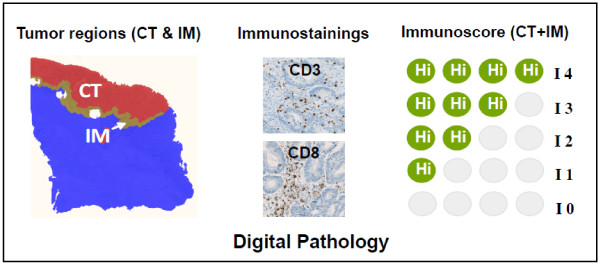
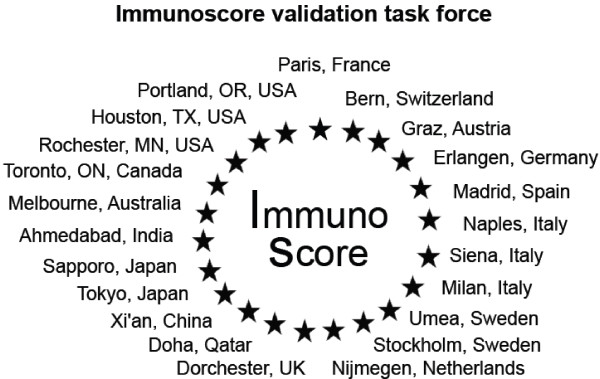
Prediction of clinical outcome in cancer is usually achieved by histopathological evaluation of tissue samples obtained during surgical resection of the primary tumor. Traditional tumor staging (AJCC/UICC-TNM classification) summarizes data on tumor burden (T), presence of cancer cells in draining and regional lymph nodes (N) and evidence for metastases (M). However, it is now recognized that clinical outcome can significantly vary among patients within the same stage. The current classification provides limited prognostic information, and does not predict response to therapy. Recent literature has alluded to the importance of the host immune system in controlling tumor progression. Thus, evidence supports the notion to include immunological biomarkers, implemented as a tool for the prediction of prognosis and response to therapy. Accumulating data, collected from large cohorts of human cancers, has demonstrated the impact of immune-classification, which has a prognostic value that may add to the significance of the AJCC/UICC TNM-classification. It is therefore imperative to begin to incorporate the 'Immunoscore' into traditional classification, thus providing an essential prognostic and potentially predictive tool. Introduction of this parameter as a biomarker to classify cancers, as part of routine diagnostic and prognostic assessment of tumors, will facilitate clinical decision-making including rational stratification of patient treatment. Equally, the inherent complexity of quantitative immunohistochemistry, in conjunction with protocol variation across laboratories, analysis of different immune cell types, inconsistent region selection criteria, and variable ways to quantify immune infiltration, all underline the urgent requirement to reach assay harmonization. In an effort to promote the Immunoscore in routine clinical settings, an international task force was initiated. This review represents a follow-up of the announcement of this initiative, and of the J Transl Med. editorial from January 2012. Immunophenotyping of tumors may provide crucial novel prognostic information. The results of this international validation may result in the implementation of the Immunoscore as a new component for the classification of cancer, designated TNM-I (TNM-Immune).
Overview
The claims and statistics of this paper haven’t been checked yet.
Free: it reads the open-access text and checks the first 5 claims that cite a source we can check. Create a free account to check every claim.
Integrity signals
Registry
Cites
Statistics
Figures
Verification
Claims the paper makes
The claims and statistics of this paper haven’t been checked yet.
Free: it reads the open-access text and checks the first 5 claims that cite a source we can check. Create a free account to check every claim.
Claims other papers make about this one
Each is checked against this paper’s own text: does it say what the citing paper says it does?
The cited source says what the claim attributes to it.
In the citing paper
“Immunohistochemistry (IHC) has been shown to be clinically useful [2]”
From Gene expression markers of Tumor Infiltrating Leukocytes (2017) · cites this paper as [2]
In the citing paper
“The abundance and composition of the immune cells infiltrating a tumor predict both a patient’s prognosis [1–5] and the optimal immunotherapy for their disease [6].”
From Gene expression markers of Tumor Infiltrating Leukocytes (2017) · cites this paper as [2]
Self-check
Percentages, sums and reported differences re-computed from the paper’s own numbers.
The self-check needs the paper’s full text.
Citations
Cites
TNM Classification of Malignant Tumours
(1987) · Springer eBooks · doi:10.1007/978-3-642-82982-6 · Cited by 16,049
Type, Density, and Location of Immune Cells Within Human Colorectal Tumors Predict Clinical Outcome
Galon, J., Costes, A., Sanchez-Cabo, F., Kirilovsky, A., Mlecnik, B., Lagorce-Pagès, C., Tosolini, M., Camus, M., Berger, A., Wind, P., et al. (2006) · Science · doi:10.1126/science.1129139 · Cited by 6,516 · cited 7×
“This was particularly illustrated in CRC [5,9,13,14,19], and should be applicable to most human tumors [23].”
BackgroundMethodInfluentialSelf-citationTNM Classification of Malignant Tumors
Carter, D. (1998) · The American Journal of Surgical Pathology · doi:10.1097/00000478-199810000-00016 · Cited by 6,330
The immune contexture in human tumours: impact on clinical outcome
Fridman, W. H., Pagès, F., Sautès-Fridman, C., & Galon, J. (2012) · Nature reviews. Cancer · doi:10.1038/nrc3245 · Cited by 4,981 · cited 15×
“This was particularly illustrated in CRC [5,9,13,14,19], and should be applicable to most human tumors [23].”
BackgroundResultInfluentialSelf-citationCentral Memory and Effector Memory T Cell Subsets: Function, Generation, and Maintenance
Sallusto, F., Geginat, J., & Lanzavecchia, A. (2004) · Annual Review of Immunology · doi:10.1146/annurev.immunol.22.012703.104702 · Cited by 3,067
Effector Memory T Cells, Early Metastasis, and Survival in Colorectal Cancer
Pagès, F., Berger, A., Camus, M., Sanchez-Cabo, F., Costes, A., Molidor, R., Mlecnik, B., Kirilovsky, A., Nilsson, M., Damotte, D., et al. (2005) · New England Journal of Medicine · doi:10.1056/nejmoa051424 · Cited by 2,135 · cited 10×
“This was particularly illustrated in CRC [5,9,13,14,19], and should be applicable to most human tumors [23].”
BackgroundInfluentialSelf-citationDenkert, C., Loibl, S., Noske, A., Roller, M., Müller, B. M., Komor, M., Budczies, J., Darb-Esfahani, S., Kronenwett, R., Hanusch, C., et al. (2010) · Journal of Clinical Oncology · doi:10.1200/jco.2009.23.7370 · Cited by 1,762
ASCO 2006 Update of Recommendations for the Use of Tumor Markers in Gastrointestinal Cancer
Locker, G. Y., Hamilton, S., Harris, J., Jessup, J. M., Kemeny, N., Macdonald, J. S., Somerfield, M. R., Hayes, D. F., & Bast, R. C. (2006) · Journal of Clinical Oncology · doi:10.1200/jco.2006.08.2644 · Cited by 1,592
Gene-Expression Signatures in Breast Cancer
Sotiriou, C., & Pusztai, L. (2009) · New England Journal of Medicine · doi:10.1056/nejmra0801289 · Cited by 1,485
Weitz, J., Koch, M., Debus, J., Höhler, T., Galle, P. R., & Büchler, M. W. (2005) · The Lancet · doi:10.1016/s0140-6736(05)17706-x · Cited by 1,098
Cited by
Items 901–922 of 922
Lopes, G. D. S., da Rocha, N. P., Russomano, F. B., Portari, E. A., de Andrade, C. V., Furtado, Y., Neto, N. G. M. G., Roma, E. H., Bonecini-Almeida, M. D. G., & Fernandes, A. T. G. (2022) · Research Square · doi:10.21203/rs.3.rs-2231649/v1
Ahmad, H., Siddique, M., Malik, G. U., Shabbir, H., & Tahir, T. (2023) · Pakistan Journal of Pharmaceutical Sciences · doi:10.36721/pjps.2023.36.1.sp.337-343.1
Qadir, A., Babar, M. S., Afzal, M., Khalid, I., Arif, M. Z. E., Saeed, S., Waheed, N., Ashfaq, T., Sadiq, A., & Akhtar, S. (2023) · doi:10.53555/jptcp.v30i17.3773
Li, J., Li, L., Wang, J., Liu, N., Liu, H., Xu, F., Li, M., & Yuan, S. (2024) · Respiratory Research · doi:10.1186/s12931-024-02863-6
Expression and Clinical Significance of Nuclear Phosphoglucomutase-1 in Hepatocellular Carcinoma
Xia, Y., An, Y., Jin, R., Huang, W., Jin, G., & Xu, J. (2024) · Applied immunohistochemistry & molecular morphology · doi:10.1097/pai.0000000000001225
Elmahdi, M. H., Esmail, R. S. E. N., Ibrahim, G. A., & Shabana, M. E.-A. (2024) · Egyptian Journal of Pathology · doi:10.4103/egjp.egjp_5_24
Srinivas, S. (2024) · African Journal of Biomedical Research · doi:10.53555/ajbr.v27i3.3136
Sriwidyani, N. P., Adiputra, P. A. T., Sudarsa, I. W., & Suega, K. (2025) · Asian Pacific Journal of Cancer Prevention · doi:10.31557/apjcp.2025.26.1.117
Is It Unnecessary to Assess Tumor Stroma-Infiltrating Lymphocytes in Localized Lung Adenocarcinomas?
Mlika, M., Rais, A., Mnif, O. E., Haddouchi, C., Abdennadher, M., Ayadi, R., Braham, E., Ismaïl, O., Marghli, A., & Mezni, F. E. (2024) · PubMed Central
[Recent Advances in Peripheral Immunoscore in Lung Cancer].
Xu, F., Luo, B., Tian, J., Yang, Y. J., Cheng, Z., & Liu, Y. (2025) · PubMed Central · doi:10.3779/j.issn.1009-3419.2025.102.21
de Oliveira, J. B. (2024) · Digital Library of Theses and Dissertations (Universidade de São Paulo) · doi:10.11606/d.17.2024.tde-04042025-163635
CD3+/CD8+ Lymphocyte Intensity Score as Prognostic Predictor of Gastric AdenocarcinomaPreprint
Srini, S., & Sree, S. (2022) · Research Square · doi:10.21203/rs.3.rs-2394385/v1
Biomarker changes during chemoradiation in locally advanced rectal cancer.
Lim, S. (2017) · UNSWorks (UNSW Sydney) · doi:10.26190/unsworks/3168
Guerra, F. J. G. (2020) · LA Referencia (Red Federada de Repositorios Institucionales de Publicaciones Científicas)
Gorris, M. A. J. (2022) · Radboud Repository (Radboud University)
Prognostic factors for operated patients with stage 1 non-small cell lung cancer
Александровна, Ж. О. (2020) · Research Repository Saint Petersburg State University (Saint Petersburg State University)
The role of inflammation and tuft cells in colorectal cancer
Shin, A. E. (2022) · Scholarship@Western (Western University)
Batzke, K. (2018) · DuEPublico (University of Duisburg-Essen)
Differential Gene-expression analysis of 6 immunogenes in colon cancer
LOPES, A. (2015) · IRIS
Surendran, A., Wilkins, S., Asghari-Jafarabadi, M., Plazzer, J., Yap, R. J., Shapiro, J., & McMurrick, P. J. (2026) · Scientific Reports · doi:10.1038/s41598-026-63826-z
Battista, R. A. (n.d.) · Archivio Istituzionale della Ricerca - Università Vita-Salute San Raffaele
Tumino, N., Besi, F., Martini, S., Pace, A. L. D., Munari, E., Quatrini, L., Pelosi, A., Fiore, P. F., Fiscon, G., Paci, P., et al. (2022) · doi:10.3389/fimmu.2021.803014.s002
Metadata
- Authors
- Galon, J., Pagès, F., Marincola, F. M., Angell, H. K., Thurin, M., Lugli, A., Zlobec, I., Berger, A., Bifulco, C., Botti, G., Tatangelo, F., Britten, C. M., Kreiter, S., Chouchane, L., Delrio, P., Arndt, H., Asslaber, M., Maio, M., Masucci, G. V., Mihm, M., Vidal-Vanaclocha, F., Allison, J. P., Gnjatic, S., Hakansson, L., Huber, C., Singh-Jasuja, H., Ottensmeier, C., Zwierzina, H., Laghi, L., Grizzi, F., Ohashi, P. S., Shaw, P. A., Clarke, B. A., Wouters, B. G., Kawakami, Y., Hazama, S., Okuno, K., Wang, E., O'Donnell-Tormey, J., Lagorce, C., Pawelec, G., Nishimura, M. I., Hawkins, R., Lapointe, R., Lundqvist, A., Khleif, S. N., Ogino, S., Gibbs, P., Waring, P., Sato, N., Torigoe, T., Itoh, K., Patel, P. S., Shukla, S. N., Palmqvist, R., Nagtegaal, I. D., Wang, Y., D'Arrigo, C., Kopetz, S., Sinicrope, F. A., Trinchieri, G., Gajewski, T. F., Ascierto, P. A., & Fox, B. A.
- Venue
- Journal of Translational Medicine
- Published
- 2012-10-03
- Volume
- 10
- Issue
- 1
- Pages
- 205-205
- ISSN
- 1479-5876 (ISSN-L)
- PMC
- PMC3554496
- OpenAlex
- W2119301589
- Cited by
- 791
- References
- 40
- FWCI
- 23.43
- Type
- journal article
- Language
- en
- Open access
- gold
- Licence
- creativecommons.org/licenses/by/2.0 (tdm)
About these checks
Registry, retraction, Cites and statistics results are computed, not judged, with one exception: a printed reference that no index lists is read once by a model before it counts as a citation error. Claims are extracted by a model and kept only when their quote appears verbatim in the text; each cited source is then checked, with a model’s help, for whether it says what the claim relies on. Those verdicts can be wrong — read the claim’s quote and the cited source before relying on one.
Statistics and arithmetic are recomputed, not judged.
Confidence bands are shown only for fields calibrated on our annotated test set. None is calibrated yet, so no band is shown.
What counts as a claim ›How we measure confidence ›How we check this ›
Are you an author, or do you see a problem with this page? Request a review
Data sources
Bibliographic data: Semantic Scholar, OpenAlex, Crossref.
Contains information from the Semantic Scholar Academic Graph Datasets, made available under the ODC Attribution License (ODC-BY 1.0).
Semantic Scholar’s data is described in: Kinney, R., et al. (2023). The Semantic Scholar Open Data Platform. arXiv:2301.10140.
