

Does long-term creatine supplementation impair kidney function in resistance-trained individuals consuming a high-protein diet?
Open accessThe DOI matches its Crossref record; 19 of the 19 references it cites were found in a registry or an index; 2 of the 24 sources its claims cite were checked for support.
Abstract
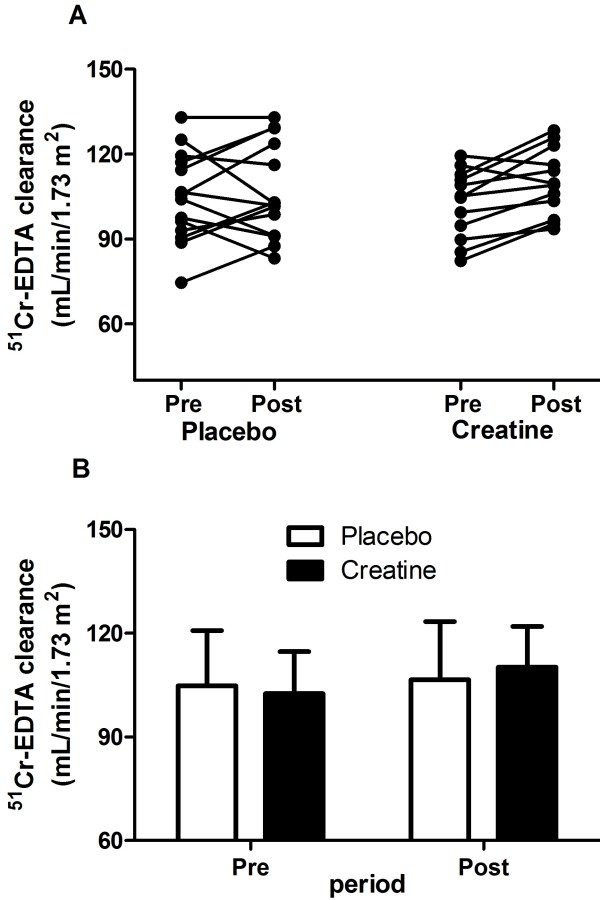
BACKGROUND: The aim of this study was to determine the effects of creatine supplementation on kidney function in resistance-trained individuals ingesting a high-protein diet. METHODS: A randomized, double-blind, placebo-controlled trial was performed. The participants were randomly allocated to receive either creatine (20 g/d for 5 d followed by 5 g/d throughout the trial) or placebo for 12 weeks. All of the participants were engaged in resistance training and consumed a high-protein diet (i.e., ≥ 1.2 g/Kg/d). Subjects were assessed at baseline (Pre) and after 12 weeks (Post). Glomerular filtration rate was measured by 51Cr-EDTA clearance. Additionally, blood samples and a 24-h urine collection were obtained for other kidney function assessments. RESULTS: No significant differences were observed for 51Cr-EDTA clearance throughout the trial (Creatine: Pre 101.42 ± 13.11, Post 108.78 ± 14.41 mL/min/1.73m2; Placebo: Pre 103.29 ± 17.64, Post 106.68 ± 16.05 mL/min/1.73m2; group x time interaction: F = 0.21, p = 0.64). Creatinine clearance, serum and urinary urea, electrolytes, proteinuria, and albuminuria remained virtually unchanged. CONCLUSIONS: A 12-week creatine supplementation protocol did not affect kidney function in resistance-trained healthy individuals consuming a high-protein diet; thus reinforcing the safety of this dietary supplement. TRIAL REGISTRATION: ClinicalTrials.gov NCT01817673.
Overview
CoChat Summary
TL;DR
In a 12-week randomized, double-blind, placebo-controlled trial, creatine supplementation did not impair kidney function in resistance-trained healthy males consuming a high-protein diet. The authors conclude that these findings reinforce the safety of creatine in this population.
Key findings
- Glomerular filtration rate measured by 51Cr-EDTA clearance did not differ significantly across time or between groups (creatine: Pre 101.42 ± 13.11, Post 108.78 ± 14.41 mL/min/1.73m2; placebo: Pre 103.29 ± 17.64, Post 106.68 ± 16.05 mL/min/1.73m2; group × time interaction: F = 0.21, p = 0.64).
- A decrease in 51Cr-EDTA clearance occurred in 2/12 creatine participants versus 6/14 placebo participants, with no significant between-group difference (P(χ2 > 2.081) = 0.149).
- Creatinine clearance, serum and urinary urea, electrolytes, proteinuria, and albuminuria remained virtually unchanged; none of the participants had albuminuria or proteinuria, and all kidney function parameters showed no significant group differences (p > 0.05).
- Protein intake ranged from 1.2 to 3.1 g/Kg/d, and diet remained unchanged throughout the study.
Methods
- Randomized, double-blind, placebo-controlled trial conducted in Sao Paulo, Brazil, between July 2011 and February 2013. Participants were healthy young males who had engaged in resistance training for at least 1 year and consumed a high-protein diet (≥ 1.2 g/Kg/d).
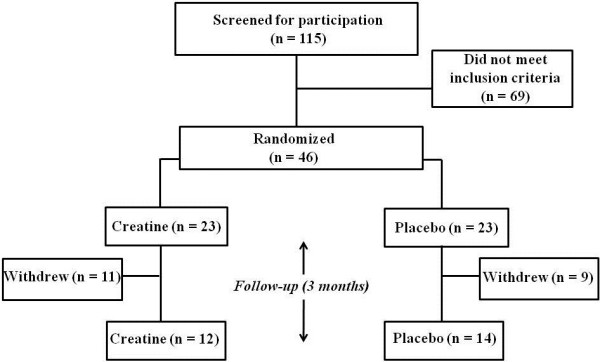
- Participants were randomized to creatine monohydrate (20 g/d for 5 d followed by 5 g/d throughout the trial) or placebo (dextrose) for 12 weeks. Of 46 randomized participants, 26 were analyzed (12 creatine, 14 placebo) after withdrawals and missed post-intervention assessments.
- Kidney function was assessed at baseline and after 12 weeks. Glomerular filtration rate was measured by 51Cr-EDTA clearance; blood samples and 24-h urine collections were also obtained. Dietary intake was assessed by 7-day food diaries. Data were analyzed with a mixed model with Kenward-Roger adjustment, with group and time as fixed factors and participants as a random factor.
Limitations
- The authors state that the follow-up was too short for definitive conclusions; the trial was originally designed for 12 months but was reduced due to a drastic withdrawal rate.
- The authors state that recreationally trained participants were selected for ecological validity, but highly-trained athletes taking anabolic steroids and undergoing exhaustive resistance training may respond differently.
- The authors state that all participants were apparently healthy, so findings cannot be extrapolated to individuals with, or at risk of, chronic kidney disease.
- Evident from the text: the analyzed sample was small (n = 26), with substantial attrition (15 withdrawals plus 5 who did not attend post-intervention assessment), and only young healthy males were included, limiting generalizability.
Model-written summary. Check it against the paper before relying on it.
Integrity signals
Registry
Cites
Statistics
Figures
Verification
Claims the paper makes
2 Valid · 0 Not valid · 8 Not checked · 25 Own results and interpretations
The cited sources support only part of this claim — read each source’s verdict below.
In the paper
“In consonance with our findings, a few cross-sectional studies have shown no significant differences in kidney function between higher and lower protein consumers [18,19].”
§ Does long-term creatine supplementation impair kidney function in resistance-trained individuals consuming a high-protein diet? > Discussion
What the sources say
- Partly supportedcites [18] Poortmans JR Dellalieux O Do regular high protein diets have potential health risks on kidney function in athletes? Int J Sport Nutr Exerc Metab 2000 10 28 38 10722779 sourceExperimental — accuracy not yet measured
The Discussion (p. 6) reports no difference in glomerular filtration rate between the higher-protein bodybuilders and the other athletes. But the Results (p. 4) report significantly greater urinary albumin excretion and lower urea clearance in the bodybuilders, so the claim of no significant differences in kidney function is too broad. The paper says these values remained within normal ranges. (LLM, conf=0.88)
- Not checked — no full text of the sourcecites [19] Brândle E Sieberth HG Hautmann RE Effect of chronic dietary protein intake on the renal function in healthy subjects Eur J Clin Nutr 1996 50 734 740 8933120
plain- Asserted: passes — The authors put it forward as true.
- Checkable: passes — It can be checked against evidence.
- Load-bearing: unclear — It is unclear whether the paper’s conclusions depend on it.
- Based: passes — The paper gives a reason why it holds.
- Partly supported
A result the paper reports from its own data — it cites no other source for it, so there is none to check. The quote shows it is in the paper.
In the paper
“No significant differences were observed for 51Cr-EDTA clearance throughout the trial (Creatine: Pre 101.42 ± 13.11, Post 108.78 ± 14.41 mL/min/1.73m2; Placebo: Pre 103.29 ± 17.64, Post 106.68 ± 16.05 mL/min/1.73m2; group x time interaction: F = 0.21, p = 0.64).”
- Also stated in: § Kidney function assessments · plain
“There were no significant differences between groups at Pre or Post (group × time interaction: F = 0.21, p = 0.64).”
§ Does long-term creatine supplementation impair kidney function in resistance-trained individuals consuming a high-protein diet? > Abstract > Results
plainn = 12- Asserted: passes — The authors put it forward as true.
- Checkable: passes — It can be checked against evidence.
- Load-bearing: passes — The paper’s conclusions depend on it.
- Based: passes — The paper gives a reason why it holds.
- Also stated in: § Kidney function assessments · plain
A result the paper reports from its own data — it cites no other source for it, so there is none to check. The quote shows it is in the paper.
In the paper
“None of the participants had either albuminuria or proteinuria.”
§ Does long-term creatine supplementation impair kidney function in resistance-trained individuals consuming a high-protein diet? > Results > Kidney function assessments
plain- Asserted: passes — The authors put it forward as true.
- Checkable: passes — It can be checked against evidence.
- Load-bearing: passes — The paper’s conclusions depend on it.
- Based: passes — The paper gives a reason why it holds.
A claim is checked only against the cited paper’s full text, never its abstract, and none is available for its sources.
In the paper
“The present results are in agreement with other investigations that have demonstrated the safety of creatine supplementation on kidney function in distinct populations [4-9].”
§ Does long-term creatine supplementation impair kidney function in resistance-trained individuals consuming a high-protein diet? > Discussion
What the sources say
- Not checked — no full text of the sourcecites [4] Poortmans JR Auquier H Renaut V Durussel A Saugy M Brisson GR Effect of short-term creatine supplementation on renal responses in men Eur J Appl Physiol Occup Physiol 1997 76 566 567 10.1007/s004210050291 9404870 source
- Not checked — no full text of the sourcecites [5] Poortmans JR Francaux M Long-term oral creatine supplementation does not impair renal function in healthy athletes Med Sci Sports Exerc 1999 31 1108 1110 10.1097/00005768-199908000-00005 10449011 source
- Not checked — no full text of the sourcecites [6] Poortmans JR Kumps A Duez P Fofonka A Carpentier A Francaux M Effect of oral creatine supplementation on urinary methylamine, formaldehyde, and formate Med Sci Sports Exerc 2005 37 1717 1720 10.1249/01.mss.0000176398.64189.e6 16260971 source
- Not checked — no full text of the sourcecites [7] Gualano B de Salles PV Roschel H Lugaresi R Dorea E Artioli GG Lima FR da Silva ME Cunha MR Seguro AC Otaduy MC Shimizu MH Sapienza MT da Costa LC Bonfá E Lancha Junior AH Creatine supplementation does not impair kidney function in type 2 diabetic patients: A randomized, double-blind, placebo-controlled, clinical trial Eur J Appl Physiol 2011 111 749 756 10.1007/s00421-010-1676-3 20976468 source
- Not checked — no full text of the sourcecites [8] Gualano B Ugrinowitsch C Novaes RB Artioli GG Shimizu MH Seguro AC Harris RC Lancha AH Jr Effects of creatine supplementation on renal function: A randomized, double-blind, placebo-controlled clinical trial Eur J Appl Physiol 2008 103 33 40 10.1007/s00421-007-0669-3 18188581 source
- Not checked — no full text of the sourcecites [9] Neves M Jr Gualano B Roschel H Lima FR Lúcia De Sá-Pinto A Seguro AC Shimizu MH Sapienza MT Fuller R Lancha AH Jr Bonfa E Effect of creatine supplementation on measured glomerular filtration rate in postmenopausal women Appl Physiol Nutr Metab 2011 36 419 422 10.1139/h11-014 21574777 source
boosted- Asserted: passes — The authors put it forward as true.
- Checkable: passes — It can be checked against evidence.
- Load-bearing: unclear — It is unclear whether the paper’s conclusions depend on it.
- Based: passes — The paper gives a reason why it holds.
A conclusion the paper draws from its own results — it cites no other source for it, so there is none to check. The quote shows it is in the paper.
In the paper
“A 12-week creatine supplementation protocol did not affect kidney function in resistance-trained healthy individuals consuming a high-protein diet; thus reinforcing the safety of this dietary supplement.”
- Also stated in: § Conclusions · plain
“Three months of creatine supplementation did not have a detrimental effect on kidney function in resistance-trained practitioners consuming a high-protein diet (i.e., ≥ 1.2 g/Kg/d).”
§ Does long-term creatine supplementation impair kidney function in resistance-trained individuals consuming a high-protein diet? > Abstract > Conclusions
plain- Asserted: passes — The authors put it forward as true.
- Checkable: passes — It can be checked against evidence.
- Load-bearing: passes — The paper’s conclusions depend on it.
- Based: passes — The paper gives a reason why it holds.
- Also stated in: § Conclusions · plain
7 more claims
Create a free account to see all 35 claims and every source verdict.
- Probably not a substantial claim. 13
- It may state two separate claims as one. 16
- The quote only partly states this claim. 1
Citations
Cites
Creatine and Creatinine Metabolism
Wyss, M., & Kaddurah-Daouk, R. (2000) · Physiological Reviews · doi:10.1152/physrev.2000.80.3.1107 · Cited by 2,950 · cited 1×
“However, the spontaneous conversion of creatine into creatinine [13] may falsely suggest decreased kidney function in creatine-supplemented individuals [8].”
BackgroundBurd, N. A., Tang, J. E., Moore, D. R., & Phillips, S. M. (2009) · Journal of Applied Physiology · doi:10.1152/japplphysiol.91351.2008 · Cited by 390 · cited 1×
“2 g/Kg/d; which is a usual prescription to resistance-trained practitioners [14]) were eligible to participate.”
BackgroundInternational Society of Sports Nutrition position stand: creatine supplementation and exercise
Buford, T. W., Kreider, R. B., Stout, J. R., Greenwood, M., Campbell, B., Spano, M., Ziegenfuss, T., Lopez, H., Landis, J., & Antonio, J. (2007) · Journal of the International Society of Sports Nutrition · doi:10.1186/1550-2783-4-6 · Cited by 341 · cited 1×
“Creatine supplementation has been recognized as one of the most efficient dietary supplements capable of increasing muscle strength and lean mass [1], as well as high-intensity exercise performance [2].”
BackgroundLong-term oral creatine supplementation does not impair renal function in healthy athletes
POORTMANS, J. R., & FRANCAUX, M. (1999) · Medicine & Science in Sports & Exercise · doi:10.1097/00005768-199908000-00005 · Cited by 215 · cited 2×
“Discussion The present results are in agreement with other investigations that have demonstrated the safety of creatine supplementation on kidney function in distinct populations [4-9].”
BackgroundResultKreider, R. B., Melton, C., Rasmussen, C. J., Greenwood, M., Lancaster, S., Cantler, E. C., Milnor, P., & Almada, A. L. (2003) · Molecular and Cellular Biochemistry · doi:10.1023/a:1022469320296 · Cited by 181 · cited 1×
“Despite the increasing number of publications showing that creatine supplementation may not affect kidney function in humans [4-10], it has been recommended”
BackgroundIn sickness and in health: the widespread application of creatine supplementation
Gualano, B., Roschel, H., Lancha, A. H., Brightbill, C. E., & Rawson, E. S. (2012) · Amino Acids · doi:10.1007/s00726-011-1132-7 · Cited by 172 · cited 1×
“Creatine supplementation has been recognized as one of the most efficient dietary supplements capable of increasing muscle strength and lean mass [1], as well as high-intensity exercise performance [2].”
BackgroundSelf-citationEffect of short-term creatine supplementation on renal responses in men
Poortmans, J. R., Auquier, H., Renaut, V., Durussel, A., Saugy, M., & Brisson, G. R. (1997) · European Journal of Applied Physiology · doi:10.1007/s004210050291 · Cited by 170 · cited 2×
“Discussion The present results are in agreement with other investigations that have demonstrated the safety of creatine supplementation on kidney function in distinct populations [4-9].”
BackgroundResultDo Regular High Protein Diets Have Potential Health Risks on Kidney Function in Athletes?
Poortmans, J. R., & Dellalieux, O. (2000) · International Journal of Sport Nutrition and Exercise Metabolism · doi:10.1123/ijsnem.10.1.28 · Cited by 115 · cited 1×
“In consonance with our findings, a few cross-sectional studies have shown no significant differences in kidney function between higher and lower protein consumers [18,19].”
ResultCreatine in Type 2 Diabetes: A Randomized, Double-Blind, Placebo-Controlled Trial
GUALANO, B., DE SALLES PAINNELI, V., ROSCHEL, H., ARTIOLI, G. G., NEVES, M., DE SÁ PINTO, A. L., DA SILVA, M. E. R., CUNHA, M. R., OTADUY, M. C. G., DA COSTA LEITE, C., et al. (2011) · Medicine & Science in Sports & Exercise · doi:10.1249/mss.0b013e3181fcee7d · Cited by 99 · cited 1×
“Moreover, we reported that 3 months of creatine supplementation had no deleterious effect on kidney function in post-menopausal women [9] and in type-2 diabetic patients [17], corroborating the safety of this supplement.”
BackgroundSelf-citationStudies on the safety of creatine supplementation
Kim, H. J., Kim, C. K., Carpentier, A., & Poortmans, J. R. (2011) · Amino Acids · doi:10.1007/s00726-011-0878-2 · Cited by 94 · cited 2×
“; licensee BioMed Centra Commons Attribution License (http://creativec reproduction in any medium, provided the or that the chronic effects of creatine supplementation should be better examined in some specific populations [3].”
BackgroundEffect of Oral Creatine Supplementation on Urinary Methylamine, Formaldehyde, and Formate
POORTMANS, J. R., KUMPS, A., DUEZ, P., FOFONKA, A., CARPENTIER, A., & FRANCAUX, M. (2005) · Medicine & Science in Sports & Exercise · doi:10.1249/01.mss.0000176398.64189.e6 · Cited by 91 · cited 2×
“Discussion The present results are in agreement with other investigations that have demonstrated the safety of creatine supplementation on kidney function in distinct populations [4-9].”
BackgroundResultGualano, B., de Salles Painelli, V., Roschel, H., Lugaresi, R., Dorea, E., Artioli, G. G., Lima, F. R., da Silva, M. E. R., Cunha, M. R., Seguro, A. C., et al. (2011) · European Journal of Applied Physiology · doi:10.1007/s00421-010-1676-3 · Cited by 88 · cited 2×
“Discussion The present results are in agreement with other investigations that have demonstrated the safety of creatine supplementation on kidney function in distinct populations [4-9].”
BackgroundResultSelf-citationGualano, B., Ugrinowitsch, C., Novaes, R. B., Artioli, G. G., Shimizu, M. H., Seguro, A. C., Harris, R. C., & Lancha, A. H. (2008) · European Journal of Applied Physiology · doi:10.1007/s00421-007-0669-3 · Cited by 88 · cited 4×
“Discussion The present results are in agreement with other investigations that have demonstrated the safety of creatine supplementation on kidney function in distinct populations [4-9].”
BackgroundResultInfluentialSelf-citationAre High-Protein, Vegetable-Based Diets Safe for Kidney Function? A Review of the Literature
Bernstein, A. M., Treyzon, L., & Li, Z. (2007) · Journal of the American Dietetic Association · doi:10.1016/j.jada.2007.01.002 · Cited by 85 · cited 1×
“In fact, there is compelling evidence indicating that high-protein diets can accelerate renal deterioration in individuals with chronic kidney disease [11], although it is unknown whether this holds true in healthy persons [12].”
Background(1996) · PubMed · Cited by 76
Gualano, B., Ferreira, D. C., Sapienza, M. T., Seguro, A. C., & Lancha, A. H. (2010) · American Journal of Kidney Diseases · doi:10.1053/j.ajkd.2009.10.053 · Cited by 48 · cited 1×
“Applying the above mentioned technique, we previously showed that 35 days of creatine supplementation did not alter kidney function in a 20-year-old man with a single kidney [16].”
MethodSelf-citationEffect of creatine supplementation on measured glomerular filtration rate in postmenopausal women
Neves, M., Gualano, B., Roschel, H., Lima, F. R., Lúcia de Sá-Pinto, A., Seguro, A. C., Shimizu, M. H., Sapienza, M. T., Fuller, R., Lancha, A. H., et al. (2011) · Applied Physiology Nutrition and Metabolism · doi:10.1139/h11-014 · Cited by 40 · cited 3×
“Discussion The present results are in agreement with other investigations that have demonstrated the safety of creatine supplementation on kidney function in distinct populations [4-9].”
BackgroundResultSelf-citationDietary protein safety and resistance exercise: what do we really know?
Lowery, L. M., & Devia, L. (2009) · Journal of the International Society of Sports Nutrition · doi:10.1186/1550-2783-6-3 · Cited by 26
How we estimate GFR ? a pitfall of using a serum creatinine-based formula
Refaie, R., Moochhala, S. H., & Kanagasundaram, N. S. (2007) · Clinical Nephrology · doi:10.5414/cnp68235 · Cited by 11 · cited 1×
“Although serum creatinine was not significantly elevated in the current study, previous observations from our group [8] and others [15] support the inaccuracy of creatininebased markers in the evaluation of kidney function in creatine-supplemented individuals.”
Result
Cited by
Kreider, R. B., Kalman, D. S., Antonio, J., Ziegenfuss, T. N., Wildman, R., Collins, R., Candow, D. G., Kleiner, S. M., Almada, A. L., & Lopez, H. L. (2017) · Journal of the International Society of Sports Nutrition · doi:10.1186/s12970-017-0173-z · Cited by 1,057
Creatine Supplementation and Brain Health
Roschel, H., Gualano, B., Ostojic, S. M., & Rawson, E. S. (2021) · Nutrients · doi:10.3390/nu13020586 · Cited by 174
Self-citationDolan, E., Gualano, B., & Rawson, E. S. (2019) · European Journal of Sport Science · doi:10.1080/17461391.2018.1500644 · Cited by 171
“Additionally, creatine supplements are widely available, inexpensive, and have a very good safety profile (Gualano et al., 2011, 2012; Hayashi et al., 2014; Lugaresi et al., 2013; Pereira et al., 2015; Persky & Rawson, 2007; Rawson, Clarkson, & Tarnopolsky, 2017), which also favours the decision to recommend creatine…”
BackgroundSelf-citationPost, A., Tsikas, D., & Bakker, S. J. L. (2019) · Nutrients · doi:10.3390/nu11051044 · Cited by 223
“Other studies found no change in either serum creatinine or other biomarkers of renal function after creatine supplementation [97,105,106].”
BackgroundNilsson, M. I., Mikhail, A., Lan, L., Di Carlo, A., Hamilton, B., Barnard, K., Hettinga, B. P., Hatcher, E., Tarnopolsky, M. G., Nederveen, J. P., et al. (2020) · Nutrients · doi:10.3390/nu12082391 · Cited by 94
“As previously discussed by others, commonly used estimates of kidney function that are based on serum creatinine levels must be interpreted in the broader context of total protein intake and creatine supplementation [94].”
Background
Metadata
- Authors
- Lugaresi, R., Leme, M., de Salles Painelli, V., Murai, I. H., Roschel, H., Sapienza, M. T., Lancha Junior, A. H., & Gualano, B.
- Affiliations
- Universidade de São Paulo (BR)
- School of Physical Education and Sport - Laboratory of Applied Nutrition and MetabolismUniversity of Sao Paulo Av Mello de Moraes, 65 05508-030 Sao Paulo SP Brazil
- Corresponding author
- Gualano, Bruno
- Venue
- Journal of the International Society of Sports Nutrition
- Publisher
- Informa UK Limited
- Published
- 2013-01-03
- Volume
- 10
- Issue
- 1
- Pages
- 26-26
- ISSN
- 1550-2783 (ISSN-L)
- PMC
- PMC3661339
- OpenAlex
- W2106495308
- Semantic Scholar
- 0a0ec28d215495db55059414303df1816000787b
- Cited by
- 72
- References
- 19
- Citations by year
- 2026: 8 · 2025: 6 · 2024: 9 · 2023: 6 · 2022: 4 · 2021: 1 · 2020: 8 · 2019: 9 · 2018: 5 · 2017: 3 · 2016: 3 · 2015: 3 · 2014: 4 · 2013: 3
- FWCI
- 3.61
- Type
- journal article
- Language
- en
- Open access
- gold
- doi.org
- Licence
- Locations
- Journal of the International Society of Sports Nutrition (publishedVersion, cc-by)
- Europe PMC (PubMed Central) (publishedVersion, cc-by)
- PubMed Central (publishedVersion, cc-by)
- PubMed (publishedVersion)
- Portuguese National Funding Agency for Science, Research and Technology (RCAAP Project by FCT) (publishedVersion, other-oa)
- Portuguese National Funding Agency for Science, Research and Technology (RCAAP Project by FCT) (publishedVersion)
- Funders
- Fundação de Amparo à Pesquisa do Estado de São Paulo
- Conselho Nacional de Desenvolvimento Científico e Tecnológico
- Topics
- Health Sciences › Nursing › Nutrition and Dietetics › Muscle metabolism and nutrition
- Health Sciences › Medicine › Nephrology › Dialysis and Renal Disease Management
- Health Sciences › Medicine › Physiology (medical) › Biochemical effects in animals
- Keywords
- creatine supplementation, renal function, high-protein diet, resistance training, glomerular filtration rate, creatinine clearance, proteinuria, albuminuria, supplement safety, 51Cr-EDTA clearance
About these checks
Registry, retraction, Cites and statistics results are computed, not judged, with one exception: a printed reference that no index lists is read once by a model before it counts as a citation error. Claims are extracted by a model and kept only when their quote appears verbatim in the text; each cited source is then checked, with a model’s help, for whether it says what the claim relies on. Those verdicts can be wrong — read the claim’s quote and the cited source before relying on one.
The claim verdicts this report counts are experimental: their accuracy is not yet measured.
A language model drew the claims from the paper on 2026-10-07, under version 3 of the claim definition (model deepseek-v4.1-flash, prompt extract-v3).
A second model labelled each claim on 2026-10-07 (model jev-1.13-20260917, definition revision gold-guideline-v0.2).
Cited sources are checked with a language model’s help (gpt-6-sol).
Statistics and arithmetic are recomputed, not judged.
Confidence bands are shown only for fields calibrated on our annotated test set. None is calibrated yet, so no band is shown.
What counts as a claim ›How we measure confidence ›How we check this ›
Are you an author, or do you see a problem with this page? Request a review
Data sources
Bibliographic data: Semantic Scholar, OpenAlex, Crossref.
Contains information from the Semantic Scholar Academic Graph Datasets, made available under the ODC Attribution License (ODC-BY 1.0).
Semantic Scholar’s data is described in: Kinney, R., et al. (2023). The Semantic Scholar Open Data Platform. arXiv:2301.10140.
