

Cardiovascular and ride time-to-exhaustion effects of an energy drink
Open accessThe DOI matches its Crossref record; 51 of the 52 references it cites were found in a registry or an index.
Abstract
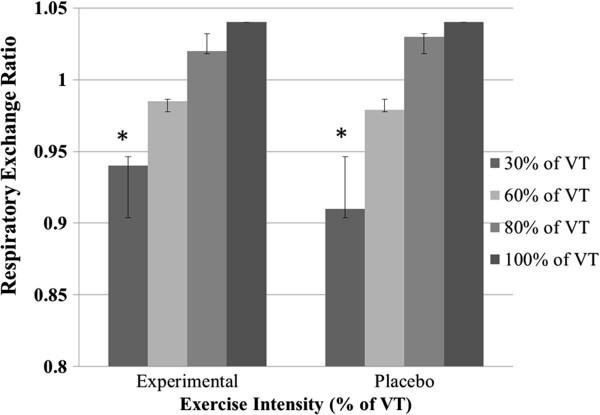
BACKGROUND: Currently, there are few studies on the cardiovascular and fatigue effects of commercially available energy drinks. This study investigated the effects of Monster energy drink (Monster Beverage Corporation, Corona, California), on resting heart rate (HR), heart rate variability (HRV), ride time-to-exhaustion, peak exercise HR, respiratory exchange ratio (RER), and peak rating of perceived exertion (RPE). METHODS: The study used a double-blind, randomized, placebo controlled, crossover design. After an 8-hr fast, 15 subjects consumed Monster Energy Drink (ED standardized to 2.0 mg * kg-1 caffeine) or a flavor-matched placebo preexercise. Resting HR and HRV were determined. After an initial submaximal workload for 30 minutes, subjects completed 10 min at 80% ventilatory threshold (VT) and rode until volitional fatigue at 100% VT. RESULTS: Resting HR was significantly different (ED: 65+/-10 bpm vs. placebo: 58+/-8 bpm, p = 0.02), but resting HRV was not different between the energy drink and placebo trials. Ride time-to-exhaustion was not significantly different between trials (ED: 45.5+/- 9.8 vs. placebo: 43.8+/-9.3 min, p = 0.62). No difference in peak RPE (ED: 9.1 +/- 0.5 vs. placebo: 9.0 +/- 0.8, p = 1.00) nor peak HR (ED: 177 +/- 11 vs. placebo: 175 +/- 12, p = 0.73) was seen. The RER at 30% of VT was significantly different (ED: 0.94 +/- 0.06 vs. placebo: 0.91 +/- 0.05, p = 0.046), but no difference between the two conditions were seen at the other intensities. CONCLUSION: Although preexercise ingestion of the energy drink does increase resting HR there was no alteration in HRV parameters. Ride time-to-exhaustion was not enhanced.
Overview
The claims and statistics of this paper haven’t been checked yet.
Free: it reads the open-access text and checks the first 5 claims that cite a source we can check. Create a free account to check every claim.
Integrity signals
Registry
Cites
Statistics
Figures
Verification
Claims the paper makes
The claims and statistics of this paper haven’t been checked yet.
Free: it reads the open-access text and checks the first 5 claims that cite a source we can check. Create a free account to check every claim.
Claims other papers make about this one
Each is checked against this paper’s own text: does it say what the citing paper says it does?
The cited source says what the claim attributes to it.
In the citing paper
“A FC de repouso foi maior quando os indivíduos ingeriam a BE, em comparação à ingestão de placebo (BE: 65+10bpm vs. Placebo: 58+8bpm, p=0,02), embora os índices da VFC (RMSSD, SDNN, PNN50, FC, LF e LF/HF) mantiveram-se sem alteração significativa. 17”
The check wasn’t confident either way, so it gives no verdict — never disputed.
In the citing paper
“Até o presente momento, estudos que avaliaram os efeitos das BEs sobre a recuperação da FC não os comparou entre populações de diferentes perfis cardiorrespiratórios. 14 - 17”
From Efeitos Agudos da Bebida Energética sobre Parâmetros Autonômicos e Cardiovasculares em Indivíduos com Diferentes Capacidades Cardiorrespiratórias: Um Ensaio Controlado, Randomizado, Crossover e Duplo Cego (2022) · cites this paper as [17]
Experimental — accuracy not yet measured
Self-check
Percentages, sums and reported differences re-computed from the paper’s own numbers.
The self-check needs the paper’s full text.
Citations
Cites
Heart Rate Variability: Standards of Measurement, Physiological Interpretation, and Clinical Use
Electrophysiology, T. F. O. T. E. S. O. C. T. N. A. (1996) · Circulation · doi:10.1161/01.cir.93.5.1043 · Cited by 17,159
Psychophysical bases of perceived exertion
BORG, G. A. V. (1982) · Medicine & Science in Sports & Exercise · doi:10.1249/00005768-198205000-00012 · Cited by 16,580 · cited 1×
“Rating of perceived exertion (RPE) was obtained at the end of each stage using the 10-point Borg category scale [28].”
MethodHeart rate variability: Standards of measurement, physiological interpretation, and clinical use
Malik, M., Bigger, J. T., Camm, A. J., Kleiger, R. E., Malliani, A., Moss, A. J., & Schwartz, P. J. (1996) · European Heart Journal · doi:10.1093/oxfordjournals.eurheartj.a014868 · Cited by 15,289
Physiological actions of taurine
Huxtable, R. J. (1992) · Physiological Reviews · doi:10.1152/physrev.1992.72.1.101 · Cited by 2,595 · cited 2×
“Taurine has been shown to moderate the flow of cations, especially calcium, across the cell membranes, thus protecting the heart muscle from both high and low concentrations [18,19].”
BackgroundBody composition from fluid spaces and density: analysis of methods. 1961.
Siri, W. E. (1993) · PubMed · Cited by 2,573
Physiology of Sport and Exercise
Wilmore, J. H., Costill, D. L., & Gleim, G. W. (1995) · Medicine & Science in Sports & Exercise · doi:10.1249/00005768-199505000-00024 · Cited by 2,174
Exercise physiology: Human bioenergetics and its applications
Brooks, G. A. (1984) · Medical Entomology and Zoology · Cited by 1,182
Montano, N., Ruscone, T. G., Porta, A., Lombardi, F., Pagani, M., & Malliani, A. (1994) · Circulation · doi:10.1161/01.cir.90.4.1826 · Cited by 1,108 · cited 1×
“Heart rate variability may serve as a method to further investigate the cardiac effects of these drinks as it allows quantification of sympathovagal balance [43,44].”
MethodSympathovagal Balance: A Critical Appraisal
Eckberg, D. L. (1997) · Circulation · doi:10.1161/01.cir.96.9.3224 · Cited by 1,087
Caffeine and Exercise: Metabolism, Endurance and Performance
Graham, T. E. (2001) · Sports Medicine · doi:10.2165/00007256-200131110-00002 · Cited by 819
Cited by
Energy Drink Consumption : Beneficial and Adverse Health Effects
Alsunni, A. A. (2015) · International Journal of Health Sciences · doi:10.12816/0031237 · Cited by 167
“(52) A recent study (53) evaluated the acute”
BackgroundSouza, D. B., Del Coso, J., Casonatto, J., & Polito, M. D. (2017) · European Journal of Nutrition · doi:10.1007/s00394-016-1331-9 · Cited by 169
International society of sports nutrition position stand: Energy drinks and energy shots
Jagim, A. R., Harty, P. S., Tinsley, G. M., Kerksick, C. M., Gonzalez, A. M., Kreider, R. B., Arent, S. M., Jager, R., Smith-Ryan, A. E., Stout, J. R., et al. (2023) · Journal of the International Society of Sports Nutrition · doi:10.1080/15502783.2023.2171314 · Cited by 98
“In contrast, several investigations have reported null findings when examining the effects of ED on endurance exercise performance [145,159,168,171-176].”
Taurine and skeletal muscle function
Spriet, L. L., & Whitfield, J. (2015) · Current Opinion in Clinical Nutrition and Metabolic Care · doi:10.1097/mco.0000000000000135 · Cited by 90
Gutiérrez-Hellín, J., & Varillas-Delgado, D. (2021) · Nutrients · doi:10.3390/nu13030715 · Cited by 67
“[82] also reported that there was no significant difference in the time-to-exhaustion between placebo and energy drink trials (43.”
BackgroundEnergy Drinks and Their Impact on the Cardiovascular System: Potential Mechanisms
Grasser, E. K., Miles-Chan, J. L., Charrière, N., Loonam, C., Dulloo, A. G., & Montani, J. (2016) · Advances in Nutrition · doi:10.3945/an.116.012526 · Cited by 104
“65 g sugar/kg) significantly elevated heart rate after 60 min compared with the placebo control (20), 2) a study in which blood pressure and heart rate responses to a sugarsweetened ED (Rockstar, Rockstar, Inc.”
BackgroundCardiovascular Complications of Energy Drinks
Higgins, J. P., Yarlagadda, S., & Yang, B. K. (2015) · Beverages · doi:10.3390/beverages1020104 · Cited by 85
“by rigorous scientific evidence [12,97–100].”
Kammerer, M., Jaramillo, J. A., García, A., Calderín, J. C., & Valbuena, L. H. (2014) · Journal of the International Society of Sports Nutrition · doi:10.1186/s12970-014-0044-9 · Cited by 41
“On the other hand, our findings are consistent with the results obtained by Candow and colleagues [10], Umana-Alvarado and Moncada-Jiménez [27], and Nelson and colleagues [28] in which the consumption of the commercial beverage had not positively influenced the outcome of the physical tests performed.”
ResultCardiovascular and Autonomic Responses to Energy Drinks-Clinical Implications
Somers, K. R., & Svatikova, A. (2020) · Journal of Clinical Medicine · doi:10.3390/jcm9020431 · Cited by 45
“Interestingly, the energy drink also did not increase exercise capacity, measured as ride time to exhaustion [31].”
BackgroundBenjamim, C. J. R., Kliszczewicz, B., Garner, D. M., Cavalcante, T. C. F., da Silva, A. A. M., Santana, M. D. R., & Valenti, V. E. (2020) · Journal of the American College of Nutrition · doi:10.1080/07315724.2019.1705201 · Cited by 39
Benjamim, C. J. R., Júnior, F. W. S., de Figueiredo, M. Í. L. S., Benjamim, C. J. R., Cavalcante, T. C. F., da Silva, A. A. M., Monteiro, L. R. L., Santana, M. D. R., Garner, D. M., & Valenti, V. E. (2020) · Journal of the American College of Nutrition · doi:10.1080/07315724.2020.1774441 · Cited by 35
“(39), which described an increase in HR (Energy Drink (ED): 65 ± 10 bpm vs Placebo: 58 ± 8 bpm, p1⁄4 0.”
BackgroundEnergy Drink Ingredients and their Effect on Endothelial Function: A Review
Higgins, J. P. (2014) · International Journal of Clinical Cardiology · doi:10.23937/2378-2951/1410006 · Cited by 32
“Studies on the effects of EDs to improve one’s physical or cognitive performance have yielded mixed results [7-12].”
ResultKarayiğit, R., Naderi, A., Saunders, B., Forbes, S. C., Coso, J. D., Berjisian, E., Yıldırım, U. C., & Suzuki, K. (2021) · Sports · doi:10.3390/sports9120162 · Cited by 25
“For example, co-ingestion enhanced upper body muscular endurance [12] and time trial performance [13] but had no effect on repeated sprints [14], aerobic endurance [15] and WAnT [16] performance.”
BackgroundCaffeine slows heart rate autonomic recovery following strength exercise in healthy subjects
Benjamim, C. J. R., Monteiro, L. R. L., Pontes, Y. M. D. M., Silva, A. A. M. D., Souza, T. K. M. D., Valenti, V. E., Garner, D. M., & Cavalcante, T. C. F. (2021) · Revista Portuguesa de Cardiologia (English Edition) · doi:10.1016/j.repce.2020.07.021 · Cited by 24
“Although the study did not report any alterations in HRV, there was an increase in HR before resistive physical exercise.(27) In this study, we did not detect significant differences in resting HR between the two groups.”
Gualberto, P. I. B., Benvindo, V. V., Waclawovsky, G., & Deresz, L. F. (2023) · Nutrition Reviews · doi:10.1093/nutrit/nuad112 · Cited by 29
Ergogenic effects of spinal cord stimulation on exercise performance following spinal cord injury
Hodgkiss, D. D., Williams, A. M. M., Shackleton, C., Samejima, S., Balthazaar, S. J. T., Lam, T., Krassioukov, A. V., & Nightingale, T. E. (2024) · Frontiers in Neuroscience · doi:10.3389/fnins.2024.1435716 · Cited by 20
António, J., Antonio, B. B., Arent, S. M., Candow, D. G., Escalante, G., Evans, C., Forbes, S. C., Fukuda, D. H., Gibbons, M., Harty, P. S., et al. (2024) · Nutrients · doi:10.3390/nu17010067 · Cited by 22
Self-citationAl-Fares, M. N., Alsunni, A. A., Majeed, F., & Badar, A. (2015) · Saudi Medical Journal · doi:10.15537/smj.2015.5.11141 · Cited by 14
Grinberg, N., Benkhedda, K., Barber, J., Krahn, A. D., & Vieille, S. L. (2022) · Applied Physiology, Nutrition, and Metabolism · doi:10.1139/apnm-2021-0807 · Cited by 21
Clark, N. W., Herring, C. H., Goldstein, E. R., Stout, J. R., Wells, A. J., & Fukuda, D. H. (2020) · Nutrients · doi:10.3390/nu12082372 · Cited by 16
“The HF band is also termed the respiratory band due to the influence that breathing can play in HF modulation [39].”
BackgroundLasheras, I., Seral, P., Alonso‐Ventura, V., & Santabárbara, J. (2021) · Journal of Electrocardiology · doi:10.1016/j.jelectrocard.2021.01.020 · Cited by 18
The Effects of an Energy Drink on Psychomotor Vigilance in Trained Individuals
António, J., Kenyon, M., Horn, C., Jiannine, L., Carson, C., Ellerbroek, A., Roberts, J., Peacock, C. A., & Tartar, J. L. (2019) · Journal of Functional Morphology and Kinesiology · doi:10.3390/jfmk4030047 · Cited by 16
Porto, A. A., Valenti, V. E., Tonon do Amaral, J. A., Benjamim, C. J. R., Garner, D. M., & Ferreira, C. (2021) · Journal of the American College of Nutrition · doi:10.1080/07315724.2020.1768175 · Cited by 13
Campbell, B. I., Richmond, J. L., & Dawes, J. J. (2016) · International Journal of Exercise Science · doi:10.70252/lhfd6764 · Cited by 10
“Specifically, no improvements in performance were reported for anaerobic (11, 18) or high intensity aerobic (5, 21) exercise following energy drink ingestion.”
BackgroundMai‐Lippold, S. A., Dettlinger, C. M., Khalsa, S. S., & Pollatos, O. (2020) · European Journal of Health Psychology · doi:10.1027/2512-8442/a000061 · Cited by 11
Mandilaras, G., Li, P., Dalla‐Pozza, R., Jakob, A., Haas, N. A., & Oberhoffer, F. S. (2025) · Pediatric Cardiology · doi:10.1007/s00246-025-03770-3 · Cited by 10
“For example, Grasser et al. (2014) reported that young adults presented elevated blood pressure, a double product and a lower cerebral velocity following ED consumption, indicating reduced parasympathetic activity and heightened sympathetic tone [23].”
Blake, M. S., Johnson, N., Trautman, K. A., Grier, J. W., Stastny, S., & Hackney, K. J. (2020) · International journal of exercise science · doi:10.70252/phum1873 · Cited by 8
“The effects of caffeine on HRV have been well investigated, (48) and HRV has also been examined with an energy drink (60).”
BackgroundÇalışkan, Ş. G. (2024) · Applied Sciences · doi:10.3390/app14114912 · Cited by 6
Porto, A. A., Gonzaga, L. A., Benjamim, C. J. R., Bueno, C. R., Garner, D. M., Vanderlei, L. C. M., Ferreira, C., & Valenti, V. E. (2022) · Arquivos Brasileiros de Cardiologia · doi:10.36660/abc.20210625 · Cited by 5
Banks, N. F., Rogers, E. M., Helwig, N. J., Schwager, L. E., Alpers, J. P., Schulte, S. L., Trachta, E. R., Lockwood, C. M., & Jenkins, N. D. M. (2024) · Journal of the International Society of Sports Nutrition · doi:10.1080/15502783.2023.2297988 · Cited by 4
“Nelson et al . provided a MED at the volume necessary to provide 2 mg/kg of caffeine to 15 healthy recreationally active male and female participants 30-min prior to a maximal exercise test at 100% ventilatory threshold, and also reported higher RERs compared to placebo [45].”
MethodÇalışkan, Ş. G., & Bilgin, M. (2022) · Çukurova medical journal (Online)/Çukurova medical journal · doi:10.17826/cumj.1089294 · Cited by 4
Rica, R. L., Evangelista, A. L., Maia, A. F., Machado, A. F., Teixeira, C. V. L. S., Barbosa, W. A., Hacbart, F., Guerra, M. A., Guimarães‐Ferreira, L., Gomes, J. H., et al. (2019) · Journal of Physical Education and Sport · doi:10.7752/jpes.2019.s1017 · Cited by 7
Nabulsi, M., & Ahmead, M. (2025) · Frontiers in Nutrition · doi:10.3389/fnut.2025.1709218 · Cited by 3
Domaszewski, P. (2026) · Nutrients · doi:10.3390/nu18020328 · Cited by 4
“Isolated caffeine studies predominantly focus on acute performance metrics, such as time to exhaustion, maximal power output, or repetition performance [30,31].”
Trkulja, J., Tomić, S., Tomić, S. D., & Malenković, G. (2021) · Sestrinska rec · doi:10.5937/sestrec2182023t · Cited by 3
Energy Drinks: Cardiovascular Complications
Higgins, J. P. (2021) · Open Access Journal of Cardiology · doi:10.23880/oajc-16000162 · Cited by 2
Energy Drinks: Cardiovascular Complications
Higgins, J. P., & Jogimahanti, A. V. (2021) · Austin Journal of Clinical Cardiology · doi:10.26420/austinjclincardiolog.2021.1085 · Cited by 1
“Their purported “benefits” have not been supported by rigorous scientific evidence [12,109-112].”
BackgroundPorto, A. A., Benjamim, C. J. R., Gonzaga, L. A., Garner, D. M., & Valenti, V. E. (2022) · Science & Sports · doi:10.1016/j.scispo.2021.09.005 · Cited by 1
Bartman, N. E., Temple, J. L., Hess, H. W., Colburn, D., & Hostler, D. P. (2025) · The Journal of Strength and Conditioning Research · doi:10.1519/jsc.0000000000005138 · Cited by 1
Porto, A. A., Gonzaga, L. A., Benjamim, C. J. R., Cardoso, V. F., Garner, D. M., Ferreira, C., Bueno Junior, C., & Valenti, V. E. (2023) · LA Referencia (Red Federada de Repositorios Institucionales de Publicaciones Científicas)
Benjelloun, Z. (2017) · theses.fr (ABES) · doi:10.70675/562df67cz9948z46e7z953ez6cb4c1a05d3a · Cited by 2
Metadata
- Authors
- Nelson, M. T., Biltz, G. R., & Dengel, D. R.
- Affiliations
- University of Minnesota (US)
- Corresponding author
- Nelson, Michael T
- Venue
- Journal of the International Society of Sports Nutrition
- Publisher
- Informa UK Limited
- Published
- 2014-08-15
- Volume
- 11
- Issue
- 1
- Pages
- 2-2
- ISSN
- 1550-2783 (ISSN-L)
- PMC
- PMC3937107
- OpenAlex
- W2131278878
- Semantic Scholar
- 08fb9be93b33651802b00154258c883244d60479
- Cited by
- 41
- References
- 52
- Citations by year
- 2026: 1 · 2025: 3 · 2024: 4 · 2023: 3 · 2022: 4 · 2021: 7 · 2020: 6 · 2019: 3 · 2017: 1 · 2016: 3 · 2015: 3 · 2014: 3
- FWCI
- 2.43
- Type
- journal article
- Language
- en
- Open access
- gold
- doi.org
- Licence
- Locations
- Journal of the International Society of Sports Nutrition (publishedVersion, cc-by)
- Europe PMC (PubMed Central) (publishedVersion, cc-by)
- PubMed Central (publishedVersion, cc-by)
- PubMed (publishedVersion)
- Topics
- Health Sciences › Medicine › Pharmacology (medical) › Coffee research and impacts
- Health Sciences › Medicine › Physiology (medical) › Cardiovascular and exercise physiology
- Health Sciences › Medicine › Physiology (medical) › Thermoregulation and physiological responses
- Keywords
- energy drinks, caffeine, resting heart rate, heart rate variability, time to exhaustion, exercise fatigue, respiratory exchange ratio, rating of perceived exertion, peak heart rate, ventilatory threshold
About these checks
Registry, retraction, Cites and statistics results are computed, not judged, with one exception: a printed reference that no index lists is read once by a model before it counts as a citation error. Claims are extracted by a model and kept only when their quote appears verbatim in the text; each cited source is then checked, with a model’s help, for whether it says what the claim relies on. Those verdicts can be wrong — read the claim’s quote and the cited source before relying on one.
Statistics and arithmetic are recomputed, not judged.
Confidence bands are shown only for fields calibrated on our annotated test set. None is calibrated yet, so no band is shown.
What counts as a claim ›How we measure confidence ›How we check this ›
Are you an author, or do you see a problem with this page? Request a review
Data sources
Bibliographic data: Semantic Scholar, OpenAlex, Crossref.
Contains information from the Semantic Scholar Academic Graph Datasets, made available under the ODC Attribution License (ODC-BY 1.0).
Semantic Scholar’s data is described in: Kinney, R., et al. (2023). The Semantic Scholar Open Data Platform. arXiv:2301.10140.
