

Performance enhancement with supplements: incongruence between rationale and practice
Open accessThe DOI matches its Crossref record; 49 of the 51 references it cites were found in a registry or an index.
Abstract
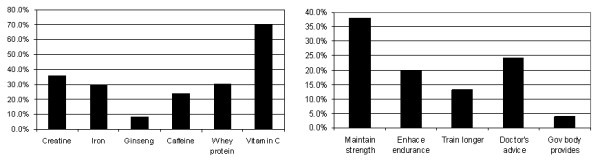
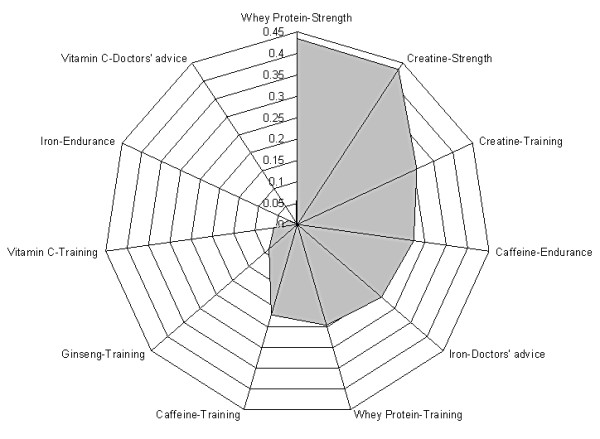
BACKGROUND: Athletes are expected to consider multiple factors when making informed decision about nutritional supplement use. Besides rules, regulations and potential health hazards, the efficacy of different nutritional supplements in performance enhancement is a key issue. The aim of this paper was to find evidence for informed decision making by investigating the relationship between specific performance-related reasons for supplement use and the reported use of nutritional supplements. METHODS: The 'UK Sport 2005 Drug Free Survey' data (n = 874) were re-analysed using association [chi2] and 'strength of association' tests [varphi] to show the proportion of informed choices and to unveil incongruencies between self-reported supplement use and the underlying motives. RESULTS: Participants (n = 520) reported supplement use in the pattern of: vitamin C (70.4%), creatine (36.1%), whey protein (30.6%), iron (29.8%), caffeine (23.8%), and ginseng (8.3%) for the following reasons: strength maintenance (38.1%), doctors' advice (24.2%), enhancing endurance (20.0%), ability to train longer (13.3%), and provided by the governing body (3.8%). Of thirty possible associations between the above supplements and reasons, 11 were predictable from literature precedents and only 8 were evidenced and these were not strong (varphi < .7). The best associations were for the ability to train longer with creatine (reported by 73.9%, chi2 = 49.14, p < .001; varphi = .307, p < .001), and maintaining strength with creatine (reported by 62.6%, chi2 = 97.08, p < .001; varphi = .432, p < .001) and whey protein (reported by 56.1%, chi2 = 97.82, p < .001; varphi = .434, p < .001). CONCLUSION: This study provided a platform for assessing congruence between athletes' reasons for supplement use and their actual use. These results suggest that a lack of understanding exists in supplement use. There is an urgent need to provide accurate information which will help athletes make informed choices about the use of supplements.
Overview
The claims and statistics of this paper haven’t been checked yet.
Free: it reads the open-access text and checks the first 5 claims that cite a source we can check. Create a free account to check every claim.
Integrity signals
Registry
Cites
Statistics
Figures
Verification
Claims the paper makes
The claims and statistics of this paper haven’t been checked yet.
Free: it reads the open-access text and checks the first 5 claims that cite a source we can check. Create a free account to check every claim.
Claims other papers make about this one
Each is checked against this paper’s own text: does it say what the citing paper says it does?
The cited source doesn’t support the claim as written.
In the citing paper
“Of note, a strong relationship was present between reasons for creatine use and physiological rationale among creatine users.”
From Creatine Supplementation in Children and Adolescents (2021) · cites this paper as [26]
Checked by a reasoning model — may be wrong.
Experimental — accuracy not yet measuredThe source backs part of the claim, not all of it — or backs it for a different population, condition or comparison.
In the citing paper
“For example, Petroczi et al. [26] surveyed elite adolescent athletes as part of the United Kingdom Sport 2005 Drug Free Survey and when a subsample of 874 athletes were reanalyzed, 36.1% of athletes reported using creatine.”
From Creatine Supplementation in Children and Adolescents (2021) · cites this paper as [26]
Experimental — accuracy not yet measuredThe source backs part of the claim, not all of it — or backs it for a different population, condition or comparison.
In the citing paper
“This relationship indicates that those self-reporting creatine use were able to correctly identify the purported benefits while selecting physiologically appropriate reasons for use, which was not observed for other dietary supplements.”
From Creatine Supplementation in Children and Adolescents (2021) · cites this paper as [26]
Experimental — accuracy not yet measuredThe source backs part of the claim, not all of it — or backs it for a different population, condition or comparison.
In the citing paper
“While creatine appears to be a popular dietary supplement of choice among elite adolescent athletes, creatine is still less frequently used when compared to other dietary supplement categories such as multivitamins, protein powders, and energy products, in which usage rates of these product categories can range anywhere from 60–80% among adolescent athletes [26,27,28,29,30,31,32].”
From Creatine Supplementation in Children and Adolescents (2021) · cites this paper as [26]
Experimental — accuracy not yet measured
Self-check
Percentages, sums and reported differences re-computed from the paper’s own numbers.
The self-check needs the paper’s full text.
Citations
Cites
Statistical Power Analysis for the Behavioral Sciences
Muller, K. (1989) · Technometrics · doi:10.1080/00401706.1989.10488618 · Cited by 99,167
Statistical power analysis for the behavioral sciences
(1990) · Computers, Environment and Urban Systems · doi:10.1016/0198-9715(90)90050-4 · Cited by 65,269
Applied Nonparametric Statistics
Wozniak, P. J., & Daniel, W. W. (1991) · Technometrics · doi:10.2307/1268795 · Cited by 4,987
GPOWER: A general power analysis program
Erdfelder, E., Faul, F., & Buchner, A. (1996) · Behavior Research Methods, Instruments, & Computers · doi:10.3758/bf03203630 · Cited by 4,864
ISSN exercise & sport nutrition review: research & recommendations
Kreider, R. B., Wilborn, C. D., Taylor, L., Campbell, B., Almada, A. L., Collins, R., Cooke, M., Earnest, C. P., Greenwood, M., Kalman, D. S., et al. (2010) · Journal of the International Society of Sports Nutrition · doi:10.1186/1550-2783-7-7 · Cited by 428
Designing and conducting survey research
Rea, L. M., Names, Parker, R., & Allen, R. (2016) · Cited by 428
The efficacy of ginseng. A systematic review of randomised clinical trials
Vogler, B. K., Pittler, M. H., & Ernst, E. (1999) · European Journal of Clinical Pharmacology · doi:10.1007/s002280050674 · Cited by 364 · cited 1×
“Pairs of supplements and reasons for use are given in Table 1, where literature precedents indicating expected associations [7,9,11,22-26].”
Exercise, nutrition and immune function
Gleeson, M., Nieman, D. C., & Pedersen, B. K. (2004) · Journal of Sports Sciences · doi:10.1080/0264041031000140590 · Cited by 362
International Society of Sports Nutrition position stand: creatine supplementation and exercise
Buford, T. W., Kreider, R. B., Stout, J. R., Greenwood, M., Campbell, B., Spano, M., Ziegenfuss, T., Lopez, H., Landis, J., & Antonio, J. (2007) · Journal of the International Society of Sports Nutrition · doi:10.1186/1550-2783-4-6 · Cited by 341 · cited 1×
“This is not surprising as creatine has proven effects on muscle mass, high intensity exercise capacity [29] and sprint performance [30], but not on endurance or prolonged training sessions [31], and is considered as the most effective ergogenic nutritional supplement currently available to athletes [32].”
Effect of different protocols of caffeine intake on metabolism and endurance performance
Cox, G. R., Desbrow, B., Montgomery, P. G., Anderson, M. E., Bruce, C. R., Macrides, T. A., Martin, D. T., Moquin, A., Roberts, A., Hawley, J. A., et al. (2002) · Journal of Applied Physiology · doi:10.1152/japplphysiol.00249.2002 · Cited by 309 · cited 1×
“This was despite the fact that research shows that anaerobic performance in trained athletes improves with caffeine [35], even with low doses [36].”
Cited by
Prevalence of dietary supplement use by athletes: Systematic review and meta-analysis
Knapik, J. J., Steelman, R. A., Hoedebecke, S. S., Austin, K. G., Farina, E. K., & Lieberman, H. R. (2016) · Sports Medicine · doi:10.1007/s40279-015-0387-7 · Cited by 452
Paulsen, G., Cumming, K. T., Holden, G., Hallén, J., Rønnestad, B. R., Sveen, O., Skaug, A., Paur, I., Bastani, N. E., Østgaard, H. N., et al. (2014) · The Journal of Physiology · doi:10.1113/jphysiol.2013.267419 · Cited by 333
Mission impossible? Regulatory and enforcement issues to ensure safety of dietary supplements
Petróczi, A., Taylor, G., & Naughton, D. P. (2010) · Food and Chemical Toxicology · doi:10.1016/j.fct.2010.11.014 · Cited by 195
Self-citationBackhouse, S. H., Whitaker, L., & Petróczi, A. (2013) · Scandinavian Journal of Medicine & Science in Sports · doi:10.1111/j.1600-0838.2011.01374.x · Cited by 186
Self-citationSport Nutrigenomics: Personalized Nutrition for Athletic Performance
Guest, N. S., Horne, J., Vanderhout, S. M., & El-Sohemy, A. (2019) · Frontiers in Nutrition · doi:10.3389/fnut.2019.00008 · Cited by 174
Prohibited Contaminants in Dietary Supplements
Mathews, N. M. (2018) · Sports Health: A Multidisciplinary Approach · doi:10.1177/1941738117727736 · Cited by 169
Dietary Supplementation Practices in Canadian High-Performance Athletes
Lun, V., Erdman, K. A., Fung, T. S., & Reimer, R. A. (2012) · International Journal of Sport Nutrition and Exercise Metabolism · doi:10.1123/ijsnem.22.1.31 · Cited by 115
Effects of Commercial Energy Drink Consumption on Athletic Performance and Body Composition
Ballard, S. L., Wellborn-Kim, J. J., & Clauson, K. A. (2010) · The Physician and Sportsmedicine · doi:10.3810/psm.2010.04.1768 · Cited by 87
Dietary Supplementation Habits and Perceptions of Supplement Use Among Elite Finnish Athletes
Heikkinen, A., Alaranta, A., Helenius, I., & Vasankari, T. (2011) · International Journal of Sport Nutrition and Exercise Metabolism · doi:10.1123/ijsnem.21.4.271 · Cited by 74
Petróczi, A., Mazanov, J., Nepusz, T., Backhouse, S. H., & Naughton, D. P. (2008) · Journal of Occupational Medicine and Toxicology · doi:10.1186/1745-6673-3-19 · Cited by 88
Self-citationKnapik, J. J., Steelman, R. A., Hoedebecke, S. S., Farina, E. K., Austin, K. G., & Lieberman, H. R. (2014) · BMC Complementary and Alternative Medicine · doi:10.1186/1472-6882-14-143 · Cited by 78
Heikkinen, A., Alaranta, A., Helenius, I., & Vasankari, T. (2011) · Journal of the International Society of Sports Nutrition · doi:10.1186/1550-2783-8-1 · Cited by 64
The Use of Nutritional Supplements Among Recreational Athletes in Athens, Greece
Tsitsimpikou, C., Chrisostomou, N., Papalexis, P., Tsarouhas, K., Tsatsakis, A. M., & Jamurtas, A. Z. (2011) · International Journal of Sport Nutrition and Exercise Metabolism · doi:10.1123/ijsnem.21.5.377 · Cited by 82
Nutritional supplement use by elite young UK athletes: fallacies of advice regarding efficacy
Petróczi, A., Naughton, D. P., Pearce, G., Bailey, R., Bloodworth, A., & McNamee, M. (2008) · Journal of the International Society of Sports Nutrition · doi:10.1186/1550-2783-5-22 · Cited by 81
Self-citationLucidi, F., Mallia, L., Alivernini, F., Chirico, A., Manganelli, S., Galli, F., Biasi, V., & Zelli, A. (2017) · Frontiers in Psychology · doi:10.3389/fpsyg.2017.00749 · Cited by 77
Diehl, K., Thiel, A., Zipfel, S., Mayer, J., Schnell, A., & Schneider, S. (2012) · International Journal of Sport Nutrition and Exercise Metabolism · doi:10.1123/ijsnem.22.3.165 · Cited by 75
Nutritional supplement and doping use in sport: Possible underlying social cognitive processes
Barkoukis, V., Lazuras, L., Lucidi, F., & Tsorbatzoudis, H. (2014) · Scandinavian Journal of Medicine and Science in Sports · doi:10.1111/sms.12377 · Cited by 75
Tsarouhas, K., Kioukia‐Fougia, N., Papalexis, P., Tsatsakis, A. M., Kouretas, D., Bacopoulou, F., & Tsitsimpikou, C. (2018) · Food and Chemical Toxicology · doi:10.1016/j.fct.2018.03.043 · Cited by 66
Sousa, M., Fernandes, M. J., Carvalho, P., Soares, J., Moreira, P., & Teixeira, V. H. (2016) · Journal of Sport and Health Science · doi:10.1016/j.jshs.2015.01.006 · Cited by 49
Creatine Supplementation in Children and Adolescents
Jagim, A. R., & Kerksick, C. M. (2021) · Nutrients · doi:10.3390/nu13020664 · Cited by 61
Parnell, J. A., Wiens, K., & Erdman, K. A. (2015) · Journal of the International Society of Sports Nutrition · doi:10.1186/s12970-015-0110-y · Cited by 43
Sport nutrition and doping in tennis: an analysis of athletes' attitudes and knowledge.
Kondrič, M., Sekulić, D., Uljević, O., Gabrilo, G., & Žvan, M. (2013) · Europe PMC (PubMed Central) · Cited by 62
Van Vliet, S., Beals, J. W., Martinez, I. G., Skinner, S. K., & Burd, N. A. (2018) · Nutrients · doi:10.3390/nu10020224 · Cited by 56
Dietary supplements as a major cause of anti-doping rule violations
Lauritzen, F. (2022) · Frontiers in Sports and Active Living · doi:10.3389/fspor.2022.868228 · Cited by 55
Proteomics in quality control: Whey protein-based supplements
Garrido, B. C., Souza, G. H. M. F., Lourenço, D. C., & Fasciotti, M. (2016) · Journal of Proteomics · doi:10.1016/j.jprot.2016.03.044 · Cited by 52
Farnfield, M. M., Carey, K. A., Gran, P., Trenerry, M. K., & Cameron-Smith, D. (2009) · Nutrients · doi:10.3390/nu1020263 · Cited by 40
Jagim, A. R., Camic, C. L., & Harty, P. S. (2019) · Nutrients · doi:10.3390/nu11040855 · Cited by 35
Petróczi, A., Mazanov, J., & Naughton, D. P. (2011) · Substance Abuse Treatment Prevention and Policy · doi:10.1186/1747-597x-6-10 · Cited by 39
Self-citationCapó, X., Martorell, M., Sureda, A., Riera, J., Drobnic, F., Tur, J. A., & Pons, A. (2016) · Nutrients · doi:10.3390/nu8100619 · Cited by 38
Potentially fatal new trend in performance enhancement: a cautionary note on nitrite
Petróczi, A., & Naughton, D. P. (2010) · Journal of the International Society of Sports Nutrition · doi:10.1186/1550-2783-7-25 · Cited by 37
Self-citationTrends in dietary supplement use among athletes selected for doping controls
Lauritzen, F., & Gjelstad, A. (2023) · Frontiers in Nutrition · doi:10.3389/fnut.2023.1143187 · Cited by 36
MANAJEMEN GIZI ATLET CABANG OLAHRAGA UNGGULAN DI KABUPATEN BULELENG
Arsani, N. L. K. A. (2014) · JST (Jurnal Sains dan Teknologi) · doi:10.23887/jst-undiksha.v3i1.2906 · Cited by 35
The Role of Vitamin C in Two Distinct Physiological States: Physical Activity and Sleep
Otocka-Kmiecik, A., & Król, A. (2020) · Nutrients · doi:10.3390/nu12123908 · Cited by 35
Estimates of Energy Intake and Expenditure in Professional Rugby League Players
Tooley, E., Bitcon, M., Briggs, M. A., West, D. J., & Russell, M. A. (2015) · International Journal of Sports Science & Coaching · doi:10.1260/1747-9541.10.2-3.551 · Cited by 35
James, R. A., Naughton, D. P., & Petróczi, A. (2010) · Journal of the International Society of Sports Nutrition · doi:10.1186/1550-2783-7-37 · Cited by 33
Self-citationQidwai, W., Samani, Z. A., Azam, I., & Lalani, S. (2012) · Oman Medical Journal · doi:10.5001/omj.2012.24 · Cited by 33
Sports Doping in the Adolescent: The Faustian Conundrum of Hors De Combat
Greydanus, D. E., & Patel, D. R. (2010) · Pediatric Clinics of North America · doi:10.1016/j.pcl.2010.02.008 · Cited by 32
Nutrition and elite young athletes
Jeukendrup, A., & Cronin, L. (2011) · Medicine and Sport Science · doi:10.1159/000320630 · Cited by 31
Capó, X., Martorell, M., Busquets-Cortés, C., Sureda, A., Riera, J., Drobnic, F., Tur, J. A., & Pons, A. (2016) · Food & Function · doi:10.1039/c6fo00758a · Cited by 30
Tack, C., Shorthouse, F., & Kass, L. S. (2017) · International Journal of Sport Nutrition and Exercise Metabolism · doi:10.1123/ijsnem.2017-0267 · Cited by 29
Iron Deficiency in Athletes: An Update
Rowland, T. (2012) · American Journal of Lifestyle Medicine · doi:10.1177/1559827611431541 · Cited by 28
Effects of placebo on bench throw performance of Paralympic weightlifting athletes: a pilot study
Costa, G. D. C. T., Galvão, L., Bottaro, M., Mota, J. F., Pimentel, G. D., & Gentil, P. (2019) · Journal of the International Society of Sports Nutrition · doi:10.1186/s12970-019-0276-9 · Cited by 28
Kim, J. (2019) · Exercise Science · doi:10.15857/ksep.2019.28.3.211 · Cited by 27
Impact of multidisciplinary research on advancing anti-doping efforts
Petróczi, A., & Naughton, D. P. (2011) · International Journal of Sport Policy and Politics · doi:10.1080/19406940.2011.577083 · Cited by 26
Self-citationSafe use of chemicals by professional users and health care specialists
Apatsidou, M., Konstantopoulou, I., Foufa, E., Tsarouhas, K., Papalexis, P., Rezaee, R., Spandidos, D. A., Kouretas, D., & Tsitsimpikou, C. (2018) · Biomedical Reports · doi:10.3892/br.2018.1037 · Cited by 25
Doping in Gymnasiums in Amman: The other side of Prescription and Nonprescription Drug Abuse
Wazaify, M., Bdair, A., Al-Hadidi, K., & Scott, J. (2014) · Substance Use & Misuse · doi:10.3109/10826084.2014.891625 · Cited by 22
Petróczi, A., & Naughton, D. P. (2008) · British Journal of Sports Medicine · doi:10.1136/bjsm.2008.052894 · Cited by 20
Self-citationYu, T., & Ding, C. (2025) · Frontiers in Nutrition · doi:10.3389/fnut.2025.1675654 · Cited by 19
Huck, C. J., Johnston, C. S., Beezhold, B. L., & Swan, P. D. (2013) · Nutrition · doi:10.1016/j.nut.2012.01.021 · Cited by 18
Dismorfia muscular: características alimentares e da suplementação nutricional
Azevedo, A. M. P., Ferreira, A. D. C. D., da Silva, P. P. C., da Silva, E. A. P. C., & Caminha, I. D. O. (2011) · ConScientiae Saúde · doi:10.5585/conscientiaesaude/2011/v10n1/2560 · Cited by 18
Analysis of Sports Supplement Consumption in 1688 Federated Road Cyclists
García-Durán, J., González-Jurado, J. A., & Sánchez-Oliver, A. J. (2023) · Nutrients · doi:10.3390/nu16010123 · Cited by 15
Current knowledge about sports nutrition
Pramukova, B. (2011) · Australasian Medical Journal · doi:10.4066/amj.2011.520 · Cited by 13
Reflection on sports nutrition: Where we come from, where we are, and where we are headed
Juzwiak, C. R. (2016) · Revista de Nutrição · doi:10.1590/1678-98652016000300013 · Cited by 14
López-Domínguez, R., & Sánchez-Oliver, A. J. (2018) · Retos · doi:10.47197/retos.v0i34.65026 · Cited by 13
Intake of carbohydrate-protein supplements by recreational users at gyms: Body composition improved?
Saidi, O., Bezrati, I., Benzarti, A., Duché, P., & Serairi, R. (2018) · Science & Sports · doi:10.1016/j.scispo.2018.02.004 · Cited by 13
Nutritional supplement-usage associated characteristics of high-performing athletes
Sousa, M., Fernandes, M. J., Soares, J., Moreira, P. A. M., & Teixeira, V. H. (2015) · British Food Journal · doi:10.1108/bfj-03-2015-0088 · Cited by 9
Kakutani, Y., KOIWA, A., Kamiya, S., Ono, M., Sasahara, I., & Omi, N. (2019) · Journal of Nutritional Science and Vitaminology · doi:10.3177/jnsv.65.343 · Cited by 9
Wójcicki, K. (2018) · Zywnosc-nauka Technologia Jakosc · doi:10.15193/zntj/2018/115/233 · Cited by 8
Senchina, D. S., Hallam, J. E., & Cheney, D. J. (2012) · Frontiers in Biology · doi:10.1007/s11515-012-1197-z · Cited by 8
Training, Changes in Nutritional Requirements and Dietary Support of Physical Exercise
Margaritis, I. (2018) · Elsevier eBooks · doi:10.1016/b978-0-12-810422-4.00012-9 · Cited by 9
da Costa, B. R. B., Padilha, M. C., Rodrigues, L. M., Roiffé, R. R., & de la Cruz, M. N. D. S. (2020) · Food Analytical Methods · doi:10.1007/s12161-020-01813-4 · Cited by 8
Sports Supplement Consumption in 316 Federated Female Road Cyclists
García-Durán, J., González-Jurado, J. A., & Sánchez-Oliver, A. J. (2024) · Nutrients · doi:10.3390/nu16152563 · Cited by 7
Reconditioning the Postcompetitive Football Lineman: Recognizing the Problem
Judge, L. W., Stone, M. H., & Craig, B. W. (2010) · Strength and conditioning journal · doi:10.1519/ssc.0b013e3181df8963 · Cited by 7
Reconditioning the Postcompetitive Football Lineman: Recognizing the Problem
Judge, L. W., Stone, M. H., & Craig, B. W. (2015) · Strength and conditioning journal · doi:10.1519/ssc.0000000000000186 · Cited by 5
de Vries, H., Pajor, E. M., Curfs, K. C. J., Eggers, S. M., & Oenema, A. (2019) · Health Education Research · doi:10.1093/her/cyz017 · Cited by 5
Surveying The Nutritional Habits And Behaviors Of NCAA-Division III Athletes
Wall, C. C., Coughlin, M. A., & Jones, M. T. (2010) · The Journal of Strength and Conditioning Research · doi:10.1097/01.jsc.0000367234.76471.44 · Cited by 5
Prevalence of use of permitted pharmacological substances for recovery among athletes
Omeragić, E., Marjanović, A., Djedjibegovíc, J., Turalić, A., Dedić, M., Niksić, H., Lugusić, A., & Šober, M. (2021) · Pharmacia · doi:10.3897/pharmacia.68.e54581 · Cited by 4
Safe use of chemicals and risk communication among dentists and dental students in Greece
Koulaouzidou, E. A., Tsitsimpikou, C., Nikolaidis, A. K., Karanasiou, C., Foufa, E., & Tsarouhas, K. (2020) · Toxicology and Industrial Health · doi:10.1177/0748233720933062 · Cited by 3
HIDRATACIÓN, FUNCIÓN RENAL Y DESEMPEÑO CARDIORESPIRATORIO EN JUGADORAS FEMENILES DE SOCCER.
Cisneros, A. E. R., CASTILLO, W. A. O., Corona, J. G. M., Melchor, T., MENDOZA, J. N. R., ZAINOS, M. G., & Horner, D. L. S. (2023) · Fiep Bulletin - online · doi:10.16887/93.a1.75 · Cited by 3
Using the Placebo Effect to Isolate Control Mechanisms of Athletic Performance: A Research Protocol
Broelz, E. K., Enck, P., Niess, A. M., Schneeweiß, P., & Weimer, K. (2015) · Sports and Exercise Medicine - Open Journal · doi:10.17140/semoj-1-109 · Cited by 3
Cisneros, A. E. R., González, J. M. S., Estrada, K. P., Olivares, B., Ortiz, M. M. L., Valentín Villa, O., Gallo, J. H. P., CASTILLO, W. A. O., Ishida-Gutiérrez, C., Cánovas, G. M., et al. (2021) · Revista Mexicana de Patología Clínica y Medicina de Laboratorio · doi:10.35366/103344 · Cited by 3
Potencial ergogénico e uso da creatinina e da beta-alanina no contexto do crossFit e da musculação
Freitas, J. C. R. D. S. O. (2016) · Portuguese National Funding Agency for Science, Research and Technology (RCAAP Project by FCT) · Cited by 3
Supplement Use In Professional Rugby League
Woolfenden, A. (2018) · Liverpool John Moores University · doi:10.24377/ljmu.t.00008410 · Cited by 3
Suplementos alimentares: adequabilidade à legislação e efeitos metabólicos em ratos
Ferreira, A. D. C. D. (2010) · LA Referencia (Red Federada de Repositorios Institucionales de Publicaciones Científicas) · Cited by 4
Martins, M. S., Nascimento, M. H. C., Romão, W., Haraguchi, F. K., Filgueiras, P. R., & Baraúna, V. G. (2025) · Evidência · doi:10.18593/evid.34497 · Cited by 2
Haigh, F. A., Whelehan, G., West, S., Apicella, M. C. A., Wilkinson, K., van der Heijden, I., Jameson, T. S. O., Pavis, G. F., Monteyne, A. J., Dirks, M. L., et al. (2024) · International Journal of Sport Nutrition and Exercise Metabolism · doi:10.1123/ijsnem.2024-0152 · Cited by 2
R., M. F. S., & R., D. E. R. (2013) · Cited by 2
Consumo de suplementos alimentares por desportistas: revisão sistemática da literatura
Fonte, C., Pereira, A. J. B. C., & Fernandes, A. (2021) · RevSALUS - Revista Científica da Rede Académica das Ciências da Saúde da Lusofonia · doi:10.51126/revsalus.v2i2.62 · Cited by 2
Metabolism of exogenous ketones
Stubbs, B. J. (2016) · Oxford University Research Archive (ORA) (University of Oxford) · doi:10.5287/ora-xo2jo7jax · Cited by 2
Dietary supplement use: Reasons, decisions, and health communication
Pajor, E. M. (2019) · Research Publications (Maastricht University) · doi:10.26481/dis.20190911ep · Cited by 3
Liu, C. (2021) · Kent Academic Repository (University of Kent) · doi:10.22024/unikent/01.02.88716 · Cited by 2
Gendered Marketing of Food Supplements in Lifestyle Magazines in Greece
Kotsaga, E. (2019) · Current Nutraceuticals · doi:10.2174/2665978601666191204164206 · Cited by 1
The Use of Vitamins in Pakistan
(2017) · ARC Journal of Pharmaceutical Sciences · doi:10.20431/2455-1538.0301002 · Cited by 1
Iron Assessment in Elite Athletes
Borrione, P. (2014) · Journal of Nutritional Disorders & Therapy · doi:10.4172/2161-0509-4.1000e118 · Cited by 1
Namratha, S. P. T. (2024) · International Journal of Science and Research (IJSR) · doi:10.21275/sr24315173235 · Cited by 1
SAFETY AND EFFICACY OF WHEY PROTEIN SUPPLEMENTATION IN TEENAGE ATHLETES
Stranieri, A. (2019) · Digital Commons - URI (University of Rhode Island) · doi:10.23860/thesis-stranieri-andrew-2019 · Cited by 1
Consumo de suplementos nutricionales en los gimnasios de Talavera De la Reina.
Alcaide, G., & Freddy, G. (2017) · Deposito Digital UFV (Francisco de Vitoria University) · Cited by 1
Caraterização da Ingestão Nutricional e Consumo de Suplementos no Futebol Feminino
Magalhães, C. F. S. (2017) · Portuguese National Funding Agency for Science, Research and Technology (RCAAP Project by FCT) · doi:10.34626/1ymy-r658 · Cited by 1
Στάσεις και προθέσεις αθλητών και προπονητών για το ντόπινγκ
Psouni, S. (2009) · University of Thessaly Institutional Repository (University of Thessaly) · doi:10.26253/heal.uth.2853 · Cited by 1
Ergogenic Aids and the Female Athlete
Jordan, S. L., & Naclerio, F. (2013) · Springer eBooks · doi:10.1007/978-1-4614-8884-2_30
Composition of the athletes diet
Pramuková, B., Čokášová, D., & Salaj, R. (2011) · Potravinarstvo Slovak Journal of Food Sciences · doi:10.5219/126
Adolescent Swimmers: Breathing Complaints and Prescription Asthma Medication Use and Misuse
Houlé, K., & Simonian, S. J. (2014) · Children s Health Care · doi:10.1080/02739615.2013.867787
Water sports athletes and nutritional supplements: A study of use and perceptions
Karabudak, E., ERCUuml, Ž., & Men (2011) · Scientific Research and Essays · doi:10.5897/sre11.1290
Iron Assessment in Elite Athletes
Battaglia, C. (2014) · Journal of Nutritional Disorders & Therapy · doi:10.4172/2161-0509.1000e118
Acceptance Toward the use of Micronutrients as an Alternative Treatment for Mood Disorders
McNatty, G. E. D. (2012) · UC Research Repository (University of Canterbury) · doi:10.26021/6663
Nutritional supplement knowledge of athletes with spinal cord injury
Shaw, D. M. (2013) · Otago University Research Archive (University of Otago)
de Sousa, M. V. C. (2015) · Portuguese National Funding Agency for Science, Research and Technology (RCAAP Project by FCT) · doi:10.34626/0781-7p86
da Silva, A. S. (2012) · Americanae (AECID Library)
Metadata
- Authors
- Petróczi, A., Naughton, D. P., Mazanov, J., Holloway, A., & Bingham, J.
- Affiliations
- Kingston University London (GB)
- Australian Defence Force Academy (AU)
- United Kingdom Sport (GB)
- Corresponding author
- Petróczi, Andrea
- ORCID
- Petróczi, Andrea
- Venue
- Journal of the International Society of Sports Nutrition
- Publisher
- Informa UK Limited
- Published
- 2007-07-13
- Volume
- 4
- Issue
- 1
- Pages
- 19-19
- ISSN
- 1550-2783 (ISSN-L)
- PMC
- PMC2214727
- OpenAlex
- W2091165126
- Cited by
- 93
- References
- 51
- Citations by year
- 2026: 3 · 2025: 2 · 2024: 3 · 2023: 3 · 2022: 1 · 2021: 4 · 2020: 3 · 2019: 9 · 2018: 7 · 2017: 4 · 2016: 5 · 2015: 7 · 2014: 8 · 2013: 4 · 2012: 8
- FWCI
- 13.50
- Type
- journal article
- Language
- en
- Open access
- gold
- doi.org
- Licence
- Locations
- Journal of the International Society of Sports Nutrition (publishedVersion, cc-by)
- PubMed Central (publishedVersion, cc-by)
- PubMed (publishedVersion)
- Research Repository (Kingston University London) (acceptedVersion)
- DOAJ (DOAJ: Directory of Open Access Journals) (submittedVersion, cc-by-sa)
- Topics
- Social Sciences › Sociology and Political Science › Doping in Sports
- Health Sciences › Medicine › Public Health, Environmental and Occupational Health › Nutrition and Health Studies
- Health Sciences › Medicine › Orthopedics and Sports Medicine › Sports Performance and Training
- Keywords
- dietary supplements, athletes, performance improvement, informed decision-making, creatine, whey protein, vitamin C, caffeine, iron supplementation, ginseng, strength maintenance, endurance
About these checks
Registry, retraction, Cites and statistics results are computed, not judged, with one exception: a printed reference that no index lists is read once by a model before it counts as a citation error. Claims are extracted by a model and kept only when their quote appears verbatim in the text; each cited source is then checked, with a model’s help, for whether it says what the claim relies on. Those verdicts can be wrong — read the claim’s quote and the cited source before relying on one.
Statistics and arithmetic are recomputed, not judged.
Confidence bands are shown only for fields calibrated on our annotated test set. None is calibrated yet, so no band is shown.
What counts as a claim ›How we measure confidence ›How we check this ›
Are you an author, or do you see a problem with this page? Request a review
Data sources
Bibliographic data: Semantic Scholar, OpenAlex, Crossref.
Contains information from the Semantic Scholar Academic Graph Datasets, made available under the ODC Attribution License (ODC-BY 1.0).
Semantic Scholar’s data is described in: Kinney, R., et al. (2023). The Semantic Scholar Open Data Platform. arXiv:2301.10140.
