

Performance enhancement with supplements: incongruence between rationale and practice
Open accessThe DOI matches its Crossref record; 49 of the 51 references it cites were found in a registry or an index.
Abstract
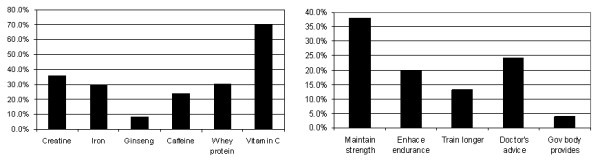
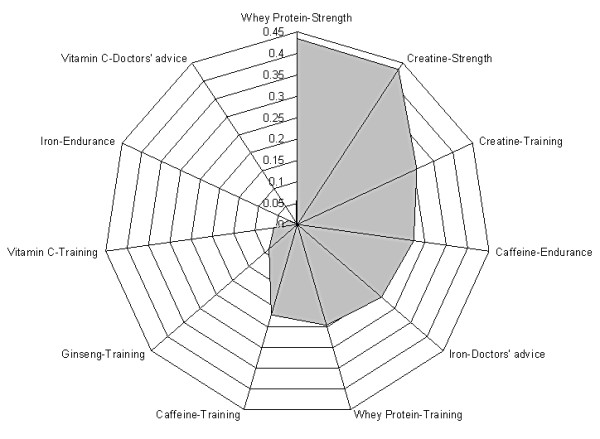
BACKGROUND: Athletes are expected to consider multiple factors when making informed decision about nutritional supplement use. Besides rules, regulations and potential health hazards, the efficacy of different nutritional supplements in performance enhancement is a key issue. The aim of this paper was to find evidence for informed decision making by investigating the relationship between specific performance-related reasons for supplement use and the reported use of nutritional supplements. METHODS: The 'UK Sport 2005 Drug Free Survey' data (n = 874) were re-analysed using association [chi2] and 'strength of association' tests [varphi] to show the proportion of informed choices and to unveil incongruencies between self-reported supplement use and the underlying motives. RESULTS: Participants (n = 520) reported supplement use in the pattern of: vitamin C (70.4%), creatine (36.1%), whey protein (30.6%), iron (29.8%), caffeine (23.8%), and ginseng (8.3%) for the following reasons: strength maintenance (38.1%), doctors' advice (24.2%), enhancing endurance (20.0%), ability to train longer (13.3%), and provided by the governing body (3.8%). Of thirty possible associations between the above supplements and reasons, 11 were predictable from literature precedents and only 8 were evidenced and these were not strong (varphi < .7). The best associations were for the ability to train longer with creatine (reported by 73.9%, chi2 = 49.14, p < .001; varphi = .307, p < .001), and maintaining strength with creatine (reported by 62.6%, chi2 = 97.08, p < .001; varphi = .432, p < .001) and whey protein (reported by 56.1%, chi2 = 97.82, p < .001; varphi = .434, p < .001). CONCLUSION: This study provided a platform for assessing congruence between athletes' reasons for supplement use and their actual use. These results suggest that a lack of understanding exists in supplement use. There is an urgent need to provide accurate information which will help athletes make informed choices about the use of supplements.
Overview
The claims and statistics of this paper haven’t been checked yet.
Free: it reads the open-access text and checks the first 5 claims that cite a source we can check. Create a free account to check every claim.
Integrity signals
Registry
Cites
Statistics
Figures
Verification
Claims the paper makes
The claims and statistics of this paper haven’t been checked yet.
Free: it reads the open-access text and checks the first 5 claims that cite a source we can check. Create a free account to check every claim.
Claims other papers make about this one
Each is checked against this paper’s own text: does it say what the citing paper says it does?
The cited source doesn’t support the claim as written.
In the citing paper
“Of note, a strong relationship was present between reasons for creatine use and physiological rationale among creatine users.”
From Creatine Supplementation in Children and Adolescents (2021) · cites this paper as [26]
Checked by a reasoning model — may be wrong.
Experimental — accuracy not yet measuredThe source backs part of the claim, not all of it — or backs it for a different population, condition or comparison.
In the citing paper
“For example, Petroczi et al. [26] surveyed elite adolescent athletes as part of the United Kingdom Sport 2005 Drug Free Survey and when a subsample of 874 athletes were reanalyzed, 36.1% of athletes reported using creatine.”
From Creatine Supplementation in Children and Adolescents (2021) · cites this paper as [26]
Experimental — accuracy not yet measuredThe source backs part of the claim, not all of it — or backs it for a different population, condition or comparison.
In the citing paper
“This relationship indicates that those self-reporting creatine use were able to correctly identify the purported benefits while selecting physiologically appropriate reasons for use, which was not observed for other dietary supplements.”
From Creatine Supplementation in Children and Adolescents (2021) · cites this paper as [26]
Experimental — accuracy not yet measuredThe source backs part of the claim, not all of it — or backs it for a different population, condition or comparison.
In the citing paper
“While creatine appears to be a popular dietary supplement of choice among elite adolescent athletes, creatine is still less frequently used when compared to other dietary supplement categories such as multivitamins, protein powders, and energy products, in which usage rates of these product categories can range anywhere from 60–80% among adolescent athletes [26,27,28,29,30,31,32].”
From Creatine Supplementation in Children and Adolescents (2021) · cites this paper as [26]
Experimental — accuracy not yet measured
Self-check
Percentages, sums and reported differences re-computed from the paper’s own numbers.
The self-check needs the paper’s full text.
Citations
Cites
Statistical Power Analysis for the Behavioral Sciences
Muller, K. (1989) · Technometrics · doi:10.1080/00401706.1989.10488618 · Cited by 99,167
Statistical power analysis for the behavioral sciences
(1990) · Computers, Environment and Urban Systems · doi:10.1016/0198-9715(90)90050-4 · Cited by 65,269
Applied Nonparametric Statistics
Wozniak, P. J., & Daniel, W. W. (1991) · Technometrics · doi:10.2307/1268795 · Cited by 4,987
GPOWER: A general power analysis program
Erdfelder, E., Faul, F., & Buchner, A. (1996) · Behavior Research Methods, Instruments, & Computers · doi:10.3758/bf03203630 · Cited by 4,864
ISSN exercise & sport nutrition review: research & recommendations
Kreider, R. B., Wilborn, C. D., Taylor, L., Campbell, B., Almada, A. L., Collins, R., Cooke, M., Earnest, C. P., Greenwood, M., Kalman, D. S., et al. (2010) · Journal of the International Society of Sports Nutrition · doi:10.1186/1550-2783-7-7 · Cited by 428
Designing and conducting survey research
Rea, L. M., Names, Parker, R., & Allen, R. (2016) · Cited by 428
The efficacy of ginseng. A systematic review of randomised clinical trials
Vogler, B. K., Pittler, M. H., & Ernst, E. (1999) · European Journal of Clinical Pharmacology · doi:10.1007/s002280050674 · Cited by 364 · cited 1×
“Pairs of supplements and reasons for use are given in Table 1, where literature precedents indicating expected associations [7,9,11,22-26].”
Exercise, nutrition and immune function
Gleeson, M., Nieman, D. C., & Pedersen, B. K. (2004) · Journal of Sports Sciences · doi:10.1080/0264041031000140590 · Cited by 362
International Society of Sports Nutrition position stand: creatine supplementation and exercise
Buford, T. W., Kreider, R. B., Stout, J. R., Greenwood, M., Campbell, B., Spano, M., Ziegenfuss, T., Lopez, H., Landis, J., & Antonio, J. (2007) · Journal of the International Society of Sports Nutrition · doi:10.1186/1550-2783-4-6 · Cited by 341
Effect of different protocols of caffeine intake on metabolism and endurance performance
Cox, G. R., Desbrow, B., Montgomery, P. G., Anderson, M. E., Bruce, C. R., Macrides, T. A., Martin, D. T., Moquin, A., Roberts, A., Hawley, J. A., et al. (2002) · Journal of Applied Physiology · doi:10.1152/japplphysiol.00249.2002 · Cited by 309 · cited 1×
“This was despite the fact that research shows that anaerobic performance in trained athletes improves with caffeine [35], even with low doses [36].”
Adverse events associated with dietary supplements: an observational study
Palmer, M. E., Haller, C., McKinney, P. E., Klein-Schwartz, W., Tschirgi, A., Smolinske, S. C., Woolf, A., Sprague, B. M., Ko, R., Everson, G., et al. (2003) · The Lancet · doi:10.1016/s0140-6736(03)12227-1 · Cited by 273
Nissen, S. L., & Sharp, R. L. (2003) · Journal of Applied Physiology · doi:10.1152/japplphysiol.00755.2002 · Cited by 258
Joint position statement: nutrition and athletic performance
(2001) · Scandinavian Journal of Medicine & Science in Sports · doi:10.1046/j.1524-4725.2001.110310_2.x · Cited by 253
Contamination of dietary supplements and positive drug tests in sport
Maughan, R. (2005) · Journal of Sports Sciences · doi:10.1080/02640410400023258 · Cited by 237 · cited 1×
“The unregulated use of nutritional supplements therefore poses an increased health risk to an otherwise healthy population [44].”
James, J. E. (2004) · Psychosomatic Medicine · doi:10.1097/10.psy.0000107884.78247.f9 · Cited by 232 · cited 1×
“Caffeine [40], vitamin C [41], and iron [42] have all been shown to have potentially adverse effects if used over a long period.”
Vitamin/Mineral Supplement Use among Athletes: A Review of the Literature
Sobal, J., & Marquart, L. F. (1994) · International Journal of Sport Nutrition · doi:10.1123/ijsn.4.4.320 · Cited by 214
Health risks of herbal remedies: an update
DESMET, P. (2004) · Clinical Pharmacology & Therapeutics · doi:10.1016/j.clpt.2004.03.005 · Cited by 213
Nutrition and Athletic Performance
(2000) · Medicine and Science in Sports and Exercise · doi:10.1097/00005768-200012000-00025 · Cited by 211
Consumption of nutritional supplements among adolescents: usage and perceived benefits
O'Dea, J. A. (2003) · Health Education Research · doi:10.1093/her/18.1.98 · Cited by 202
Medication Use in Athletes Selected for Doping Control at the Sydney Olympics (2000)
Corrigan, B., & Kazlauskas, R. (2003) · Clinical Journal of Sport Medicine · doi:10.1097/00042752-200301000-00007 · Cited by 172
Maughan, R. J., King, D. S., & Lea, T. (2004) · Journal of Sports Sciences · doi:10.1080/0264041031000140581 · Cited by 151
Iron supplementation in athletes—first do no harm
Zoller, H., & Vogel, W. (2004) · Nutrition · doi:10.1016/j.nut.2004.04.006 · Cited by 143 · cited 1×
“While there is no clear evidence for the ergogenic properties of ginseng [24] or the much used iron [33], they are often used by athletes believing in their ergogenic properties.”
Evaluation of the Ergogenic Properties of Ginseng: An Update
Bahrke, M. S., & Morgan, W. P. (2000) · Sports Medicine · doi:10.2165/00007256-200029020-00004 · Cited by 140 · cited 2×
“The lack of knowledge regarding iron, vitamin C and ginseng is notable (Tables 2 and 3). While there is no clear evidence for the ergogenic properties of ginseng [ 24 ] or the much used iron [33], they are often used by athletes believing in their ergogenic properties.”
Bryer, S. C., & Goldfarb, A. H. (2006) · International Journal of Sport Nutrition and Exercise Metabolism · doi:10.1123/ijsnem.16.3.270 · Cited by 137 · cited 1×
“On the contrary, the positive effects of vitamin C on delayed muscle soreness and enhanced recovery time are well documented for [34] but these are often taken as a preventive measure in health maintenance and not for direct performancerelated reasons.”
Research of stimulants and anabolic steroids in dietary supplements
Baume, N., Mahler, N., Kamber, M., Mangin, P., & Saugy, M. (2006) · Scandinavian Journal of Medicine & Science in Sports · doi:10.1111/j.1600-0838.2005.00442.x · Cited by 124 · cited 1×
“Owing to diverse forms of regulation across Europe [12] and the documented widespread contamination of nutritional supplements [13], high performing athletes are generally advised by sport governing bodies to stay away from supplements as the safety of the supplements is not guaranteed.”
Nutritional supplement practices in UK junior national track and field athletes
Nieper, A. (2005) · British Journal of Sports Medicine · doi:10.1136/bjsm.2004.015842 · Cited by 119 · cited 3×
“A recent investigation among UK junior track and field athletes [4] revealed widespread use (62%) of nutritional supplements, and that athletes are likely to use supplements in combinations (reporting an average of 2.”
InfluentialVerroken, M. (2000) · Best Practice & Research Clinical Endocrinology & Metabolism · doi:10.1053/beem.2000.0050 · Cited by 118 · cited 1×
“Background Following deaths or near fatal incidents among high performing competitors associated with stimulant abuse [1], establishing official doping control was suggested at the 1960 Summer Olympic Games in Rome and implemented seven years later in Mexico City during a preOlympic event, but without having a standar…”
Popular sports supplements and ergogenic aids
Juhn, M. S. (2003) · Sports Medicine · doi:10.2165/00007256-200333120-00004 · Cited by 113
Influence of performance level on dietary supplementation in elite Canadian athletes
ERDMAN, K. A., FUNG, T. S., & REIMER, R. A. (2006) · Medicine & Science in Sports & Exercise · doi:10.1249/01.mss.0000187332.92169.e0 · Cited by 107 · cited 1×
“With contrasting advice about their use, in some cases, supplement use among elite athletes soars above 80% percent [2,3].”
Conway, K. J., Orr, R., & Stannard, S. R. (2003) · Journal of Applied Physiology · doi:10.1152/japplphysiol.00911.2002 · Cited by 102 · cited 1×
“This was despite the fact that research shows that anaerobic performance in trained athletes improves with caffeine [35], even with low doses [36].”
Doping Use among Tertiary Education Students in Six Developed Countries
Papadopoulos, F. C., Skalkidis, I., Parkkari, J., Petridou, E., & “Sports Injuries” European Union Group (2006) · European Journal of Epidemiology · doi:10.1007/s10654-006-0018-6 · Cited by 91 · cited 1×
“Investigating nutritional supplement use for the purpose of enhancing performance is particularly important as a recent study claims the existence of a link between supplement use and doping [17].”
McGrath, J. C., & Cowan, D. (2008) · British Journal of Pharmacology · doi:10.1038/bjp.2008.171 · Cited by 81
Aoi, W., Naito, Y., & Yoshikawa, T. (2006) · Nutrition Journal · doi:10.1186/1475-2891-5-15 · Cited by 80
Creatine supplementation improves sprint performance in male sprinters
Skare, O. ‐., Skadberg, Ø., & Wisnes, A. R. (2001) · Scandinavian Journal of Medicine & Science in Sports · doi:10.1034/j.1600-0838.2001.011002096.x · Cited by 78 · cited 1×
“This is not surprising as creatine has proven effects on muscle mass, high intensity exercise capacity [29] and sprint performance [30], but not on endurance or prolonged training sessions [31], and is considered as the most effective ergogenic nutritional supplement currently available to athletes [32].”
Iron supplements: the quick fix with long-term consequences
Fisher, A. E., & Naughton, D. P. (2004) · Nutrition Journal · doi:10.1186/1475-2891-3-2 · Cited by 77
Self-citationRisk assessment for creatine monohydrate
Shao, A. E., & Hathcock, J. N. (2006) · Regulatory Toxicology and Pharmacology · doi:10.1016/j.yrtph.2006.05.005 · Cited by 66 · cited 1×
“For example, the observed safe level (OSL) for creatine (5 g/day) is frequently exceeded both in practice and in scientific studies [45].”
Use of permitted drugs in Italian professional soccer players
Taioli, E. (2007) · British Journal of Sports Medicine · doi:10.1136/bjsm.2006.034405 · Cited by 66
Nissen, S. L., & Sharp, R. L. (2003) · Scandinavian Journal of Medicine & Science in Sports · doi:10.1034/j.1600-0838.2003.00339.x · Cited by 65 · cited 1×
“This is not surprising as creatine has proven effects on muscle mass, high intensity exercise capacity [29] and sprint performance [30], but not on endurance or prolonged training sessions [31], and is considered as the most effective ergogenic nutritional supplement currently available to athletes [32].”
Assinewe, V., Arnason, J. T., Aubry, A. J., Mullin, J., & Lemaire, I. B. (2002) · Phytomedicine · doi:10.1078/09447110260571625 · Cited by 65
Van Thuyne, W., & Delbeke, F. (2006) · International Journal of Sports Medicine · doi:10.1055/s-2005-872921 · Cited by 51
IOC consensus statement on sports nutrition 2010
(2011) · Journal of Sports Sciences · doi:10.1080/02640414.2011.619349 · Cited by 50
Nutrition and Sports Supplements: Fact or Fiction
Lawrence, M. E., & Kirby, D. F. (2002) · Journal of Clinical Gastroenterology · doi:10.1097/00004836-200210000-00005 · Cited by 48 · cited 1×
“This is not surprising as creatine has proven effects on muscle mass, high intensity exercise capacity [29] and sprint performance [30], but not on endurance or prolonged training sessions [31], and is considered as the most effective ergogenic nutritional supplement currently available to athletes [32].”
Petróczi, A., & Naughton, D. P. (2007) · Journal of Occupational Medicine and Toxicology · doi:10.1186/1745-6673-2-4 · Cited by 48 · cited 3×
“Petróczi A, Naughton DP: Supplement use in sport: is there a potentially dangerous incongruence between rationale and practice?”
InfluentialSelf-citationAnalysis of x-ray diffraction as a probe of interdiffusion in Si/SiGe heterostructures
Aubertine, D. B., Ozguven, N., McIntyre, P. C., & Brennan, S. (2003) · Journal of Applied Physics · doi:10.1063/1.1589600 · Cited by 40
Nutrition for football: The FIFA/F-MARC Consensus Conference
(2006) · Journal of Sports Sciences · doi:10.1080/02640410500482461 · Cited by 38
ISSN Exercise & Sport Nutrition Review: Research & Recommendations
Kreider, R. B., Almada, A. L., Antonio, J., Broeder, C., Earnest, C., Greenwood, M., Incledon, T., Kalman, D. S., Kleiner, S. M., Leutholtz, B., et al. (2004) · Journal of the International Society of Sports Nutrition · doi:10.1186/1550-2783-1-1-1 · Cited by 38
IOC consensus statement on sports nutrition 2003.
(2004) · PubMed · Cited by 37
Drugs in Sport: The Pressure to Perform
Ratta, R. K. D. (2003) · Annals of Internal Medicine · doi:10.7326/0003-4819-138-1-200301070-00033 · Cited by 26
Nutritional supplements: fact vs. fiction.
Johnson, W. A., & Landry, G. L. (1998) · PubMed · Cited by 25
Drugs in sport: the pressure to perform
Jarvis, C. (2004) · British Journal of Sports Medicine · doi:10.1136/bjsm.2003.008185 · Cited by 25
[Can the administration of large doses of vitamin C have a harmful effect?].
Wróblewski, K. P. (2005) · PubMed · Cited by 15
Cited by
Prevalence of dietary supplement use by athletes: Systematic review and meta-analysis
Knapik, J. J., Steelman, R. A., Hoedebecke, S. S., Austin, K. G., Farina, E. K., & Lieberman, H. R. (2016) · Sports Medicine · doi:10.1007/s40279-015-0387-7 · Cited by 452
Paulsen, G., Cumming, K. T., Holden, G., Hallén, J., Rønnestad, B. R., Sveen, O., Skaug, A., Paur, I., Bastani, N. E., Østgaard, H. N., et al. (2014) · The Journal of Physiology · doi:10.1113/jphysiol.2013.267419 · Cited by 333
Mission impossible? Regulatory and enforcement issues to ensure safety of dietary supplements
Petróczi, A., Taylor, G., & Naughton, D. P. (2010) · Food and Chemical Toxicology · doi:10.1016/j.fct.2010.11.014 · Cited by 195
Self-citationBackhouse, S. H., Whitaker, L., & Petróczi, A. (2013) · Scandinavian Journal of Medicine & Science in Sports · doi:10.1111/j.1600-0838.2011.01374.x · Cited by 186
Self-citationSport Nutrigenomics: Personalized Nutrition for Athletic Performance
Guest, N. S., Horne, J., Vanderhout, S. M., & El-Sohemy, A. (2019) · Frontiers in Nutrition · doi:10.3389/fnut.2019.00008 · Cited by 174
Metadata
- Authors
- Petróczi, A., Naughton, D. P., Mazanov, J., Holloway, A., & Bingham, J.
- Affiliations
- Kingston University London (GB)
- Australian Defence Force Academy (AU)
- United Kingdom Sport (GB)
- Corresponding author
- Petróczi, Andrea
- ORCID
- Petróczi, Andrea
- Venue
- Journal of the International Society of Sports Nutrition
- Publisher
- Informa UK Limited
- Published
- 2007-07-13
- Volume
- 4
- Issue
- 1
- Pages
- 19-19
- ISSN
- 1550-2783 (ISSN-L)
- PMC
- PMC2214727
- OpenAlex
- W2091165126
- Cited by
- 93
- References
- 51
- Citations by year
- 2026: 3 · 2025: 2 · 2024: 3 · 2023: 3 · 2022: 1 · 2021: 4 · 2020: 3 · 2019: 9 · 2018: 7 · 2017: 4 · 2016: 5 · 2015: 7 · 2014: 8 · 2013: 4 · 2012: 8
- FWCI
- 13.50
- Type
- journal article
- Language
- en
- Open access
- gold
- doi.org
- Licence
- Locations
- Journal of the International Society of Sports Nutrition (publishedVersion, cc-by)
- PubMed Central (publishedVersion, cc-by)
- PubMed (publishedVersion)
- Research Repository (Kingston University London) (acceptedVersion)
- DOAJ (DOAJ: Directory of Open Access Journals) (submittedVersion, cc-by-sa)
- Topics
- Social Sciences › Sociology and Political Science › Doping in Sports
- Health Sciences › Medicine › Public Health, Environmental and Occupational Health › Nutrition and Health Studies
- Health Sciences › Medicine › Orthopedics and Sports Medicine › Sports Performance and Training
- Keywords
- dietary supplements, athletes, performance improvement, informed decision-making, creatine, whey protein, vitamin C, caffeine, iron supplementation, ginseng, strength maintenance, endurance
About these checks
Registry, retraction, Cites and statistics results are computed, not judged, with one exception: a printed reference that no index lists is read once by a model before it counts as a citation error. Claims are extracted by a model and kept only when their quote appears verbatim in the text; each cited source is then checked, with a model’s help, for whether it says what the claim relies on. Those verdicts can be wrong — read the claim’s quote and the cited source before relying on one.
Statistics and arithmetic are recomputed, not judged.
Confidence bands are shown only for fields calibrated on our annotated test set. None is calibrated yet, so no band is shown.
What counts as a claim ›How we measure confidence ›How we check this ›
Are you an author, or do you see a problem with this page? Request a review
Data sources
Bibliographic data: Semantic Scholar, OpenAlex, Crossref.
Contains information from the Semantic Scholar Academic Graph Datasets, made available under the ODC Attribution License (ODC-BY 1.0).
Semantic Scholar’s data is described in: Kinney, R., et al. (2023). The Semantic Scholar Open Data Platform. arXiv:2301.10140.
