

Photocatalytic reduction synthesis of SrTiO3-graphene nanocomposites and their enhanced photocatalytic activity
Open accessThe DOI matches its Crossref record; 39 of the 39 references it cites were found in a registry or an index.
Abstract
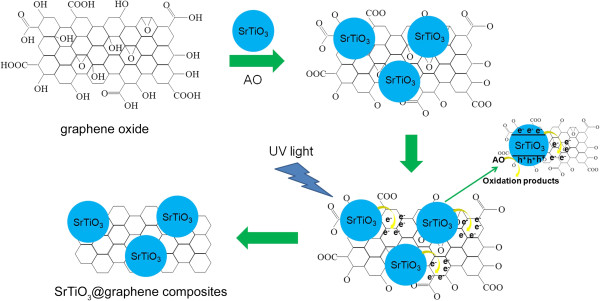
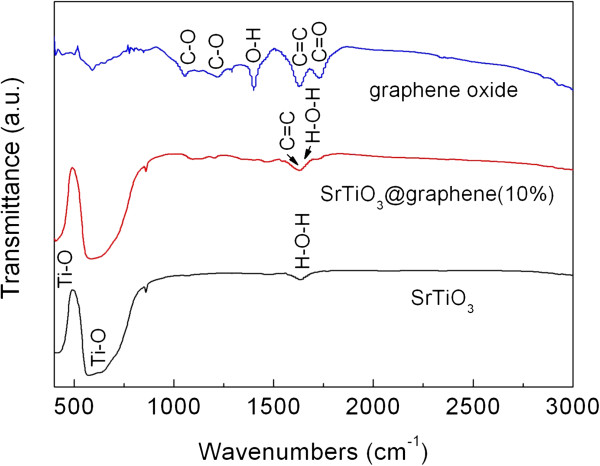
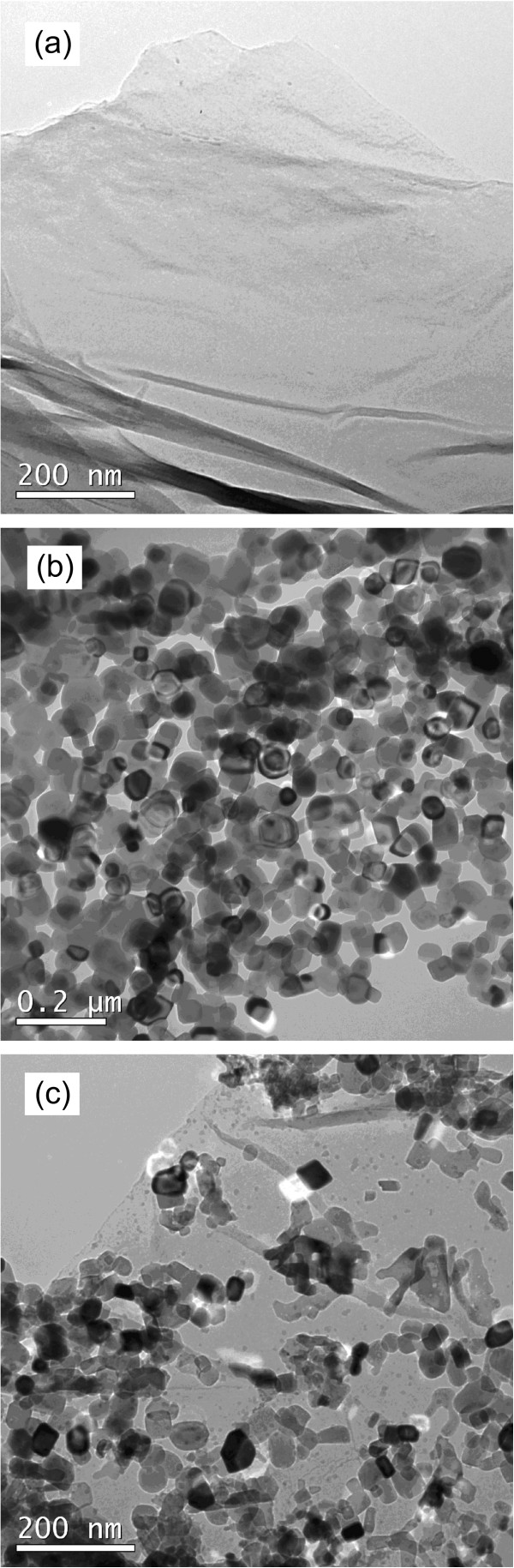
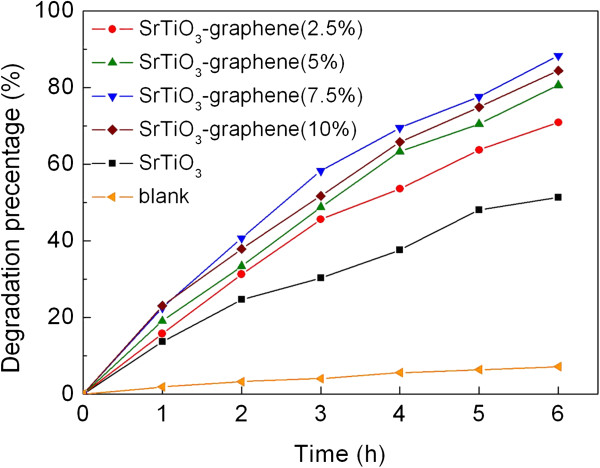
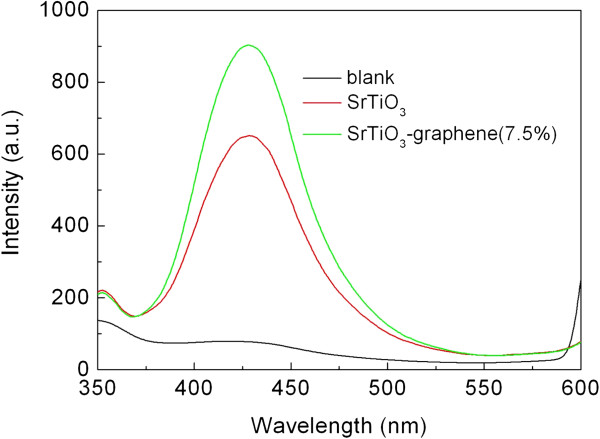
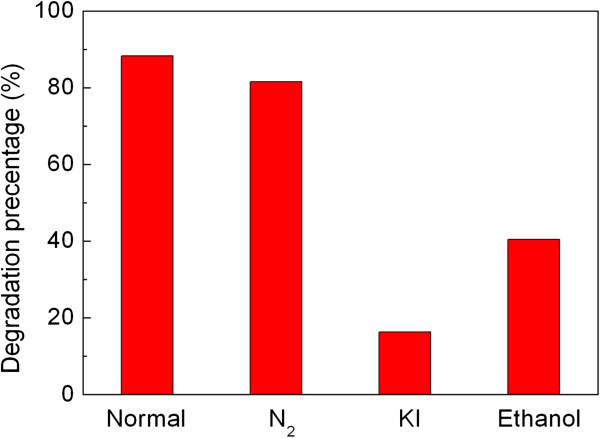
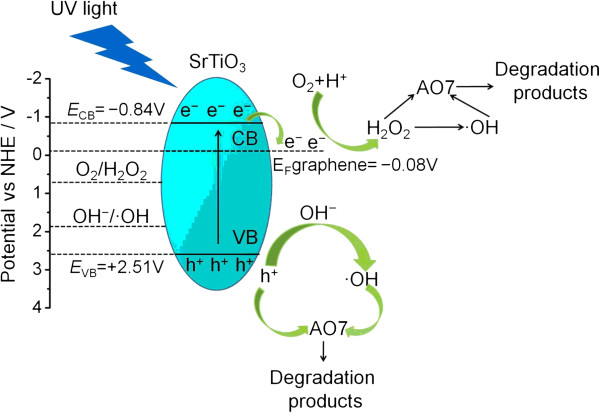
SrTiO3-graphene nanocomposites were prepared via photocatalytic reduction of graphene oxide by UV light-irradiated SrTiO3 nanoparticles. Fourier transformed infrared spectroscopy analysis indicates that graphene oxide is reduced into graphene. Transmission electron microscope observation shows that SrTiO3 nanoparticles are well assembled onto graphene sheets. The photocatalytic activity of as-prepared SrTiO3-graphene composites was evaluated by the degradation of acid orange 7 (AO7) under a 254-nm UV irradiation, revealing that the composites exhibit significantly enhanced photocatalytic activity compared to the bare SrTiO3 nanoparticles. This can be explained by the fact that photogenerated electrons are captured by graphene, leading to an increased separation and availability of electrons and holes for the photocatalytic reaction. Hydroxyl (·OH) radicals were detected by the photoluminescence technique using terephthalic acid as a probe molecule and were found to be produced over the irradiated SrTiO3 nanoparticles and SrTiO3-graphene composites; especially, an enhanced yield is observed for the latter. The influence of ethanol, KI, and N2 on the photocatalytic efficiency was also investigated. Based on the experimental results, ·OH, h(+), and H2O2 are suggested to be the main active species in the photocatalytic degradation of AO7 by SrTiO3-graphene composites. PACS: 61.46. + w; 78.67.Bf; 78.66.Sq.
Overview
The claims and statistics of this paper haven’t been checked yet.
Free: it reads the open-access text and checks the first 5 claims that cite a source we can check. Create a free account to check every claim.
Integrity signals
Registry
Cites
Statistics
Figures
Verification
Claims the paper makes
The claims and statistics of this paper haven’t been checked yet.
Free: it reads the open-access text and checks the first 5 claims that cite a source we can check. Create a free account to check every claim.
Claims other papers make about this one
Each is checked against this paper’s own text: does it say what the citing paper says it does?
The source backs part of the claim, not all of it — or backs it for a different population, condition or comparison.
In the citing paper
“The RST nanoparticles showed a broad peak from 500 to 900 cm−1, which is the characteristic peak of TiO6 octahedron stretching vibrations.39”
From Three-Dimensional Carbonaceous Aerogels Embedded with Rh-SrTiO3 for Enhanced Hydrogen Evolution Triggered by Efficient Charge Transfer and Light Absorption (2020) · cites this paper as [39]
Experimental — accuracy not yet measured
Self-check
Percentages, sums and reported differences re-computed from the paper’s own numbers.
The self-check needs the paper’s full text.
Citations
Cites
Environmental applications of semiconductor photocatalysis
Hoffmann, M. R., Martin, S. T., Choi, W., & Bahnemann, D. W. (1995) · Chemical Reviews · doi:10.1021/cr00033a004 · Cited by 18,495 · cited 1×
“Semiconductor photocatalysts have attracted considerable attention over the past decades due to their potential applications in solar energy conversion and environmental purification [1,2].”
BackgroundSuperior Thermal Conductivity of Single-Layer Graphene
Balandin, A. A., Ghosh, S., Bao, W., Calizo, I., Teweldebrhan, D., Miao, F., & Lau, C. N. (2008) · Nano Letters · doi:10.1021/nl0731872 · Cited by 13,823 · cited 1×
“Graphene, being a two-dimensional (2D) sheet of sp(2)-hybridized carbon atoms, possesses unique properties including high electrical conductivity, electron mobility, thermal conductivity, mechanical strength, and chemical stability [11-13].”
BackgroundUltrahigh electron mobility in suspended graphene
Bolotin, K. I., Sikes, K. J., Jiang, Z., Klima, M., Fudenberg, G., Hone, J., Kim, P., & Stormer, H. L. (2008) · Solid State Communications · doi:10.1016/j.ssc.2008.02.024 · Cited by 8,057
Co3O4 nanocrystals on graphene as a synergistic catalyst for oxygen reduction reaction
Liang, Y., Li, Y., Wang, H., Zhou, J., Wang, J., Regier, T., & Dai, H. (2011) · Nature Materials · doi:10.1038/nmat3087 · Cited by 5,494
Electrochemistry at Semiconductor and Oxidized Metal Electrodes
Morrison, S. R. (1980) · Springer eBooks · doi:10.1007/978-1-4613-3144-5 · Cited by 1,665
Binding energies in atomic negative ions
Hotop, H., & Lineberger, W. C. (1975) · Journal of Physical and Chemical Reference Data · doi:10.1063/1.555524 · Cited by 1,539
Water purification by semiconductor photocatalysis
Mills, A., Davies, R. H., & Worsley, D. (1993) · Chemical Society Reviews · doi:10.1039/cs9932200417 · Cited by 1,427
Mechanical properties of suspended graphene sheets
Frank, I. W., Tanenbaum, D. M., van der Zande, A. M., & McEuen, P. L. (2007) · Journal of Vacuum Science & Technology B: Microelectronics and Nanometer Structures Processing, Measurement, and Phenomena · doi:10.1116/1.2789446 · Cited by 1,162
Xu, T., Zhang, L., Cheng, H., & Zhu, Y. (2011) · Applied Catalysis B: Environmental · doi:10.1016/j.apcatb.2010.10.007 · Cited by 1,132
Daneshvar, N., Salari, D., & Khataee, A. R. (2003) · Journal of Photochemistry and Photobiology A: Chemistry · doi:10.1016/s1010-6030(03)00015-7 · Cited by 923
Cited by
Yang, S., Niu, C., Huang, D., Zhang, H., Liang, C., & Zeng, G. (2017) · Environmental Science Nano · doi:10.1039/c6en00597g · Cited by 202
Self-citationShahabuddin, S., Muhamad Sarih, N., Mohamad, S., & Joon Ching, J. (2016) · Polymers · doi:10.3390/polym8020027 · Cited by 193
Zeng, W., Ye, X., Dong, Y., Zhang, Y., Sun, C., Zhang, T., Guan, X., & Guo, L. (2024) · Coordination Chemistry Reviews · doi:10.1016/j.ccr.2024.215753 · Cited by 190
Kumar, A., Kumar, S., Bahuguna, A., Kumar, A., Sharma, V., & Krishnan, V. (2017) · Materials Chemistry Frontiers · doi:10.1039/c7qm00362e · Cited by 154
Faisal, M., Harraz, F. A., Ismail, A. A., El‐Toni, A. M., Al-Sayari, S. A., Al‐Hajry, A., & Al-Assiri, M. S. (2017) · Separation and Purification Technology · doi:10.1016/j.seppur.2017.08.037 · Cited by 136
Metadata
- Authors
- Xian, T., Yang, H., Di, L., Ma, J., Zhang, H., & Dai, J.
- Affiliations
- Lanzhou University of Technology (CN)
- Corresponding author
- Yang, Hua
- Venue
- Nanoscale Research Letters
- Published
- 2014-06-29
- Volume
- 9
- Issue
- 1
- Pages
- 327-327
- ISSN
- 1556-276X (ISSN-L)
- PMC
- PMC4094787
- OpenAlex
- W2160151165
- Cited by
- 170
- References
- 39
- Citations by year
- 2026: 10 · 2025: 11 · 2024: 16 · 2023: 25 · 2022: 14 · 2021: 15 · 2020: 13 · 2019: 17 · 2018: 14 · 2017: 16 · 2016: 12 · 2015: 5 · 2014: 2
- FWCI
- 3.85
- Type
- journal article
- Language
- en
- Open access
- gold
- doi.org
- Licence
- cc-by
- Locations
- Nanoscale Research Letters (publishedVersion, cc-by)
- Europe PMC (PubMed Central) (publishedVersion, cc-by)
- PubMed Central (publishedVersion, cc-by)
- PubMed (publishedVersion)
- Funders
- Lanzhou University
- National Natural Science Foundation of China (J201205, 51262018)
- Lanzhou University of Technology (51262018, J201205)
- Topics
- Physical Sciences › Energy › Renewable Energy, Sustainability and the Environment › Advanced Photocatalysis Techniques
- Physical Sciences › Energy › Renewable Energy, Sustainability and the Environment › TiO2 Photocatalysis and Solar Cells
- Physical Sciences › Environmental Science › Water Science and Technology › Advanced oxidation water treatment
- Keywords
- photocatalytic reduction, graphene oxide reduction, SrTiO3 nanoparticles, acid orange 7 degradation, dye degradation, hydroxyl radicals, photogenerated charge separation, UV irradiation, photocatalytic activity enhancement, ethanol effects, nitrogen effect
About these checks
Registry, retraction, Cites and statistics results are computed, not judged, with one exception: a printed reference that no index lists is read once by a model before it counts as a citation error. Claims are extracted by a model and kept only when their quote appears verbatim in the text; each cited source is then checked, with a model’s help, for whether it says what the claim relies on. Those verdicts can be wrong — read the claim’s quote and the cited source before relying on one.
Statistics and arithmetic are recomputed, not judged.
Confidence bands are shown only for fields calibrated on our annotated test set. None is calibrated yet, so no band is shown.
What counts as a claim ›How we measure confidence ›How we check this ›
Are you an author, or do you see a problem with this page? Request a review
Data sources
Bibliographic data: Semantic Scholar, OpenAlex, Crossref.
Contains information from the Semantic Scholar Academic Graph Datasets, made available under the ODC Attribution License (ODC-BY 1.0).
Semantic Scholar’s data is described in: Kinney, R., et al. (2023). The Semantic Scholar Open Data Platform. arXiv:2301.10140.
