

Multi-channel acoustic recording and automated analysis of Drosophila courtship songs
Open accessThe DOI matches its Crossref record; 45 of the 45 references it cites were found in a registry or an index.
Abstract
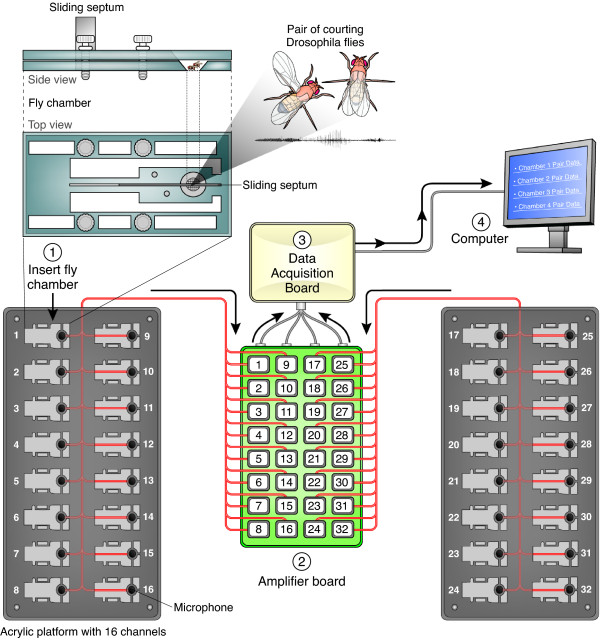
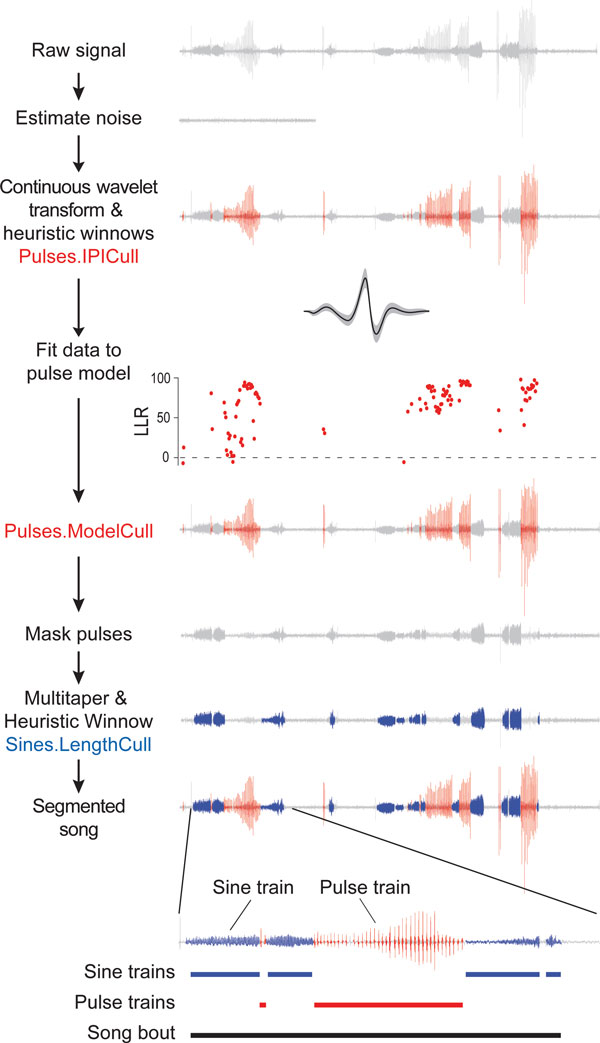
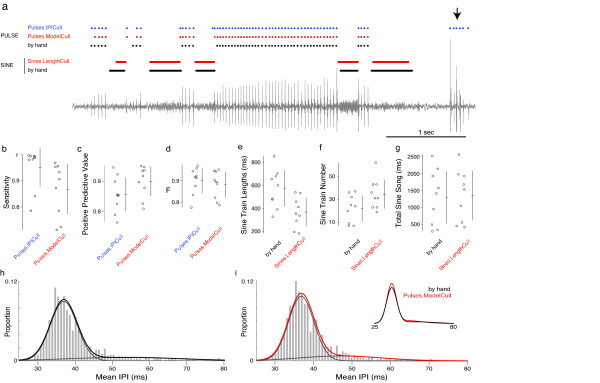
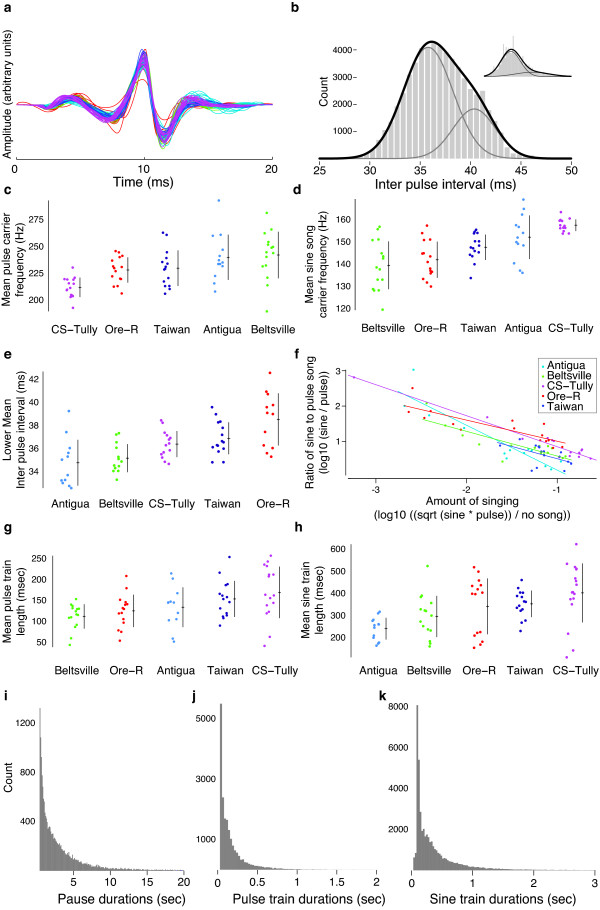
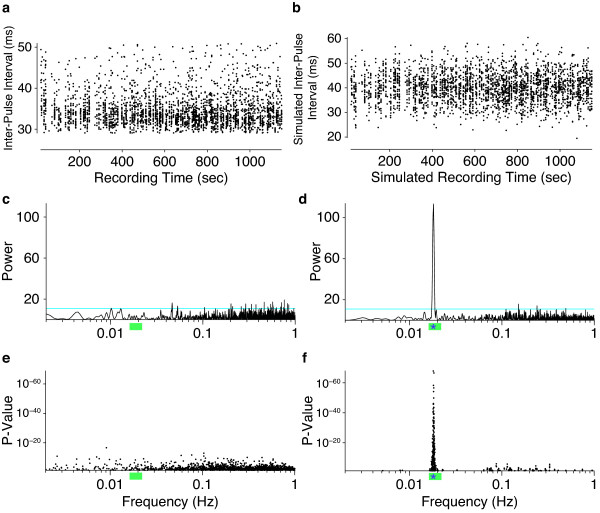
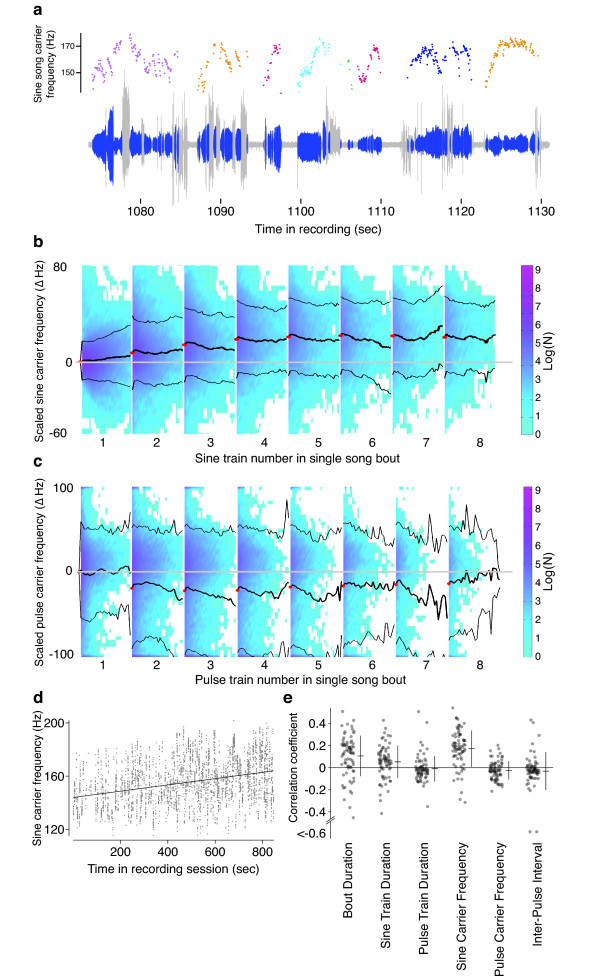
BACKGROUND: Drosophila melanogaster has served as a powerful model system for genetic studies of courtship songs. To accelerate research on the genetic and neural mechanisms underlying courtship song, we have developed a sensitive recording system to simultaneously capture the acoustic signals from 32 separate pairs of courting flies as well as software for automated segmentation of songs. RESULTS: Our novel hardware design enables recording of low amplitude sounds in most laboratory environments. We demonstrate the power of this system by collecting, segmenting and analyzing over 18 hours of courtship song from 75 males from five wild-type strains of Drosophila melanogaster. Our analysis reveals previously undetected modulation of courtship song features and extensive natural genetic variation for most components of courtship song. Despite having a large dataset with sufficient power to detect subtle modulations of song, we were unable to identify previously reported periodic rhythms in the inter-pulse interval of song. We provide detailed instructions for assembling the hardware and for using our open-source segmentation software. CONCLUSIONS: Analysis of a large dataset of acoustic signals from Drosophila melanogaster provides novel insight into the structure and dynamics of species-specific courtship songs. Our new system for recording and analyzing fly acoustic signals should therefore greatly accelerate future studies of the genetics, neurobiology and evolution of courtship song.
Overview
The claims and statistics of this paper haven’t been checked yet.
Free: it reads the open-access text and checks the first 5 claims that cite a source we can check. Create a free account to check every claim.
Integrity signals
Registry
Cites
Statistics
Figures
Verification
Claims the paper makes
The claims and statistics of this paper haven’t been checked yet.
Free: it reads the open-access text and checks the first 5 claims that cite a source we can check. Create a free account to check every claim.
Claims other papers make about this one
Each is checked against this paper’s own text: does it say what the citing paper says it does?
The source backs part of the claim, not all of it — or backs it for a different population, condition or comparison.
In the citing paper
“whereas recordings from sine-preferring (Figure 4C) or intermediate preference neurons (Figure 4D) showed either low- or band-pass frequency tuning, with individual tuning curves tiling the broad range of frequencies present in conspecific sine song (100–400 Hz) 14.”
From Neural network organization for courtship-song feature detection in Drosophila (2022) · cites this paper as [14]
Experimental — accuracy not yet measuredIn the citing paper
“D. melanogaster males alternate between two major song modes during courtship: pulse and sine song (Figure 1A; 13,14).”
From Neural network organization for courtship-song feature detection in Drosophila (2022) · cites this paper as [14]
Self-check
Percentages, sums and reported differences re-computed from the paper’s own numbers.
The self-check needs the paper’s full text.
Citations
Cites
Introduction to Quantitative Genetics.
Edwards, A. W. F., & Falconer, D. S. (1982) · Biometrics · doi:10.2307/2529912 · Cited by 21,447
Scargle, J. D. (1982) · The Astrophysical Journal · doi:10.1086/160554 · Cited by 7,376
Least-squares frequency analysis of unequally spaced data
Lomb, N. R. (1976) · Astrophysics and Space Science · doi:10.1007/bf00648343 · Cited by 5,717
Procedures for Detecting Outlying Observations in Samples
Grubbs, F. E. (1969) · Technometrics · doi:10.1080/00401706.1969.10490657 · Cited by 4,105 · cited 1×
“Statistical outliers were identified and removed prior to statistical analysis and plotting with an iterative Grubb ’ s test [41,42].”
MethodA Wavelet Tour of Signal Processing : The Sparse Way
Mallat, S., & Gabriel Peyré, A. (2008) · Cited by 2,734
Spectral Analysis for Physical Applications
Percival, D. B., & Walden, A. T. (1993) · Cambridge University Press eBooks · doi:10.1017/cbo9780511622762 · Cited by 2,161
Introduction to Quantitative Genetics.
Veale, A. M. O., & Falconer, D. S. (1960) · Applied Statistics · doi:10.2307/2985722 · Cited by 1,540
Spectral Analysis for Physical Applications: Multitaper and Conventional Univariate Techniques.
DSS, Percival, D. B., & Walden, A. T. (1997) · Journal of the American Statistical Association · doi:10.2307/2965609 · Cited by 955
A Wavelet Tour of Signal Processing, Third Edition: The Sparse Way
Mallat, S. (2008) · Academic Press eBooks · Cited by 947
The neural basis of Drosophila gravity-sensing and hearing
Kamikouchi, A., Inagaki, H. K., Effertz, T., Hendrich, O., Fiala, A., Göpfert, M. C., & Ito, K. (2009) · Nature · doi:10.1038/nature07810 · Cited by 406 · cited 1×
“Movement of the third antennal segment activates mechanosensory neurons housed within the antenna that transmit auditory information to the brain [7,8].”
BackgroundZehring, W. A., Wheeler, D. A., Reddy, P., Konopka, R. J., Kyriacou, C. P., Rosbash, M., & Hall, J. C. (1984) · Cell · doi:10.1016/0092-8674(84)90015-1 · Cited by 393
Neuronal control of Drosophila courtship song
von Philipsborn, A. C., Liu, T., Yu, J. Y., Masser, C., Bidaye, S. S., & Dickson, B. J. (2011) · Neuron · doi:10.1016/j.neuron.2011.01.011 · Cited by 374
Kyriacou, C. P., & Hall, J. C. (1980) · Proceedings of the National Academy of Sciences · doi:10.1073/pnas.77.11.6729 · Cited by 350
The Courtship Songs of Drosophila
Ewing, A. W., & Bennet-Clark, H. C. (1968) · Behaviour · doi:10.1163/156853968x00298 · Cited by 256
Glynn, E. F., Chen, J., & Mushegian, A. R. (2006) · Bioinformatics · doi:10.1093/bioinformatics/bti789 · Cited by 253
The function of pulse song and sine song in the courtship of Drosophila melanogaster
Schilcher, F. V. (1976) · Animal Behaviour · doi:10.1016/s0003-3472(76)80076-0 · Cited by 206
Wheeler, D. A., Kyriacou, C. P., Greenacre, M. L., Yu, Q., Rutila, J. E., Rosbash, M., & Hall, J. C. (1991) · Science · doi:10.1126/science.1900131 · Cited by 184
Cowling, D. E., & Burnet, B. (1981) · Animal Behaviour · doi:10.1016/s0003-3472(81)80030-9 · Cited by 182
Interspecific Genetic Control of Courtship Song Production and Reception in Drosophila
Kyriacou, C. P., & Hall, J. C. (1986) · Science · doi:10.1126/science.3083506 · Cited by 176
BENNET-CLARK, H. C. (1971) · Nature · doi:10.1038/234255a0 · Cited by 176
The mechanical basis of Drosophila audition
Göpfert, M. C., & Robert, D. (2002) · Journal of Experimental Biology · doi:10.1242/jeb.205.9.1199 · Cited by 172
A New Chamber for Studying the Behavior of Drosophila
Simon, J. C., & Dickinson, M. H. (2010) · PLoS ONE · doi:10.1371/journal.pone.0008793 · Cited by 147
Nature of the Sound Produced by Drosophila melanogaster during Courtship
Shorey, H. H. (1962) · Science · doi:10.1126/science.137.3531.677 · Cited by 144
Pulses, patterns and paths: neurobiology of acoustic behaviour in crickets
Hedwig, B. (2006) · Journal of Comparative Physiology A · doi:10.1007/s00359-006-0115-8 · Cited by 142
Investigating Natural Variation in Drosophila Courtship Song by the Evolve and Resequence Approach
Turner, T. L., & Miller, P. M. (2012) · Genetics · doi:10.1534/genetics.112.139337 · Cited by 117
Talyn, B., & Dowse, H. B. (2004) · Animal Behaviour · doi:10.1016/j.anbehav.2003.11.023 · Cited by 105
Rapid evolution of courtship song pattern in Drosophila willistoni sibling species
Ritchie, M. G., & Gleason, J. M. (1995) · Journal of Evolutionary Biology · doi:10.1046/j.1420-9101.1995.8040463.x · Cited by 104
Gleason, J. M., & Ritchie, M. G. (2004) · Genetics · doi:10.1534/genetics.166.3.1303 · Cited by 103
Hawaiian Courtship Songs: Evolutionary Innovation in Communication Signals of Drosophila
Hoy, R. R., Hoikkala, A., & Kaneshiro, K. Y. (1988) · Science · doi:10.1126/science.3127882 · Cited by 95
Quantitative trait loci affecting a courtship signal in Drosophila melanogaster
Gleason, J. M., Nuzhdin, S. V., & Ritchie, M. G. (2002) · Heredity · doi:10.1038/sj.hdy.6800099 · Cited by 94
Spectral analysis of Drosophila courtship song rhythms
Kyriacou, C. P., & Hall, J. C. (1989) · Animal Behaviour · doi:10.1016/0003-3472(89)90069-9 · Cited by 92
Ewing, A. W. (1979) · Journal of Comparative Physiology A · doi:10.1007/bf02582977 · Cited by 84
The collected works of John W. Tukey
Tukey, J. W., & Brillinger, D. R. (1984) · Medical Entomology and Zoology · Cited by 82
Grace, J. L., & Shaw, K. L. (2011) · Evolution · doi:10.1111/j.1558-5646.2011.01278.x · Cited by 69
The neuromuscular basis of courtship song inDrosophila: The role of the indirect flight muscles
Ewing, A. W. (1977) · Journal of Comparative Physiology A · doi:10.1007/bf00656637 · Cited by 67
A Particle Velocity Microphone for the Song of Small Insects and Other Acoustic Measurements
Bennet-Clark, H. C. (1984) · Journal of Experimental Biology · doi:10.1242/jeb.108.1.459 · Cited by 55
Genetic variability of courtship song in a population of Drosophila melanogaster
Ritchie, M. G., & Kyriacou, C. P. (1994) · Animal Behaviour · doi:10.1006/anbe.1994.1256 · Cited by 52
Cycles in the courtship song of male Drosophila melanogaster have not been detected
Ewing, A. W. (1988) · Animal Behaviour · doi:10.1016/s0003-3472(88)80068-x · Cited by 43
Failure to confirm rhythms in Drosophila courtship song
Crossley, S. A. (1988) · Animal Behaviour · doi:10.1016/s0003-3472(88)80069-1 · Cited by 41
Song Choice Is Modulated by Female Movement in Drosophila Males
Trott, A., Donelson, N. C., Griffith, L. C., & Ejima, A. (2012) · PLoS ONE · doi:10.1371/journal.pone.0046025 · Cited by 29
Moulin, B., Rybak, F., Aubin, T., & Jallon, J. M. (2001) · Behavior Genetics · doi:10.1023/a:1012231409691 · Cited by 29
Divergence in Multiple Courtship Song Traits between Drosophila santomea and D. yakuba
Blyth, J. E., Lachaise, D., & Ritchie, M. G. (2008) · Ethology · doi:10.1111/j.1439-0310.2008.01519.x · Cited by 19
A referee's comment on the identification of cycles in the courtship song of Drosophila melanogaster
Logan, I. G., & Rosenberg, J. (1989) · Animal Behaviour · doi:10.1016/0003-3472(89)90070-5 · Cited by 16
Toward an Efficient and Integrative Analysis of Limited-Choice Behavioral Experiments: Figure 1.
Schilling, K., Oberdick, J., & Schilling, R. L. (2012) · Journal of Neuroscience · doi:10.1523/jneurosci.1452-12.2012 · Cited by 12
Artificial neural network classification of Drosophila courtship song mutants
Neumann, E., Wheeler, D. A., Bernstein, A. S., Burnside, J. W., & Hall, J. C. (1992) · Biological Cybernetics · doi:10.1007/bf00204113 · Cited by 10
Research works printed but not linked: 2
- Bennet-Clark HC Microphone and pre-amplifier for recording courtship song of Drosophila Drosophila Information Service 1972 49 127 128
- wav files for "Multi-channel acoustic recording and automated analysis of Drosophila courtship songs" http://flycourtship.github.com/FlySongSegmenter/ PMC3599446 23369160
Cited by
Fast animal pose estimation using deep neural networks
Pereira, T. D., Aldarondo, D. E., Willmore, L., Kislin, M., Wang, S. S.-H., Murthy, M., & Shaevitz, J. W. (2019) · Nature Methods · doi:10.1038/s41592-018-0234-5 · Cited by 687
Self-citationQuantifying behavior to understand the brain
Pereira, T. D., Shaevitz, J. W., & Murthy, M. (2020) · Nature Neuroscience · doi:10.1038/s41593-020-00734-z · Cited by 309
Self-citationUnsupervised identification of the internal states that shape natural behavior
Calhoun, A. J., Pillow, J. W., & Murthy, M. (2019) · Nature Neuroscience · doi:10.1038/s41593-019-0533-x · Cited by 205
“patterning, we speculate that the remaining variability is due to either some noise in our 337 segmentation of song [3] or the fact that we do not measure some male behaviors that are known to 338 be part of the courtship interaction, including tapping of the female via the forelegs and proboscis 339 extension [49,72].”
BackgroundSelf-citationPCK2 activation mediates an adaptive response to glucose depletion in lung cancer
Leithner, K., Hrzenjak, A., Trötzmüller, M., Moustafa, T., Köfeler, H. C., Wohlkoenig, C., Stacher, E., Lindenmann, J., Harris, A. L., Olschewski, A., et al. (2015) · Oncogene · doi:10.1038/onc.2014.47 · Cited by 200
Measuring behavior across scales
Berman, G. J. (2018) · BMC Biology · doi:10.1186/s12915-018-0494-7 · Cited by 184
“[91] Arthur BJ, Sunayama-Morita T, Coen P, Murthy M,”
Metadata
- Authors
- Arthur, B. J., Sunayama-Morita, T., Coen, P., Murthy, M., & Stern, D. L.
- Affiliations
- Cornell University (US)
- Howard Hughes Medical Institute (US)
- Princeton University (US)
- Corresponding author
- Murthy, Mala
- Stern, David L
- Venue
- BMC Biology
- Published
- 2013-01-31
- Volume
- 11
- Issue
- 1
- Pages
- 11-11
- ISSN
- 1741-7007 (ISSN-L)
- PMC
- PMC3599446
- OpenAlex
- W2068762572
- Cited by
- 117
- References
- 45
- Citations by year
- 2026: 9 · 2025: 9 · 2024: 9 · 2023: 7 · 2022: 6 · 2021: 10 · 2020: 9 · 2019: 10 · 2018: 13 · 2017: 10 · 2016: 9 · 2015: 4 · 2014: 11 · 2013: 1
- FWCI
- 4.04
- Type
- journal article
- Language
- en
- Open access
- gold
- doi.org
- Licence
- cc-by
- Locations
- BMC Biology (publishedVersion, cc-by)
- Europe PMC (PubMed Central) (publishedVersion, cc-by)
- PubMed Central (publishedVersion, cc-by)
- PubMed (publishedVersion)
- UCL Discovery (University College London) (submittedVersion)
- Funders
- National Science Foundation (CAREER)
- Howard Hughes Medical Institute
- Alfred P. Sloan Foundation
- McKnight Foundation
- University of California, San Diego
- National Institute on Deafness and Other Communication Disorders (R01DC000103)
- Topics
- Life Sciences › Neuroscience › Cellular and Molecular Neuroscience › Neurobiology and Insect Physiology Research
- Life Sciences › Agricultural and Biological Sciences › Ecology, Evolution, Behavior and Systematics › Animal Vocal Communication and Behavior
- Life Sciences › Agricultural and Biological Sciences › Ecology, Evolution, Behavior and Systematics › Orthoptera Research and Taxonomy
- Keywords
- Drosophila melanogaster, courtship song, natural genetic variation, interpulse interval, open source software
- MeSH terms
- Animals, Animal Communication, Drosophila melanogaster, Sexual Behavior, Animal, Genetic Variation, Videotape Recording
About these checks
Registry, retraction, Cites and statistics results are computed, not judged, with one exception: a printed reference that no index lists is read once by a model before it counts as a citation error. Claims are extracted by a model and kept only when their quote appears verbatim in the text; each cited source is then checked, with a model’s help, for whether it says what the claim relies on. Those verdicts can be wrong — read the claim’s quote and the cited source before relying on one.
Statistics and arithmetic are recomputed, not judged.
Confidence bands are shown only for fields calibrated on our annotated test set. None is calibrated yet, so no band is shown.
What counts as a claim ›How we measure confidence ›How we check this ›
Are you an author, or do you see a problem with this page? Request a review
Data sources
Bibliographic data: Semantic Scholar, OpenAlex, Crossref.
Contains information from the Semantic Scholar Academic Graph Datasets, made available under the ODC Attribution License (ODC-BY 1.0).
Semantic Scholar’s data is described in: Kinney, R., et al. (2023). The Semantic Scholar Open Data Platform. arXiv:2301.10140.
