

Multi-channel acoustic recording and automated analysis of Drosophila courtship songs
Open accessThe DOI matches its Crossref record; 45 of the 45 references it cites were found in a registry or an index.
Abstract
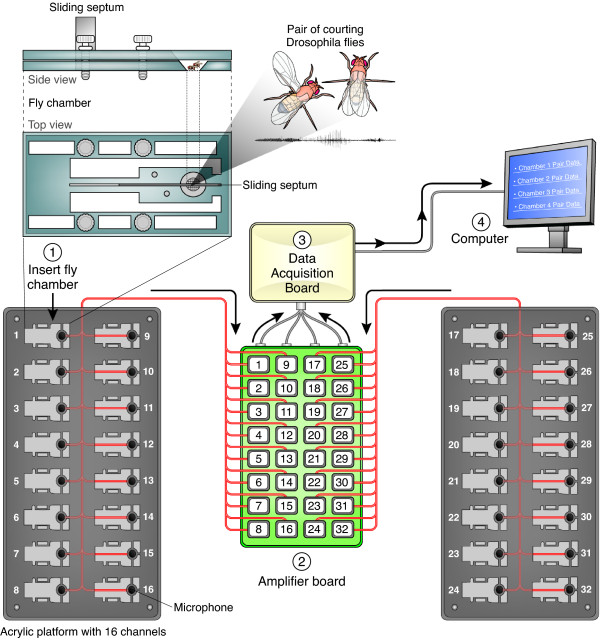
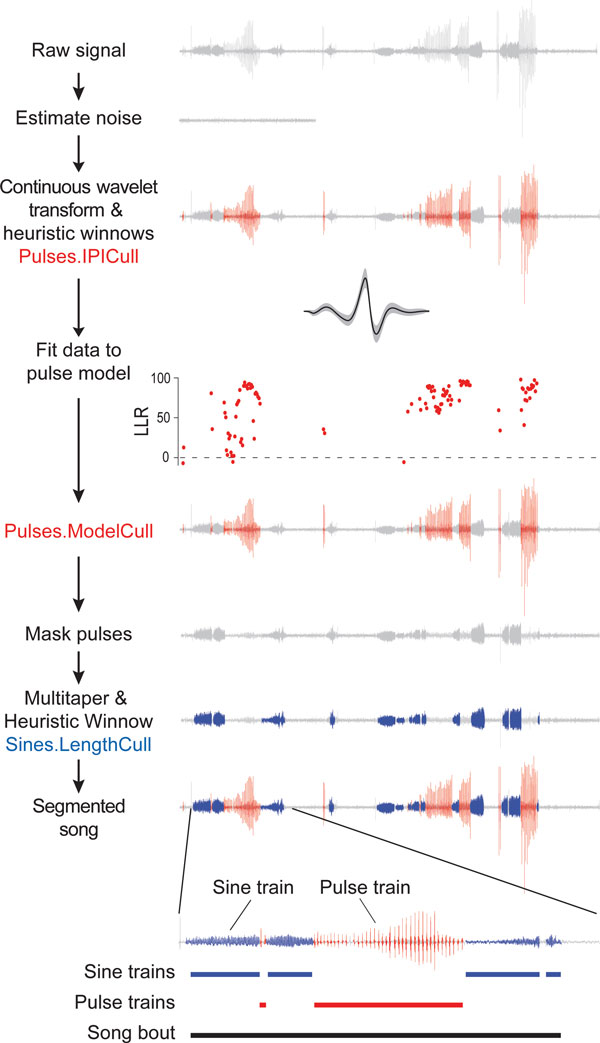
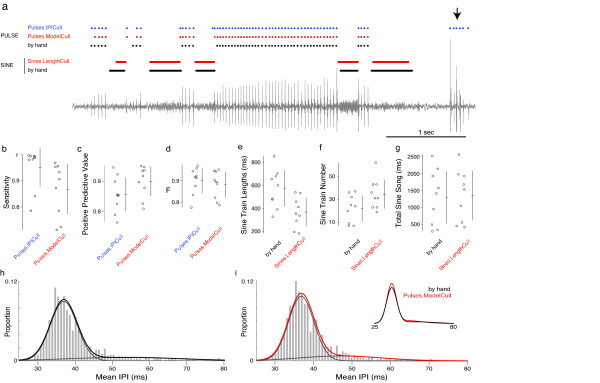
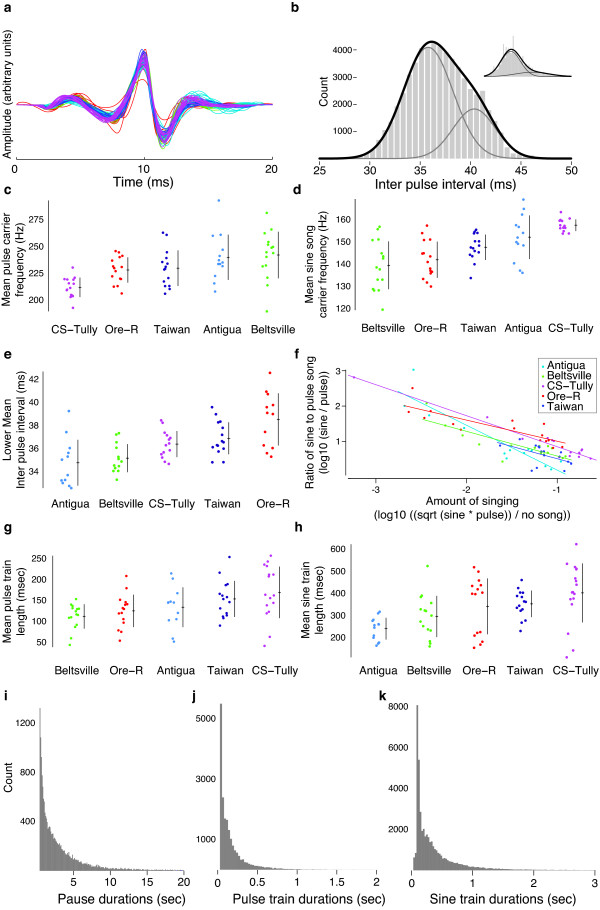
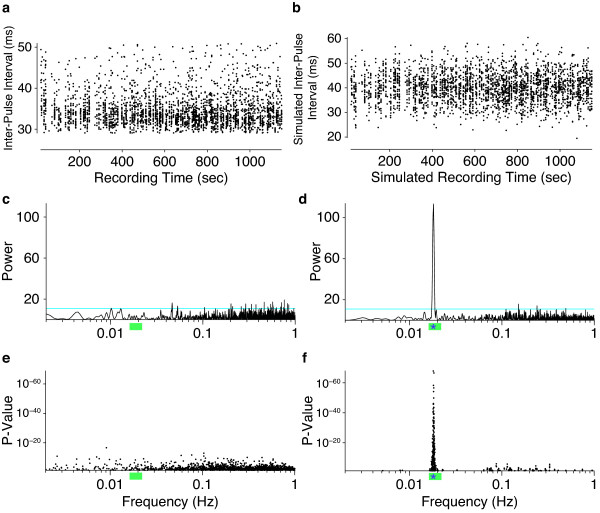
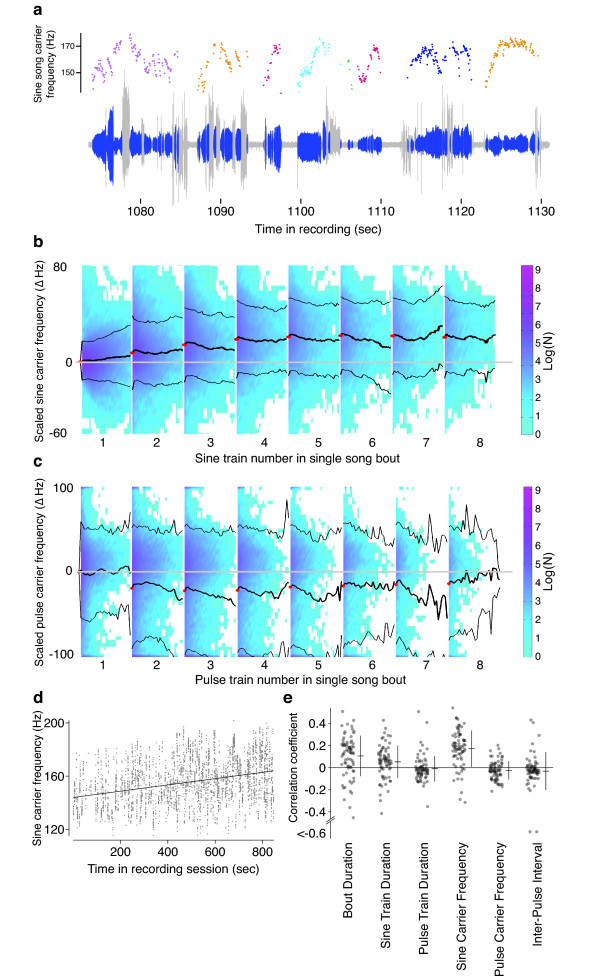
BACKGROUND: Drosophila melanogaster has served as a powerful model system for genetic studies of courtship songs. To accelerate research on the genetic and neural mechanisms underlying courtship song, we have developed a sensitive recording system to simultaneously capture the acoustic signals from 32 separate pairs of courting flies as well as software for automated segmentation of songs. RESULTS: Our novel hardware design enables recording of low amplitude sounds in most laboratory environments. We demonstrate the power of this system by collecting, segmenting and analyzing over 18 hours of courtship song from 75 males from five wild-type strains of Drosophila melanogaster. Our analysis reveals previously undetected modulation of courtship song features and extensive natural genetic variation for most components of courtship song. Despite having a large dataset with sufficient power to detect subtle modulations of song, we were unable to identify previously reported periodic rhythms in the inter-pulse interval of song. We provide detailed instructions for assembling the hardware and for using our open-source segmentation software. CONCLUSIONS: Analysis of a large dataset of acoustic signals from Drosophila melanogaster provides novel insight into the structure and dynamics of species-specific courtship songs. Our new system for recording and analyzing fly acoustic signals should therefore greatly accelerate future studies of the genetics, neurobiology and evolution of courtship song.
Overview
The claims and statistics of this paper haven’t been checked yet.
Free: it reads the open-access text and checks the first 5 claims that cite a source we can check. Create a free account to check every claim.
Integrity signals
Registry
Cites
Statistics
Figures
Verification
Claims the paper makes
The claims and statistics of this paper haven’t been checked yet.
Free: it reads the open-access text and checks the first 5 claims that cite a source we can check. Create a free account to check every claim.
Claims other papers make about this one
Each is checked against this paper’s own text: does it say what the citing paper says it does?
The source backs part of the claim, not all of it — or backs it for a different population, condition or comparison.
In the citing paper
“whereas recordings from sine-preferring (Figure 4C) or intermediate preference neurons (Figure 4D) showed either low- or band-pass frequency tuning, with individual tuning curves tiling the broad range of frequencies present in conspecific sine song (100–400 Hz) 14.”
From Neural network organization for courtship-song feature detection in Drosophila (2022) · cites this paper as [14]
Experimental — accuracy not yet measuredIn the citing paper
“D. melanogaster males alternate between two major song modes during courtship: pulse and sine song (Figure 1A; 13,14).”
From Neural network organization for courtship-song feature detection in Drosophila (2022) · cites this paper as [14]
Self-check
Percentages, sums and reported differences re-computed from the paper’s own numbers.
The self-check needs the paper’s full text.
Citations
Cites
Introduction to Quantitative Genetics.
Edwards, A. W. F., & Falconer, D. S. (1982) · Biometrics · doi:10.2307/2529912 · Cited by 21,447
Scargle, J. D. (1982) · The Astrophysical Journal · doi:10.1086/160554 · Cited by 7,376
Least-squares frequency analysis of unequally spaced data
Lomb, N. R. (1976) · Astrophysics and Space Science · doi:10.1007/bf00648343 · Cited by 5,717
Procedures for Detecting Outlying Observations in Samples
Grubbs, F. E. (1969) · Technometrics · doi:10.1080/00401706.1969.10490657 · Cited by 4,105 · cited 1×
“Statistical outliers were identified and removed prior to statistical analysis and plotting with an iterative Grubb ’ s test [41,42].”
MethodA Wavelet Tour of Signal Processing : The Sparse Way
Mallat, S., & Gabriel Peyré, A. (2008) · Cited by 2,734
Spectral Analysis for Physical Applications
Percival, D. B., & Walden, A. T. (1993) · Cambridge University Press eBooks · doi:10.1017/cbo9780511622762 · Cited by 2,161
Introduction to Quantitative Genetics.
Veale, A. M. O., & Falconer, D. S. (1960) · Applied Statistics · doi:10.2307/2985722 · Cited by 1,540
Spectral Analysis for Physical Applications: Multitaper and Conventional Univariate Techniques.
DSS, Percival, D. B., & Walden, A. T. (1997) · Journal of the American Statistical Association · doi:10.2307/2965609 · Cited by 955
A Wavelet Tour of Signal Processing, Third Edition: The Sparse Way
Mallat, S. (2008) · Academic Press eBooks · Cited by 947
The neural basis of Drosophila gravity-sensing and hearing
Kamikouchi, A., Inagaki, H. K., Effertz, T., Hendrich, O., Fiala, A., Göpfert, M. C., & Ito, K. (2009) · Nature · doi:10.1038/nature07810 · Cited by 406 · cited 1×
“Movement of the third antennal segment activates mechanosensory neurons housed within the antenna that transmit auditory information to the brain [7,8].”
Background
Research works printed but not linked: 2
- Bennet-Clark HC Microphone and pre-amplifier for recording courtship song of Drosophila Drosophila Information Service 1972 49 127 128
- wav files for "Multi-channel acoustic recording and automated analysis of Drosophila courtship songs" http://flycourtship.github.com/FlySongSegmenter/ PMC3599446 23369160
Cited by
Fast animal pose estimation using deep neural networks
Pereira, T. D., Aldarondo, D. E., Willmore, L., Kislin, M., Wang, S. S.-H., Murthy, M., & Shaevitz, J. W. (2019) · Nature Methods · doi:10.1038/s41592-018-0234-5 · Cited by 687
Self-citationQuantifying behavior to understand the brain
Pereira, T. D., Shaevitz, J. W., & Murthy, M. (2020) · Nature Neuroscience · doi:10.1038/s41593-020-00734-z · Cited by 309
Self-citationUnsupervised identification of the internal states that shape natural behavior
Calhoun, A. J., Pillow, J. W., & Murthy, M. (2019) · Nature Neuroscience · doi:10.1038/s41593-019-0533-x · Cited by 205
“patterning, we speculate that the remaining variability is due to either some noise in our 337 segmentation of song [3] or the fact that we do not measure some male behaviors that are known to 338 be part of the courtship interaction, including tapping of the female via the forelegs and proboscis 339 extension [49,72].”
BackgroundSelf-citationPCK2 activation mediates an adaptive response to glucose depletion in lung cancer
Leithner, K., Hrzenjak, A., Trötzmüller, M., Moustafa, T., Köfeler, H. C., Wohlkoenig, C., Stacher, E., Lindenmann, J., Harris, A. L., Olschewski, A., et al. (2015) · Oncogene · doi:10.1038/onc.2014.47 · Cited by 200
Measuring behavior across scales
Berman, G. J. (2018) · BMC Biology · doi:10.1186/s12915-018-0494-7 · Cited by 184
“[91] Arthur BJ, Sunayama-Morita T, Coen P, Murthy M,”
The roles of supervised machine learning in systems neuroscience
Glaser, J. I., Benjamin, A. S., Farhoodi, R., & Kording, K. P. (2019) · Progress in Neurobiology · doi:10.1016/j.pneurobio.2019.01.008 · Cited by 174
Dynamic sensory cues shape song structure in Drosophila
Coen, P., Clemens, J., Weinstein, A. J., Pacheco, D. A., Deng, Y., & Murthy, M. (2014) · Nature · doi:10.1038/nature13131 · Cited by 166
Self-citationNatural courtship song variation caused by an intronic retroelement in an ion channel gene
Ding, Y., Berrocal, A., Morita, T., Longden, K. D., & Stern, D. L. (2016) · Nature · doi:10.1038/nature19093 · Cited by 163
Self-citationSexual circuitry in Drosophila
Auer, T. O., & Benton, R. (2016) · Current Opinion in Neurobiology · doi:10.1016/j.conb.2016.01.004 · Cited by 161
The neural basis for a persistent internal state in Drosophila females
Deutsch, D., Pacheco, D., Encarnacion-Rivera, L., Pereira, T., Fathy, R., Clemens, J., Girardin, C., Calhoun, A., Ireland, E., Burke, A., et al. (2020) · eLife · doi:10.7554/elife.59502 · Cited by 115
“Audio signals were recorded at 10KHz, and the fly song was segmented as previously described (Arthur et al., 2013; Coen et al., 2014).”
BackgroundMethodSelf-citationThe Neural Basis for a Persistent Internal State in Drosophila Females
Deutsch, D., Pacheco, D. A., Encarnacion-Rivera, L. J., Pereira, T., Fathy, R., Calhoun, A., Ireland, E. C., Burke, A. T., Dorkenwald, S., McKellar, C., et al. (2020) · doi:10.1101/2020.02.13.947952 · Cited by 115
Self-citationHenriques, S., Guilhaumon, F., Villéger, S., Amoroso, S., França, S., Pasquaud, S., Cabral, H. N., & Vasconcelos, R. P. (2017) · Fish and Fisheries · doi:10.1111/faf.12203 · Cited by 111
Abdominal-B Neurons Control Drosophila Virgin Female Receptivity
Bussell, J. J., Yapici, N., Zhang, S. X., Dickson, B. J., & Vosshall, L. B. (2014) · Current Biology · doi:10.1016/j.cub.2014.06.011 · Cited by 109
Neural Evolution of Context-Dependent Fly Song
Ding, Y., Lillvis, J. L., Cande, J., Berman, G. J., Arthur, B. J., Long, X., Xu, M., Dickson, B. J., & Stern, D. L. (2019) · Current Biology · doi:10.1016/j.cub.2019.02.019 · Cited by 109
Self-citationVillarreal, S. M., Winokur, O. C., & Harrington, L. C. (2017) · Journal of Medical Entomology · doi:10.1093/jme/tjx079 · Cited by 100
Arthur, B. J., Emr, K. S., Wyttenbach, R. A., & Hoy, R. R. (2014) · The Journal of the Acoustical Society of America · doi:10.1121/1.4861233 · Cited by 95
Self-citationFunctional Maps of Mechanosensory Features in the Drosophila Brain
Patella, P., & Wilson, R. I. (2018) · Current Biology · doi:10.1016/j.cub.2018.02.074 · Cited by 92
Fast and accurate annotation of acoustic signals with deep neural networks
Steinfath, E., Palacios-Muñoz, A., Rottschäfer, J. R., Yuezak, D., & Clemens, J. (2021) · eLife · doi:10.7554/elife.68837 · Cited by 90
Cellular and Behavioral Functions of fruitless Isoforms in Drosophila Courtship
von Philipsborn, A. C., Jörchel, S., Tirian, L., Demir, E., Morita, T., Stern, D. L., & Dickson, B. J. (2014) · Current Biology · doi:10.1016/j.cub.2013.12.015 · Cited by 88
Self-citationEvolution of Reproductive Behavior
Anholt, R. R. H., O’Grady, P., Wolfner, M. F., & Harbison, S. T. (2020) · Genetics · doi:10.1534/genetics.119.302263 · Cited by 88
The yellow gene influences Drosophila male mating success through sex comb melanization
Massey, J. H., Chung, D., Siwanowicz, I., Stern, D. L., & Wittkopp, P. J. (2019) · eLife · doi:10.7554/elife.49388 · Cited by 84
Self-citationClemens, J., Coen, P., Roemschied, F. A., Pereira, T. D., Mazumder, D., Aldarondo, D. E., Pacheco, D. A., & Murthy, M. (2018) · Current Biology · doi:10.1016/j.cub.2018.06.011 · Cited by 83
“The method takes as input pulses detected from an automatic song segmenter [9, 10]—which can detect both pulse types with high speed and reliability (detection rates: 78% for all pulses; Figure S1B; 80% for Pslow; 77% for Pfast)—and then classifies returned pulses based on their similarity with templates derived from…”
Self-citationCentral neural circuitry mediating courtship song perception in male Drosophila
Zhou, C., Franconville, R., Vaughan, A. G., Robinett, C. C., Jayaraman, V., & Baker, B. S. (2015) · eLife · doi:10.7554/elife.08477 · Cited by 82
“…a rhythmic pulse song with an ∼35-ms inter-pulse interval (IPI) that strongly elicits male courtship behavior as well as female receptivity, as well as a ∼160-Hz sine song that may play a secondary role (Shorey, 1962; Bennet-Clark and Ewing, 1967; von Philipsborn et al., 2011; Arthur et al., 2013).”
BackgroundMotor Control of Drosophila Courtship Song
Shirangi, T. R., Stern, D. L., & Truman, J. W. (2013) · Cell Reports · doi:10.1016/j.celrep.2013.09.039 · Cited by 81
Self-citationFemale resistance and harmonic convergence influence male mating success in Aedes aegypti
Aldersley, A., & Cator, L. J. (2019) · Scientific Reports · doi:10.1038/s41598-019-38599-3 · Cited by 79
Comparative Aspects of Hearing in Vertebrates and Insects with Antennal Ears
Albert, J. T., & Kozlov, A. S. (2016) · Current Biology · doi:10.1016/j.cub.2016.09.017 · Cited by 73
Multifunctional wing motor control of song and flight
O’Sullivan, A., Lindsay, T., Prudnikova, A., Erdi, B., Dickinson, M., & von Philipsborn, A. C. (2018) · Current Biology · doi:10.1016/j.cub.2018.06.038 · Cited by 70
Connecting neural codes with behavior in the auditory system of Drosophila
Clemens, J., Girardin, C. C., Coen, P., Guan, X.-J., Dickson, B. J., & Murthy, M. (2015) · Neuron · doi:10.1016/j.neuron.2015.08.014 · Cited by 69
“Numerous patterns on timescales ranging from tens of milliseconds to several seconds are present within song (Arthur et al., 2013); how females process and respond to these timescales of auditory information has never before been addressed.”
Self-citationShared song detector neurons in Drosophila male and female brains drive sex-specific behaviors
Deutsch, D., Clemens, J., Thiberge, S. Y., Guan, G., & Murthy, M. (2019) · Current Biology · doi:10.1016/j.cub.2019.08.008 · Cited by 67
Self-citationRapid reconstruction of neural circuits using tissue expansion and light sheet microscopy
Lillvis, J. L., Otsuna, H., Ding, X., Pisarev, I., Kawase, T., Colonell, J., Rokicki, K., Goina, C., Gao, R., Hu, A., et al. (2022) · eLife · doi:10.7554/elife.81248 · Cited by 67
Auditory activity is diverse and widespread throughout the central brain of Drosophila
Pacheco, D. A., Thiberge, S. Y., Pnevmatikakis, E., & Murthy, M. (2021) · Nature Neuroscience · doi:10.1038/s41593-020-00743-y · Cited by 66
Self-citationNested neural circuits generate distinct acoustic signals during Drosophila courtship
Lillvis, J. L., Wang, K., Shiozaki, H. M., Xu, M., Stern, D. L., & Dickson, B. J. (2024) · Current Biology · doi:10.1016/j.cub.2024.01.015 · Cited by 59
Self-citationNeural network organization for courtship-song feature detection in Drosophila
Baker, C. A., McKellar, C., Pang, R., Nern, A., Dorkenwald, S., Pacheco, D. A., Eckstein, N., Funke, J., Dickson, B. J., & Murthy, M. (2022) · Current Biology · doi:10.1016/j.cub.2022.06.019 · Cited by 57
Self-citationMapping model units to visual neurons reveals population code for social behaviour
Cowley, B. R., Calhoun, A. J., Rangarajan, N., Ireland, E., Turner, M. H., Pillow, J. W., & Murthy, M. (2024) · Nature · doi:10.1038/s41586-024-07451-8 · Cited by 55
Self-citationAcoustic Pattern Recognition and Courtship Songs: Insights from Insects
Baker, C. A., Clemens, J., & Murthy, M. (2019) · Annual Review of Neuroscience · doi:10.1146/annurev-neuro-080317-061839 · Cited by 52
Self-citationMale-male interactions shape mate selection in Drosophila
Sten, T. H., Li, R., Hollunder, F., Eleazer, S., & Ruta, V. (2025) · Cell · doi:10.1016/j.cell.2025.01.008 · Cited by 52
Effects of air pollution exposure on social behavior: a synthesis and call for research
Weitekamp, C. A., & Hofmann, H. A. (2021) · Environmental Health · doi:10.1186/s12940-021-00761-8 · Cited by 52
Auditory experience controls the maturation of song discrimination and sexual response in Drosophila
Li, X., Ishimoto, H., & Kamikouchi, A. (2018) · eLife · doi:10.7554/elife.34348 · Cited by 51
An unsupervised method for quantifying the behavior of paired animals
Klibaite, U., Berman, G. J., Cande, J., Stern, D. L., & Shaevitz, J. W. (2017) · Physical Biology · doi:10.1088/1478-3975/aa5c50 · Cited by 50
Self-citationDrosophila sechellia: A Genetic Model for Behavioral Evolution and Neuroecology
Auer, T. O., Shahandeh, M. P., & Benton, R. (2021) · Annual Review of Genetics · doi:10.1146/annurev-genet-071719-020719 · Cited by 46
Flexible circuit mechanisms for context-dependent song sequencing
Roemschied, F. A., Pacheco, D. A., Aragon, M. J., Ireland, E. C., Li, X., Thieringer, K., Pang, R., & Murthy, M. (2023) · Nature · doi:10.1038/s41586-023-06632-1 · Cited by 44
Self-citationQuantitative analysis of harmonic convergence in mosquito auditory interactions
Aldersley, A., CHAMPNEYS, A. R., Homer, M., & Robert, D. (2016) · Journal of The Royal Society Interface · doi:10.1098/rsif.2015.1007 · Cited by 44
Quantifying behavior to solve sensorimotor transformations: advances from worms and flies
Calhoun, A. J., & Murthy, M. (2017) · Current Opinion in Neurobiology · doi:10.1016/j.conb.2017.08.006 · Cited by 41
Self-citationFast intensity adaptation enhances the encoding of sound in Drosophila
Clemens, J., Ozeri-Engelhard, N., & Murthy, M. (2018) · Nature Communications · doi:10.1038/s41467-017-02453-9 · Cited by 39
Self-citationSinging on the fly: sensorimotor integration and acoustic communication in Drosophila
Coen, P., & Murthy, M. (2016) · Current Opinion in Neurobiology · doi:10.1016/j.conb.2016.01.013 · Cited by 39
Self-citationFast tuning of posture control by visual feedback underlies gaze stabilization in walking Drosophila
Cruz, T. L., Pérez, S. M., & Chiappe, M. E. (2021) · Current Biology · doi:10.1016/j.cub.2021.08.041 · Cited by 37
Acoustic duetting in Drosophila virilis relies on the integration of auditory and tactile signals
LaRue, K. M., Clemens, J., Berman, G. J., & Murthy, M. (2015) · eLife · doi:10.7554/elife.07277 · Cited by 35
Self-citationYe, D., Walsh, J. T., Junker, I. P., & Ding, Y. (2024) · Current Biology · doi:10.1016/j.cub.2024.04.020 · Cited by 34
Ehrhardt, E., Whitehead, S. C., Namiki, S., Minegishi, R., Siwanowicz, I., Feng, K., Otsuna, H., FlyLight Project Team, Meissner, G. W., Stern, D., et al. (2023) · bioRxiv (Cold Spring Harbor Laboratory) · doi:10.1101/2023.05.31.542897 · Cited by 29
Self-citationActive mechanisms of vibration encoding and frequency filtering in central mechanosensory neurons
Azevedo, A. W., & Wilson, R. I. (2017) · Neuron · doi:10.1016/j.neuron.2017.09.004 · Cited by 29
“The brain could use phase information to reduce ambiguity even further—for example, to determine whether the sound source is in front or in back—because Drosophila courtship song pulses have a stereotyped phase profile (Arthur et al., 2013).”
BackgroundCande, J., Stern, D. L., Morita, T., Prud’homme, B., & Gompel, N. (2014) · Cell Reports · doi:10.1016/j.celrep.2014.06.023 · Cited by 29
Self-citationFlexibility of neural circuits regulating mating behaviors in mice and flies
Karigo, T., & Deutsch, D. S. (2022) · Frontiers in Neural Circuits · doi:10.3389/fncir.2022.949781 · Cited by 29
Genetic and Environmental Control of Neurodevelopmental Robustness in Drosophila
Mellert, D. J., Williamson, W. R., Shirangi, T. R., Card, G. M., & Truman, J. W. (2016) · PLOS ONE · doi:10.1371/journal.pone.0155957 · Cited by 28
Reported Drosophila courtship song rhythms are artifacts of data analysis
Stern, D. L. (2014) · BMC Biology · doi:10.1186/1741-7007-12-38 · Cited by 26
Self-citationThe role of fruitless in specifying courtship behaviors across divergent Drosophila species
Baker, C. A., Guan, X.-J., Choi, M., & Murthy, M. (2024) · Science Advances · doi:10.1126/sciadv.adk1273 · Cited by 25
Self-citationMolecular and neural mechanisms regulating sexual motivation of virgin female Drosophila
Ishimoto, H., & Kamikouchi, A. (2021) · Cellular and Molecular Life Sciences · doi:10.1007/s00018-021-03820-y · Cited by 23
Arthur, B. J., Ding, Y., Sosale, M., Khalif, F., Kim, E., Waddell, P., Turaga, S. C., & Stern, D. L. (2021) · bioRxiv (Cold Spring Harbor Laboratory) · doi:10.1101/2021.03.26.437280 · Cited by 22
Self-citationActivity of nested neural circuits drives different courtship songs in Drosophila
Shiozaki, H. M., Wang, K., Lillvis, J. L., Xu, M., Dickson, B. J., & Stern, D. L. (2024) · Nature Neuroscience · doi:10.1038/s41593-024-01738-9 · Cited by 20
Self-citationIdentification of fish vocalizations from ocean acoustic data
Sattar, F., Cullis-Suzuki, S., & Jin, F. (2016) · Applied Acoustics · doi:10.1016/j.apacoust.2016.03.025 · Cited by 20
Kyriacou, C. P., Green, E. W., Piffer, A., & Dowse, H. B. (2017) · Proceedings of the National Academy of Sciences · doi:10.1073/pnas.1615198114 · Cited by 17
Drosophila females have an acoustic preference for symmetric males
Vijendravarma, R. K., Narasimha, S., Steinfath, E., Clemens, J., & Léopold, P. (2022) · Proceedings of the National Academy of Sciences · doi:10.1073/pnas.2116136119 · Cited by 17
Sound production in Drosophila melanogaster: Behaviour and neurobiology
Swain, B., & von Philipsborn, A. C. (2021) · Advances in insect physiology · doi:10.1016/bs.aiip.2021.08.001 · Cited by 16
Nanni, A. V., Martinez, N., Graze, R. M., Morse, A. M., Newman, J. R. B., Jain, V., Vlaho, S., Signor, S. A., Nuzhdin, S. V., Renne, R., et al. (2023) · Molecular Biology and Evolution · doi:10.1093/molbev/msad078 · Cited by 15
Titin-dependent biomechanical feedback tailors sarcomeres to specialized muscle functions in insects
Loreau, V., Koolhaas, W., Chan, E. H., de Boissier, P., Brouilly, N., Avosani, S., Sane, A., Pitaval, C., Reiter, S., Luis, N. M., et al. (2025) · Science Advances · doi:10.1126/sciadv.ads8716 · Cited by 15
Experimental and statistical reevaluation provides no evidence for Drosophila courtship song rhythms
Stern, D. L., Clemens, J., Coen, P., Calhoun, A. J., Hogenesch, J. B., Arthur, B. J., & Murthy, M. (2017) · Proceedings of the National Academy of Sciences · doi:10.1073/pnas.1707471114 · Cited by 14
Self-citationGABAergic signaling shapes multiple aspects of Drosophila courtship motor behavior
Amin, H., Nolte, S. S., Swain, B., & von Philipsborn, A. C. (2023) · iScience · doi:10.1016/j.isci.2023.108069 · Cited by 12
Microsatellite Repeat Instability Fuels Evolution of Embryonic Enhancers in Hawaiian Drosophila
Brittain, A. M., Stroebele, E., & Erives, A. J. (2014) · PLoS ONE · doi:10.1371/journal.pone.0101177 · Cited by 12
Mate choice intensifies motor signalling in Drosophila
Debelle, A., Courtiol, A., Ritchie, M. G., & Snook, R. R. (2017) · Animal Behaviour · doi:10.1016/j.anbehav.2017.09.014 · Cited by 12
Sawtelle, S. C., Narayan, L., Ding, Y., Kim, E., Behrman, E. L., Lillvis, J. L., Kawase, T., & Stern, D. L. (2024) · bioRxiv (Cold Spring Harbor Laboratory) · doi:10.1101/2024.01.09.574712 · Cited by 11
Self-citationPeterson, E. K., Yukilevich, R., Kehlbeck, J. D., LaRue, K. M., Ferraiolo, K., Hollocher, K. T., Hirsch, H. V. B., & Possidente, B. P. (2017) · Current Zoology · doi:10.1093/cz/zox016 · Cited by 10
Castillo, S. S. G., Pritts, K., Krishnan, R. S., Harrington, L. C., & League, G. P. (2021) · Scientific Reports · doi:10.1038/s41598-021-03236-5 · Cited by 10
Motor context coordinates visually guided walking in DrosophilaPreprint
Cruz, T. L., Fujiwara, T., Varela, N., Mohammad, F., Claridge‐Chang, A., & Chiappe, M. E. (2019) · bioRxiv (Cold Spring Harbor Laboratory) · doi:10.1101/572792 · Cited by 8
Combinatorial circuit dynamics orchestrate flexible motor patterns in DrosophilaPreprint
Shiozaki, H. M., Wang, K., Lillvis, J. L., Xu, M., Dickson, B. J., & Stern, D. L. (2022) · bioRxiv (Cold Spring Harbor Laboratory) · doi:10.1101/2022.12.14.520499 · Cited by 8
Self-citationGeneration and characterization of fruitless P1 promoter mutant in Drosophila melanogaster
Neville, M. C., Eastwood, A., Allen, A. M., de Haan, A., Nojima, T., & Goodwin, S. F. (2021) · Journal of Neurogenetics · doi:10.1080/01677063.2021.1931179 · Cited by 8
Medina, I., Jimenez, J. C., & Fabre, C. C. G. (2015) · Biology Open · doi:10.1242/bio.014332 · Cited by 8
Orima, T., Wakita, S., & Motoyoshi, I. (2025) · Journal of Cognitive Neuroscience · doi:10.1162/jocn_a_02279 · Cited by 7
A neural circuit for context-dependent multimodal signaling in Drosophila
Steinfath, E., Khalili, A., Stenger, M., Schultze, B. L., Nair, S. R., Alizadeh, K., & Clemens, J. (2025) · Nature Communications · doi:10.1038/s41467-025-64907-9 · Cited by 7
High-speed whole-brain imaging in Drosophila
Gauthey, W., Lin, A., Ahmed, O. M., Leifer, A. M., Murthy, M., & Thiberge, S. Y. (2026) · Nature Communications · doi:10.1038/s41467-026-72437-1 · Cited by 6
Self-citationShared Song Detector Neurons in Drosophila Male and Female Brains Drive Sex-Specific BehaviorsPreprint
Deutsch, D., Clemens, J., Thiberge, S. Y., Guan, G., & Murthy, M. (2018) · bioRxiv (Cold Spring Harbor Laboratory) · doi:10.1101/366765 · Cited by 6
Self-citationIshikawa, Y., Okamoto, N., Yoneyama, Y., Maeda, N., & Kamikouchi, A. (2019) · Journal of Neurogenetics · doi:10.1080/01677063.2019.1611805 · Cited by 6
A mathematical model provides mechanistic links to temporal patterns in Drosophila daily activity
Lazopulo, A., & Syed, S. (2016) · BMC Neuroscience · doi:10.1186/s12868-016-0248-9 · Cited by 6
Probing Acoustic Communication during Fly Reproductive Behaviors
von Philipsborn, A. C., Shohat-Ophir, G., & Rezával, C. (2023) · Cold Spring Harbor Protocols · doi:10.1101/pdb.prot108107 · Cited by 5
Connecting Neural Codes with Behavior in the Auditory System of Drosophila
Clemens, J., Girardin, C. C., Coen, P., Guan, X.-J., Dickson, B. J., & Murthy, M. (2018) · Neuron · doi:10.1016/j.neuron.2017.12.033 · Cited by 4
Self-citationEhrhardt, E., Whitehead, S. C., Namiki, S., Minegishi, R., Siwanowicz, I., Feng, K., Otsuna, H., FlyLight Project Team, Meissner, G. W., Stern, D. L., et al. (2025) · eLife · doi:10.7554/elife.106548.1 · Cited by 4
Self-citationRibeiro, T. D. S., Lollar, M. J., Sprengelmeyer, Q. D., Huang, Y., Benson, D. M., Orr, M. S., Johnson, Z. C., Corbett-Detig, R. B., & Pool, J. E. (2025) · G3 Genes Genomes Genetics · doi:10.1093/g3journal/jkaf051 · Cited by 4
Assessing Experience-dependent Tuning of Song Preference in Fruit Flies (Drosophila melanogaster)
Li, X., Ishimoto, H., & Kamikouchi, A. (2018) · BIO-PROTOCOL · doi:10.21769/bioprotoc.2932 · Cited by 4
Kyriacou, C. P., Dowse, H. B., Zhang, L., & Green, E. W. (2020) · Journal of Biological Rhythms · doi:10.1177/0748730420901929 · Cited by 4
Barnard, A. A., & Masly, J. P. (2018) · Ecology and Evolution · doi:10.1002/ece3.4669 · Cited by 4
Peterson, E. K., Stark, A., Varian‐Ramos, C. W., Hollocher, K. T., & Possidente, B. P. (2020) · Bulletin of Environmental Contamination and Toxicology · doi:10.1007/s00128-020-02825-w · Cited by 4
Neural Network Organization for Courtship Song Feature Detection in Drosophila
Baker, C. A., McKellar, C., Nern, A., Dorkenwald, S., Pacheco, D. A., Pang, R., Eckstein, N., Funke, J., Dickson, B. J., & Murthy, M. (2020) · doi:10.1101/2020.10.08.332148 · Cited by 4
Self-citationFemaleDrosophila melanogasterrespond to song-amplitude modulations
Brüggemeier, B., Porter, M. A., Vigoreaux, J. O., & Goodwin, S. F. (2018) · Biology Open · doi:10.1242/bio.032003 · Cited by 3
Ehrhardt, E., Whitehead, S. C., Namiki, S., Minegishi, R., Siwanowicz, I., Feng, K., Otsuna, H., FlyLight Project Team, Meissner, G. W., Stern, D. L., et al. (2025) · eLife · doi:10.7554/elife.106548 · Cited by 3
Self-citationAugustin, J., Zsebők, S., Kovács, D., Jánki, Z., Bánhalmi, A., Soltész, Z., Seffer, P., Bilicki, V., & Garamszegi, L. Z. (2026) · PLOS One · doi:10.1371/journal.pone.0343060 · Cited by 2
“The first set-up consisted of 4 microphones (CMP5247TFK) (one on each side of the cage) connected to pre-amplifiers (based on [55] and a Zoom H4n Handheld Digital Recorder (sample rate: 48kHz)).”
Nair, S. R., Palacios-Muñoz, A., Martineau, S., Nasr, M., & Clemens, J. (2026) · Nature Communications · doi:10.1038/s41467-026-72057-9 · Cited by 2
Divergent co-transmission by a predictive motor circuit modulates auditory processing
Bennett, M. M., Cheong, H. S., Boone, K. N., Salman, F., Ralston, J. D., Luthman, J., Daly, K. C., Card, G. M., & Dacks, A. M. (2026) · Current Biology · doi:10.1016/j.cub.2026.06.080 · Cited by 2
Neural evolution of complex motor behaviors: insights from Drosophila courtship song
Ding, Y., & Lillvis, J. L. (2025) · Current Opinion in Neurobiology · doi:10.1016/j.conb.2025.103131 · Cited by 2
Genetic dissection of courtship song variation using the Drosophila Synthetic Population ResourcePreprint
Pischedda, A., Cochrane, V. A., Cochrane, W. G., & Turner, T. L. (2014) · bioRxiv (Cold Spring Harbor Laboratory) · doi:10.1101/006643 · Cited by 2
Unraveling Notch Signaling in Reproductive Biology
Murta, D., Silva, E., Trindade, A., Henrique, D., Duarte, A., & Lopes-da-Costa, L. (2020) · Springer eBooks · doi:10.1007/978-3-030-61981-7_21 · Cited by 2
Recent social experience alters song behavior in Drosophila
Roemschied, F. A., Ireland, E. C., Calhoun, A. J., Choi, M., Ahmed, O. M., & Murthy, M. (2026) · Current Biology · doi:10.1016/j.cub.2026.02.003 · Cited by 1
Self-citationClemens, J., & Hennig, R. M. (2020) · Elsevier eBooks · doi:10.1016/b978-0-12-809324-5.24184-9 · Cited by 1
Metadata
- Authors
- Arthur, B. J., Sunayama-Morita, T., Coen, P., Murthy, M., & Stern, D. L.
- Affiliations
- Cornell University (US)
- Howard Hughes Medical Institute (US)
- Princeton University (US)
- Corresponding author
- Murthy, Mala
- Stern, David L
- Venue
- BMC Biology
- Published
- 2013-01-31
- Volume
- 11
- Issue
- 1
- Pages
- 11-11
- ISSN
- 1741-7007 (ISSN-L)
- PMC
- PMC3599446
- OpenAlex
- W2068762572
- Cited by
- 117
- References
- 45
- Citations by year
- 2026: 9 · 2025: 9 · 2024: 9 · 2023: 7 · 2022: 6 · 2021: 10 · 2020: 9 · 2019: 10 · 2018: 13 · 2017: 10 · 2016: 9 · 2015: 4 · 2014: 11 · 2013: 1
- FWCI
- 4.04
- Type
- journal article
- Language
- en
- Open access
- gold
- doi.org
- Licence
- cc-by
- Locations
- BMC Biology (publishedVersion, cc-by)
- Europe PMC (PubMed Central) (publishedVersion, cc-by)
- PubMed Central (publishedVersion, cc-by)
- PubMed (publishedVersion)
- UCL Discovery (University College London) (submittedVersion)
- Funders
- National Science Foundation (CAREER)
- Howard Hughes Medical Institute
- Alfred P. Sloan Foundation
- McKnight Foundation
- University of California, San Diego
- National Institute on Deafness and Other Communication Disorders (R01DC000103)
- Topics
- Life Sciences › Neuroscience › Cellular and Molecular Neuroscience › Neurobiology and Insect Physiology Research
- Life Sciences › Agricultural and Biological Sciences › Ecology, Evolution, Behavior and Systematics › Animal Vocal Communication and Behavior
- Life Sciences › Agricultural and Biological Sciences › Ecology, Evolution, Behavior and Systematics › Orthoptera Research and Taxonomy
- Keywords
- Drosophila melanogaster, courtship song, natural genetic variation, interpulse interval, open source software
- MeSH terms
- Animals, Animal Communication, Drosophila melanogaster, Sexual Behavior, Animal, Genetic Variation, Videotape Recording
About these checks
Registry, retraction, Cites and statistics results are computed, not judged, with one exception: a printed reference that no index lists is read once by a model before it counts as a citation error. Claims are extracted by a model and kept only when their quote appears verbatim in the text; each cited source is then checked, with a model’s help, for whether it says what the claim relies on. Those verdicts can be wrong — read the claim’s quote and the cited source before relying on one.
Statistics and arithmetic are recomputed, not judged.
Confidence bands are shown only for fields calibrated on our annotated test set. None is calibrated yet, so no band is shown.
What counts as a claim ›How we measure confidence ›How we check this ›
Are you an author, or do you see a problem with this page? Request a review
Data sources
Bibliographic data: Semantic Scholar, OpenAlex, Crossref.
Contains information from the Semantic Scholar Academic Graph Datasets, made available under the ODC Attribution License (ODC-BY 1.0).
Semantic Scholar’s data is described in: Kinney, R., et al. (2023). The Semantic Scholar Open Data Platform. arXiv:2301.10140.
