

The DOI matches its Crossref record; 45 of the 46 references it cites were found in a registry or an index, and 1 are not checked yet.
Plasminogen activator inhibitor-1 4G/5G polymorphism and retinopathy risk in type 2 diabetes: a meta-analysis
Open accessAbstract
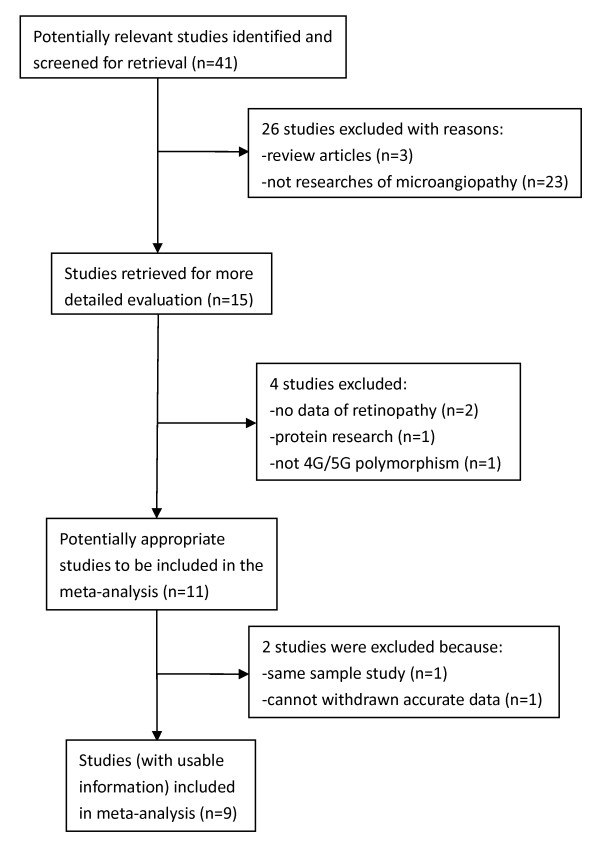
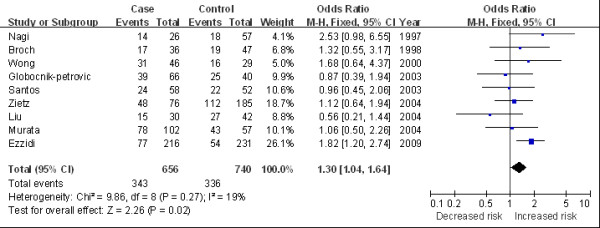
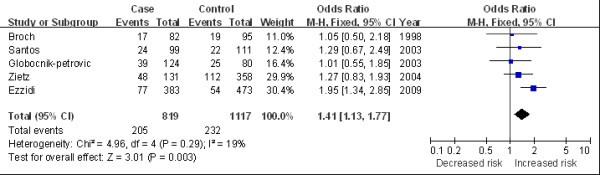
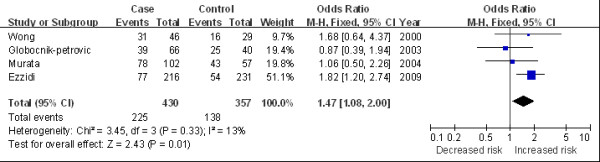
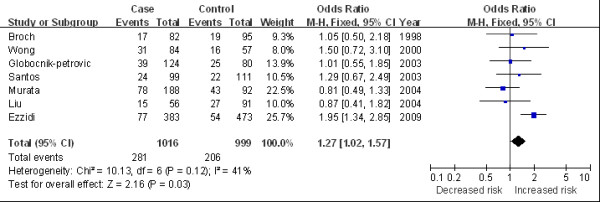
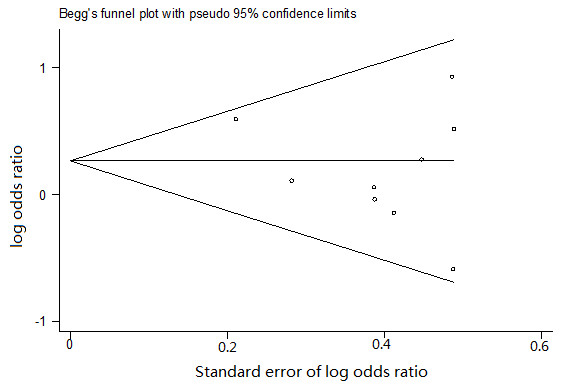
Background: Mounting evidence has suggested that plasminogen activator inhibitor-1 (PAI-1) is a candidate for increased risk of diabetic retinopathy. Studies have reported that insertion/deletion polymorphism in the PAI-1 gene may influence the risk of this disease. To comprehensively address this issue, we performed a meta-analysis to evaluate the association of PAI-1 4G/5G polymorphism with diabetic retinopathy in type 2 diabetes. Methods: Data were retrieved in a systematic manner and analyzed using Review Manager and STATA Statistical Software. Crude odds ratios (ORs) with 95% confidence intervals (CIs) were used to assess the strength of associations. Results: Nine studies with 1, 217 cases and 1, 459 controls were included. Allelic and genotypic comparisons between cases and controls were evaluated. Overall analysis suggests a marginal association of the 4G/5G polymorphism with diabetic retinopathy (for 4G versus 5G: OR 1.13, 95%CI 1.01 to 1.26; for 4G/4G versus 5G/5G: OR 1.30, 95%CI 1.04 to 1.64; for 4G/4G versus 5G/5G + 4G/5G: OR 1.26, 95%CI 1.05 to 1.52). In subgroup analysis by ethnicity, we found an association among the Caucasian population (for 4G versus 5G: OR 1.14, 95% CI 1.00 to 1.30; for 4G/4G versus 5G/5G: OR 1.33, 95%CI 1.02 to 1.74; for 4G/4G versus 5G/5G + 4G/5G: OR 1.41, 95%CI 1.13 to 1.77). When stratified by the average duration of diabetes, patients with diabetes histories longer than 10 years have an elevated susceptibility to diabetic retinopathy than those with shorter histories (for 4G/4G versus 5G/5G: OR 1.47, 95%CI 1.08 to 2.00). We also detected a higher risk in hospital-based studies (for 4G/4G versus 5G/5G+4G/5G: OR 1.27, 95%CI 1.02 to 1.57). Conclusions: The present meta-analysis suggested that 4G/5G polymorphism in the PAI-1 gene potentially increased the risk of diabetic retinopathy in type 2 diabetes and showed a discrepancy in different ethnicities. A higher susceptibility in patients with longer duration of diabetes (more than 10 years) indicated a gene-environment interaction in determining the risk of diabetic retinopathy.
Overview
The claims and statistics of this paper haven’t been checked yet.
Run the check — free, no account needed. It reads the open-access text and checks the sources it cites.
Integrity signals
Registry
Cites
Statistics
Figures
Verification
Claims the paper makes
The claims and statistics of this paper haven’t been checked yet.
Run the check — free, no account needed. It reads the open-access text and checks the sources it cites.
Claims other papers make about this one
Each is checked against this paper’s own text: does it say what the citing paper says it does?
The cited source doesn’t support the claim as written.
In the citing paper
“Documents were selected for inclusion based on their relevance to the IPT and included a diverse range of literature, such as commentaries or theoretical papers which could contribute to programme theory development [36].”
From Do hospital-to-home transitions work for older adults with multiple long-term conditions including dementia? A realist review (2025) · cites this paper as [36]
Checked by a reasoning model — may be wrong.
Experimental — accuracy not yet measuredThe check wasn’t confident either way, so it gives no verdict — never disputed.
In the citing paper
“Quality was assessment for relevance (i.e. contributed to IPT development/testing) and rigour (ensuring data were credible and trustworthy) [36].”
From Do hospital-to-home transitions work for older adults with multiple long-term conditions including dementia? A realist review (2025) · cites this paper as [36]
Experimental — accuracy not yet measured
Self-check
Percentages, sums and reported differences re-computed from the paper’s own numbers.
The self-check needs the paper’s full text.
Citations
Cites
Preferred Reporting Items for Systematic Reviews and Meta-Analyses: the PRISMA statement
Moher, D., Liberati, A., Tetzlaff, J., Altman, D. G., & for the PRISMA Group (2009) · BMJ · doi:10.1136/bmj.b2535 · Cited by 83,823
Bias in meta-analysis detected by a simple, graphical test
Egger, M., Smith, G. D., Schneider, M., & Minder, C. (1997) · BMJ · doi:10.1136/bmj.315.7109.629 · Cited by 56,722
Preferred reporting items for systematic reviews and meta-analyses: the PRISMA Statement.
(2009) · PubMed Central · Cited by 44,859
Meta-analysis in clinical trials
DerSimonian, R., & Laird, N. (1986) · Controlled Clinical Trials · doi:10.1016/0197-2456(86)90046-2 · Cited by 39,552
Operating characteristics of a rank correlation test for publication bias
Begg, C. B., & Mazumdar, M. (1994) · Biometrics · doi:10.2307/2533446 · Cited by 16,955
Statistical Aspects of the Analysis of Data From Retrospective Studies of Disease
(1959) · JNCI: Journal of the National Cancer Institute · doi:10.1093/jnci/22.4.719 · Cited by 14,689 · cited 1×
“10, the fixed-effects model (the Mantel-Haenszel method [27]) was selected.”
MethodQuantitative Synthesis in Systematic Reviews
Lau, J., Ioannidis, J. P. A., & Schmid, C. H. (1997) · Annals of Internal Medicine · doi:10.7326/0003-4819-127-9-199711010-00008 · Cited by 2,517 · cited 2×
“Between-study heterogeneity was evaluated by c(2)based Q-test [25] and was considered significant if P < 0.”
MethodInfluentialA comprehensive review of genetic association studies
Hirschhorn, J. N., Lohmueller, K., Byrne, E., & Hirschhorn, K. (2002) · Genetics in Medicine · doi:10.1097/00125817-200203000-00002 · Cited by 1,674
Molecular networks as sensors and drivers of common human diseases
Schadt, E. E. (2009) · Nature · doi:10.1038/nature08454 · Cited by 814
Eriksson, P. O., Kallin, B., Hooft, F. M. V. '., Båvenholm, P., & Hamsten, A. (1995) · Proceedings of the National Academy of Sciences · doi:10.1073/pnas.92.6.1851 · Cited by 737
Cited by
Sorted by citations
Challenges and opportunities in global mental health: a research-to-practice perspective
Wainberg, M. L., Scorza, P., Shultz, J. M., Helpman, L., Mootz, J. J., Johnson, K. A., Neria, Y., Bradford, J.-M. E., Oquendo, M. A., & Arbuckle, M. R. (2017) · Current Psychiatry Reports · doi:10.1007/s11920-017-0780-z · Cited by 875
Molecular pathways of major depressive disorder converge on the synapse
Fries, G. R., Saldana, V. A., Finnstein, J., & Rein, T. (2023) · Molecular Psychiatry · doi:10.1038/s41380-022-01806-1 · Cited by 504
Wiltshire, G., & Ronkainen, N. J. (2021) · Journal of Critical Realism · doi:10.1080/14767430.2021.1894909 · Cited by 403
Mazidi, M., Rezaie, P., Gao, H., & Kengne, A. P. (2017) · Journal of the American Heart Association · doi:10.1161/jaha.116.004007 · Cited by 347
Hertzum (2017) · doi:10.1145/3127358 · Cited by 307
Metadata
- Authors
- Zhang, T., Pang, C., Li, N., Zhou, E., & Zhao, K.
- Affiliations
- Tianjin Medical University (CN)
- Tianjin Medical University Cancer Institute and Hospital (CN)
- Tianjin Medical University Eye Hospital (CN)
- Yale University (US)
- Corresponding author
- Zhao, Kanxing
- Venue
- BMC Medicine
- Published
- 2013-01-02
- Volume
- 11
- Issue
- 1
- Pages
- 1-1
- ISSN
- 1741-7015 (ISSN-L)
- PMC
- PMC3565939
- OpenAlex
- W1978237749
- Cited by
- 270
- References
- 45
- Citations by year
- 2026: 6 · 2025: 24 · 2024: 21 · 2023: 18 · 2022: 28 · 2021: 37 · 2020: 11 · 2019: 15 · 2018: 17 · 2017: 30 · 2016: 30 · 2015: 19 · 2014: 10 · 2013: 4
- FWCI
- 3.67
- Type
- journal article
- Language
- en
- Open access
- gold
- doi.org
- Licence
- Locations
- BMC Medicine (publishedVersion, cc-by)
- Europe PMC (PubMed Central) (publishedVersion, cc-by)
- PubMed Central (publishedVersion, cc-by)
- PubMed (publishedVersion)
- DOAJ (DOAJ: Directory of Open Access Journals) (submittedVersion)
- Funders
- Tianjin Medical University
- Project 211
- Topics
- Health Sciences › Medicine › Ophthalmology › Retinal Diseases and Treatments
- Health Sciences › Medicine › Hematology › Blood Coagulation and Thrombosis Mechanisms
- Life Sciences › Biochemistry, Genetics and Molecular Biology › Genetics › Genetic Associations and Epidemiology
- Keywords
- plasminogen activator inhibitor-1, PAI-1 4G/5G polymorphism, diabetic retinopathy, type 2 diabetes, genetic susceptibility, insertion/deletion polymorphism, diabetes duration, Caucasian population, ethnicity-stratified analysis, fibrinolysis, hypercoagulability, retinopathy risk factors, gene-environment interaction, alcohol consumption
- MeSH terms
- Diabetes Mellitus, Type 2, Diabetic Retinopathy, Ethnicity, Humans, Polymorphism, Genetic, Plasminogen Activator Inhibitor 1, Risk Assessment, Diabetes Complications
About these checks
Registry, retraction, Cites and statistics results are computed, not judged, with one exception: a printed reference that no index lists is read once by a model before it counts as a citation error. Claims are extracted by a model and kept only when their quote appears verbatim in the text; each cited source is then checked, with a model’s help, for whether it says what the claim relies on. Those verdicts can be wrong — read the claim’s quote and the cited source before relying on one.
Statistics and arithmetic are recomputed, not judged.
Confidence bands are shown only for fields calibrated on our annotated test set. None is calibrated yet, so no band is shown.
What counts as a claim ›How we measure confidence ›How we check this ›
Are you an author, or do you see a problem with this page? Request a review
