

Reporting of analyses from randomized controlled trials with multiple arms: a systematic review
Open accessThe DOI matches its Crossref record; 23 of the 23 references it cites were found in a registry or an index; 2 of the 19 sources its claims cite were checked for support.
Abstract
BACKGROUND: Multiple-arm randomized trials can be more complex in their design, data analysis, and result reporting than two-arm trials. We conducted a systematic review to assess the reporting of analyses in reports of randomized controlled trials (RCTs) with multiple arms. METHODS: The literature in the MEDLINE database was searched for reports of RCTs with multiple arms published in 2009 in the core clinical journals. Two reviewers extracted data using a standardized extraction form. RESULTS: In total, 298 reports were identified. Descriptions of the baseline characteristics and outcomes per group were missing in 45 reports (15.1%) and 48 reports (16.1%), respectively. More than half of the articles (n = 171, 57.4%) reported that a planned global test comparison was used (that is, assessment of the global differences between all groups), but 67 (39.2%) of these 171 articles did not report details of the planned analysis. Of the 116 articles reporting a global comparison test, 12 (10.3%) did not report the analysis as planned. In all, 60% of publications (n = 180) described planned pairwise test comparisons (that is, assessment of the difference between two groups), but 20 of these 180 articles (11.1%) did not report the pairwise test comparisons. Of the 204 articles reporting pairwise test comparisons, the comparisons were not planned for 44 (21.6%) of them. Less than half the reports (n = 137; 46%) provided baseline and outcome data per arm and reported the analysis as planned. CONCLUSIONS: Our findings highlight discrepancies between the planning and reporting of analyses in reports of multiple-arm trials.
Overview
CoChat Summary
## TL;DR
This systematic review found substantial gaps between how multiple-arm RCT analyses were planned and how they were reported in 298 trial reports from core clinical journals in 2009. Baseline/outcome data per arm and planned comparisons were often missing or inconsistently reported, suggesting possible selective reporting.
## Key findings
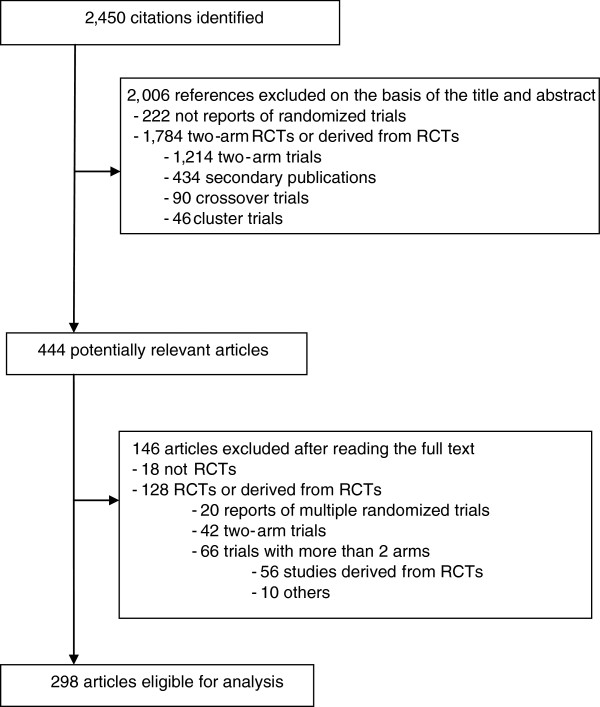
- The search yielded 2,450 citations, and the review included 298 reports from 68 journals; these 298 reports represented 17.6% of the 1,690 RCTs assessed.
- Baseline characteristics and outcomes per group were missing in 45 reports (15.1%) and 48 reports (16.1%), respectively; only 137 reports (46%) provided baseline and outcome data per arm and reported the analysis as planned.
- 171 reports (57.4%) said a global comparison test was planned, but 67 (39.2%) of those did not report the planned analysis; among 116 reports with a global comparison test, 12 (10.3%) did not report it as planned.
- 180 reports (60%) said pairwise comparisons were planned, but 20 (11.1%) of those did not report them; among 204 reports with pairwise comparisons, 44 (21.6%) were not reported as planned.
## Methods
- Systematic review of reports of randomized controlled trials with multiple arms published in 2009 in core clinical journals indexed in MEDLINE/PubMed.
- One reviewer screened titles/abstracts and full texts, with a second reviewer consulted when needed; only first reports of trial results were included, excluding sub-studies and secondary analyses.
- Two reviewers used a standardized extraction form to collect trial characteristics and reporting items, and the analysis was descriptive, stratified by study design; selective reporting was assessed by comparing planned vs reported comparisons.
## Limitations
- The paper states it assessed reports of RCTs and not protocols, which limits assessment of whether comparisons were truly planned.
- The paper states that methods may have been pre-specified but not reported in the articles.
- The paper states findings are limited to core clinical journals from the National Library of Medicine, so they may not generalize to other journals.
Model-written summary. Check it against the paper before relying on it.
Integrity signals
Registry
Cites
Statistics
Figures
Verification
Claims the paper makes
1 Valid · 0 Not valid · 14 Not checked · 41 Own results and interpretations
A result the paper reports from its own data — it cites no other source for it, so there is none to check. The quote shows it is in the paper.
In the paper
“Of the 1690 RCTs assessed, the proportion of multiple-arm trials was 17.6% (n = 298; 95% confidence interval 15.8 to 19.5)”
§ Reporting of analyses from randomized controlled trials with multiple arms: a systematic review > Results > Characteristics of multiple-arm trials
plainn = 298- Asserted: passes — The authors put it forward as true.
- Checkable: passes — It can be checked against evidence.
- Load-bearing: unclear — It is unclear whether the paper’s conclusions depend on it.
- Based: passes — The paper gives a reason why it holds.
A result the paper reports from its own data — it cites no other source for it, so there is none to check. The quote shows it is in the paper.
In the paper
“Of the 57 publications describing pooled analyses (19.1%), 17 (28.1%) did not provide results for each randomized group.”
§ Reporting of analyses from randomized controlled trials with multiple arms: a systematic review > Results > Reporting
plain- Asserted: passes — The authors put it forward as true.
- Checkable: passes — It can be checked against evidence.
- Load-bearing: passes — The paper’s conclusions depend on it.
- Based: passes — The paper gives a reason why it holds.
A result the paper reports from its own data — it cites no other source for it, so there is none to check. The quote shows it is in the paper.
In the paper
“and 9 (5.0%) of the remaining 180 articles explained why no adjustment was used.”
§ Reporting of analyses from randomized controlled trials with multiple arms: a systematic review > Results > Reporting
plain- Asserted: passes — The authors put it forward as true.
- Checkable: passes — It can be checked against evidence.
- Load-bearing: unclear — It is unclear whether the paper’s conclusions depend on it.
- Based: passes — The paper gives a reason why it holds.
A result the paper reports from its own data — it cites no other source for it, so there is none to check. The quote shows it is in the paper.
In the paper
“but 20 of these 180 articles (11.1%) did not report the pairwise test comparisons.”
§ Reporting of analyses from randomized controlled trials with multiple arms: a systematic review > Abstract > Results
plainn = 180- Asserted: passes — The authors put it forward as true.
- Checkable: passes — It can be checked against evidence.
- Load-bearing: passes — The paper’s conclusions depend on it.
- Based: passes — The paper gives a reason why it holds.
A result the paper reports from its own data — it cites no other source for it, so there is none to check. The quote shows it is in the paper.
In the paper
“The description of baseline characteristics and outcomes per group were missing in 45 (15.1%) and 48 (16.1%), respectively, of the reports investigated.”
§ Reporting of analyses from randomized controlled trials with multiple arms: a systematic review > Results > Reporting
plain- Asserted: passes — The authors put it forward as true.
- Checkable: passes — It can be checked against evidence.
- Load-bearing: passes — The paper’s conclusions depend on it.
- Based: passes — The paper gives a reason why it holds.
24 more claims
Create a free account to see all 56 claims and to verify the 17 references still open.
- Probably not a substantial claim. 19
- It may state two separate claims as one. 12
- The quote only partly states this claim. 1
Citations
Cites
Cochrane Handbook for Systematic Reviews of Interventions: Cochrane Book Series
(2008) · doi:10.1002/9780470712184 · Cited by 25,048
Moher, D., Hopewell, S., Schulz, K. F., Montori, V., Gotzsche, P. C., Devereaux, P. J., Elbourne, D., Egger, M., & Altman, D. G. (2010) · BMJ · doi:10.1136/bmj.c869 · Cited by 8,883
Cochrane Handbook for Systematic Reviews of Interventions Version 5.0.1. The Cochrane Collaboration
Higgins, J. P. T., Green, S. R., & Higgins, J. P. T. (2008) · Cited by 7,247
Consort 2010 statement: extension to cluster randomised trials
Campbell, M. K., Piaggio, G., Elbourne, D. R., Altman, D. G., & for the CONSORT Group (2012) · BMJ · doi:10.1136/bmj.e5661 · Cited by 3,510
CONSORT statement: extension to cluster randomised trials
Campbell, M. K., Elbourne, D. R., & Altman, D. G. (2004) · BMJ · doi:10.1136/bmj.328.7441.702 · Cited by 2,557 · cited 1×
“Conclusion The CONSORT (Consolidated Standards of Reporting Trials) group is developing recommendations to help improve the reporting of multiple-arm trials [22,23].”
MethodChan, A.-W., Hróbjartsson, A., Haahr, M. T., Gøtzsche, P. C., & Altman, D. G. (2004) · JAMA · doi:10.1001/jama.291.20.2457 · Cited by 1,845 · cited 1×
“Our results are likely have underestimated any selective outcome reporting bias because we assessed articles and not protocols [12].”
ResultStatistical Power, Sample Size, and Their Reporting in Randomized Controlled Trials
Moher, D. (1994) · JAMA: The Journal of the American Medical Association · doi:10.1001/jama.1994.03520020048013 · Cited by 608 · cited 1×
“Many randomized trials with two parallel arms exhibit inadequate power for revealing differences [14], and sample-size calculation is poorly reported in articles of trials and can be inaccurate [15].”
BackgroundEpidemiology and reporting of randomised trials published in PubMed journals
Chan, A.-W., & Altman, D. G. (2005) · The Lancet · doi:10.1016/s0140-6736(05)71879-1 · Cited by 474 · cited 1×
“Multiple-arm randomized trials are becoming increasingly common, with a quarter of randomized trials having more than two intervention groups [7].”
BackgroundMultiplicity in randomised trials I: endpoints and treatments
Schulz, K. F., & Grimes, D. A. (2005) · The Lancet · doi:10.1016/s0140-6736(05)66461-6 · Cited by 366
Multiplicity in randomised trials II: subgroup and interim analyses
Schulz, K. F., & Grimes, D. A. (2005) · The Lancet · doi:10.1016/s0140-6736(05)66516-6 · Cited by 357 · cited 1×
“Multiple-treatment arms are possible sources of multiplicity in an RCT [6,10].”
BackgroundSoares, H. P., Daniels, S., Kumar, A., Clarke, M., Scott, C., Swann, S., & Djulbegovic, B. (2004) · BMJ · doi:10.1136/bmj.328.7430.22 · Cited by 313 · cited 1×
“Second, the methods may have been pre-specified but not reported in the articles [20,21].”
MethodReporting of sample size calculation in randomised controlled trials: review
Charles, P., Giraudeau, B., Dechartres, A., Baron, G., & Ravaud, P. (2009) · BMJ · doi:10.1136/bmj.b1732 · Cited by 274 · cited 1×
“Many randomized trials with two parallel arms exhibit inadequate power for revealing differences [14], and sample-size calculation is poorly reported in articles of trials and can be inaccurate [15].”
BackgroundSelf-citationMultiplicity Considerations in the Design and Analysis of Clinical Trials
Cook, R. J., & Farewell, V. T. (1996) · Journal of the Royal Statistical Society. Series A (Statistics in Society) · doi:10.2307/2983471 · Cited by 255
An introduction to hierarchical linear modelling
Sullivan, L. M., Dukes, K. A., & Losina, E. (1999) · Statistics in Medicine · doi:10.1002/(sici)1097-0258(19990415)18:7<855::aid-sim117>3.0.co;2-7 · Cited by 250
Practical Guidelines for Multiplicity Adjustment in Clinical Trials
Proschan, M. A., & Waclawiw, M. A. (2000) · Controlled Clinical Trials · doi:10.1016/s0197-2456(00)00106-9 · Cited by 225 · cited 3×
“Controlling for type I error is not needed when several experimental arms are compared with the control or the standard arms [3], but is necessary when adjusting for post hoc comparisons or when the tested hypotheses cannot be prioritized [18].”
BackgroundMulti-Arm Clinical Trials of New Agents: Some Design Considerations
Freidlin, B., Korn, E. L., Gray, R., & Martin, A. (2008) · Clinical Cancer Research · doi:10.1158/1078-0432.ccr-08-0325 · Cited by 143 · cited 3×
“Background Randomized controlled trials (RCTs) with multiple arms are sometimes considered an attractive way of optimizing resources and simultaneously testing various treatment strategies [1-4].”
BackgroundDiscrepancy between published report and actual conduct of randomized clinical trials
Hill, C. L., LaValley, M. P., & Felson, D. T. (2002) · Journal of Clinical Epidemiology · doi:10.1016/s0895-4356(02)00440-7 · Cited by 133 · cited 1×
“Second, the methods may have been pre-specified but not reported in the articles [20,21].”
MethodWaiving confidentiality for the greater good
Chan, A.-W., Upshur, R., Singh, J. A., Ghersi, D., Chapuis, F., & Altman, D. G. (2006) · BMJ · doi:10.1136/bmj.332.7549.1086 · Cited by 46 · cited 1×
“We did not assess protocols because of the difficulties in obtaining access to trial protocols [19].”
MethodClinical trials in ovarian carcinoma: study methodology
Vermorken, J. B., Parmar, M., Brady, M. F., Eisenhauer, E. A., Högberg, T., Ozols, R. F., Rochon, J., Rustin, G. J. S., Sagae, S., & Verheijen, R. H. M. (2005) · Annals of Oncology · doi:10.1093/annonc/mdi963 · Cited by 30 · cited 1×
“; licensee BioMed Central L Commons Attribution License (http://creativec reproduction in any medium, provided the or However, because of the number of arms, such trials can be more complex in design, data analysis and result reporting compared with two-arm trials [2,8,9].”
A multiple comparison procedure for three- and four-armed controlled clinical trials
Proschan, M. A. (1999) · Statistics in Medicine · doi:10.1002/(sici)1097-0258(19990415)18:7<787::aid-sim77>3.0.co;2-m · Cited by 20
How to deal with multiple treatment or dose groups in randomized clinical trials?
Hothorn, L. A. (2007) · Fundamental and Clinical Pharmacology · doi:10.1111/j.1472-8206.2007.00469.x · Cited by 17 · cited 1×
“The question of adjusting for control type I error in multiple-arm trials is a subject of debate [2,3,6,16-18].”
BackgroundBetween-Arm Comparisons in Randomized Phase II Trials
Jung, S., & George, S. L. (2009) · Journal of Biopharmaceutical Statistics · doi:10.1080/10543400902802391 · Cited by 12 · cited 1×
“Background Randomized controlled trials (RCTs) with multiple arms are sometimes considered an attractive way of optimizing resources and simultaneously testing various treatment strategies [1-4].”
BackgroundHow to deal with multiple treatment or dose groups in randomized clinical trials? Another approach
Boissel, J. (2007) · Fundamental and Clinical Pharmacology · doi:10.1111/j.1472-8206.2007.00478.x · Cited by 2
Research works printed but not linked: 2
- Higgins JPT, Green S Cochrane Handbook for Systematic Reviews of Interventions 2008 Chichester: Wiley
- Juszczak E Altman D Chan AW A review of the methodology and reporting of multi-arm, parallel group, randomised clinical trials (RCTs). 3rd Joint Meeting of the International Society for Clinical Biostatistics and Society for Clinical Trials 2003 London (UK)
Cited by
An introduction to multiplicity issues in clinical trials: the what, why, when and how
Li, G., Taljaard, M., Van den Heuvel, E. R., Levine, M. A., Cook, D. J., Wells, G. A., Devereaux, P. J., & Thabane, L. (2016) · International Journal of Epidemiology · doi:10.1093/ije/dyw320 · Cited by 381
“6%, reflecting the increased popularity of multi-arm trials.(11) However, when multiple comparisons are made in multi-arm trials, multiplicity adjustments may need to be considered to avoid an increase in the type I error rate.”
BackgroundResidual Weighted Learning for Estimating Individualized Treatment Rules
Zhou, X., Mayer-Hamblett, N., Khan, U., & Kosorok, M. R. (2017) · Journal of the American Statistical Association · doi:10.1080/01621459.2015.1093947 · Cited by 205
“A recent review by Baron et al. (2013) reported that 17.6% of published randomized clinical trials in 2009 were multiplearm. Because of the number of possible comparisons, it is more complex to find ITRs in such trials compared with two-arm trials. It would thus be worthwhile to extend RWL to multiplearm trials. In th…”
BackgroundInfluentialCorrecting for multiple-testing in multi-arm trials: is it necessary and is it done?
Wason, J. M. S., Stecher, L., & Mander, A. P. (2014) · Trials · doi:10.1186/1745-6215-15-364 · Cited by 179
“[4] found that around 40% of multi-arm trials published in 2009 adjusted for multipletesting, although did not distinguish between exploratory and confirmatory trials.”
BackgroundGaudry, S., Messika, J., Ricard, J.-D., Guillo, S., Pasquet, B., Dubief, E., Boukertouta, T., Dreyfuss, D., & Tubach, F. (2017) · Annals of Intensive Care · doi:10.1186/s13613-017-0243-z · Cited by 140
Bertsimas, D., Dunn, J., & Mundru, N. (2019) · INFORMS Journal on Optimization · doi:10.1287/ijoo.2018.0005 · Cited by 124
Metadata
- Authors
- Baron, G., Perrodeau, E., Boutron, I., & Ravaud, P.
- Affiliations
- Inserm (FR)
- Corresponding author
- Baron, Gabriel
- Venue
- BMC Medicine
- Published
- 2013-03-27
- Volume
- 11
- Issue
- 1
- Pages
- 84-84
- ISSN
- 1741-7015 (ISSN-L)
- PMC
- PMC3621416
- OpenAlex
- W2125096909
- Semantic Scholar
- 66c15bded6ddfde6e1fa3ff5187904caea8a5967
- Cited by
- 39
- References
- 22
- Citations by year
- 2026: 1 · 2025: 3 · 2024: 2 · 2023: 1 · 2022: 2 · 2021: 3 · 2020: 7 · 2019: 3 · 2018: 3 · 2017: 3 · 2016: 6 · 2015: 3 · 2014: 2
- FWCI
- 0.74
- Type
- journal article
- Language
- en
- Open access
- gold
- doi.org
- Licence
- Locations
- BMC Medicine (publishedVersion, cc-by)
- Europe PMC (PubMed Central) (publishedVersion, cc-by)
- PubMed Central (publishedVersion, cc-by)
- PubMed (publishedVersion)
- HAL (submittedVersion, other-oa)
- Funders
- Fondation pour la Recherche Médicale
- Topics
- Social Sciences › Decision Sciences › Statistics, Probability and Uncertainty › Meta-analysis and systematic reviews
- Physical Sciences › Mathematics › Statistics and Probability › Statistical Methods in Clinical Trials
- Health Sciences › Nursing › Issues, ethics and legal aspects › Pharmaceutical industry and healthcare
- Keywords
- statistical reporting, pairwise comparison, baseline characteristics, trial reporting quality
- MeSH terms
- Humans, Research Design, Randomized Controlled Trials as Topic, Biomedical Research
About these checks
Registry, retraction, Cites and statistics results are computed, not judged, with one exception: a printed reference that no index lists is read once by a model before it counts as a citation error. Claims are extracted by a model and kept only when their quote appears verbatim in the text; each cited source is then checked, with a model’s help, for whether it says what the claim relies on. Those verdicts can be wrong — read the claim’s quote and the cited source before relying on one.
A language model drew the claims from the paper on 2026-10-11, under version 3 of the claim definition (model deepseek-v4.1-flash, prompt extract-v3).
A second model labelled each claim on 2026-10-11 (model jev-1.13-20260917, definition revision gold-guideline-v0.2).
Statistics and arithmetic are recomputed, not judged.
Confidence bands are shown only for fields calibrated on our annotated test set. None is calibrated yet, so no band is shown.
What counts as a claim ›How we measure confidence ›How we check this ›
Are you an author, or do you see a problem with this page? Request a review
Data sources
Bibliographic data: Semantic Scholar, OpenAlex, Crossref.
Contains information from the Semantic Scholar Academic Graph Datasets, made available under the ODC Attribution License (ODC-BY 1.0).
Semantic Scholar’s data is described in: Kinney, R., et al. (2023). The Semantic Scholar Open Data Platform. arXiv:2301.10140.
