

Promoting childbirth companions in South Africa: a randomised pilot study
Open accessThe DOI matches its Crossref record; 25 of the 25 references it cites were found in a registry or an index.
Abstract
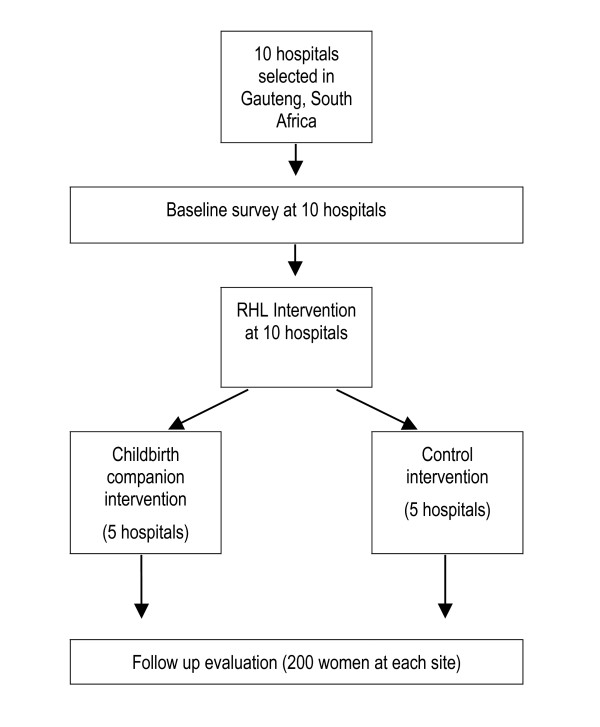
BACKGROUND: Most women delivering in South African State Maternity Hospitals do not have a childbirth companion; in addition, the quality of care could be better, and at times women are treated inhumanely. We piloted a multi-faceted intervention to encourage uptake of childbirth companions in state hospitals, and hypothesised that lay carers would improve the behaviour of health professionals. METHODS: We conducted a pilot randomised controlled trial of an intervention to promote childbirth companions in hospital deliveries. We promoted evidence-based information for maternity staff at 10 hospitals through access to the World Health Organization Reproductive Health Library (RHL), computer hardware and training to all ten hospitals. We surveyed 200 women at each site, measuring companionship, and indicators of good obstetric practice and humanity of care. Five hospitals were then randomly allocated to receive an educational intervention to promote childbirth companions, and we surveyed all hospitals again at eight months through a repeat survey of postnatal women. Changes in median values between intervention and control hospitals were examined. RESULTS: At baseline, the majority of hospitals did not allow a companion, or access to food or fluids. A third of women were given an episiotomy. Some women were shouted at (17.7%, N = 2085), and a few reported being slapped or struck (4.3%, N = 2080). Despite an initial positive response from staff to the childbirth companion intervention, we detected no difference between intervention and control hospitals in relation to whether a companion was allowed by nursing staff, good obstetric practice or humanity of care. CONCLUSION: The quality and humanity of care in these state hospitals needs to improve. Introducing childbirth companions was more difficult than we anticipated, particularly in under-resourced health care systems with frequent staff changes. We were unable to determine whether the presence of a lay carer impacted on the humanity of care provided by health professionals. TRIAL REGISTRATION: Current Controlled Trials ISRCTN33728802.
Overview
The claims and statistics of this paper haven’t been checked yet.
Free: it reads the open-access text and checks the first 5 claims that cite a source we can check. Create a free account to check every claim.
Integrity signals
Registry
Cites
Statistics
Figures
Verification
Claims the paper makes
The claims and statistics of this paper haven’t been checked yet.
Free: it reads the open-access text and checks the first 5 claims that cite a source we can check. Create a free account to check every claim.
Claims other papers make about this one
Each is checked against this paper’s own text: does it say what the citing paper says it does?
The cited source says what the claim attributes to it.
In the citing paper
“In total, 12 studies had relevant quantitative data [25–27,44–52].”
From The Mistreatment of Women during Childbirth in Health Facilities Globally: A Mixed-Methods Systematic Review (2015) · cites this paper as [44]
The cited source says what the claim attributes to it.
In the citing paper
“4.3% of women were slapped or struck [44].”
From The Mistreatment of Women during Childbirth in Health Facilities Globally: A Mixed-Methods Systematic Review (2015) · cites this paper as [44]
The cited source says what the claim attributes to it.
In the citing paper
“a pilot randomized controlled trial in South Africa reported that 84.5% of women were not allowed companions during childbirth”
From The Mistreatment of Women during Childbirth in Health Facilities Globally: A Mixed-Methods Systematic Review (2015) · cites this paper as [44]
The cited source says what the claim attributes to it.
In the citing paper
“The other nine studies with relevant quantitative data were indirectly relevant to this review, were limited in scope, and varied in their operational definition of the mistreatment of women [44–52].”
From The Mistreatment of Women during Childbirth in Health Facilities Globally: A Mixed-Methods Systematic Review (2015) · cites this paper as [44]
Self-check
Percentages, sums and reported differences re-computed from the paper’s own numbers.
The self-check needs the paper’s full text.
Citations
Cites
The cochrane database of systematic reviews
Geddes, J. (1996) · Journal of Psychosomatic Research · doi:10.1016/s0022-3999(96)90063-x · Cited by 5,989
From best evidence to best practice: effective implementation of change in patients' care
Grol, R., & Grimshaw, J. (2003) · The Lancet · doi:10.1016/s0140-6736(03)14546-1 · Cited by 4,531
Framework for design and evaluation of complex interventions to improve health
Campbell, M. (2000) · BMJ · doi:10.1136/bmj.321.7262.694 · Cited by 3,474 · cited 1×
“Because of the difficulties in replicating and documenting complex interventions, they are often evaluated using phased or non-experimental designs that provide information about context and critical success factors, as well as the likelihood that change will be sustained beyond the study period [15,16].”
Continuous support for women during childbirth
Hodnett, E. D., Gates, S., Hofmeyr, G. J., & Sakala, C. (2012) · Cochrane Database of Systematic Reviews · doi:10.1002/14651858.cd003766.pub4 · Cited by 1,155
Self-citationContinuous Support for Women During Childbirth
Hodnett, E. D., Gates, S., Hofmeyr, G. J., & Sakala, C. (2005) · Birth · doi:10.1111/j.0730-7659.2005.00336.x · Cited by 886
Self-citationCarroli, G., & Mignini, L. (2009) · Cochrane Database of Systematic Reviews · doi:10.1002/14651858.cd000081.pub2 · Cited by 701
Why do nurses abuse patients? Reflections from South African obstetric services
Jewkes, R., Abrahams, N., & Mvo, Z. (1998) · Social Science & Medicine · doi:10.1016/s0277-9536(98)00240-8 · Cited by 541
Position in the second stage of labour for women without epidural anaesthesia
Gupta, J. K., Sood, A., Hofmeyr, G. J., & Vogel, J. P. (2017) · Cochrane Database of Systematic Reviews · doi:10.1002/14651858.cd002006.pub4 · Cited by 487
Self-citationCarroli, G., & Belizan, J. (1999) · Cochrane Database of Systematic Reviews · doi:10.1002/14651858.cd000081 · Cited by 339
External cephalic version for breech presentation before term
Hutton, E. K., & Hofmeyr, G. J. (2006) · Cochrane Database of Systematic Reviews · doi:10.1002/14651858.cd000084.pub2 · Cited by 317
Self-citation
Research works printed but not linked: 4
- Fawcus S Crowther C van Baelen P Booked versus unbooked deliveries at Harare Central Hospital: maternal characteristics and fetal outcome International Epidemiological Association African Regional Conference; 1989 7 – 13 August; Harare, Zimbabwe
- World Health Organization The WHO Reproductive Health Library 2006 2006 Oxford: Update Software Ltd
- Hofmeyr GJ Ways of making birth difficult S Afr Med J 1990 11 164 169
- Smith H Garner P Better Births Initiative: A programme for action in low and middle-income countries Making Safer Technical Report 2002 Global Health Council. Washington DC: Global Health Council
Cited by
Bohren, M. A., Vogel, J. P., Hunter, E. C., Lutsiv, O., Makh, S. K., Souza, J. P., Aguiar, C., Saraiva Coneglian, F., Diniz, A. L. A., Tunçalp, Ö., et al. (2015) · PLOS Medicine · doi:10.1371/journal.pmed.1001847 · Cited by 1,656
Continuous support for women during childbirth
Hodnett, E. D., Gates, S., Hofmeyr, G. J., & Sakala, C. (2012) · Cochrane Database of Systematic Reviews · doi:10.1002/14651858.cd003766.pub4 · Cited by 1,155
Self-citationContinuous support for women during childbirth
Bohren, M. A., Hofmeyr, G. J., Sakala, C., Fukuzawa, R. K., & Cuthbert, A. (2017) · Cochrane Database of Systematic Reviews · doi:10.1002/14651858.cd003766.pub6 · Cited by 1,100
Self-citationLewin, S., Munabi-Babigumira, S., Glenton, C., Daniels, K., Bosch-Capblanch, X., van Wyk, B. E., Odgaard-Jensen, J., Johansen, M., Aja, G. N., Zwarenstein, M., et al. (2010) · Cochrane Database of Systematic Reviews · doi:10.1002/14651858.cd004015.pub3 · Cited by 985
Continuous support for women during childbirth
Hodnett, E. D., Gates, S., Hofmeyr, G. J., & Sakala, C. (2013) · Cochrane Database of Systematic Reviews · doi:10.1002/14651858.cd003766.pub5 · Cited by 389
Self-citation
Metadata
- Authors
- Brown, H., Hofmeyr, G. J., Nikodem, V. C., Smith, H., & Garner, P.
- Affiliations
- University of Fort Hare (ZA)
- University of the Western Cape (ZA)
- Liverpool School of Tropical Medicine (GB)
- Corresponding author
- Hofmeyr, G Justus
- Venue
- BMC Medicine
- Published
- 2007-04-30
- Volume
- 5
- Issue
- 1
- Pages
- 7-7
- ISSN
- 1741-7015 (ISSN-L)
- PMC
- PMC1905915
- OpenAlex
- W2119019424
- Cited by
- 66
- References
- 25
- Citations by year
- 2026: 1 · 2025: 3 · 2024: 3 · 2023: 9 · 2022: 2 · 2021: 5 · 2020: 1 · 2019: 4 · 2018: 8 · 2017: 4 · 2016: 5 · 2015: 2 · 2014: 4 · 2013: 2 · 2012: 2
- FWCI
- 3.09
- Type
- journal article
- Language
- en
- Open access
- gold
- doi.org
- Licence
- Locations
- BMC Medicine (publishedVersion, cc-by)
- PubMed Central (publishedVersion, cc-by)
- PubMed (publishedVersion)
- Research Explorer (The University of Manchester) (publishedVersion)
- LSTM Online Archive (Liverpool School of Tropical Medicine) (acceptedVersion)
- DOAJ (DOAJ: Directory of Open Access Journals) (submittedVersion)
- Funders
- South African Medical Research Council
- Department for International Development
- Medical Research Council
- Topics
- Health Sciences › Medicine › Obstetrics and Gynecology › Maternal and Perinatal Health Interventions
- Health Sciences › Medicine › Pediatrics, Perinatology and Child Health › Global Maternal and Child Health
- Health Sciences › Health Professions › General Health Professions › Health Policy Implementation Science
- Keywords
- birth companions, lay carers, maternal rights, health professionals' practices, educational intervention, South Africa
- MeSH terms
- Adult, Enema, Episiotomy, Female, Food Deprivation, Health Promotion, Hospitals, Maternity, Hospitals, Public, Humans, Obstetrics, Obstetrics and Gynecology Department, Hospital, Pilot Projects, Posture, Pregnancy, Professional-Patient Relations, Quality Assurance, Health Care, South Africa, Teaching Materials, Violence, Volunteers, Water Deprivation, World Health Organization, Organizational Policy, Patient Satisfaction, Practice Guidelines as Topic, Guideline Adherence, Friends
About these checks
Registry, retraction, Cites and statistics results are computed, not judged, with one exception: a printed reference that no index lists is read once by a model before it counts as a citation error. Claims are extracted by a model and kept only when their quote appears verbatim in the text; each cited source is then checked, with a model’s help, for whether it says what the claim relies on. Those verdicts can be wrong — read the claim’s quote and the cited source before relying on one.
Statistics and arithmetic are recomputed, not judged.
Confidence bands are shown only for fields calibrated on our annotated test set. None is calibrated yet, so no band is shown.
What counts as a claim ›How we measure confidence ›How we check this ›
Are you an author, or do you see a problem with this page? Request a review
Data sources
Bibliographic data: Semantic Scholar, OpenAlex, Crossref.
Contains information from the Semantic Scholar Academic Graph Datasets, made available under the ODC Attribution License (ODC-BY 1.0).
Semantic Scholar’s data is described in: Kinney, R., et al. (2023). The Semantic Scholar Open Data Platform. arXiv:2301.10140.
