

Differential effects of age on circulating and splenic leukocyte populations in C57BL/6 and BALB/c male mice
Open accessThe DOI matches its Crossref record; 64 of the 64 references it cites were found in a registry or an index.
Abstract
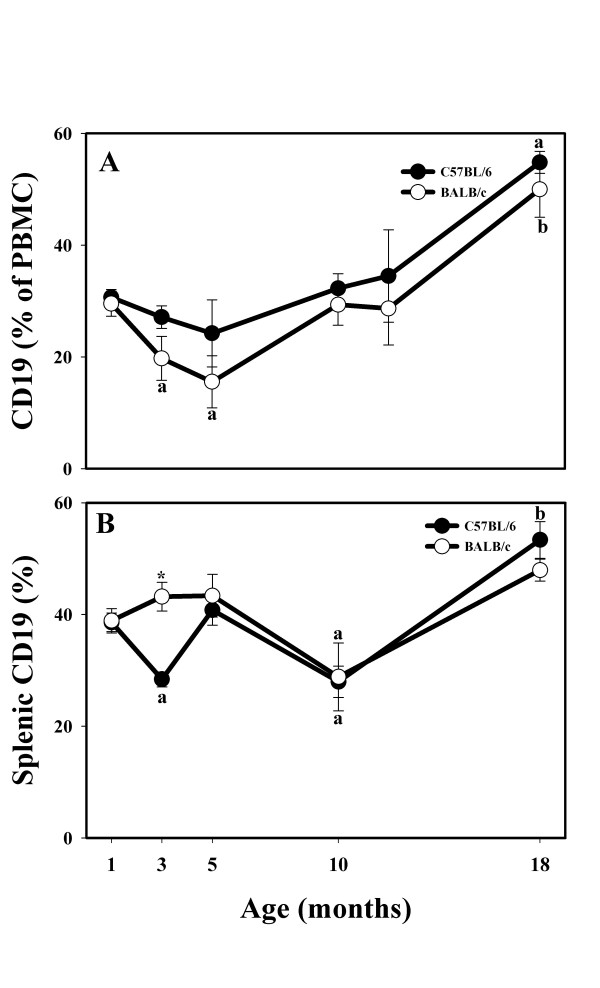
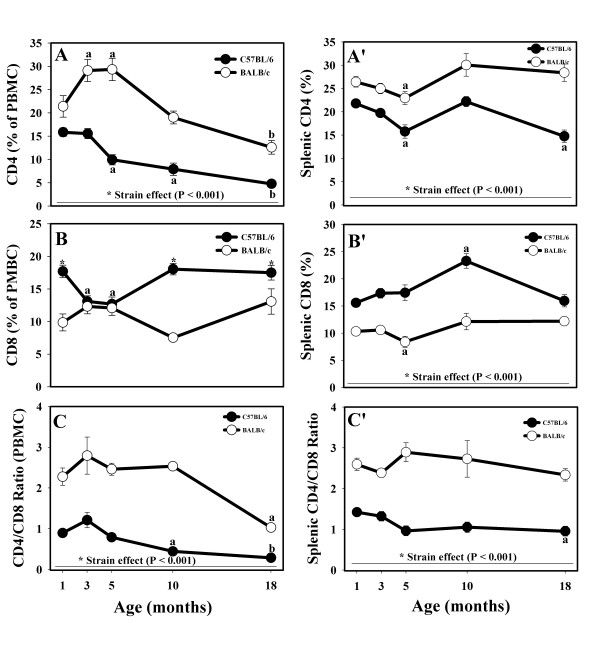
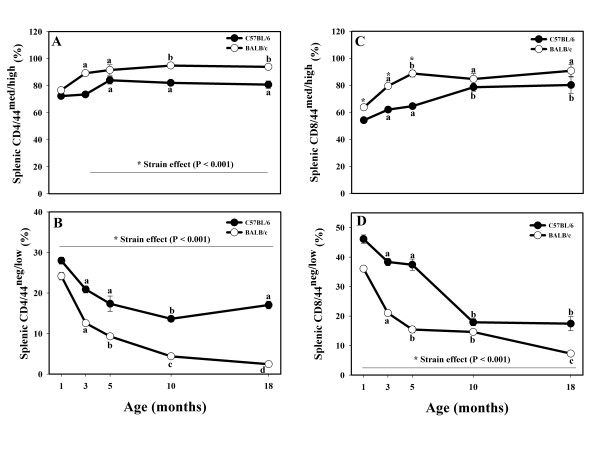
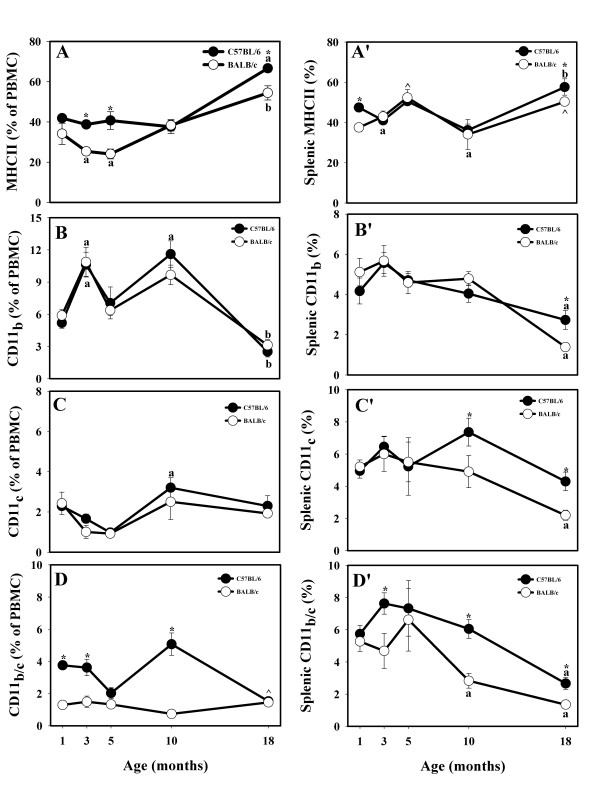
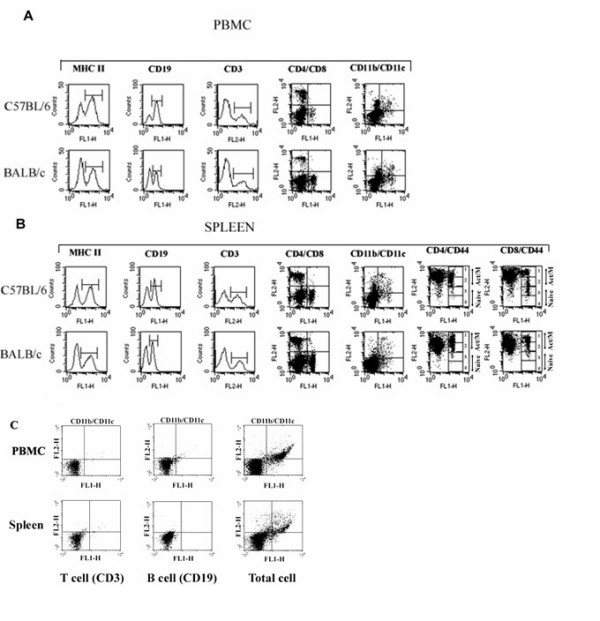
BACKGROUND: Despite several reports on age-related phenotypic changes of the immune system's cells, studies that use a multipoint age comparison between the specific and innate immune cell populations of prototypical Th1- and Th2-type polarized mouse strains are still lacking. RESULTS: Using a multipoint age comparison approach, cells from the two major immune system compartments, peripheral blood and spleen, and flow cytometry analysis, we found several principal differences in T cell and professional antigen presenting cell (APC) populations originating from a prototypical T helper (Th) 1 mouse strain, C57BL/6, and a prototypical Th2 strain, BALB/c. For example, regardless of age, there were strain differences in both peripheral blood mononuclear cells (PBMC) and spleens in the proportion of CD4+ (higher in the BALB/c strain), CD8+ T cells and CD11b+/CD11c+ APC (greater in C57BL/6 mice). Other differences were present only in PBMC (MHC class II + and CD19+ were greater in C57BL/6 mice) or differences were evident in the spleens but not in circulation (CD3+ T cells were greater in C57BL/6 mice). There were populations of cells that increased with age in PBMC and spleens of both strains (MHC class II+), decreased in the periphery and spleens of both strains (CD11b+) or did not change in the PBMC and spleens of both strains (CD8+). We also found strain and age differences in the distribution of naïve and memory/activated splenic T cells, e.g., BALB/c mice had more memory/activated and less naive CD8+ and CD4+ T cells and the C57BL/6 mice. CONCLUSION: Our data provide important information on the principal differences, within the context of age, in T cell and professional APC populations between the prototypical Th1 mouse strain C57BL/6 and the prototypical Th2 strain BALB/c. Although the age-related changes that occur may be rather subtle, they may be very relevant in conditions of disease and stress. Importantly, our data indicate that age and strain should be considered in concert in the selection of appropriate mouse models for immunological research.
Overview
The claims and statistics of this paper haven’t been checked yet.
Free: it reads the open-access text and checks the first 5 claims that cite a source we can check. Create a free account to check every claim.
Integrity signals
Registry
Cites
Statistics
Figures
Verification
Claims the paper makes
The claims and statistics of this paper haven’t been checked yet.
Free: it reads the open-access text and checks the first 5 claims that cite a source we can check. Create a free account to check every claim.
Claims other papers make about this one
Each is checked against this paper’s own text: does it say what the citing paper says it does?
The source backs part of the claim, not all of it — or backs it for a different population, condition or comparison.
In the citing paper
“When working with mice, 18 months of age or older is considered truly aged [350]”
From Guidelines for the use of flow cytometry and cell sorting in immunological studies (third edition) (2021) · cites this paper as [350]
Experimental — accuracy not yet measured
Self-check
Percentages, sums and reported differences re-computed from the paper’s own numbers.
The self-check needs the paper’s full text.
Citations
Cites
Age-related changes in lymphocyte development and function
Linton, P. J., & Dorshkind, K. (2004) · Nature Immunology · doi:10.1038/ni1033 · Cited by 1,181
Maraskovsky, E., Brasel, K., Teepe, M., Roux, E. R., Lyman, S. D., Shortman, K., & McKenna, H. J. (1996) · The Journal of experimental medicine · doi:10.1084/jem.184.5.1953 · Cited by 1,115
Posnett, D. N., Sinha, R., Kabak, S., & Russo, C. (1994) · The Journal of experimental medicine · doi:10.1084/jem.179.2.609 · Cited by 760
Genetic control of the CD4/CD8 T-cell ratio in humans
Amadori, A., Zamarchi, R., De Silvestro, G., Forza, G., Cavatton, G., Danieli, G. A., Clementi, M., & Chieco-Bianchi, L. (1995) · Nature Medicine · doi:10.1038/nm1295-1279 · Cited by 440
Dendritic cells: Understanding immunogenicity
Steinman, R. M. (2007) · European Journal of Immunology · doi:10.1002/eji.200737400 · Cited by 401
Dendritic cell maturation by innate lymphocytes
Münz, C., Steinman, R. M., & Fujii, S.-I. (2005) · The Journal of Experimental Medicine · doi:10.1084/jem.20050810 · Cited by 393
Solana, R., Pawelec, G., & Tarazona, R. (2006) · Immunity · doi:10.1016/j.immuni.2006.05.003 · Cited by 313
Ageing of lymphocytes and lymphocytes in the aged
Globerson, A., & Effros, R. B. (2000) · Immunology Today · doi:10.1016/s0167-5699(00)01714-x · Cited by 309
Expanded CD4+ and CD8+ T cell clones in elderly humans
Schwab, R., Szabo, P., Manavalan, J. S., Weksler, M. E., Posnett, D. N., Pannetier, C., Kourilsky, P., & Even, J. (1997) · The Journal of Immunology · doi:10.4049/jimmunol.158.9.4493 · Cited by 291
Pgp‐1hi T lymphocytes accumulate with age in mice and respond poorly to concanavalin A
Lerner, A., Yamada, T., & Miller, R. A. (1989) · European Journal of Immunology · doi:10.1002/eji.1830190604 · Cited by 275
Cited by
Items 101–129 of 129
The involvement of IRAK-1 in the regulation of NFATc2 in T cells
Zhang, L. (2008) · VTechWorks (Virginia Tech)
MicroRNAs in the Regulation of Cellular Stress Responses
Li, H. (2015) · TSpace (University of Toronto)
Mutize, T., Dludla, P. V., Mkandla, Z., & Nkambule, B. B. (2019) · bioRxiv (Cold Spring Harbor Laboratory) · doi:10.1101/825125
Wu, T. (2020) · IUScholarWorks (Indiana University) · doi:10.7912/c2/2032
Establishment of a Chronic Trypanosoma Equiperdum Infection Model in MicePreprint
Tanaka, Y., Suganuma, K., Watanabe, K., & KOBAYASHI, Y. (2020) · Research Square · doi:10.21203/rs.3.rs-128721/v1
Overcoming barriers to T cell activation, infiltration and function in tumors
Melssen, M. M. (2021) · Leiden Repository (Leiden University)
Arendse, G. V. (2018) · HARVEST (University of Saskatchewan)
Pashkina, E. A., Aktanova, A. A., Коваленко, Е. А., & Va, K. (2023) · Russian Journal of Immunology · doi:10.46235/1028-7221-9970-eoc
Serologic Cross-reactivity of Murine Parvovirus Capsid Antigens
Wagner, A. M., Romero-Aleshire, M. J., Billheimer, D. D., Henderson, K. S., & Besselsen, D. G. (2024) · Comparative Medicine · doi:10.30802/aalas-cm-24-000013
Fluxu-zitometria bidez sagu-laginak immunofenotipatzeko lan-fluxuaren diseinua
Uriaque, U. G., Maestre-Guillén, A., Iglesias–Ara, A., & Zubiaga, A. M. (2025) · IkerGazte Nazioarteko ikerketa euskaraz · doi:10.26876/ikergazte.vi.04.20
Shokina, V., Maleeva, A. V., Volok, V. P., Shcherbakova, O. V., Postika, N., Melikhova, A., Mokhirev, D. Y., Tikhonova, A. A., Engin, D., Lukina-Gronskaya, A. V., et al. (2025) · Biochemistry (Moscow) Supplement Series A Membrane and Cell Biology · doi:10.1134/s1990747825700163
Wu, T., Plett, P. A., Sampson, C. H., Chua, H. L., Fisher, A., Feng, H., Stashevsky, J., Pelus, L. M., & Orschell, C. M. (2025) · Radiation Research · doi:10.1667/rade-25-00068.1
Determining the mechanism by which NK cells regulate T cell responses to infection
Lund, M. M. (2018) · Carolina Digital Repository (University of North Carolina at Chapel Hill) · doi:10.17615/kz7p-g946
Nikolaou, C., Mühle, K., Schlickeiser, S., Japp, A. S., Matzmohr, N., Kunkel, D., Frentsch, M., & Thiel, A. (2021) · Figshare · doi:10.6084/m9.figshare.14456667
Oncolytic Virotherapy Targeting Tim-3 Expressing Macrophages in Breast Cancer
Demiral, S. (2024) · White Rose eTheses Online (University of Leeds, The University of Sheffield, University of York)
Đuretić, J. (2019) · FarFar - Pharmacy Repository
Diet Induced Obesity in an Adipose Tissue Specific Monoacylglycerol Lipase Knockout Mouse Model
Pann, P., Adamski, J. C. 2. /. J., & München, T. U. (2022) · mediaTUM (Technical University of Munich)
The effects of exercise on hematopoiesis and the development of the hematopoietic stem cell niche
Baker, J. (2017) · MacSphere (McMaster University) · doi:10.71548/11900
Dansokho, D. C. (2015) · theses.fr (ABES) · doi:10.70675/437ccce4z4280z4deez849fzaf930edfd424
Bao, W.-Q., Jiang, M., Zhou, N., Lian, L.-R., Li, S., Huang, B., Liang, T.-L., Ma, G.-Y., Zhang, C., Chen, Y., et al. (2026) · Journal of Immunology Research · doi:10.1155/jimr/3335332
Qiu, Y., Liu, J., Yang, X., Hou, L., Lan, X., 周倍伊, Zhang, Q., Gao, W., Dong, X., Shang, S., et al. (2026) · Animal Diseases · doi:10.1186/s44149-026-00252-8
Zhong, Q., Lyu, W., Li, J., Song, Y., Huang, Y., Wang, C., & Ji, J. (2026) · Frontiers in Immunology · doi:10.3389/fimmu.2026.1963310
Abouda, A., Alimo, E. T., Azimi, A., Bigleri, A., Rahmati, A., Shahbaz, S., & Elahi, S. (2026) · Frontiers in Immunology · doi:10.3389/fimmu.2026.1940192
Howard, F., Conner, J., Danson, S., & Muthana, M. (2022) · doi:10.3389/fmolb.2022.889395.s001
Supporting information 1 of Host Immunity Influences the Composition of Murine Gut Microbiota
averbeke, V. V., Berkell, M., Mysara, M., Rodriguez-Ruiz, J. P., Xavier, B. B., Winter, F. H. R. D., Jongers, B. ‘., Jairam, R. K., Hotterbeekx, A., Goossens, H., et al. (2022) · doi:10.3389/fimmu.2022.828016.s001
Mohtashami, M., Li, Y. R., Lee, C. R., & Zúñiga-Pflücker, J. C. (2022) · doi:10.3389/fimmu.2022.926773.s001
Fahy, N., Cabeza, V. P., Lolli, A., Witte-Bouma, J., Merino, A., Ridwan, Y., Wolvius, E. B., Hoogduijn, M. J., Farrell, E., & Brama, P. A. J. (2021) · doi:10.3389/fimmu.2021.715267.s001
Mauduit, O., Delcroix, V., Umazume, T., de Paiva, C. S., Dartt, D. A., & Makarenkova, H. P. (2022) · doi:10.3389/fimmu.2022.1011125.s001
Metadata
- Authors
- Pinchuk, L. M., & Filipov, N. M.
- Affiliations
- Mississippi State University (US)
- Corresponding author
- Filipov, Nikolay M
- Venue
- Immunity & Ageing
- Published
- 2008-02-11
- Volume
- 5
- Issue
- 1
- Pages
- 1-1
- ISSN
- 1742-4933 (ISSN-L)
- PMC
- PMC2268915
- OpenAlex
- W1976371683
- Cited by
- 108
- References
- 63
- Citations by year
- 2026: 4 · 2025: 10 · 2024: 3 · 2023: 8 · 2022: 10 · 2021: 11 · 2020: 9 · 2019: 6 · 2018: 4 · 2017: 5 · 2016: 7 · 2015: 8 · 2014: 7 · 2013: 5
- FWCI
- 1.53
- Type
- journal article
- Language
- en
- Open access
- gold
- doi.org
- Licence
- cc-by
- creativecommons.org/licenses/by/2.0 (tdm)
- Locations
- Immunity & Ageing (publishedVersion, cc-by)
- PubMed Central (publishedVersion, cc-by)
- PubMed (publishedVersion)
- DOAJ (DOAJ: Directory of Open Access Journals) (submittedVersion, cc-by-sa)
- Funders
- Mississippi State University
- National Institutes of Health
- National Institute of Environmental Health Sciences (ES011654, K22ES011654)
- Topics
- Life Sciences › Immunology and Microbiology › Immunology › T-cell and B-cell Immunology
- Life Sciences › Immunology and Microbiology › Immunology › Immunotoxicology and immune responses
- Life Sciences › Immunology and Microbiology › Immunology › Immunotherapy and Immune Responses
- Keywords
- aging, immunosenescence, strain differences, C57BL/6 mice, BALB/c mice, T cell populations, CD4+ T cells, CD8+ T cells, professional antigen-presenting cells, MHC class II, naive and memory T cells, splenocytes, peripheral blood mononuclear cells
About these checks
Registry, retraction, Cites and statistics results are computed, not judged, with one exception: a printed reference that no index lists is read once by a model before it counts as a citation error. Claims are extracted by a model and kept only when their quote appears verbatim in the text; each cited source is then checked, with a model’s help, for whether it says what the claim relies on. Those verdicts can be wrong — read the claim’s quote and the cited source before relying on one.
Statistics and arithmetic are recomputed, not judged.
Confidence bands are shown only for fields calibrated on our annotated test set. None is calibrated yet, so no band is shown.
What counts as a claim ›How we measure confidence ›How we check this ›
Are you an author, or do you see a problem with this page? Request a review
Data sources
Bibliographic data: Semantic Scholar, OpenAlex, Crossref.
Contains information from the Semantic Scholar Academic Graph Datasets, made available under the ODC Attribution License (ODC-BY 1.0).
Semantic Scholar’s data is described in: Kinney, R., et al. (2023). The Semantic Scholar Open Data Platform. arXiv:2301.10140.
