

The DOI matches its Crossref record; 158 of the 159 references it cites were found in a registry or an index.
The immune system and the impact of zinc during aging
Open accessAbstract
The trace element zinc is essential for the immune system, and zinc deficiency affects multiple aspects of innate and adaptive immunity. There are remarkable parallels in the immunological changes during aging and zinc deficiency, including a reduction in the activity of the thymus and thymic hormones, a shift of the T helper cell balance toward T helper type 2 cells, decreased response to vaccination, and impaired functions of innate immune cells. Many studies confirm a decline of zinc levels with age. Most of these studies do not classify the majority of elderly as zinc deficient, but even marginal zinc deprivation can affect immune function. Consequently, oral zinc supplementation demonstrates the potential to improve immunity and efficiently downregulates chronic inflammatory responses in the elderly. These data indicate that a wide prevalence of marginal zinc deficiency in elderly people may contribute to immunosenescence.
Overview
The claims and statistics of this paper haven’t been checked yet.
Run the check — free, no account needed. It reads the open-access text and checks the sources it cites.
Integrity signals
Registry
Cites
Statistics
Figures
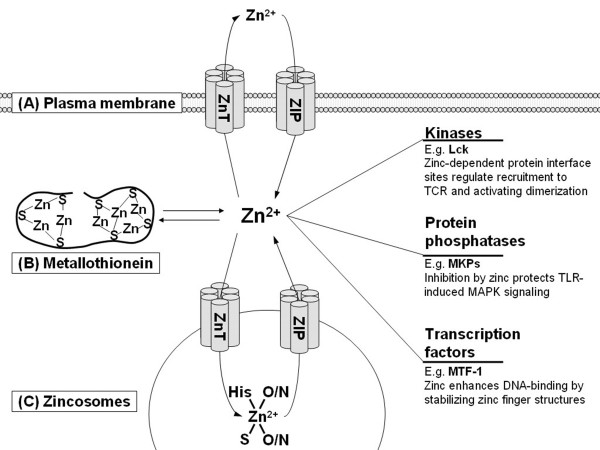
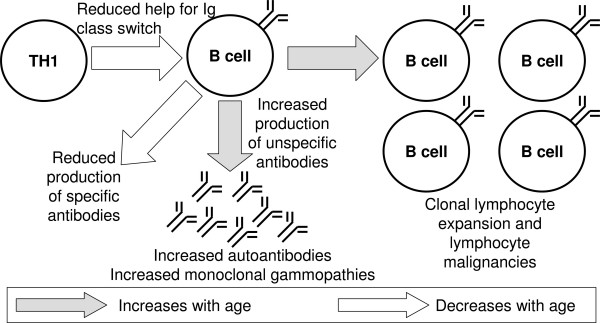
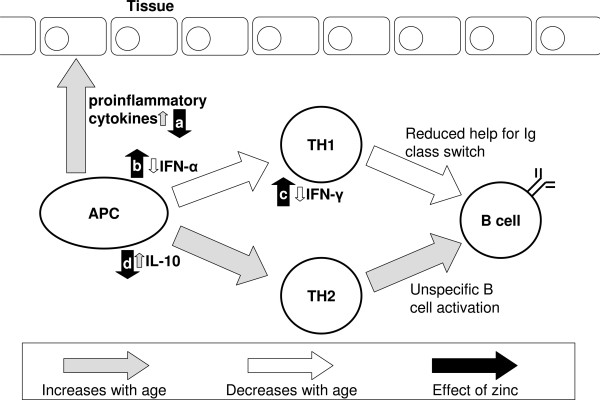
Verification
Claims the paper makes
The claims and statistics of this paper haven’t been checked yet.
Run the check — free, no account needed. It reads the open-access text and checks the sources it cites.
Claims other papers make about this one
Each is checked against this paper’s own text: does it say what the citing paper says it does?
In the citing paper
“Zinc deficiency can cause decreased levels of serum thymulin, a zinc dependent peptide hormone produced by thymic epithelial cells, with an activity that is progressively reduced with age, with a peak in pre-adolescence (78, 104, 108).”
From Immunosenescence and Its Hallmarks: How to Oppose Aging Strategically? A Review of Potential Options for Therapeutic Intervention (2019) · cites this paper as [104]
In the citing paper
“Even slight deficiencies in zinc can have important consequences (104–107).”
From Immunosenescence and Its Hallmarks: How to Oppose Aging Strategically? A Review of Potential Options for Therapeutic Intervention (2019) · cites this paper as [104]
Self-check
Percentages, sums and reported differences re-computed from the paper’s own numbers.
The self-check needs the paper’s full text.
Citations
Cites
The biochemical basis of zinc physiology
Vallée, B. L., & Falchuk, K. H. (1993) · Physiological Reviews · doi:10.1152/physrev.1993.73.1.79 · Cited by 3,005
Zinc requirements and the risks and benefits of zinc supplementation
Maret, W., & Sandstead, H. H. (2006) · Journal of Trace Elements in Medicine and Biology · doi:10.1016/j.jtemb.2006.01.006 · Cited by 1,139
Counting the Zinc-Proteins Encoded in the Human Genome
Andreini, C., Banci, L., Bertini, I., & Rosato, A. (2006) · Journal of Proteome Research · doi:10.1021/pr050361j · Cited by 1,109
Posnett, D. N., Sinha, R., Kabak, S., & Russo, C. (1994) · The Journal of Experimental Medicine · doi:10.1084/jem.179.2.609 · Cited by 761
Mammalian Zinc Transporters: Nutritional and Physiologic Regulation
Lichten, L. A., & Cousins, R. J. (2009) · Annual Review of Nutrition · doi:10.1146/annurev-nutr-033009-083312 · Cited by 749
Mammalian Zinc Transport, Trafficking, and Signals
Cousins, R. J., Liuzzi, J. P., & Lichten, L. A. (2006) · Journal of Biological Chemistry · doi:10.1074/jbc.r600011200 · Cited by 714
Increased cytokine production in mononuclear cells of healthy elderly people
Fagiolo, U., Cossarizza, A., Scala, E., Fanales‐Belasio, E., Ortolani, C., Cozzi, E., Monti, D., Franceschi, C., & Paganelli, R. (1993) · European Journal of Immunology · doi:10.1002/eji.1830230950 · Cited by 665
Letter: Hypoglycaemia in propranolol-treated dialysis patients.
Jensen, H. A., Bjaeldager, P., & Broch‐Møller, B. (1976) · PubMed · Cited by 649
The Incidence of Herpes Zoster
Donahue, J. G. (1995) · Archives of Internal Medicine · doi:10.1001/archinte.1995.00430150071008 · Cited by 618
Ibs, K.-H., & Rink, L. (2003) · Journal of Nutrition · doi:10.1093/jn/133.5.1452s · Cited by 603
Self-citation
Research works printed but not linked: 1
- Kaplan J, Hess JW, Prasad AS: Impaired interleukin-2 production in the elderly: Association with mild zinc deficiency. J Trace Elem Exp Med. 1988, 1: 3-8.
Cited by
Sorted by citations
Items 301–334 of 334
Steele, I., Allright, D., & Deutsch, R. (2020) · Functional Foods in Health and Disease · doi:10.31989/ffhd.v10i3.695 · Cited by 1
Al-zubaidy, A. A., Dalia, A. A. K. A.-S., & Mustafa, G. (2012)
Zinc Supplements in COVID-19 Pathogenesis-Current Perspectives
Sami-Sabinsa Group Limited, B. 5. 0., Majeed, M., Chavez, M., Nagabhushanam, K., Mundkur, L., & Sami-Sabinsa Group Limited, B. 5. 0. (2021) · Austin Journal of Nutrition & Metabolism · doi:10.26420/austinjnutrmetab.2021.1107
de Avance, A. D., Filho, D. R., & Filho, I. J. Z. (2021) · International Journal of Nutrology · doi:10.54448/ijn21404
The importance of dietary balance at COVID-19: the systematic review
Brugnoli, M. I. S., & Garrett, D. A. D. A. (2021) · International Journal of Nutrology · doi:10.54448/ijn21310
Trivedi, M. K. (2016) · American Journal of Life Sciences · doi:10.11648/j.ajls.20160406.14
Zinc Status in Iron Deficient Anaemic Patients in Sudan
Yagob, T., Bode, P., van de Wiel, A., Ismail, F., & Wolterbeek, H. T. (2017) · Journal of Nutritional Biology · doi:10.18314/jnb.v3i1
Evaluation of some immunological markers related to immune anergy in tuberculosis patients
Israa, K. O., Al-Saadi, A., & Hadi, F. (2022) · International Journal of Health Sciences · doi:10.53730/ijhs.v6ns2.9007
LIFESTYLE BEHAVIORS OF OLDER ADULTS IN INDEPENDENT LIVING DURING COVID-19
(2022) · International Journal of Aging Research · doi:10.28933/ijoar-2022-04-2105r
Lessa, P. M., Lessa, K. D. B., Oliveira, B. D. S., Filho, R. S. B., & Rajab, M. L. P. (2022) · International Journal of Nutrology · doi:10.54448/ijn22307
Merloto, R. F., & Soares, B. R. (2024) · International Journal of Nutrology · doi:10.54448/ijn24107
Orthomolekulare Medizin und F.-X.-Mayr-Medizin zur Immunstimulation
Stossier, H. (2024) · Springer eBooks · doi:10.1007/978-3-662-67508-3_14
Acrodermatitis enteropathica: Shedding the light on an under-recognised nutritional disorder
Loh, C. H., Ling, A. L. E., & Heng, Y. K. (2024) · Proceedings of Singapore Healthcare · doi:10.1177/20101058241284657
Evaluation of the effect of iron, zinc and selenium on metabolic processes in viral diseases
LENO, O. R., REPETA, K. A., STOROZHYNSKA, M. V., Fedevych, Y. M., & Pokotylo, P. (2024) · Experimental and Clinical Physiology and Biochemistry · doi:10.25040/ecpb2024.02.046
Food allergies in older people: Protocol for a systematic review and meta-analysis
Azzolino, D., Baldassari, I., Perna, S., Caneva, E., Spolidoro, G. C. I., Cesari, M., & Lucchi, T. A. (2025) · Nutrition and Health · doi:10.1177/02601060251321561
Zinc and selenium levels in ICU patients: association with disease severity and nutritional statusPreprint
Soltani, E. (2025) · Research Square · doi:10.21203/rs.3.rs-6714153/v1
Soltani, E., Vahidinia, A., & Ahmadimoghaddam, D. (2025) · Research Square · doi:10.21203/rs.3.rs-6714153/v2
Soltani, E., Vahidinia, A., Rahimi‐Bashar, F., & Ahmadimoghaddam, D. (2025) · Research Square · doi:10.21203/rs.3.rs-6714153/v3
Pritchard, J., Struszczak, L., Henry, C. O., Lugtmeijer, C., Bowtell, J. L., & O’Leary, M. F. (2025) · Frontiers in Nutrition · doi:10.3389/fnut.2025.1656798
Edelman, R., Deming, M. E., Toapanta, F. R., Heuser, M. D., Chrisley, L., Barnes, R. S., Wasserman, S. S., Blackwelder, W. C., Handwerger, B. S., Pasetti, M., et al. (2020) · Figshare · doi:10.6084/m9.figshare.12211514
Sturza, A., Furdui-Lința, A. V., Buriman, D. G., Ionică, L. N., Lighezan, R., & Muntean, D. M. (2026) · Advances in biochemistry in health and disease · doi:10.1007/978-3-032-14441-6_9
Zhou, A., Zhang, L., Chen, H., Peng, Y., Meng, R., Qin, X., Liu, S., Zou, Y., & Wang, M. (2026) · Environmental Chemistry and Ecotoxicology · doi:10.1016/j.enceco.2026.02.023
Vieillissement et maladies neurodégénératives : nouvelles contraintes apportées par la métallomique
Sauzéat, L. (2018) · theses.fr (ABES) · doi:10.70675/6f22af22z8cfcz4a9fzb647zf065e4131641
Zinc-Induced Hematologic Toxicities: A Systematic Review of Descriptive Studies
Dutta, A., Chaudhary, V., Kumari, S., Rohita, Sharma, K. K., & Pal, B. (2026) · Biological Trace Element Research · doi:10.1007/s12011-026-05136-z
Zinc as a central modulator of heat stress–induced intestinal and systemic dysfunction in poultry
Erek, G., Uulu, N. A., & Şahin, K. (2026) · Journal of Thermal Biology · doi:10.1016/j.jtherbio.2026.104499
Effects of Zinc supplementation in Magnesium alloys on hemogram and erythrocyte osmotic fragility
Yaşar, S., Comba, A., MİS, L., Çiçek, B., Comba, B., & Sancak, T. (2026) · Revista Científica de la Facultad de Ciencias Veterinarias · doi:10.52973/rcfcv-e362929
The Impact of Zinc on T Cell Motility and the Immunological Synapse
Dermaku, A., Schoofs, H., Rink, L., & Fischer, H. J. (2026) · International Journal of Molecular Sciences · doi:10.3390/ijms27125249
Self-citationHung, K., Yu, T., Lai, Y.-C., Liu, W., & Chen, I. (2026) · Frontiers in Nutrition · doi:10.3389/fnut.2026.1897312
Kudeken, N. (2026) · Geriatrics and gerontology international/Geriatrics & gerontology international · doi:10.1111/ggi.70816
Bet, T., Vilvert, M. P., Cécere, B. G. D. O., Mangoni, A. C. B., Cunico, L. P., Bourckhardt, L. E. H., Boff, V. G., Bajay, M. M., & da Silva, A. S. (2026) · Biological Trace Element Research · doi:10.1007/s12011-026-05335-8
Metadata
- Authors
- Haase, H., & Rink, L.
- Affiliations
- RWTH Aachen University (DE)
- Corresponding author
- Rink, Lothar
- Venue
- Immunity & Ageing
- Published
- 2009-06-12
- Volume
- 6
- Issue
- 1
- Pages
- 9-9
- ISSN
- 1742-4933 (ISSN-L)
- PMC
- PMC2702361
- OpenAlex
- W2124890716
- Cited by
- 334
- References
- 157
- Citations by year
- 2026: 14 · 2025: 20 · 2024: 18 · 2023: 14 · 2022: 30 · 2021: 38 · 2020: 31 · 2019: 18 · 2018: 13 · 2017: 17 · 2016: 16 · 2015: 13 · 2014: 17 · 2013: 16 · 2012: 28
- FWCI
- 19.04
- Type
- journal article
- Language
- en
- Open access
- gold
- doi.org
- Licence
- Locations
- Immunity & Ageing (publishedVersion, cc-by)
- PubMed Central (publishedVersion, cc-by)
- PubMed (publishedVersion)
- DOAJ (DOAJ: Directory of Open Access Journals) (submittedVersion)
- RWTH Publications (RWTH Aachen) (submittedVersion, cc-by)
- Topics
- Health Sciences › Nursing › Nutrition and Dietetics › Trace Elements in Health
- Health Sciences › Medicine › Hematology › Iron Metabolism and Disorders
- Health Sciences › Medicine › Physiology (medical) › Nutrition and Health in Aging
- Keywords
- zinc, zinc deficiency, immunosenescence, aging, innate immunity, adaptive immunity, thymus, T helper cells, Th2 shift, vaccine response, oral zinc supplementation, chronic inflammation, older adults
About these checks
Registry, retraction, Cites and statistics results are computed, not judged, with one exception: a printed reference that no index lists is read once by a model before it counts as a citation error. Claims are extracted by a model and kept only when their quote appears verbatim in the text; each cited source is then checked, with a model’s help, for whether it says what the claim relies on. Those verdicts can be wrong — read the claim’s quote and the cited source before relying on one.
Statistics and arithmetic are recomputed, not judged.
Confidence bands are shown only for fields calibrated on our annotated test set. None is calibrated yet, so no band is shown.
What counts as a claim ›How we measure confidence ›How we check this ›
Are you an author, or do you see a problem with this page? Request a review
