

The DOI matches its Crossref record; 40 of the 42 references it cites were found in a registry or an index.
Quantitative classification of pediatric swallowing through accelerometry
Open accessAbstract
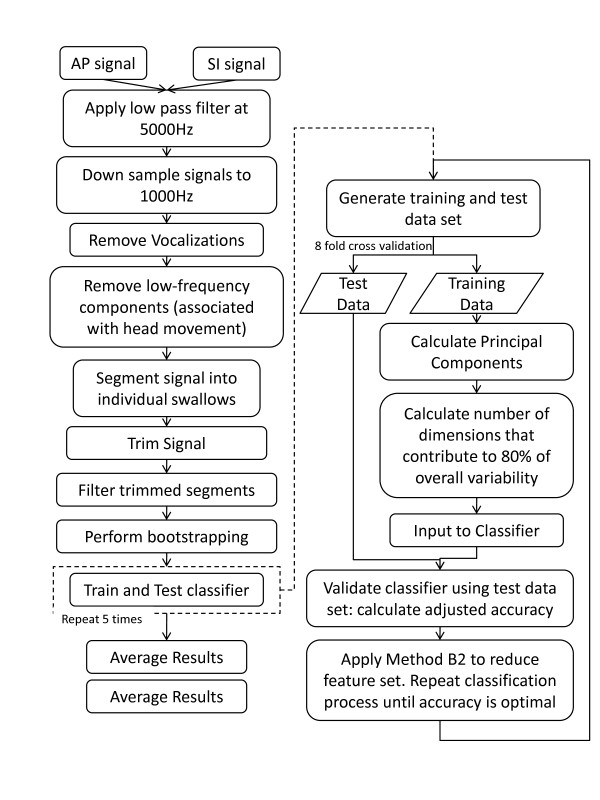
Background: Dysphagia or swallowing disorder negatively impacts a child’s health and development. The gold standard of dysphagia detection is videofluoroscopy which exposes the child to ionizing radiation, and requires specialized clinical expertise and expensive institutionally-based equipment, precluding day-to-day and repeated assessment of fluctuating swallowing function. Swallowing accelerometry is the non-invasive measurement of cervical vibrations during swallowing and may provide a portable and cost-effective bedside alternative. In particular, dual-axis swallowing accelerometry has demonstrated screening potential in older persons with neurogenic dysphagia, but the technique has not been evaluated in the pediatric population. Methods: In this study, dual-axis accelerometric signals were collected simultaneous to videofluoroscopic records from 29 pediatric participants (age 6.8 ± 4.8 years; 20 males) previously diagnosed with neurogenic dysphagia. Participants swallowed 3-5 sips of barium-coated boluses of different consistencies (normally, from thick puree to thin liquid) by spoon or bottle. Videofluoroscopic records were reviewed retrospectively by a clinical expert to extract swallow timings and ratings. The dual-axis acceleration signals corresponding to each identified swallow were pre-processed, segmented and trimmed prior to feature extraction from time, frequency, time-frequency and information theoretic domains. Feature space dimensionality was reduced via principal components. Results: Using 8-fold cross-validation, 16-17 dimensions and a support vector machine classifier with an RBF kernel, an adjusted accuracy of 89.6% ± 0.9 was achieved for the discrimination between swallows with and with out airway entry. Conclusions: Our results suggest that dual-axis accelerometry has merit in the non-invasive detection of unsafe swallows in children and deserves further consideration as a pediatric medical device.
Overview
The claims and statistics of this paper haven’t been checked yet.
Free: it reads the open-access text and checks the first 5 claims that cite a source we can check. Create a free account to check every claim.
Integrity signals
Registry
Cites
Statistics
Figures

Verification
Claims the paper makes
The claims and statistics of this paper haven’t been checked yet.
Free: it reads the open-access text and checks the first 5 claims that cite a source we can check. Create a free account to check every claim.
Claims other papers make about this one
Each is checked against this paper’s own text: does it say what the citing paper says it does?
The cited source says what the claim attributes to it.
In the citing paper
“In the pediatric population, cerebral palsy was the most cited condition in studies focusing on this age group(20,37,49).”
From Artificial intelligence in the diagnosis and management of dysphagia: a scoping review (2025) · cites this paper as [37]
Self-check
Percentages, sums and reported differences re-computed from the paper’s own numbers.
The self-check needs the paper’s full text.
Citations
Cites
Bootstrap methods: another look at the jackknife
Efron, B. (1979) · The Annals of Statistics · doi:10.1214/aos/1176344552 · Cited by 17,602
IEEE Transactions on Pattern Analysis and Machine Intelligence
(2004) · IEEE Transactions on Pattern Analysis and Machine Intelligence · doi:10.1109/tpami.2004.1307293 · Cited by 3,721
A review of classification algorithms for EEG-based brain–computer interfaces
Lotte, F., Congedo, M., Lécuyer, A., Lamarche, F., & Arnaldi, B. (2007) · Journal of Neural Engineering · doi:10.1088/1741-2560/4/2/r01 · Cited by 2,665
Clinical measurement of speech and voice
Baken, R. J. (1987) · Cited by 1,465
Small sample size effects in statistical pattern recognition: Recommendations for practitioners
Raudys, S. J., & Jain, A. K. (1991) · IEEE Transactions on Pattern Analysis and Machine Intelligence · doi:10.1109/34.75512 · Cited by 1,384
The evaluation and treatment of swallowing disorders
Logemann, J. A. (1998) · Current Opinion in Otolaryngology & Head and Neck Surgery · doi:10.1097/00020840-199812000-00008 · Cited by 1,222
Journal of the Royal Statistical Society: Series C (Applied Statistics)
(2023) · Journal of the Royal Statistical Society Series C (Applied Statistics) · doi:10.1111/(issn)1467-9876 · Cited by 1,178
Discarding Variables in a Principal Component Analysis. I: Artificial Data
Jolliffe, I. T. (1972) · Applied Statistics · doi:10.2307/2346488 · Cited by 907
Optimal number of features as a function of sample size for various classification rules
Hua, J., Xiong, Z., Lowey, J., Suh, E., & Dougherty, E. R. (2005) · Bioinformatics · doi:10.1093/bioinformatics/bti171 · Cited by 437
Assessment of pediatric dysphagia and feeding disorders: Clinical and instrumental approaches
Arvedson, J. C. (2008) · Developmental Disabilities Research Reviews · doi:10.1002/ddrr.17 · Cited by 420
Cited by
Pediatric Dysphagia: Physiology, Assessment, and Management
Dodrill, P., & Gosa, M. M. (2015) · Annals of Nutrition and Metabolism · doi:10.1159/000381372 · Cited by 283
Oropharyngeal dysphagia: manifestations and diagnosis
Rommel, N., & Hamdy, S. (2016) · Nature Reviews Gastroenterology & Hepatology · doi:10.1038/nrgastro.2015.199 · Cited by 272
Dudik, J. M., Coyle, J. L., & Sejdić, E. (2015) · IEEE Transactions on Human-Machine Systems · doi:10.1109/thms.2015.2408615 · Cited by 97
Self-citationYagi, N., Nagami, S., Lin, M., Yabe, T., Itoda, M., Imai, T., & Oku, Y. (2016) · Medical & Biological Engineering & Computing · doi:10.1007/s11517-016-1561-2 · Cited by 69
Sejdić, E., Steele, C. M., & Chau, T. T. (2013) · IEEE Transactions on Biomedical Engineering · doi:10.1109/tbme.2013.2243730 · Cited by 51
Self-citation
Metadata
- Authors
- Celeste, M., Azadeh, K., Sejdić, E., Berall, G., & Chau, T.
- Affiliations
- University of Toronto (CA)
- University of Pittsburgh (US)
- North York General Hospital (CA)
- Corresponding author
- Celeste, Merey
- Venue
- Journal of NeuroEngineering and Rehabilitation
- Published
- 2012-06-09
- Volume
- 9
- Issue
- 1
- Pages
- 34-34
- ISSN
- 1743-0003 (ISSN-L)
- PMC
- PMC3453511
- OpenAlex
- W2171356272
- Cited by
- 37
- References
- 42
- Citations by year
- 2026: 3 · 2025: 6 · 2024: 3 · 2023: 2 · 2022: 1 · 2021: 2 · 2020: 2 · 2019: 3 · 2018: 4 · 2017: 1 · 2016: 3 · 2015: 5 · 2014: 1 · 2013: 1
- FWCI
- 5.36
- Type
- journal article
- Language
- en
- Open access
- gold
- doi.org
- Licence
- cc-by
- Locations
- Journal of NeuroEngineering and Rehabilitation (publishedVersion, cc-by)
- Europe PMC (PubMed Central) (publishedVersion, cc-by)
- PubMed Central (publishedVersion, cc-by)
- PubMed (publishedVersion)
- D-Scholarship@Pitt (University of Pittsburgh) (acceptedVersion)
- TSpace (University of Toronto) (submittedVersion)
- DOAJ (DOAJ: Directory of Open Access Journals) (submittedVersion, cc-by-sa)
- Funders
- Bloorview Research Institute
- University of Toronto
- Topics
- Health Sciences › Health Professions › Speech and Hearing › Dysphagia Assessment and Management
- Health Sciences › Health Professions › Speech and Hearing › Voice and Speech Disorders
- Health Sciences › Health Professions › Health Information Management › Artificial Intelligence in Healthcare
- Keywords
- pediatric dysphagia, neurogenic dysphagia, videofluoroscopy, support vector machine
- MeSH terms
- Acceleration, Algorithms, Barium Sulfate, Child, Contrast Media, Cricoid Cartilage, Data Collection, Data Interpretation, Statistical, Deglutition, Deglutition Disorders, Female, Fluoroscopy, Humans, Male, Vibration, Reproducibility of Results, Head Movements, Principal Component Analysis, Support Vector Machine
About these checks
Registry, retraction, Cites and statistics results are computed, not judged, with one exception: a printed reference that no index lists is read once by a model before it counts as a citation error. Claims are extracted by a model and kept only when their quote appears verbatim in the text; each cited source is then checked, with a model’s help, for whether it says what the claim relies on. Those verdicts can be wrong — read the claim’s quote and the cited source before relying on one.
Statistics and arithmetic are recomputed, not judged.
Confidence bands are shown only for fields calibrated on our annotated test set. None is calibrated yet, so no band is shown.
What counts as a claim ›How we measure confidence ›How we check this ›
Are you an author, or do you see a problem with this page? Request a review
How to cite
Cite CoChat for the checks on this page, and the paper for its own findings.
- This page
- CoChat. (2026). Citation check: Quantitative classification of pediatric swallowing through accelerometry. https://app.cochat.ai/papers/10.1186/1743-0003-9-34
- The paper
- Celeste, M., Azadeh, K., Sejdić, E., Berall, G., & Chau, T. (2012). Quantitative classification of pediatric swallowing through accelerometry. Journal of NeuroEngineering and Rehabilitation. https://doi.org/10.1186/1743-0003-9-34
Data sources
Bibliographic data: Semantic Scholar, OpenAlex, Crossref.
Contains information from the Semantic Scholar Academic Graph Datasets, made available under the ODC Attribution License (ODC-BY 1.0).
Semantic Scholar’s data is described in: Kinney, R., et al. (2023). The Semantic Scholar Open Data Platform. arXiv:2301.10140.
