

Quantitative classification of pediatric swallowing through accelerometry
Open accessThe DOI matches its Crossref record; 40 of the 42 references it cites were found in a registry or an index.
Abstract
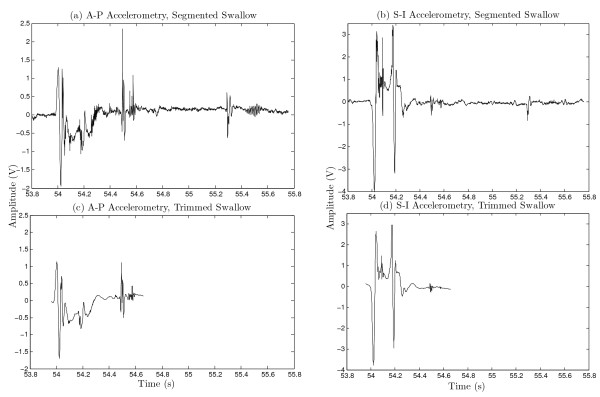
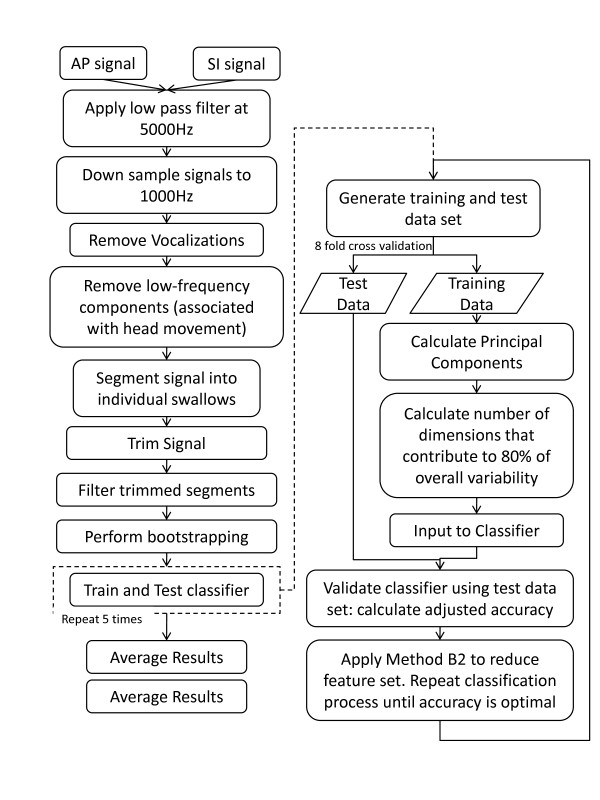
Background: Dysphagia or swallowing disorder negatively impacts a child’s health and development. The gold standard of dysphagia detection is videofluoroscopy which exposes the child to ionizing radiation, and requires specialized clinical expertise and expensive institutionally-based equipment, precluding day-to-day and repeated assessment of fluctuating swallowing function. Swallowing accelerometry is the non-invasive measurement of cervical vibrations during swallowing and may provide a portable and cost-effective bedside alternative. In particular, dual-axis swallowing accelerometry has demonstrated screening potential in older persons with neurogenic dysphagia, but the technique has not been evaluated in the pediatric population. Methods: In this study, dual-axis accelerometric signals were collected simultaneous to videofluoroscopic records from 29 pediatric participants (age 6.8 ± 4.8 years; 20 males) previously diagnosed with neurogenic dysphagia. Participants swallowed 3-5 sips of barium-coated boluses of different consistencies (normally, from thick puree to thin liquid) by spoon or bottle. Videofluoroscopic records were reviewed retrospectively by a clinical expert to extract swallow timings and ratings. The dual-axis acceleration signals corresponding to each identified swallow were pre-processed, segmented and trimmed prior to feature extraction from time, frequency, time-frequency and information theoretic domains. Feature space dimensionality was reduced via principal components. Results: Using 8-fold cross-validation, 16-17 dimensions and a support vector machine classifier with an RBF kernel, an adjusted accuracy of 89.6% ± 0.9 was achieved for the discrimination between swallows with and with out airway entry. Conclusions: Our results suggest that dual-axis accelerometry has merit in the non-invasive detection of unsafe swallows in children and deserves further consideration as a pediatric medical device.
Overview
The claims and statistics of this paper haven’t been checked yet.
Free: it reads the open-access text and checks the first 5 claims that cite a source we can check. Create a free account to check every claim.
Integrity signals
Registry
Cites
Statistics
Figures
Verification
Claims the paper makes
The claims and statistics of this paper haven’t been checked yet.
Free: it reads the open-access text and checks the first 5 claims that cite a source we can check. Create a free account to check every claim.
Claims other papers make about this one
Each is checked against this paper’s own text: does it say what the citing paper says it does?
The cited source says what the claim attributes to it.
In the citing paper
“In the pediatric population, cerebral palsy was the most cited condition in studies focusing on this age group(20,37,49).”
From Artificial intelligence in the diagnosis and management of dysphagia: a scoping review (2025) · cites this paper as [37]
Self-check
Percentages, sums and reported differences re-computed from the paper’s own numbers.
The self-check needs the paper’s full text.
Citations
Cites
Bootstrap methods: another look at the jackknife
Efron, B. (1979) · The Annals of Statistics · doi:10.1214/aos/1176344552 · Cited by 17,602
IEEE Transactions on Pattern Analysis and Machine Intelligence
(2004) · IEEE Transactions on Pattern Analysis and Machine Intelligence · doi:10.1109/tpami.2004.1307293 · Cited by 3,721
A review of classification algorithms for EEG-based brain–computer interfaces
Lotte, F., Congedo, M., Lécuyer, A., Lamarche, F., & Arnaldi, B. (2007) · Journal of Neural Engineering · doi:10.1088/1741-2560/4/2/r01 · Cited by 2,665
Clinical measurement of speech and voice
Baken, R. J. (1987) · Cited by 1,465
Small sample size effects in statistical pattern recognition: Recommendations for practitioners
Raudys, S. J., & Jain, A. K. (1991) · IEEE Transactions on Pattern Analysis and Machine Intelligence · doi:10.1109/34.75512 · Cited by 1,384
The evaluation and treatment of swallowing disorders
Logemann, J. A. (1998) · Current Opinion in Otolaryngology & Head and Neck Surgery · doi:10.1097/00020840-199812000-00008 · Cited by 1,222
Journal of the Royal Statistical Society: Series C (Applied Statistics)
(2023) · Journal of the Royal Statistical Society Series C (Applied Statistics) · doi:10.1111/(issn)1467-9876 · Cited by 1,178
Discarding Variables in a Principal Component Analysis. I: Artificial Data
Jolliffe, I. T. (1972) · Applied Statistics · doi:10.2307/2346488 · Cited by 907
Optimal number of features as a function of sample size for various classification rules
Hua, J., Xiong, Z., Lowey, J., Suh, E., & Dougherty, E. R. (2005) · Bioinformatics · doi:10.1093/bioinformatics/bti171 · Cited by 437
Assessment of pediatric dysphagia and feeding disorders: Clinical and instrumental approaches
Arvedson, J. C. (2008) · Developmental Disabilities Research Reviews · doi:10.1002/ddrr.17 · Cited by 420
Cited by
Pediatric Dysphagia: Physiology, Assessment, and Management
Dodrill, P., & Gosa, M. M. (2015) · Annals of Nutrition and Metabolism · doi:10.1159/000381372 · Cited by 283
Oropharyngeal dysphagia: manifestations and diagnosis
Rommel, N., & Hamdy, S. (2016) · Nature Reviews Gastroenterology & Hepatology · doi:10.1038/nrgastro.2015.199 · Cited by 272
Dudik, J. M., Coyle, J. L., & Sejdic, E. (2015) · IEEE Transactions on Human-Machine Systems · doi:10.1109/thms.2015.2408615 · Cited by 86
Self-citationYagi, N., Nagami, S., Lin, M., Yabe, T., Itoda, M., Imai, T., & Oku, Y. (2016) · Medical & Biological Engineering & Computing · doi:10.1007/s11517-016-1561-2 · Cited by 69
Sejdic, E., Steele, C. M., & Chau, T. (2013) · IEEE Transactions on Biomedical Engineering · doi:10.1109/tbme.2013.2243730 · Cited by 41
Self-citationA statistical analysis of cervical auscultation signals from adults with unsafe airway protection
Dudik, J. M., Kurosu, A., Coyle, J. L., & Sejdić, E. (2016) · Journal of NeuroEngineering and Rehabilitation · doi:10.1186/s12984-015-0110-9 · Cited by 42
“However in order to achieve the reported accuracies, these classification techniques simultaneously utilize multiple features that were selected either through principle component analysis [49, 51] or because the features were of particular interest to the researcher [21, 50, 52].”
MethodSelf-citationClassifying Dysphagic Swallowing Sounds with Support Vector Machines
Miyagi, S., Sugiyama, S., Kozawa, K., Moritani, S., Sakamoto, S., & Sakai, O. (2020) · Healthcare · doi:10.3390/healthcare8020103 · Cited by 32
Diagnostic validity of methods for assessment of swallowing sounds: a systematic review
Taveira, K. V. M., Santos, R. S., Cavalcante-Leão, B. L., Stechman‐Neto, J., Pernambuco, L. D. A., da Silva, L. K., Canto, G. D. L., & Porporatti, A. L. (2018) · Brazilian Journal of Otorhinolaryngology · doi:10.1016/j.bjorl.2017.12.008 · Cited by 29
High-resolution cervical auscultation and data science: new tools to address an old problem
Coyle, J. L., & Sejdić, E. (2020) · American Journal of Speech-Language Pathology · doi:10.1044/2020_ajslp-19-00155 · Cited by 28
“For example, machine learning algorithms have been successfully applied in classifying swallowing signals to identify and differentiate swallows exhibiting no aspiration and those with aspiration with a very high accuracy (Celeste et al., 2012; Sejdi ć et al., 2013).”
Self-citationInoue, K., Yoshioka, M., Yagi, N., Nagami, S., & Oku, Y. (2018) · IEEE Transactions on Biomedical Engineering · doi:10.1109/tbme.2018.2807487 · Cited by 27
Frakking, T. T., Chang, A. B., Carty, C., Newing, J., Weir, K. A., Schwerin, B., & So, S. (2022) · Dysphagia · doi:10.1007/s00455-022-10410-y · Cited by 23
“Also, previous classifier accuracy results were based on swallowing sounds collected from children with large age ranges (2–11.6 years [27] and 2–9.9 years [28]) and on a variety of fluid viscosities.”
BackgroundResultInfluentialLai, D. K.-H., Cheng, E. S.-W., Lim, H.-J., So, B. P.-H., Lam, W., Cheung, D. S. K., Wong, D. W., & Cheung, J. C. (2023) · Frontiers in Bioengineering and Biotechnology · doi:10.3389/fbioe.2023.1205009 · Cited by 22
Swallowing accelerometry signal feature variations with sensor displacement
Mamun, K. A., Steele, C. M., & Chau, T. T. (2015) · Medical Engineering & Physics · doi:10.1016/j.medengphy.2015.04.007 · Cited by 19
Self-citationRomero, R. G., Arnal, I. R., Montañés, M. J. R., Calahorra, J. A. L., Alonso, C., Hernández, B. I., & de Vicente, C. M. (2017) · Anales de Pediatría · doi:10.1016/j.anpedi.2017.07.009 · Cited by 18
A matched dual-tree wavelet denoising for tri-axial swallowing vibrations
Dudik, J. M., Coyle, J. L., El-Jaroudi, A., Sun, M., & Sejdić, E. (2016) · Biomedical Signal Processing and Control · doi:10.1016/j.bspc.2016.01.012 · Cited by 18
Self-citationInfant aspiration and associated signs on clinical feeding evaluation
Balest, A. L., Mahoney, A. S., Shaffer, A. D., White, K. E., Theiss, R., & Dohar, J. E. (2021) · International Journal of Pediatric Otorhinolaryngology · doi:10.1016/j.ijporl.2021.110856 · Cited by 15
Acoustic signal of silent tracheal aspiration in children with oropharyngeal dysphagia
de Almeida, S. T., Ferlin, E. L., Maciel, A. C., Fagondes, S. C., Callegari-Jacques, S. M., Fornari, F., Silva, D. B. S. G., & Goldani, H. A. S. (2018) · Logopedics Phoniatrics Vocology · doi:10.1080/14015439.2018.1487993 · Cited by 12
Cron, A. C., David, M., Orbell‐Smith, J., Chang, A. B., Weir, K. A., & Frakking, T. T. (2024) · Clinical Otolaryngology · doi:10.1111/coa.14202 · Cited by 8
Contemporary Trends in the Diagnosis and Management of Pediatric Dysphagia
Elluru, R. G. (2024) · Current Treatment Options in Pediatrics · doi:10.1007/s40746-024-00305-5 · Cited by 8
A review on intelligent aid diagnosis for dysphagia using swallowing sounds
Li, D., Wu, J., Jin, X., Li, Y., Tong, B., Zeng, W., Liu, P., Wang, W., & Shang, S. (2023) · Interdisciplinary Nursing Research · doi:10.1097/nr9.0000000000000040 · Cited by 8
Evaluation of dysphagia. Results after one year of incorporating videofluoroscopy into its study
Romero, R. G., Arnal, I. R., Montañés, M. J. R., Calahorra, J. A. L., Alonso, C., Hernández, B. I., & de Vicente, C. M. (2018) · Anales de Pediatría (English Edition) · doi:10.1016/j.anpede.2017.07.010 · Cited by 8
Artificial intelligence in the diagnosis and management of dysphagia: a scoping review
Silva, R. D. D., Almeida, S. B., Gonçalves, F. M., Zeigelboim, B. S., Stechman-Neto, J., Schroder, A. G. D., Nascimento, W. V., Santos, R. S., & Araujo, C. M. D. (2025) · CoDAS · doi:10.1590/2317-1782/e20240305en · Cited by 6
“In the pediatric population, cerebral palsy was the most cited condition in studies focusing on this age group (20,37,49) .”
So, S., Tadj, T., Schwerin, B., Chang, A. B., Humphries, S., & Frakking, T. T. (2025) · Dysphagia · doi:10.1007/s00455-025-10879-3 · Cited by 5
Navarro, D., Nogales, A., Rossell, A., López, K., Candelario, E., Materán, V., Neri, S., & Belandria, K. (2014) · Revista GEN · doi:10.61155/gen.v68i3.63 · Cited by 5
Frakking, T. T., Humphries, S., Chang, A. B., Schwerin, B., Palmer, M. M., David, M., Cron, A. C., So, S., collaborative, S., Bautista, M., et al. (2025) · Dysphagia · doi:10.1007/s00455-025-10807-5 · Cited by 4
Nahrstaedt, H. (2017) · DepositOnce · doi:10.14279/depositonce-6427 · Cited by 4
An accelerometry and gyroscopy-based system for detecting swallowing and coughing events
Stevens, G., de Velde, S. V., Larmuseau, M., Poelaert, J., Damme, A. V., & Verdonck, P. (2024) · Journal of Clinical Monitoring and Computing · doi:10.1007/s10877-024-01222-6 · Cited by 2
Toledo-Rodríguez, L., Casanova-Román, M., Manzur, H., & Soto-Fernández, P. (2025) · Dysphagia · doi:10.1007/s00455-025-10900-9 · Cited by 2
Classification of Swallowing Foods Using Machine Learning Algorithms
Lim, J. H., Djurić, P. M., & Stanaćević, M. (2021) · International Conference on Electrical, Computer and Energy Technologies (ICECET) · doi:10.1109/icecet52533.2021.9698484 · Cited by 2
Galanis, C., Tsipianitis, D., & Michou, E. (2025) · International Conference on Information, Intelligence, Systems & Applications (IISA) · doi:10.1109/iisa66859.2025.11311258 · Cited by 1
Wang, L., Cui, N., Li, X. X., Qiao, J., Wei, Z., Dou, Z., Liu, Y., & Wei, X. (2026) · Digital Health · doi:10.1177/20552076261465164 · Cited by 1
Pharyngeal Manometry in Pediatric Dysphagia Assessment
Ferris, L. F., & Omari, T. I. (2019) · Perspectives of the ASHA Special Interest Groups · doi:10.1044/2019_pers-sig13-2018-0008 · Cited by 1
A Study of Swallowing Detection for Care-requiring Elderly People during Meal Assistance
TSUZUKI, Y., Nishitani, K., Kim, J., Nakabayashi, M., Tsubouti, N., Hayashi, K., & Nakajima, K. (2015) · Transactions of the Society of Instrument and Control Engineers · doi:10.9746/sicetr.51.520 · Cited by 1
Effects of Liquid Viscosity and Food Texture on Swallowing Sounds
Feng, C. (2020) · DigitalCommons@UNMC · Cited by 1
Wearable sensors for monitoring neurogenic dysphagia: a scoping review
Gasperini, D., Pierotti, F., Privitera, L., Steele, C. M., & Bandini, A. (2026) · Progress in Biomedical Engineering · doi:10.1088/2516-1091/ae6d5d · Cited by 1
Evaluación de la Disfagia en Niños
Alvarez, R. P. (2014) · Revista GEN · doi:10.61155/gen.v68i3.72 · Cited by 1
Cervical auscultation for the identification of swallowing difficulties
Dudik, J. M. (2015) · D-Scholarship@Pitt (University of Pittsburgh)
A Study on Signal Processing Method for Wearable Swallowing Sensor to Eliminate Motion Artifacts
Saito, M., ORITANI, N., Kim, J., Nakabayashi, M., Tsubouti, N., HAYASHI, K., & Nakajima, K. (2019) · Transactions of the Society of Instrument and Control Engineers · doi:10.9746/sicetr.55.379
Quantitative and Portable Instrumentation for the Screening and Assessment of Pharyngeal Dysphagia
Henderson, M. (2018) · Kent Academic Repository (University of Kent) · doi:10.22024/unikent/01.02.72490
Mohammadi, H. (2017) · TSpace (University of Toronto)
Gallois, Y., Souche, J., Lemaire, Y., Gravellier, L., Barone, P., Nicolini, L., Farinas, J., Gaillard, P., & Woisard, V. (2025) · Brain Organoid and Systems Neuroscience Journal · doi:10.1016/j.bosn.2025.04.002
Almeida, S. T. D. (2013) · Lume (Universidade Federal do Rio Grande do Sul)
Gravellier, L. (2024) · theses.fr (ABES) · doi:10.70675/2f70927azd193z4a39z980dzf634365bf934
Humphries, S., James, S., Affleck, J., Robertson, M. D., Day, S., & Frakking, T. T. (2026) · International Journal of Speech-Language Pathology · doi:10.1080/17549507.2026.2742286
Metadata
- Authors
- Celeste, M., Azadeh, K., Sejdić, E., Berall, G., & Chau, T.
- Affiliations
- University of Toronto (CA)
- University of Pittsburgh (US)
- North York General Hospital (CA)
- Corresponding author
- Celeste, Merey
- Venue
- Journal of NeuroEngineering and Rehabilitation
- Published
- 2012-06-09
- Volume
- 9
- Issue
- 1
- Pages
- 34-34
- ISSN
- 1743-0003 (ISSN-L)
- PMC
- PMC3453511
- OpenAlex
- W2171356272
- Cited by
- 37
- References
- 42
- Citations by year
- 2026: 3 · 2025: 6 · 2024: 3 · 2023: 2 · 2022: 1 · 2021: 2 · 2020: 2 · 2019: 3 · 2018: 4 · 2017: 1 · 2016: 3 · 2015: 5 · 2014: 1 · 2013: 1
- FWCI
- 5.36
- Type
- journal article
- Language
- en
- Open access
- gold
- doi.org
- Licence
- cc-by
- Locations
- Journal of NeuroEngineering and Rehabilitation (publishedVersion, cc-by)
- Europe PMC (PubMed Central) (publishedVersion, cc-by)
- PubMed Central (publishedVersion, cc-by)
- PubMed (publishedVersion)
- D-Scholarship@Pitt (University of Pittsburgh) (acceptedVersion)
- TSpace (University of Toronto) (submittedVersion)
- DOAJ (DOAJ: Directory of Open Access Journals) (submittedVersion, cc-by-sa)
- Funders
- Bloorview Research Institute
- University of Toronto
- Topics
- Health Sciences › Health Professions › Speech and Hearing › Dysphagia Assessment and Management
- Health Sciences › Health Professions › Speech and Hearing › Voice and Speech Disorders
- Health Sciences › Health Professions › Health Information Management › Artificial Intelligence in Healthcare
- Keywords
- pediatric dysphagia, neurogenic dysphagia, videofluoroscopy, support vector machine
- MeSH terms
- Acceleration, Algorithms, Barium Sulfate, Child, Contrast Media, Cricoid Cartilage, Data Collection, Data Interpretation, Statistical, Deglutition, Deglutition Disorders, Female, Fluoroscopy, Humans, Male, Vibration, Reproducibility of Results, Head Movements, Principal Component Analysis, Support Vector Machine
About these checks
Registry, retraction, Cites and statistics results are computed, not judged, with one exception: a printed reference that no index lists is read once by a model before it counts as a citation error. Claims are extracted by a model and kept only when their quote appears verbatim in the text; each cited source is then checked, with a model’s help, for whether it says what the claim relies on. Those verdicts can be wrong — read the claim’s quote and the cited source before relying on one.
Statistics and arithmetic are recomputed, not judged.
Confidence bands are shown only for fields calibrated on our annotated test set. None is calibrated yet, so no band is shown.
What counts as a claim ›How we measure confidence ›How we check this ›
Are you an author, or do you see a problem with this page? Request a review
Data sources
Bibliographic data: Semantic Scholar, OpenAlex, Crossref.
Contains information from the Semantic Scholar Academic Graph Datasets, made available under the ODC Attribution License (ODC-BY 1.0).
Semantic Scholar’s data is described in: Kinney, R., et al. (2023). The Semantic Scholar Open Data Platform. arXiv:2301.10140.
