

Pox proteomics: mass spectrometry analysis and identification of Vaccinia virion proteins
Open accessThe DOI matches its Crossref record; 84 of the 84 references it cites were found in a registry or an index.
Abstract
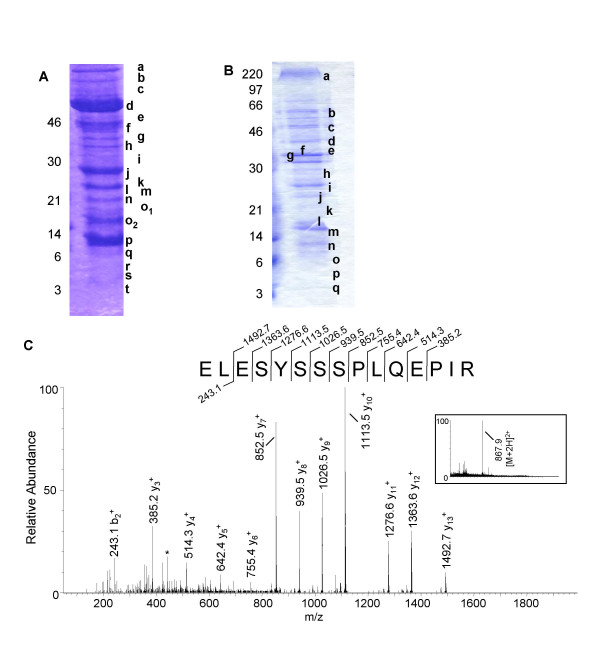
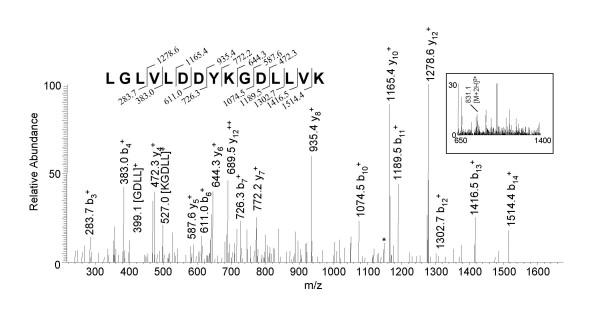
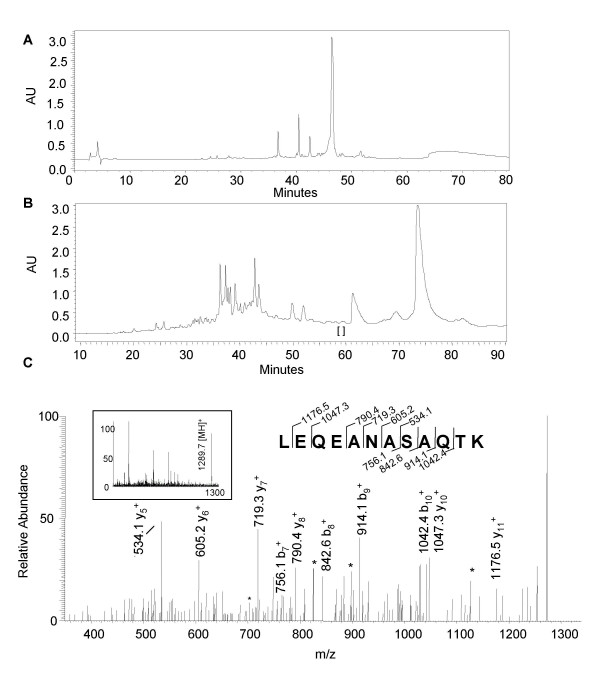
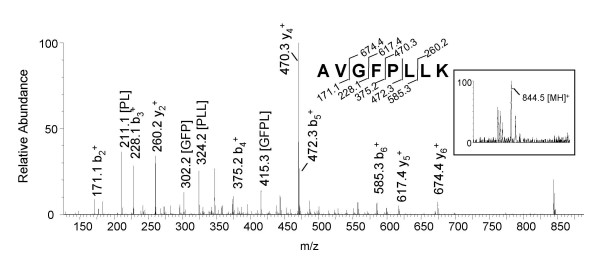
Background: Although many vaccinia virus proteins have been identified and studied in detail, only a few studies have attempted a comprehensive survey of the protein composition of the vaccinia virion. These projects have identified the major proteins of the vaccinia virion, but little has been accomplished to identify the unknown or less abundant proteins. Obtaining a detailed knowledge of the viral proteome of vaccinia virus will be important for advancing our understanding of orthopoxvirus biology, and should facilitate the development of effective antiviral drugs and formulation of vaccines. Results: In order to accomplish this task, purified vaccinia virions were fractionated into a soluble protein enriched fraction (membrane proteins and lateral bodies) and an insoluble protein enriched fraction (virion cores). Each of these fractions was subjected to further fractionation by either sodium dodecyl sulfate-polyacrylamide gel electophoresis, or by reverse phase high performance liquid chromatography. The soluble and insoluble fractions were also analyzed directly with no further separation. The samples were prepared for mass spectrometry analysis by digestion with trypsin. Tryptic digests were analyzed by using either a matrix assisted laser desorption ionization time of flight tandem mass spectrometer, a quadrupole ion trap mass spectrometer, or a quadrupole-time of flight mass spectrometer (the latter two instruments were equipped with electrospray ionization sources). Proteins were identified by searching uninterpreted tandem mass spectra against a vaccinia virus protein database created by our lab and a non-redundant protein database. Conclusion: Sixty three vaccinia proteins were identified in the virion particle. The total number of peptides found for each protein ranged from 1 to 62, and the sequence coverage of the proteins ranged from 8.2% to 94.9%. Interestingly, two vaccinia open reading frames were confirmed as being expressed as novel proteins: E6R and L3L.
Overview
The claims and statistics of this paper haven’t been checked yet.
Free: it reads the open-access text and checks the first 5 claims that cite a source we can check. Create a free account to check every claim.
Integrity signals
Registry
Cites
Statistics
Figures
Verification
Claims the paper makes
The claims and statistics of this paper haven’t been checked yet.
Free: it reads the open-access text and checks the first 5 claims that cite a source we can check. Create a free account to check every claim.
Claims other papers make about this one
Each is checked against this paper’s own text: does it say what the citing paper says it does?
The cited source says what the claim attributes to it.
In the citing paper
“For compositional analysis, most studies have focused on viruses with high proteomic complexity, including those in the families Herpesviridae (4–9) and Poxviridae (10–12).”
From The Impact of Mass Spectrometry–Based Proteomics on Fundamental Discoveries in Virology (2014) · cites this paper as [12]
Self-check
Percentages, sums and reported differences re-computed from the paper’s own numbers.
The self-check needs the paper’s full text.
Citations
Cites
Cleavage of Structural Proteins during the Assembly of the Head of Bacteriophage T4
LAEMMLI, U. K. (1970) · Nature · doi:10.1038/227680a0 · Cited by 249,961 · cited 1×
“Virion fractions were mixed with equal amounts of SDS-PAGE loading buffer and resolved on SDS-PAGE gels (12.5%) [ 15 ].”
MethodInfluentialGapped BLAST and PSI-BLAST: a new generation of protein database search programs
Altschul, S. (1997) · Nucleic Acids Research · doi:10.1093/nar/25.17.3389 · Cited by 73,302
Raza, H., John, A., & Nemmar, A. (2013) · Cellular Physiology and Biochemistry · doi:10.1159/000350087 · Cited by 47,221
A simple method for displaying the hydropathic character of a protein
Kyte, J., & Doolittle, R. F. (1982) · Journal of Molecular Biology · doi:10.1016/0022-2836(82)90515-0 · Cited by 22,843 · cited 2×
“Hydrophobicity plots revealed no specific region of interest [ 10 ].”
BackgroundMass Spectrometric Sequencing of Proteins from Silver-Stained Polyacrylamide Gels
Shevchenko, A., Wilm, M., Vorm, O., & Mann, M. (1996) · Analytical Chemistry · doi:10.1021/ac950914h · Cited by 8,995 · cited 1×
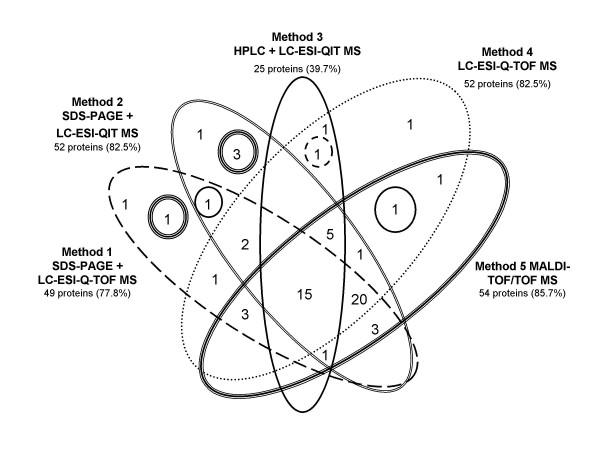
“Protein bands were excised and the preparation for in-gel digestion [16] Diagram of proteins identified using multiple methods Figure 6 Diagram of proteins identified using multiple methods.”
MethodThe complete DNA sequence of vaccinia virus
Goebel, S. J., Johnson, G. P., Perkus, M. E., Davis, S. W., Winslow, J. P., & Paoletti, E. (1990) · Virology · doi:10.1016/0042-6822(90)90294-2 · Cited by 850
Chang, H. W., Watson, J. C., & Jacobs, B. L. (1992) · Proceedings of the National Academy of Sciences · doi:10.1073/pnas.89.11.4825 · Cited by 483
A46R and A52R from vaccinia virus are antagonists of host IL-1 and toll-like receptor signaling
Bowie, A., Kiss-Toth, E., Symons, J. A., Smith, G. L., Dower, S. K., & O'Neill, L. A. J. (2000) · Proceedings of the National Academy of Sciences · doi:10.1073/pnas.160027697 · Cited by 466
A Tyr/Ser protein phosphatase encoded by vaccinia virus
Guan, K., Broyles, S. S., & Dixon, J. E. (1991) · Nature · doi:10.1038/350359a0 · Cited by 396 · cited 1×
“8 H1L Protein phosphatase [64] 1,2,3,4,5 10 67.”
Blasco, R., & Moss, B. (1991) · Journal of Virology · doi:10.1128/jvi.65.11.5910-5920.1991 · Cited by 317 · cited 2×
“7 F13L EEV membrane protein [58] 1,2,4,5 9 32.”
Research works printed but not linked: 1
- Moss B Fields BN Poxviridae: The Viruses and Their Replication Fields Virology 1996 Volume 2 3rd Edition Philadelphia, Lippincott-Raven 2637 2671
Cited by
Items 101–111 of 111
Regulation of infected cell fusion by the vaccinia virus A56 and K2 proteins
Wagenaar, T. R. (2008) · University Libraries (University of Maryland)
Mass Spectrometry Based Proteomics and Lipidomics Studies
Kang, H. Y. (2015) · ScholarsArchive (Brigham Young University)
Structural and functional analysis of the Vaccinia virus O1 virulence protein
Weeks, A. C. (2017) · The Scholarship East Carolina University's Institutional Repository (East Carolina University)
Control of regulatory T cell activity by endogenous and pathogen-derived EGFR ligand
McCrae, J. (2020) · ERA · doi:10.7488/era/332
Bryk, P., & Ward, B. M. (2018) · UR Research (University of Rochester)
Characterizing Human and Viral Proteins in the HIV-1 Envelope Using Novel Methods in Flow Virometry
Burnie, J. (2023) · TSpace (University of Toronto)
Glycerophospholipid fluorescence imaging during Vaccinia Virus replication
Napoli, A. (2019) · theses.fr (ABES) · doi:10.70675/31910ac6z8ecfz4d56zb5a3z5f930f8f9c0f
Schlosser-Perrin, L. (2024) · theses.fr (ABES) · doi:10.70675/7bd1c44bzcd0dz4aadzb3faza36d60ee7a6c
High-resolution Structure of the Vaccinia Virus Phospholipase D-fold Endonuclease K4
Gröger, H., Trouba, C., Barbaste, J., Lacroix, G., Schoehn, G., Burmeister, W. P., & Tarbouriech, N. (2026) · Journal of Molecular Biology · doi:10.1016/j.jmb.2026.169961
Metadata
- Authors
- Yoder, J. D., Chen, T. S., Gagnier, C. R., Vemulapalli, S., Maier, C. S., & Hruby, D. E.
- Affiliations
- Oregon State University (US)
- Corresponding author
- Hruby, Dennis E
- ORCID
- Maier, Claudia S
- Venue
- Virology Journal
- Published
- 2006-03-01
- Volume
- 3
- Issue
- 1
- Pages
- 10-10
- ISSN
- 1743-422X (ISSN-L)
- PMC
- PMC1540416
- OpenAlex
- W2158023273
- Cited by
- 104
- References
- 83
- Citations by year
- 2026: 2 · 2025: 2 · 2024: 2 · 2023: 1 · 2022: 4 · 2021: 2 · 2020: 4 · 2019: 3 · 2018: 2 · 2017: 4 · 2016: 2 · 2015: 6 · 2014: 10 · 2013: 3 · 2012: 3
- FWCI
- 4.16
- Type
- journal article
- Language
- en
- Open access
- gold
- doi.org
- Licence
- cc-by
- Locations
- Virology Journal (publishedVersion, cc-by)
- Europe PMC (PubMed Central) (publishedVersion, cc-by)
- PubMed (publishedVersion)
- DOAJ (DOAJ: Directory of Open Access Journals) (submittedVersion, cc-by-sa)
- Funders
- National Institutes of Health (#ES00210)
- National Institute of Allergy and Infectious Diseases (R21AI059331, AI2335, AI059331)
- National Institute of Environmental Health Sciences (P30ES000210, #P30-ES00210)
- Topics
- Life Sciences › Immunology and Microbiology › Virology › Poxvirus research and outbreaks
- Physical Sciences › Chemistry › Spectroscopy › Advanced Proteomics Techniques and Applications
- Life Sciences › Biochemistry, Genetics and Molecular Biology › Molecular Biology › vaccines and immunoinformatics approaches
- Keywords
- vaccinia virus, viral proteome, virion proteins, orthopoxvirus, protein identification, membrane proteins, open reading frames, antiviral drug discovery, vaccine formulation
- MeSH terms
- Amino Acid Sequence, Electrophoresis, Polyacrylamide Gel, Molecular Sequence Data, Peptides, Mass Spectrometry, Trypsin, Vaccinia virus, Viral Proteins, Virion, Open Reading Frames, Spectrometry, Mass, Matrix-Assisted Laser Desorption-Ionization, Proteome, Databases, Protein, Proteomics
About these checks
Registry, retraction, Cites and statistics results are computed, not judged, with one exception: a printed reference that no index lists is read once by a model before it counts as a citation error. Claims are extracted by a model and kept only when their quote appears verbatim in the text; each cited source is then checked, with a model’s help, for whether it says what the claim relies on. Those verdicts can be wrong — read the claim’s quote and the cited source before relying on one.
Statistics and arithmetic are recomputed, not judged.
Confidence bands are shown only for fields calibrated on our annotated test set. None is calibrated yet, so no band is shown.
What counts as a claim ›How we measure confidence ›How we check this ›
Are you an author, or do you see a problem with this page? Request a review
Data sources
Bibliographic data: Semantic Scholar, OpenAlex, Crossref.
Contains information from the Semantic Scholar Academic Graph Datasets, made available under the ODC Attribution License (ODC-BY 1.0).
Semantic Scholar’s data is described in: Kinney, R., et al. (2023). The Semantic Scholar Open Data Platform. arXiv:2301.10140.
