

The DOI matches its Crossref record; 10 of the 10 references it cites were found in a registry or an index.
Is deck B a disadvantageous deck in the Iowa Gambling Task?
Abstract
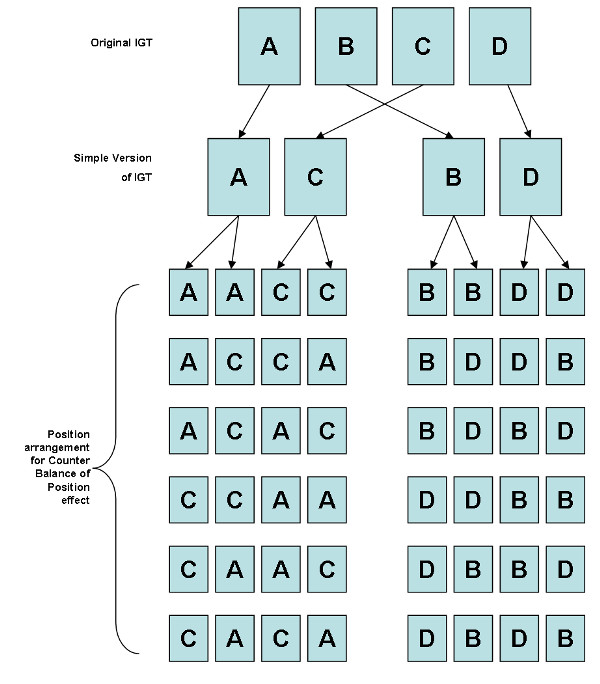
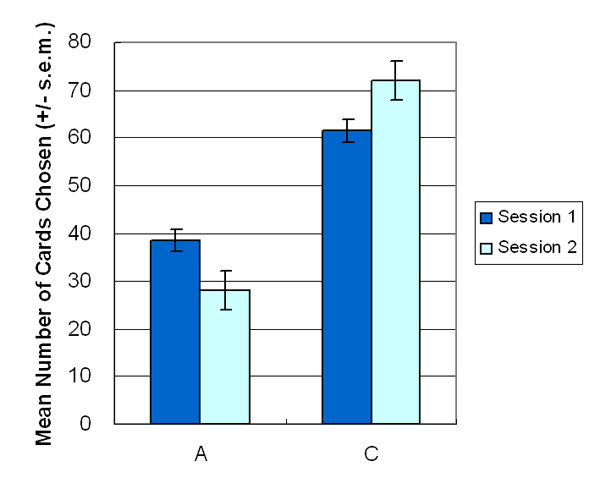
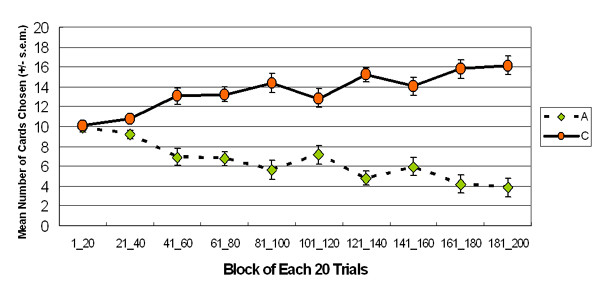
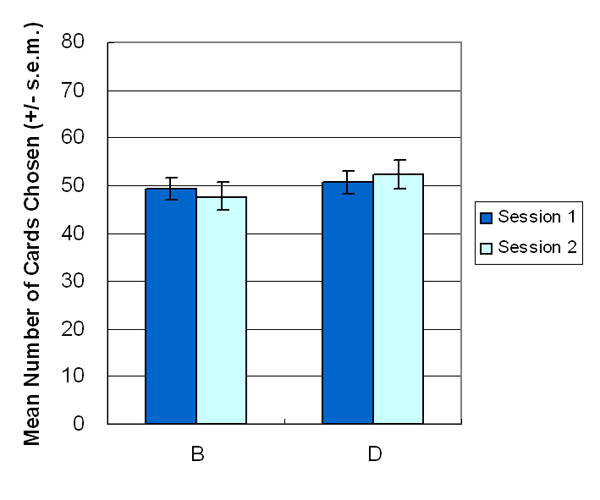
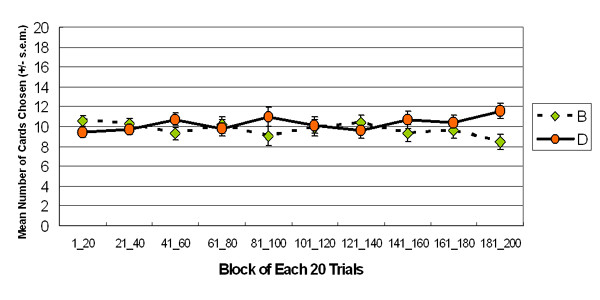
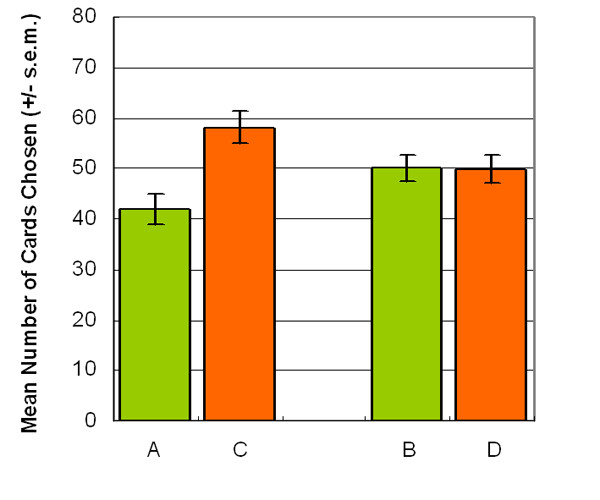
Background: The Iowa gambling task is a popular test for examining monetary decision behavior under uncertainty. According to Dunn et al. review article, the difficult-to-explain phenomenon of "prominent deck B" was revealed, namely that normal decision makers prefer bad final-outcome deck B to good final-outcome decks C or D. This phenomenon was demonstrated especially clearly by Wilder et al. and Toplak et al. The "prominent deck B" phenomenon is inconsistent with the basic assumption in the IGT; however, most IGT-related studies utilized the "summation" of bad decks A and B when presenting their data, thereby avoiding the problems associated with deck B. Methods: To verify the "prominent deck B" phenomenon, this study launched a two-stage simple version IGT, namely, an AACC and BBDD version, which possesses a balanced gain-loss structure between advantageous and disadvantageous decks and facilitates monitoring of participant preferences after the first 100 trials. Results: The experimental results suggested that the "prominent deck B" phenomenon exists in the IGT. Moreover, participants cannot suppress their preference for deck B under the uncertain condition, even during the second stage of the game. Although this result is incongruent with the basic assumption in IGT, an increasing number of studies are finding similar results. The results of the AACC and BBDD versions can be congruent with the decision literatures in terms of gain-loss frequency. Conclusion: Based on the experimental findings, participants can apply the "gain-stay, loss-shift" strategy to overcome situations involving uncertainty. This investigation found that the largest loss in the IGT did not inspire decision makers to avoid choosing bad deck B.
Overview
The claims and statistics of this paper haven’t been checked yet.
Run the check — free, no account needed. It reads the open-access text and checks the sources it cites.
Integrity signals
Registry
Cites
Statistics
Figures
Verification
Claims the paper makes
The claims and statistics of this paper haven’t been checked yet.
Run the check — free, no account needed. It reads the open-access text and checks the sources it cites.
Claims other papers make about this one
Each is checked against this paper’s own text: does it say what the citing paper says it does?
In the citing paper
“deck B′ was considered “risky” on the basis of the intertemporal attribute and is preferred to other “safe” decks (Lin et al., 2007)”
From Dual conception of risk in the Iowa Gambling Task: effects of sleep deprivation and test-retest gap (2013) · cites this paper as Lin et al., 2007
Self-check
Percentages, sums and reported differences re-computed from the paper’s own numbers.
The self-check needs the paper’s full text.
Citations
Cites
Prospect Theory: An Analysis of Decision under Risk
Kahneman, D., & Tversky, A. (1979) · Econometrica · doi:10.2307/1914185 · Cited by 48,524
The Framing of Decisions and the Psychology of Choice
Tversky, A., & Kahneman, D. (1981) · Science · doi:10.1126/science.7455683 · Cited by 18,497
Insensitivity to future consequences following damage to human prefrontal cortex
Bechara, A., Damasio, A. R., Damasio, H., & Anderson, S. W. (1994) · Cognition · doi:10.1016/0010-0277(94)90018-3 · Cited by 6,128
Maps of Bounded Rationality: Psychology for Behavioral Economics
Kahneman, D. (2003) · American Economic Review · doi:10.1257/000282803322655392 · Cited by 5,377
The somatic marker hypothesis and the possible functions of the prefrontal cortex
Damasio, A. R. (1996) · Philosophical Transactions of the Royal Society of London. Series B: Biological Sciences · doi:10.1098/rstb.1996.0125 · Cited by 2,847 · cited 2×
“riority of normal decision makers over patients with emotional deficits in IGT results from the intact somatic marker [1,12-16].”
Different contributions of the human amygdala and ventromedial prefrontal cortex to decision-making
Bechara, A., Damasio, H., Damasio, A. R., & Lee, G. P. (1999) · The Journal of Neuroscience · doi:10.1523/jneurosci.19-13-05473.1999 · Cited by 2,001
DAMASIO, A. (1990) · Behavioural Brain Research · doi:10.1016/0166-4328(90)90144-4 · Cited by 1,275
Chronic pain patients are impaired on an emotional decision-making task
Apkarian, V. A., Sosa, Y., Krauss, B. R., Thomas, S. P., Fredrickson, B. E., Levy, R. E., Harden, N. R., & Chialvo, D. R. (2004) · Pain · doi:10.1016/j.pain.2003.12.015 · Cited by 536
Rolls, E. T. (2005) · doi:10.1093/acprof:oso/9780198570035.001.0001 · Cited by 339
Toplak, M. E., Jain, U., & Tannock, R. (2005) · Behavioral and Brain Functions · doi:10.1186/1744-9081-1-8 · Cited by 303
Research works printed but not linked: 40
- Damasio AR: Descartes’ error: emotion, reason, and the human brain. 1994, New York, G. P. Putnam's Sons, 205-222.
- Greenfield S: BBC Brain Story: Unlocking Our inner World of Emotion, Memories, Ideas and Desires. 2001, English
- Gazzaniga M, Ivry R, Mangun G: Cognitive neuroscience: the biology of the mind. 2002, New York , Norton & Company, Inc., 2nd
- Elliott R: Brain Systems Mediating Reward. Human Brain Function. Edited by: Frackowiak RSJ. 2004, London , Elsevier Academic Press, 445-470.
- Leland J, Grafman J: Experimental tests of Somatic Marker hypothesis. Games Econ Behav. 2005, 52: 386-409. 10.1016/j.geb.2004.09.001. · DOI
- Dunn BD, Dalgleish T, Lawrence AD: The somatic marker hypothesis: A critical evaluation. Neurosci Biobehav Rev. 2006, 30 (2): 239-271. 10.1016/j.neubiorev.2005.07.001. · DOI · Paper page
- Glimcher P: Decisions, Uncertainty, and the Brain: The science of neuroeconomics. 2003, London , MIT Press · DOI
- Shiv B, Loewenstein G, Bechara A, Damasio H, Damasio AR: Investment behavior and the negative side of emotion. Psychological Science. 2004, 16: 435-439. · DOI · Paper page
- Glimcher P: Neuroeconomics: the consilience of brain and decision. Science. 2004, 306: 447-452. 10.1126/science.1102566. · DOI
- Damasio A, Tranel D, Damasio H: Somatic Markers and the Guidance of Behavior: Theory and Preliminary Testing. Frontal Lobe Function and Dysfunction. Edited by: S.Levin H, Eisenberg HM, Benton AL. 1991, New York , Oxford University Press, 217-229. · DOI
- Tranel D, Bechara A, Damasio A: Decision Making and the Somatic Marker Hypothesis. The new cognitive neurosciences. Edited by: Gazzaniga M. 2000, New York , MIT Press, 1047-1061.
- Tranel D: Emotion, Decision Making, and the Ventromedial Prefrontal Cortex. Principles of frontal lobe function. Edited by: Stuss DT, Knight RT. 2002, New York , Oxford University Press, 338-353. · DOI
- Bechara A, Damasio H, Tranel D, Damasio AR: Deciding advantageously before knowing the advantageous strategy. Science. 1997, 275: 1293-1295. 10.1126/science.275.5304.1293. · DOI · Paper page
- Bechara A: Neurobiology of decision-making: risk and reward. Semin Clin Neuropsychiatry. 2001, 6 (3): 205-216. 10.1053/scnp.2001.22927. · DOI
- Bechara A, Damasio H: Decision-making and addition (part I): impaire activation of somatic states in substance dependent individuals when pondering decisions with negative future consequences. Neuropsychologia. 2002, 40: 1675-1689. 10.1016/S0028-3932(02)00015-5. · DOI
- Bechara A, Dolan S, Hindes A: Decision-making and addition (part II): Myopia for the future or hypersensitivity to reward. Neuropsychologia. 2002, 40: 1690-1705. 10.1016/S0028-3932(02)00016-7. · DOI · Paper page
- Crone EA, van der Molen MW: Developmental changes in real life decision making: performance on a gambling task previously shown to depend on the ventromedial prefrontal cortex. Dev Neuropsychol. 2004, 25 (3): 251-279. 10.1207/s15326942dn2503_2. · DOI · Paper page
- Crone EA, Bunge SA, Latenstein H, van der Molen MW: Characterization of children's decision making: sensitivity to punishment frequency, not task complexity. Neuropsychol Dev Cogn C Child Neuropsychol. 2005, 11 (3): 245-263.
- North NT, O'Carroll RE: Decision making in patients with spinal cord damage: afferent feedback and the somatic marker hypothesis. Neuropsychologia. 2001, 39 (5): 521-524. 10.1016/S0028-3932(00)00107-X. · DOI
- Tomb I, Hauser M, Deldin P, Caramazza A: Do somatic markers mediate decisions on the gambling task?. Nature Neuroscience. 2002, 5: 1103-1104. 10.1038/nn1102-1103. · DOI
- Overman WH, Frassrand K, Ansel S, Trawalter S, Bies B, Redmond A: Performance on the IOWA card task by adolescents and adults. Neuropsychologia. 2004, 42 (13): 1838-1851. 10.1016/j.neuropsychologia.2004.03.014. · DOI
- Maia TV, McClelland JL: A reexamination of the evidence for the somatic marker hypothesis: what participants really know in the Iowa gambling task. Proc Natl Acad Sci U S A. 2004, 101 (45): 16075-16080. 10.1073/pnas.0406666101. · DOI · Paper page
- Wilder KE, Weinberger DR, Goldberg TE: Operant conditioning and the orbitofrontal cortex in schizophrenic patients: unexpected evidence for intact functioning. Schizophr Res. 1998, 30 (2): 169-174. 10.1016/S0920-9964(97)00135-7. · DOI · Paper page
- O'Carroll RE, Papps BP: Decision making in humans: the effect of manipulating the central noradrenergic system. J Neurol Neurosurg Psychiatry. 2003, 74 (3): 376-378. 10.1136/jnnp.74.3.376. · DOI
- Ritter LM, Meador-Woodruff JH, Dalack GW: Neurocognitive measures of prefrontal cortical dysfunction in schizophrenia. Schizophr Res. 2004, 68 (1): 65-73. 10.1016/S0920-9964(03)00086-0. · DOI
- Bark R, Dieckmann S, Bogerts B, Northoff G: Deficit in decision making in catatonic schizophrenia: an exploratory study. Psychiatry Res. 2005, 134 (2): 131-141. 10.1016/j.psychres.2004.04.013. · DOI · Paper page
- Chiu YC, Lin CH, Huang JT, Lin S, Lee PL, Hsieh JC: Immediate gain is long-term loss: Are there foresighted decision makers in Iowa gambling task?: September 15-18; Kiawah Island, South Carolina, U.S.A.2005, ,
- Herrnstein RJ: Formal properties of the matching law. J Exp Anal Behav. 1974, 21: 159-164. 10.1901/jeab.1974.21-159. · DOI
- Rachlin H: Introduction to modern behaviorism. 1991, New York , W. H. Freeman and Company, 3rd
- Schwartz B, Wasserman EA, Robbins SJ: Psychology of learning and Behavior. 2002, New York , W. W. Norton & Company, 5th
- Colman AM: Oxford Dictionary of Psychology. 2003, New York , Oxford University Press, 1st
- Mitropoulos A: An experiment on the value of structural information in a 2x2 repeated game. Econ Letters. 2003, 78: 27-32. 10.1016/S0165-1765(02)00174-X. · DOI
- Hastie R, Dawes RM: Rational Decision in an uncertainty world: The psychology of judgment and decision making. 2001, London , Sage Publications
- Baumeister R: The psychology of irrationality: Why people make foolish, self-defeating choices. The psychology of economics decisions: Volume I: Rationality and Well-Being. Edited by: Brocas ICJD. 2003, New York , Oxford University Press
- Berridge K: Irrational Pursuits: Hyper-Incentives from a Visceral Brain. The psychology of economics decisions:Volume I: Rationality and Well-Being. Edited by: Brocas ICJD. 2003, New York , Oxford University Press, 17-40. · DOI
- Panksepp J: Damasio’s Error. Consciousness and Emotion. 2003, 4: 111-134. · DOI
- Lichtenstein S, Slovic P, Zink DJ: Effect of instruction in expected value on optimality of gambling decisions. J Exp Psychol Gen. 1969, 79: 236-240. 10.1037/h0026888. · DOI
- Lin CH, Chiu YC, Lee PL, Hsieh JC: The preferences of decision-making in IOWA Gambling Task: The testing of frequency effect and long-term outcomes in Somatic Marker Hypothesis: Münster, Germany.2004, ,
- Suzuki A, Hirota A, Takasawa N, Shigemasu K: Application of the somatic marker hypothesis to individual differences in decision making. Biol Psychol. 2003, 65 (1): 81-88. 10.1016/S0301-0511(03)00093-0. · DOI
- Heims HC, Critchley HD, Dolan R, Mathias CJ, Cipolotti L: Social and motivational functioning is not critically dependent on feedback of autonomic responses: neuropsychological evidence from patients with pure autonomic failure. Neuropsychologia. 2004, 42 (14): 1979-1988. 10.1016/j.neuropsychologia.2004.06.001. · DOI
Cited by
Sorted by citations
Toplak, M. E., Sorge, G. B., Benoit, A., West, R. F., & Stanovich, K. E. (2010) · Clinical Psychology Review · doi:10.1016/j.cpr.2010.04.002 · Cited by 326
Decision-making in ADHD: Sensitive to frequency but blind to the magnitude of penalty?
Luman, M., Oosterlaan, J., Knol, D. L., & Sergeant, J. A. (2008) · Journal of Child Psychology and Psychiatry · doi:10.1111/j.1469-7610.2008.01910.x · Cited by 72
Betz, L. T., Brambilla, P., Ilankovic, A., Premkumar, P., Kim, M.-S., Raffard, S., Bayard, S., Hori, H., Lee, K.-U., Lee, S. J., et al. (2019) · Schizophrenia Research · doi:10.1016/j.schres.2018.09.009 · Cited by 32
Dual conception of risk in the Iowa Gambling Task: effects of sleep deprivation and test-retest gap
Singh, V. (2013) · Frontiers in Psychology · doi:10.3389/fpsyg.2013.00628 · Cited by 13
Metadata
- Authors
- Lin, C.-H., Chiu, Y.-C., Lee, P.-L., & Hsieh, J.-C.
- Venue
- Behavioral and Brain Functions
- Published
- 2007-03-15
- Volume
- 3
- Issue
- 1
- ISSN
- 1744-9081
- PMC
- PMC1839101
- Cited by
- 111
- References
- 10
- Language
- en
About these checks
Registry, retraction, Cites and statistics results are computed, not judged, with one exception: a printed reference that no index lists is read once by a model before it counts as a citation error. Claims are extracted by a model and kept only when their quote appears verbatim in the text; each cited source is then checked, with a model’s help, for whether it says what the claim relies on. Those verdicts can be wrong — read the claim’s quote and the cited source before relying on one.
Statistics and arithmetic are recomputed, not judged.
Confidence bands are shown only for fields calibrated on our annotated test set. None is calibrated yet, so no band is shown.
What counts as a claim ›How we measure confidence ›How we check this ›
Are you an author, or do you see a problem with this page? Request a review
How to cite
Cite CoChat for the checks on this page, and the paper for its own findings.
- This page
- CoChat. (2026). Citation check: Is deck B a disadvantageous deck in the Iowa Gambling Task? https://app.cochat.ai/papers/10.1186/1744-9081-3-16
- The paper
- Lin, C.-H., Chiu, Y.-C., Lee, P.-L., & Hsieh, J.-C. (2007). Is deck B a disadvantageous deck in the Iowa Gambling Task? Behavioral and Brain Functions. https://doi.org/10.1186/1744-9081-3-16
