

“Spin” in wound care research: the reporting and interpretation of randomized controlled trials with statistically non-significant primary outcome results or unspecified primary outcomes
Open accessThe DOI matches its Crossref record; 26 of the 27 references it cites were found in a registry or an index.
Abstract
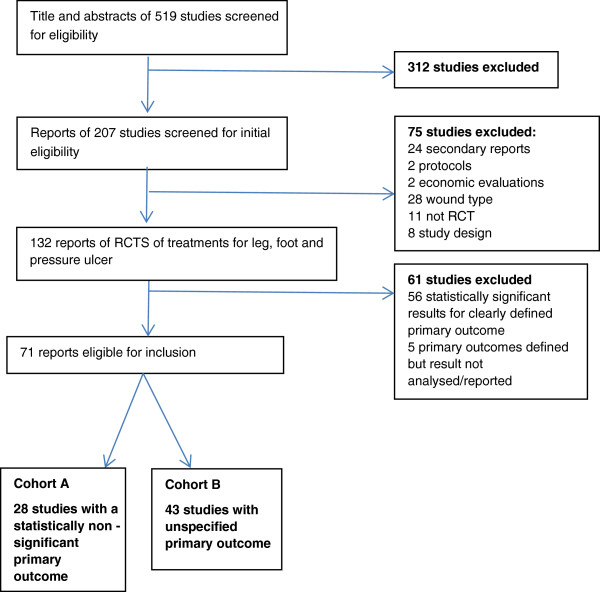
Background: Spin in the reporting of randomized controlled trials, where authors report research in a way that potentially misrepresents results and mislead readers, has been demonstrated in the broader medical literature. We investigated spin in wound care trials with (a) no statistically significant result for the primary outcome and (b) no clearly specified primary outcome. Methods: We searched the Cochrane Wounds Group Specialised Register of Trials for randomized controlled trials (RCTs). Eligible studies were: Parallel-group RCTs of interventions for foot, leg or pressure ulcers published in 2004 to 2009 (inclusive) with either a clearly identified primary outcome for which there was a statistically non-significant result (Cohort A) or studies that had no clear primary outcome (Cohort B). We extracted general study details. For both Cohorts A and B we then assessed for the presence of spin. For Cohort A we used a pre-defined process to assess reports for spin. For Cohort B we aimed to assess spin by recording the number of positive treatment effect claims made. We also compared the number of statistically significant and non-significant results reported in the main text and the abstract looking specifically for spin in the form of selective outcome reporting. Results: Of the 71 eligible studies, 28 were eligible for Cohort A; of these, 71% (20/28) contained spin. Cohort B contained 43 studies; of these, 86% (37/43) had abstracts that claimed a favorable treatment claim. Whilst 74% (32/43) of main text results in Cohort B included at least one statistically non-significant result, this was not reflected in the abstract where only 28% contained (12/43) at least one statistically non-significant result. Conclusions: Spin is a frequent phenomenon in reports of RCTs of wound treatments. Studies without statistically significant results for the primary outcome used spin in 71% of cases. Furthermore, 33% (43/132) of reports of wound RCTs did not specify a primary outcome and there was evidence of spin and selective outcome reporting in the abstracts of these. Readers should be wary of only reading the abstracts of reports of RCTs of wound treatments since they are frequently misleading regarding treatment effects.
Overview
The claims and statistics of this paper haven’t been checked yet.
Free: it reads the open-access text and checks the first 5 claims that cite a source we can check. Create a free account to check every claim.
Integrity signals
Registry
Cites
Statistics
Figures
Verification
Claims the paper makes
The claims and statistics of this paper haven’t been checked yet.
Free: it reads the open-access text and checks the first 5 claims that cite a source we can check. Create a free account to check every claim.
Claims other papers make about this one
Each is checked against this paper’s own text: does it say what the citing paper says it does?
The source backs part of the claim, not all of it — or backs it for a different population, condition or comparison.
In the citing paper
“Media outlets may spin [26–28] and encourage dissemination of eye-catching, potentially overstated, inaccurate [29], and/or misleading headlines in order to gain larger audience size [28, 30, 31].”
From Causal language and strength of inference in academic and media articles shared in social media (CLAIMS): A systematic review (2018) · cites this paper as [27]
Experimental — accuracy not yet measuredThe cited source says what the claim attributes to it.
In the citing paper
“Other methodological systematic reviews focusing on two-arm parallel-group RCTs with nonstatistically significant primary outcomes in specific medical fields found consistent results (48–54).”
From Misrepresentation and distortion of research in biomedical literature (2018) · cites this paper as [53]
The cited source says what the claim attributes to it.
In the citing paper
“Second, each of previous studies was limited to specific subspecialties such as rheumatology [7], wound research [16], surgery [8] or to limited topics such as early psychosis trials [6].”
From Overstatements in abstract conclusions claiming effectiveness of interventions in psychiatry: A meta-epidemiological investigation (2017) · cites this paper as [16]
Self-check
Percentages, sums and reported differences re-computed from the paper’s own numbers.
The self-check needs the paper’s full text.
Citations
Cites
Chan, A.-W., Hróbjartsson, A., Haahr, M. T., Gøtzsche, P. C., & Altman, D. G. (2004) · JAMA · doi:10.1001/jama.291.20.2457 · Cited by 1,845 · cited 2×
“Importance of findings Recent work on outcome reporting bias has largely focused on the selective reporting of a subset of outcomes from the full set measured; in other words, a discrepancy between study protocols and reports [3,4].”
Systematic Review of the Empirical Evidence of Study Publication Bias and Outcome Reporting Bias
Dwan, K., Altman, D. G., Arnaiz, J. A., Bloom, J., Chan, A.-W., Cronin, E., Decullier, E., Easterbrook, P. J., Von Elm, E., Gamble, C., et al. (2008) · PLoS ONE · doi:10.1371/journal.pone.0003081 · Cited by 1,546 · cited 2×
“Importance of findings Recent work on outcome reporting bias has largely focused on the selective reporting of a subset of outcomes from the full set measured; in other words, a discrepancy between study protocols and reports [3,4].”
Moher, D., Jones, A., Lepage, L., & for the CONSORT Group (2001) · JAMA · doi:10.1001/jama.285.15.1992 · Cited by 1,027
Boutron, I. (2010) · JAMA · doi:10.1001/jama.2010.651 · Cited by 842 · cited 9×
“As an extension of Boutron and colleagues [5] previous work, we also assessed the prevalence of wound RCTs that did not clearly specify the primary outcome in the trial report (to which the full application of the methodology described by Boutron and colleagues [5] is not possible).”
InfluentialHopewell, S., Clarke, M., Moher, D., Wager, E., Middleton, P., Altman, D. G., Schulz, K. F., & and the CONSORT Group (2008) · PLoS Medicine · doi:10.1371/journal.pmed.0050020 · Cited by 674
Hopewell, S., Dutton, S., Yu, L.-M., Chan, A.-W., & Altman, D. G. (2010) · BMJ · doi:10.1136/bmj.c723 · Cited by 504 · cited 2×
“This phenomenon has not been previously assessed in wounds research though it is not uncommon in other areas [2].”
A Proposal for Structured Reporting of Randomized Controlled Trials
Andrew, E. (1994) · JAMA: The Journal of the American Medical Association · doi:10.1001/jama.1994.03520240054041 · Cited by 309
(2010) · Journal of Wound Care · doi:10.12968/jowc.2010.19.6.48471 · Cited by 292 · cited 2×
“We anticipated non-specification of a primary outcome may be common in wounds research since there is a range of different outcome measures used including different measures of wound healing (for example, reduction in size versus complete healing) and no agreed core outcomes [18,19].”
Bradley, Cullum, N. A., Nelson, Petticrew, M. P., Sheldon, & Torgerson (1999) · DOAJ (DOAJ: Directory of Open Access Journals) · doi:10.3310/hta3170 · Cited by 277
Self-citationYank, V., Rennie, D., & Bero, L. A. (2007) · BMJ · doi:10.1136/bmj.39376.447211.be · Cited by 235 · cited 2×
“Whilst the concept of spin has been discussed in the British Medical Journal as far back as 1995 [8-11], and there have been a number of methodological reviews evaluating misleading claims in published reports of either RCTs [12-14] or systematic reviews [15], there has been little research into spin per se.”
Cited by
‘Spin’ in published biomedical literature: A methodological systematic review
Chiu, K., Grundy, Q., & Bero, L. (2017) · PLOS Biology · doi:10.1371/journal.pbio.2002173 · Cited by 317
Misrepresentation and distortion of research in biomedical literature
Boutron, I., & Ravaud, P. (2018) · Proceedings of the National Academy of Sciences · doi:10.1073/pnas.1710755115 · Cited by 273
Vinkers, C. H., Tijdink, J. K., & Otte, W. M. (2015) · BMJ · doi:10.1136/bmj.h6467 · Cited by 237
Yavchitz, A., Ravaud, P., Altman, D. G., Moher, D., Hrobjartsson, A., Lasserson, T., & Boutron, I. (2016) · Journal of Clinical Epidemiology · doi:10.1016/j.jclinepi.2016.01.020 · Cited by 224
“The presence of spin in scientific reports was syst ematically studied initially in reports of randomized controlled trials (RCTs)[4,6,7].”
BackgroundHaber, N., Smith, E. R., Moscoe, E., Andrews, K., Audy, R., Bell, W., Brennan, A. T., Breskin, A., Kane, J. C., Karra, M., et al. (2018) · PLoS ONE · doi:10.1371/journal.pone.0196346 · Cited by 97
Khan, M. S., Lateef, N., Siddiqi, T. J., Rehman, K. A., Alnaimat, S., Khan, S. U., Riaz, H., Murad, M. H., Mandrola, J., Doukky, R., et al. (2019) · JAMA Network Open · doi:10.1001/jamanetworkopen.2019.2622 · Cited by 93
“of citations up to May 2018, median (IQR) [range] 7 (4-17) [0-86]”
BackgroundWounds research for patient benefit: a 5-year programme of research
Cullum, N. A., Buckley, H., Dumville, J. C., Hall, J., Lamb, K. V., Madden, M., Morley, R., O’Meara, S., Saramago, P., Soares, M. O., et al. (2016) · Programme Grants for Applied Research · doi:10.3310/pgfar04130 · Cited by 108
“In a related study, Lockyer et al.(164) found that 86% of wound trials that did not define a primary outcome claimed a significant treatment effect.”
BackgroundSelf-citationMcGrath, T. A., McInnes, M. D. F., van Es, N., Leeflang, M. M. G., Korevaar, D. A., & Bossuyt, P. M. M. (2017) · Clinical Chemistry · doi:10.1373/clinchem.2017.271544 · Cited by 72
The efficacy of negative pressure wound therapy for diabetic foot ulcers: A systematised review
Wynn, M. O., & Freeman, S. (2019) · Journal of Tissue Viability · doi:10.1016/j.jtv.2019.04.001 · Cited by 75
Arunachalam, L., Hunter, I. A., & Killeen, S. (2017) · Annals of Surgery · doi:10.1097/sla.0000000000001795 · Cited by 56
Evaluation of Spin in the Abstracts of Emergency Medicine Randomized Controlled Trials
Vaughn, V., Riddle, J., Brown, J., Schiesel, M., Wayant, C., & Vassar, M. B. (2019) · Annals of Emergency Medicine · doi:10.1016/j.annemergmed.2019.03.011 · Cited by 49
An Evaluation of Spin in Lower Extremity Joint Trials
Checketts, J. X., Riddle, J., Zaaza, Z., Boose, M. A., Whitener, J. H., & Vassar, M. B. (2019) · The Journal of Arthroplasty · doi:10.1016/j.arth.2019.01.016 · Cited by 39
Arthur, W., Zaaza, Z., Checketts, J. X., Johnson, A., Middlemist, K., Basener, C., Jellison, S., Wayant, C., & Vassar, M. B. (2020) · Arthroscopy The Journal of Arthroscopic and Related Surgery · doi:10.1016/j.arthro.2019.12.025 · Cited by 41
Overinterpretation and misreporting of prognostic factor studies in oncology: a systematic review
Kempf, E., de Beyer, J. A., Cook, J. A., Holmes, J., Mohammed, S. B., Nguyen, T., Simera, I., Trivella, M., Altman, D. G., Hopewell, S., et al. (2018) · British Journal of Cancer · doi:10.1038/s41416-018-0305-5 · Cited by 41
Ghannad, M., Olsen, M., Boutron, I., & Bossuyt, P. M. (2019) · Journal of Clinical Epidemiology · doi:10.1016/j.jclinepi.2019.07.011 · Cited by 42
dos Santos, M. B. F., Agostini, B. A., de Moraes, R. R., Schwendicke, F., & Sarkis‐Onofre, R. (2019) · Journal of Clinical Periodontology · doi:10.1111/jcpe.13100 · Cited by 29
The commercialization of the biomedical sciences: (mis)understanding bias
de Melo‐Martín, I. (2019) · History & Philosophy of the Life Sciences · doi:10.1007/s40656-019-0274-x · Cited by 30
Do not make clinical decisions based on abstracts of healthcare research: A systematic review
Nascimento, D. P., Ostelo, R., van Tulder, M. W., Gonzalez, G. Z., Araújo, A. C., Vanin, A. A., & Costa, L. O. P. (2021) · Journal of Clinical Epidemiology · doi:10.1016/j.jclinepi.2021.03.030 · Cited by 30
Koroleva, A., Kamath, S., & Paroubek, P. (2019) · Journal of Biomedical Informatics · doi:10.1016/j.yjbinx.2019.100058 · Cited by 31
Priority issues for pressure injury research: An Australian consensus study
Haesler, E., Carville, K., & Haesler, P. (2018) · Research in Nursing & Health · doi:10.1002/nur.21878 · Cited by 20
Assem, Y., Adie, S., Tang, J. C. H., & Harris, I. A. (2017) · Contemporary Clinical Trials Communications · doi:10.1016/j.conctc.2017.07.007 · Cited by 21
Steegmans, P. A. J., Girolamo, N. D., & Reynders, R. M. (2019) · Research Integrity and Peer Review · doi:10.1186/s41073-019-0084-4 · Cited by 19
“These issues are important, because (1) the assessment and reporting of adverse effects of interventions is often suboptimal [7–11], (2) titles and abstracts are the most read sections of papers in the biomedical literature [1], (3) a high prevalence of spin has been identified in abstracts of both randomized and nonr…”
BackgroundGrundy, Q. (2016) · Social Science & Medicine · doi:10.1016/j.socscimed.2016.07.042 · Cited by 22
Evaluation of spin in the abstracts of orthopedic trauma literature: A cross-sectional review
Shepard, S., Checketts, J. X., Eash, C., Austin, J., Arthur, W., Wayant, C., Johnson, M., Norris, B. L., & Vassar, M. B. (2021) · Injury · doi:10.1016/j.injury.2021.04.060 · Cited by 19
There is room for improvement in the use of scoping reviews in dentistry
Zauza, D., Dotto, L., Moher, D., Tricco, A. C., Agostini, B. A., & Sarkis-Onofre, R. (2022) · Journal of Dentistry · doi:10.1016/j.jdent.2022.104161 · Cited by 16
Abstracts for reports of randomized trials of COVID-19 interventions had low quality and high spin
Wang, D., Chen, L., Wang, L., Hua, F., Li, J., Li, Y., Zhang, Y., Fan, H. S., Li, W., & Clarke, M. J. (2021) · Journal of Clinical Epidemiology · doi:10.1016/j.jclinepi.2021.06.027 · Cited by 24
Shinohara, K., Suganuma, A. M., Imai, H., Takeshima, N., Hayasaka, Y., & Furukawa, T. A. (2017) · PLOS ONE · doi:10.1371/journal.pone.0184786 · Cited by 15
Analysis of spin in vascular surgery randomized controlled trials with nonsignificant outcomes
Nguyen, J., Li, A., Tam, D. Y., & Forbes, T. L. (2021) · Journal of Vascular Surgery · doi:10.1016/j.jvs.2021.09.051 · Cited by 15
Moore, A., Karadag, P., Fisher, E., Crombez, G., Straube, S., & Eccleston, C. (2024) · Pain · doi:10.1097/j.pain.0000000000003140 · Cited by 25
Industry sponsorship in trials on fluoride varnish or gels for caries prevention
Reda, S., Elhennawy, K., Meyer‐Lückel, H., Paris, S., & Schwendicke, F. (2017) · Community Dentistry and Oral Epidemiology · doi:10.1111/cdoe.12287 · Cited by 14
Influence of overstated abstract conclusions on clinicians: a web-based randomised controlled trial
Shinohara, K., Aoki, T., So, R., Tsujimoto, Y., Suganuma, A. M., Kise, M., & Furukawa, T. A. (2017) · BMJ Open · doi:10.1136/bmjopen-2017-018355 · Cited by 18
SPIN-PM: a consensus framework to evaluate the presence of spin in studies on prediction models
Navarro, C. L. A., Damen, J. A., Ghannad, M., Dhiman, P., van Smeden, M., Reitsma, J. B., Collins, G. S., Riley, R. D., Moons, K. G. M., & Hooft, L. (2024) · Journal of Clinical Epidemiology · doi:10.1016/j.jclinepi.2024.111364 · Cited by 16
Foster, B. K., Hayes, D. S., Constantino, J., Garsed, J., Baylor, J. L., & Grandizio, L. C. (2022) · Hand · doi:10.1177/15589447221120848 · Cited by 12
Su, N., van der Linden, M. W., Faggion, C. M., & van der Heijden, G. J. M. G. (2023) · Caries Research · doi:10.1159/000531569 · Cited by 16
“Several methodological studies have assessed spin in the titles and abstracts of RCTs in medicine, including dentistry [Boutron et al., 2010; Lockyer et al., 2013; Arunachalam et al., 2017; Khan et al., 2019; Eleftheriadi et al., 2020; Wu et al., 2020; Guo et al., 2021; Ito et al., 2021; Rassy et…”
BackgroundAllan, G. M., Finley, C. R., McCormack, J. P., Kumar, V., Kwong, S., Braschi, É., Korownyk, C. S., Kolber, M. R., Lindblad, A. J., Бабенко, О., et al. (2017) · BMC Medicine · doi:10.1186/s12916-017-0821-9 · Cited by 9
“Others have similarly reported spin in RCTs evaluating wound care [8] and surgical modalities [9, 10].”
BackgroundYuan, M., Wu, J., Li, A., Gallo, L., Chin, B. H., Murphy, J., Coroneos, C. J., Voineskos, S. H., & Thoma, A. (2022) · Plastic & Reconstructive Surgery · doi:10.1097/prs.0000000000009937 · Cited by 11
Guo, F., Zhao, T., Zhai, Q., Fang, X., Yue, H., Hua, F., & He, H. (2023) · SLEEP · doi:10.1093/sleep/zsad041 · Cited by 10
Spin in randomized controlled trials of pharmacology in COVID-19: A systematic review
Oh, Y.-K., Jung, Y.-J., Purja, S., Kim, M., Yon, D. K., Lee, S. W., Cho, K., Koyanagi, A., Dai, Z., Smith, L., et al. (2023) · Accountability in Research · doi:10.1080/08989621.2023.2269083 · Cited by 10
“In addition, discrepancies in the evaluation of the prevalence of spin between abstracts and main texts have been demonstrated previously, and it is not recommended to make a clinical decision based solely on abstracts (Lockyer et al. 2013; Nascimento et al. 2019).”
Beijers, L., Jeronimus, B. F., Turner, E. H., de Jonge, P., & Roest, A. M. (2017) · BMJ Open · doi:10.1136/bmjopen-2016-012886 · Cited by 9
McInnes, E., Harvey, G., Hiller, J. E., Phillips, R., Page, T., & Wiechula, R. (2020) · Australian Health Review · doi:10.1071/ah19250 · Cited by 7
Velde, H. M., van Heteren, J. A. A., Smit, A. L., & Stegeman, I. (2021) · Frontiers in Neurology · doi:10.3389/fneur.2021.693937 · Cited by 10
“Readers should be critical when reading articles and recognize forms of spin, especially in the abstract and conclusion of publications (10, 19, 20).”
BackgroundGrundy, Q., Millington, A., Cussen, C., Held, F. P., & Dale, C. (2020) · BMJ Open · doi:10.1136/bmjopen-2020-040541 · Cited by 5
Nithianandan, H., Kuriyan, A. E., Venincasa, M. J., & Sridhar, J. S. (2020) · Clinical ophthalmology · doi:10.2147/opth.s262085 · Cited by 4
Grundy, Q., Cussen, C., & Dale, C. (2020) · Journal of Clinical Nursing · doi:10.1111/jocn.15510 · Cited by 4
Plastic surgery spin : Suppressing clarity
Freshwater, M. F. (2015) · Journal of Plastic Reconstructive & Aesthetic Surgery · doi:10.1016/j.bjps.2014.10.029 · Cited by 3
DeSpin: a prototype system for detecting spin in biomedical publications
Koroleva, A., Kamath, S., Bossuyt, P. M., & Paroubek, P. (2020) · Workshop on Biomedical Language Processing (BioNLP) · doi:10.18653/v1/2020.bionlp-1.5 · Cited by 5
Spin in Randomised Clinical Trial Reports of Interventions for Obesity
Lee, S., Won, J., Kim, S.-Y., Park, S. J., & Lee, H. (2017) · Korean Journal of Acupuncture · doi:10.14406/acu.2017.029 · Cited by 3
Reporting Quality of Randomized Controlled Trials in Rehabilitation: A Literature Review
Fujimoto, S., Komukai, K., Sugita, S., & Kobayashi, M. (2018) · Rigakuryoho Kagaku · doi:10.1589/rika.33.669 · Cited by 3
Kumar, J., Prakash, V., Hariohm, K., & Kumar, I. N. (2023) · Physiotherapy Practice and Research · doi:10.3233/ppr-230747 · Cited by 2
“During the past decade, spin in published research reports has been extensively researched and known to be highly prevalent in many disciplines of biomedical research [3, 8–12].”
A Perspective on the Principles of Integrity in Infectious Disease Research
Kavanagh, K. T., Tower, S. S., & Saman, D. M. (2016) · Journal of Patient Safety · doi:10.1097/pts.0000000000000265 · Cited by 2
Linguistic spin in randomized controlled trials about age-related macular degeneration
Veldhuis, N., Nuijts, M. A., Isphording, L., Lee-Kong, F. V. Y. L., Imhof, S. M., & Stegeman, I. (2022) · Frontiers in Epidemiology · doi:10.3389/fepid.2022.961996 · Cited by 2
Promoting Fairness in Classification of Quality of Medical Evidence
Šuster, S., Baldwin, T., & Verspoor, K. M. (2023) · Workshop on Biomedical Language Processing (BioNLP) · doi:10.18653/v1/2023.bionlp-1.39 · Cited by 2
Wounds Research Network (WReN) - a community of practice for improving wound care-related trials
Samuriwo, R. (2019) · doi:10.35279/jewma201910.04 · Cited by 1
Plastic surgery spin : Suppressing clarity
America, L. F. (2015)
Dormire, K., Whitehead, A. J., Wayant, C., Bowers, A., & Vassar, M. B. (2021) · The Clinical Respiratory Journal · doi:10.1111/crj.13295
Infections and the diabetic foot
FRCP, D. L. M. (2017) · Wiley eBooks · doi:10.1002/9781119052210.ch3
Evidenzbasierte Wundbehandlung
Burckhardt, M., & Maier-Hasselmann, A. (2023) · Springer eBooks · doi:10.1007/978-3-662-67124-5_3
Ferreira, L. S., Prado, L. C. U., Nakamoto, F. C., dos Santos, A. C. D. J., Gomes, C. A. F. D. P., Politti, F., & Biasotto‐Gonzalez, D. A. (2024) · Journal of Advances in Medicine and Medical Research · doi:10.9734/jammr/2024/v36i55423
Fabrication, Falsification and Spin
Crombie, I. (2021) · Wiley eBooks · doi:10.1002/9781394322183.ch6
Hamdan, D., Niewchas, A., Ngo, A. L. T., & Weaver, M. (2025) · Cureus · doi:10.7759/cureus.84840 · Cited by 2
“While this contradicts previous reports that found the industry-sponsored RCTs to contain more spin [19, 27, 28], it supports others that found no significant association [18, 29, 30].”
Misleading readers without lies: understanding spin and its relevance to acupuncture research
Bae, I., Ji, Y.-J., & Lee, H. (2025) · Integrative Medicine Research · doi:10.1016/j.imr.2025.101288
Assisted authoring for avoiding inadequate claims in scientific reporting
Koroleva, A. (2020) · theses.fr (ABES) · doi:10.70675/f035bb8azddf1z4a7dzbf39zdf86c6947bb9 · Cited by 2
“…et al., 2016; Altman et al., 2017), and spin, i.e. reporting only favourable outcomes and thus making research results seem more positive than the evidence justifies (Boutron et al., 2010; Lockyer et al., 2013; Lazarus et al., 2015; Chiu et al., 2017; Diong et al., 2018; Boutron and Ravaud, 2018).”
BackgroundResultInfluentialShortcomings in and preferred strategies for evaluating biomarkers as medical tests
Olsen, M. (2021) · theses.fr (ABES) · doi:10.70675/535e1627z1a35z437cz8c94z8701a5d0d2b7
Zuo, J.-L., Yuan, Y., Yin, H., Liu, X.-Z., Wu, X., Su, Y., Zhang, C., Cao, F., Huang, H.-W., Han, M., et al. (2026) · Integrative Medicine Research · doi:10.1016/j.imr.2026.101348
Chung, Z., Grant, L.-A., Chen, J., Mbuagbaw, L., Mokete, L., & Thabane, L. (2026) · Pilot and Feasibility Studies · doi:10.1186/s40814-026-01846-2
“Likewise, in wound care, 89% of industry-funded RCTs abstracts demonstrated spin compared to 60% of those with non-profit support [23].”
Kayyal, M., Sadeghi, M., Rafi, A., Mahkooyeh, S. A., Gholami, M. H., Roknabadi, A. R., Ghelichi, Z., Soheyli, A., & Khanchemehr, Y. (2026) · Jundishapur Journal of Natural Pharmaceutical Products · doi:10.5812/jjnpp-174363
Metadata
- Authors
- Lockyer, S., Hodgson, R., Dumville, J. C., & Cullum, N.
- Affiliations
- University of York (GB)
- University of Manchester (GB)
- Corresponding author
- Dumville, Jo C
- Venue
- Trials
- Published
- 2013-11-06
- Volume
- 14
- Issue
- 1
- Pages
- 371-371
- ISSN
- 1745-6215 (ISSN-L)
- PMC
- PMC3832286
- OpenAlex
- W1973932755
- Semantic Scholar
- f9eac19afb97e525226ce90f3a8b05d726406b03
- Cited by
- 66
- References
- 27
- Citations by year
- 2026: 3 · 2025: 2 · 2024: 3 · 2023: 6 · 2022: 4 · 2021: 7 · 2020: 8 · 2019: 10 · 2018: 5 · 2017: 10 · 2016: 5 · 2015: 3
- FWCI
- 2.94
- Type
- journal article
- Language
- en
- Open access
- gold
- doi.org
- Licence
- cc-by
- Locations
- Trials (publishedVersion, cc-by)
- Europe PMC (PubMed Central) (publishedVersion, cc-by)
- PubMed Central (publishedVersion, cc-by)
- PubMed (publishedVersion)
- White Rose Research Online (University of Leeds, The University of Sheffield, University of York) (acceptedVersion)
- Research Explorer (The University of Manchester) (submittedVersion, cc-by)
- Funders
- National Institute for Health and Care Research (RP-PG-0407-10428, NF-SI-0512-10028, MET-11-09-101)
- Programme Grants for Applied Research
- Topics
- Social Sciences › Decision Sciences › Statistics, Probability and Uncertainty › Meta-analysis and systematic reviews
- Health Sciences › Nursing › Issues, ethics and legal aspects › Pharmaceutical industry and healthcare
- Social Sciences › Library and Information Sciences › Academic Publishing and Open Access
- Keywords
- spin, selective outcome reporting, wound care, randomized controlled trials, pressure ulcers, leg ulcers, foot ulcer, non-significant results, abstracts, reporting quality
- MeSH terms
- Data Interpretation, Statistical, Pressure Ulcer, Humans, Leg Ulcer, Research Design, Research Support as Topic, Time Factors, Wound Healing, Reproducibility of Results, Bias, Randomized Controlled Trials as Topic, Conflict of Interest, Treatment Outcome, Health Care Sector, Endpoint Determination
About these checks
Registry, retraction, Cites and statistics results are computed, not judged, with one exception: a printed reference that no index lists is read once by a model before it counts as a citation error. Claims are extracted by a model and kept only when their quote appears verbatim in the text; each cited source is then checked, with a model’s help, for whether it says what the claim relies on. Those verdicts can be wrong — read the claim’s quote and the cited source before relying on one.
Statistics and arithmetic are recomputed, not judged.
Confidence bands are shown only for fields calibrated on our annotated test set. None is calibrated yet, so no band is shown.
What counts as a claim ›How we measure confidence ›How we check this ›
Are you an author, or do you see a problem with this page? Request a review
Data sources
Bibliographic data: Semantic Scholar, OpenAlex, Crossref.
Contains information from the Semantic Scholar Academic Graph Datasets, made available under the ODC Attribution License (ODC-BY 1.0).
Semantic Scholar’s data is described in: Kinney, R., et al. (2023). The Semantic Scholar Open Data Platform. arXiv:2301.10140.
