

The DOI matches its Crossref record; 51 of the 52 references it cites were found in a registry or an index.
The risks and rewards of covariate adjustment in randomized trials: an assessment of 12 outcomes from 8 studies
Open accessAbstract
BACKGROUND: Adjustment for prognostic covariates can lead to increased power in the analysis of randomized trials. However, adjusted analyses are not often performed in practice. METHODS: We used simulation to examine the impact of covariate adjustment on 12 outcomes from 8 studies across a range of therapeutic areas. We assessed (1) how large an increase in power can be expected in practice; and (2) the impact of adjustment for covariates that are not prognostic. RESULTS: Adjustment for known prognostic covariates led to large increases in power for most outcomes. When power was set to 80% based on an unadjusted analysis, covariate adjustment led to a median increase in power to 92.6% across the 12 outcomes (range 80.6 to 99.4%). Power was increased to over 85% for 8 of 12 outcomes, and to over 95% for 5 of 12 outcomes. Conversely, the largest decrease in power from adjustment for covariates that were not prognostic was from 80% to 78.5%. CONCLUSIONS: Adjustment for known prognostic covariates can lead to substantial increases in power, and should be routinely incorporated into the analysis of randomized trials. The potential benefits of adjusting for a small number of possibly prognostic covariates in trials with moderate or large sample sizes far outweigh the risks of doing so, and so should also be considered.
Overview
The claims and statistics of this paper haven’t been checked yet.
Run the check — free, no account needed. It reads the open-access text and checks the sources it cites.
Integrity signals
Registry
Cites
Statistics
Figures
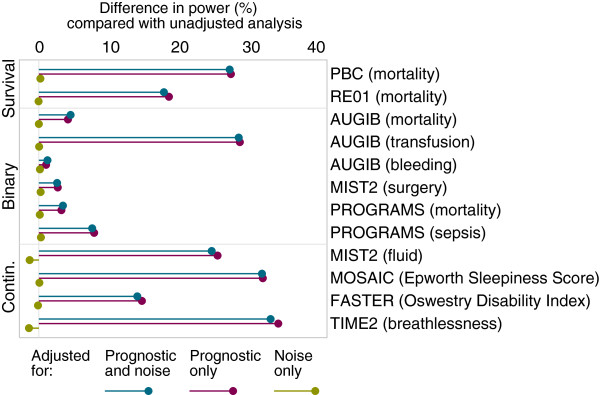
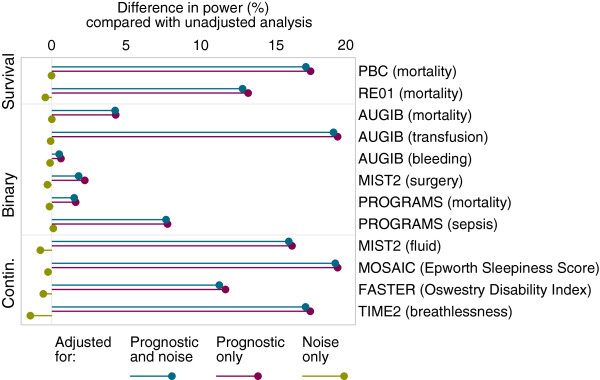
Verification
Claims the paper makes
The claims and statistics of this paper haven’t been checked yet.
Run the check — free, no account needed. It reads the open-access text and checks the sources it cites.
Claims other papers make about this one
Each is checked against this paper’s own text: does it say what the citing paper says it does?
The cited source says what the claim attributes to it.
In the citing paper
“In addition to adjusting for baseline to end-of-treatment (EOT) by group interactions, we adjusted for baseline depression, a well-established prognostic covariate of chronic pain [28], to reduce baseline differences in the outcome variables [29].”
From Yoga is effective for treating chronic pain in veterans with Gulf War Illness at long-term follow-up (2023) · cites this paper as [29]
In the citing paper
“Adjusting for baseline covariates, including those used in any stratified randomisation, is often advised in the analysis, particularly when a baseline covariate is prognostic of the outcome, as it can lead to improved power to detect an intervention effect.408 409 410”
From SPIRIT 2025 explanation and elaboration: updated guideline for protocols of randomised trials (2025) · cites this paper as [408]
In the citing paper
“However, under the assumptions of an unconfounded experimental design with batches containing both controls and cases, batch effects can be removed by adding a batch covariate to the regression model71. This increases the power compared to non-batch corrected analyses72–74.”
From scPower accelerates and optimizes the design of multi-sample single cell transcriptomic studies (2021) · cites this paper as [74]
Self-check
Percentages, sums and reported differences re-computed from the paper’s own numbers.
The self-check needs the paper’s full text.
Citations
Cites
SPIRIT 2013 explanation and elaboration: guidance for protocols of clinical trials
Chan, A.-W., Tetzlaff, J. M., Gotzsche, P. C., Altman, D. G., Mann, H., Berlin, J. A., Dickersin, K., Hrobjartsson, A., Schulz, K. F., Parulekar, W. R., et al. (2013) · BMJ · doi:10.1136/bmj.e7586 · Cited by 6,251
Pocock, S. J., & Simon, R. (1975) · Biometrics · doi:10.2307/2529712 · Cited by 2,350
Subgroup analysis and other (mis)uses of baseline data in clinical trials
Assmann, S. F., Pocock, S. J., Enos, L. E., & Kasten, L. E. (2000) · The Lancet · doi:10.1016/s0140-6736(00)02039-0 · Cited by 1,167
Pocock, S. J., Assmann, S. E., Enos, L. E., & Kasten, L. E. (2002) · Statistics in Medicine · doi:10.1002/sim.1296 · Cited by 1,077
Minimization: A new method of assigning patients to treatment and control groups
Taves, D. R. (1974) · Clinical Pharmacology & Therapeutics · doi:10.1002/cpt1974155443 · Cited by 891
Intrapleural Use of Tissue Plasminogen Activator and DNase in Pleural Infection
Rahman, N. M., Maskell, N. A., West, A., Teoh, R., Arnold, A., Mackinlay, C., Peckham, D. G., Davies, C., Ali, N. J., Kinnear, W. J. M., et al. (2011) · New England Journal of Medicine · doi:10.1056/nejmoa1012740 · Cited by 860
Self-citationSteyerberg, E. W., Eijkemans, M. J. C., Harrell, F. E., & Habbema, J. D. F. (2000) · Statistics in Medicine · doi:10.1002/(sici)1097-0258(20000430)19:8 · Cited by 789
Van Breukelen, G. J. P. (2006) · Journal of Clinical Epidemiology · doi:10.1016/j.jclinepi.2006.02.007 · Cited by 765
Davies, H. E., Mishra, E. K., Kahan, B. C., Wrightson, J., Stanton, A. E., Guhan, A., Davies, C. W. H., Grayez, J., Harrison, R. N., Prasad, A., et al. (2012) · JAMA · doi:10.1001/jama.2012.5535 · Cited by 654
Self-citationThe method of minimization for allocation to clinical trials
Scott, N. W., McPherson, G. C., Ramsay, C. R., & Campbell, M. K. (2002) · Controlled Clinical Trials · doi:10.1016/s0197-2456(02)00242-8 · Cited by 651 · cited 1×
“Patients were randomized using minimization [22-25]; stratification factors were: the size of the pleural effusion at baseline; whether the infection was hospital-acquired, and the presence of purulent pleural fluid.”
Method
Cited by
Sorted by citations
Pang, Z., Zhou, G., Ewald, J., Chang, L., Haçarız, O., Basu, N., & Xia, J. (2022) · Nature Protocols · doi:10.1038/s41596-022-00710-w · Cited by 1,449
Belsky, D. W., Caspi, A., Arseneault, L., Baccarelli, A., Corcoran, D. L., Gao, X., Hannon, E., Harrington, H. L., Rasmussen, L. J., Houts, R., et al. (2020) · eLife · doi:10.7554/elife.54870 · Cited by 652
Different ways to estimate treatment effects in randomised controlled trials
J, T., L, B., T, H., J, R., M, W., & M, H. (2018) · Contemporary Clinical Trials Communications · doi:10.1016/j.conctc.2018.03.008 · Cited by 532
Systematic Review of Multivariable Prognostic Models for Mild Traumatic Brain Injury
Silverberg, N. D., Gardner, A. J., Brubacher, J. R., Panenka, W. J., Li, J. J., & Iverson, G. L. (2015) · Journal of Neurotrauma · doi:10.1089/neu.2014.3600 · Cited by 393
Should multiple imputation be the method of choice for handling missing data in randomized trials?
Sullivan, T., White, I. R., Salter, A. B., Ryan, P., & Lee, K. J. (2016) · Statistical Methods in Medical Research · doi:10.1177/0962280216683570 · Cited by 323
Metadata
- Authors
- Kahan, B. C., Jairath, V., Doré, C. J., & Morris, T. P.
- Affiliations
- Queen Mary University of London (GB)
- University of Oxford (GB)
- University College London (GB)
- MRC Clinical Trials Unit at UCL (GB)
- Corresponding author
- Kahan, Brennan C
- Venue
- Trials
- Published
- 2014-04-23
- Volume
- 15
- Issue
- 1
- Pages
- 139-139
- ISSN
- 1745-6215 (ISSN-L)
- PMC
- PMC4022337
- OpenAlex
- W2166091513
- Cited by
- 497
- References
- 52
- Citations by year
- 2026: 31 · 2025: 69 · 2024: 61 · 2023: 67 · 2022: 73 · 2021: 57 · 2020: 37 · 2019: 22 · 2018: 26 · 2017: 16 · 2016: 20 · 2015: 11 · 2014: 6
- FWCI
- 18.68
- Type
- journal article
- Language
- en
- Open access
- gold
- doi.org
- Licence
- cc-by
- Locations
- Trials (publishedVersion, cc-by)
- Europe PMC (PubMed Central) (publishedVersion, cc-by)
- PubMed Central (publishedVersion, cc-by)
- PubMed (publishedVersion)
- UCL Discovery (University College London) (submittedVersion)
- Queen Mary Research Online (Queen Mary University of London) (submittedVersion, cc-by)
- Funders
- National Institute for Health and Care Research (CL-2013-13-008)
- Medical Research Council (MC_EX_G0800814)
- Topics
- Physical Sciences › Mathematics › Statistics and Probability › Statistical Methods in Clinical Trials
- Physical Sciences › Mathematics › Statistics and Probability › Advanced Causal Inference Techniques
- Social Sciences › Decision Sciences › Statistics, Probability and Uncertainty › Meta-analysis and systematic reviews
- Keywords
- covariate adjustment, prognostic factors, statistical power, simulation study, trial analysis
- MeSH terms
- Analysis of Variance, Computer Simulation, Data Interpretation, Statistical, Humans, Research Design, Reproducibility of Results, Models, Statistical, Linear Models, Logistic Models, Proportional Hazards Models, Randomized Controlled Trials as Topic
About these checks
Registry, retraction, Cites and statistics results are computed, not judged, with one exception: a printed reference that no index lists is read once by a model before it counts as a citation error. Claims are extracted by a model and kept only when their quote appears verbatim in the text; each cited source is then checked, with a model’s help, for whether it says what the claim relies on. Those verdicts can be wrong — read the claim’s quote and the cited source before relying on one.
Statistics and arithmetic are recomputed, not judged.
Confidence bands are shown only for fields calibrated on our annotated test set. None is calibrated yet, so no band is shown.
What counts as a claim ›How we measure confidence ›How we check this ›
Are you an author, or do you see a problem with this page? Request a review
