

Sweat rate and sodium loss during work in the heat
Open accessThe DOI matches its Crossref record; 10 of the 10 references it cites were found in a registry or an index.
Abstract
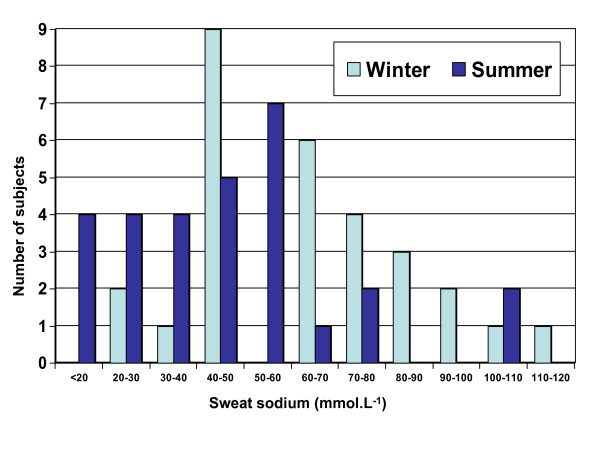
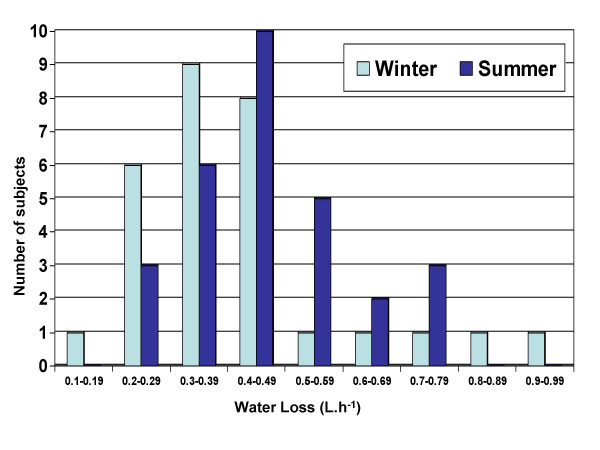
OBJECTIVE: Significant and poorly documented electrolyte losses result from prolonged sweating. This study aimed to quantify likely sodium losses during work in heat. METHODS: Male subjects exercised in an environmental chamber on two consecutive days in both winter and summer. Sweat collecting devices were attached to the upper arms and legs. RESULTS: Sweat rates were higher and sodium concentrations were lower in the summer (acclimatised) than the winter (unacclimatised) trials. Sweat sodium concentration was reduced on the second day in summer but not winter. Regional differences were found in both seasons. CONCLUSION: The difference between days in summer probably reflects short-term acclimation. The difference between seasons reflects acclimatisation. The data predict average sodium (Na) losses over a work shift of 4.8-6 g, equivalent to 10-15 g salt (NaCl). Losses are potentially greater in unacclimatised individuals.Fluid and electrolyte losses resulting from prolonged sweating must be replaced to prevent imbalance in body fluids, however guidelines for this replacement are often conflicting.This study provides important information for occupational health practitioners by quantifying the likely sodium losses over a work shift and providing recommendations for replacement.
Overview
The claims and statistics of this paper haven’t been checked yet.
Free: it reads the open-access text and checks the first 5 claims that cite a source we can check. Create a free account to check every claim.
Integrity signals
Registry
Cites
Statistics
Figures
Verification
Claims the paper makes
The claims and statistics of this paper haven’t been checked yet.
Free: it reads the open-access text and checks the first 5 claims that cite a source we can check. Create a free account to check every claim.
Claims other papers make about this one
Each is checked against this paper’s own text: does it say what the citing paper says it does?
The source backs part of the claim, not all of it — or backs it for a different population, condition or comparison.
In the citing paper
“Seasonal variation in sweat [Na+] has also been reported to be ~ 30 to 60% decrease from winter to summer (Bates and Miller 2008; Inoue et al. 1995).”
From Physiological mechanisms determining eccrine sweat composition (2020) · cites this paper as Bates and Miller 2008
Experimental — accuracy not yet measured
Self-check
Percentages, sums and reported differences re-computed from the paper’s own numbers.
The self-check needs the paper’s full text.
Citations
Cites
Effects of heat stress on cognitive performance: the current state of knowledge
Hancock, P. A., & Vasmatzidis, I. (2003) · International Journal of Hyperthermia · doi:10.1080/0265673021000054630 · Cited by 512
Effects of hot and cold temperature exposure on performance: a meta-analytic review
Pilcher, J. J., Nadler, E., & Busch, C. (2002) · Ergonomics · doi:10.1080/00140130210158419 · Cited by 500
Shirreffs, S. M., & Maughan, R. J. (1997) · Journal of Applied Physiology · doi:10.1152/jappl.1997.82.1.336 · Cited by 251
Heat exhaustion in a deep underground metalliferous mine
Donoghue, A. M., Sinclair, M. J., & Bates, G. P. (2000) · Occupational and Environmental Medicine · doi:10.1136/oem.57.3.165 · Cited by 173
Self-citationPlasma aldosterone and sweat sodium concentrations after exercise and heat acclimation
Kirby, C. R., & Convertino, V. A. (1986) · Journal of Applied Physiology · doi:10.1152/jappl.1986.61.3.967 · Cited by 163
Acclimatization to heat in man by controlled elevation of body temperature
Fox, R. H., Goldsmith, R. S., Kidd, D. J., & Lewis, H. E. (1963) · The Journal of Physiology · doi:10.1113/jphysiol.1963.sp007121 · Cited by 152
Fluid losses and hydration status of industrial workers under thermal stress working extended shifts
Brake, D. J., & Bates, G. P. (2003) · Occupational and Environmental Medicine · doi:10.1136/oem.60.2.90 · Cited by 138
Self-citationHypohydration impairs endurance exercise performance in temperate but not cold air
Cheuvront, S. N., Carter, R., Castellani, J. W., & Sawka, M. N. (2005) · Journal of Applied Physiology · doi:10.1152/japplphysiol.00329.2005 · Cited by 125
Changes in regional distribution of sweating during acclimatization to heat.
Höfler, W. (1968) · Journal of Applied Physiology · doi:10.1152/jappl.1968.25.5.503 · Cited by 93
Exercise time to fatigue and the critical limiting temperature: effect of hydration
Marino, F. E., Kay, D., & Serwach, N. (2003) · Journal of Thermal Biology · doi:10.1016/j.jtherbio.2003.08.008 · Cited by 51
Research works printed but not linked: 3
- [7]Miller VS Bates G Hydration of outdoor workers in northwest Australia The Journal of Occupational Health and Safety - Australia and New Zealand 2007 23 79 87
- [8]Barlow WK Webster HL Lawson D A simplified method of sweat collection for the diagnosis of cystic fibrosis:; Brighton, England. 1984 John Wiley & Sons 204 205
- [14]Gazey C Bates G Matthew B Fluid loss and replacement in petroleum workers from the north west of Western Australia The Journal of Occupational Health and Safety -Australia and New Zealand 1996 12 457 461
Cited by
Items 101–126 of 126
La sueur comme indicateur de la santé
Saubade, M., Norrenberg, S., Besson, C., Demuru, S., Briand, D., Paul, B., Grémeaux, V., & Lafaye, C. (2021) · JMIG · doi:10.53738/revmed.2021.17.745.1289 · Cited by 4
Hurley, S. W., Freeman, J. H., BLUMBERG, M. S., Johnson, A. K., Radley, J. J., & LaLumiere, R. T. (2015) · doi:10.17077/etd.10le4fwk
Balloni, S., Caruso, L., Schillaci, G., Valentino, M. L., Loreto, C., & Fenga, C. (2008)
Assessment for the Physiological Workload of Warterproof Workers
Lim, T., Park, S.-M., & Lee, D. (2015) · 대한건축학회 논문집 - 구조계 · doi:10.5659/jaik_sc.2015.31.6.33
Heat Stress Vulnerability among Indian Workmen
Majumder, J., Shah, P., & Kumar, S. (2015) · Advances in environmental engineering and green technologies book series · doi:10.4018/978-1-4666-8814-8.ch004
CARDIO-PROTECTIVE ROLE OF HEAT SHOCK PROTEIN 70 (HSP 70) AMONG HEAT-EXPOSED WORKERS
Farahat, S. A., Samir, A. M., Shaker, D. A.-H., & Rashed, L. A. (2010) · Egyptian Journal of Occupational Medicine · doi:10.21608/ejom.2010.685 · Cited by 1
Heidari, H., Golbabaei, F., Shamsipour, A., Forushani, A. R., & Gaeini, A. A. (2018) · Health Scope · doi:10.5812/jhealthscope.12910
Marino, P. L. (2017) · Elsevier eBooks · doi:10.1016/b978-3-437-23162-9.00035-4
Angewandte Biochemie VII: Genetisches Maximum
Michalk, C. (2019) · Springer eBooks · doi:10.1007/978-3-662-58231-2_10
Hydration, thirst and fluid balance in resting and exercising individuals
Jusoh, N. B. (2010) · OpenGrey (Institut de l'Information Scientifique et Technique)
The Effects of Dehydration and Moderate Alcohol Consumption on Human Behaviour and Performance
Irwin, C. G. (2014) · Griffith Research Online · doi:10.25904/1912/1471
Asthma treatment with its relation to changes in seasonal metabolism
Saxena, T. K., Ali, A. O., & Saxena, M. (2019) · Medical Research and Innovations · doi:10.15761/mri.1000159
محمد, د. ا. ن. ا. (2018) · المجلة العلمية لعلوم وفنون الرياضة · doi:10.21608/ijssaa.2018.64867
Nutrient Timing Programs in Sport: A Case Study Approach
Kerksick, C. M. (2011) · CRC Press eBooks · doi:10.1201/b11210-18
Chatterjee, A., & Sahu, S. (2021) · Design science and innovation · doi:10.1007/978-981-15-9054-2_39 · Cited by 1
Speed, J. S., Pollock, D. M., & Clemmer, J. S. (2023) · Clinical Science · doi:10.1042/cs20230163
Anusha, M., Lokesh, M., Aditya, G., & Mehta, A. K. (2023) · International Journal of Environment and Climate Change · doi:10.9734/ijecc/2023/v13i113652 · Cited by 1
Buhlan, R., & Nayak, B. P. (2024) · Current Psychology · doi:10.1007/s12144-024-06873-x · Cited by 1
The Effect of Coconut Water in Reducing Fatigue among Workers in North Sumatera
Rajagukguk, B. R. R., Nurmaini, N., & Sudaryati, E. (2018) · Indonesian Journal of Medicine · doi:10.26911/theijmed.2018.3.3.145
High Energy Foods: Review with Food Technological Perspective
Chikkam, S. K., Wadikar, D. D., Srihari Pandit, S., Kumar, A., Padmashree, A., & Semwal, A. D. (2025) · Defence Life Science Journal · doi:10.14429/dlsj.20043
High-performance PEDOT-thermoplastic elastomer films for stretchable electronics applications
Fiket, L., Uda, Y., Xin, S., Zhu, B., Zujovic, Z. D., Jadranka, T.-S., & Katančić, Z. (2025) · Synthetic Metals · doi:10.1016/j.synthmet.2025.118064
Can We Protect Our Hearts by Sweating Out Excess Sodium?
Hoch, J. W., & Watso, J. C. (2026) · Exercise and Sport Sciences Reviews · doi:10.1249/jes.0000000000000383
Aerosol jet and 3D printed impedance-based wearable sensors for local sweating rate monitoring
Dong, K., Wen, H., Huang, F., Gao, Z., Cao, Y., Xu, X., Ye, Q., & Liu, Q. (2026) · Microchemical Journal · doi:10.1016/j.microc.2026.118496
Agostinelli, P. J., Ozga, M., Murphy, C., Isaacs, Z., Chavez, P. J. D. D., Brown, L. R., Annarelli, A., & Davis, J.-K. (2026) · Frontiers in Public Health · doi:10.3389/fpubh.2026.1903472
Ronanki, S., Darivemula, S. B., & Bala, S. (2026) · Journal of Public Health and Primary Care · doi:10.4103/jphpc.jphpc_25_25
Ye, X.-F., Huang, Q., Wang, X., Zhu, J.-B., Zhou, Y., Wang, W., Sheng, C., Li, Y., Wang, J.-G., on behalf of the ACEI/CCB Versus ACEI/DIU Combination Antihypertensive Therapy in Chinese Hypertensive Patients (ACvAD) investigators, et al. (2026) · Hypertension Research · doi:10.1038/s41440-026-02791-6
Metadata
- Authors
- Bates, G. P., & Miller, V. S.
- Affiliations
- Curtin University (AU)
- Corresponding author
- Miller, Veronica S
- Venue
- Journal of Occupational Medicine and Toxicology
- Published
- 2008
- Volume
- 3
- Issue
- 1
- Pages
- 4
- ISSN
- 1745-6673 (ISSN-L)
- PMC
- PMC2267797
- OpenAlex
- W2009553628
- Cited by
- 126
- References
- 10
- Citations by year
- 2026: 8 · 2025: 10 · 2024: 13 · 2023: 9 · 2022: 7 · 2021: 11 · 2020: 8 · 2019: 6 · 2018: 11 · 2017: 9 · 2016: 5 · 2015: 7 · 2014: 4 · 2013: 7 · 2012: 1
- FWCI
- 2.26
- Type
- journal article
- Language
- en
- Open access
- gold
- doi.org
- Licence
- cc-by
- Locations
- Journal of Occupational Medicine and Toxicology (publishedVersion, cc-by)
- PubMed Central (publishedVersion, cc-by)
- PubMed (publishedVersion)
- DOAJ (DOAJ: Directory of Open Access Journals) (submittedVersion, cc-by-sa)
- eSpace (Curtin University) (submittedVersion, cc-by)
- Topics
- Health Sciences › Medicine › Physiology (medical) › Thermoregulation and physiological responses
- Life Sciences › Agricultural and Biological Sciences › Animal Science and Zoology › Effects of Environmental Stressors on Livestock
- Health Sciences › Medicine › Public Health, Environmental and Occupational Health › Occupational Health and Safety in Workplaces
- Keywords
- sweat rate, sweat sodium loss, heat stress, occupational heat exposure, seasonal variation, electrolyte loss, fluid replacement, occupational health
About these checks
Registry, retraction, Cites and statistics results are computed, not judged, with one exception: a printed reference that no index lists is read once by a model before it counts as a citation error. Claims are extracted by a model and kept only when their quote appears verbatim in the text; each cited source is then checked, with a model’s help, for whether it says what the claim relies on. Those verdicts can be wrong — read the claim’s quote and the cited source before relying on one.
Statistics and arithmetic are recomputed, not judged.
Confidence bands are shown only for fields calibrated on our annotated test set. None is calibrated yet, so no band is shown.
What counts as a claim ›How we measure confidence ›How we check this ›
Are you an author, or do you see a problem with this page? Request a review
Data sources
Bibliographic data: Semantic Scholar, OpenAlex, Crossref.
Contains information from the Semantic Scholar Academic Graph Datasets, made available under the ODC Attribution License (ODC-BY 1.0).
Semantic Scholar’s data is described in: Kinney, R., et al. (2023). The Semantic Scholar Open Data Platform. arXiv:2301.10140.
