

The DOI matches its Crossref record; 363 of the 365 references it cites were found in a registry or an index; 92 of the 523 sources its claims cite were checked for support.
Physiological mechanisms determining eccrine sweat composition
Open accessAbstract
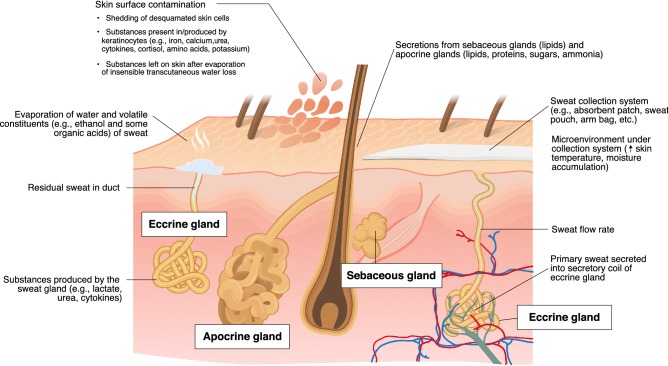
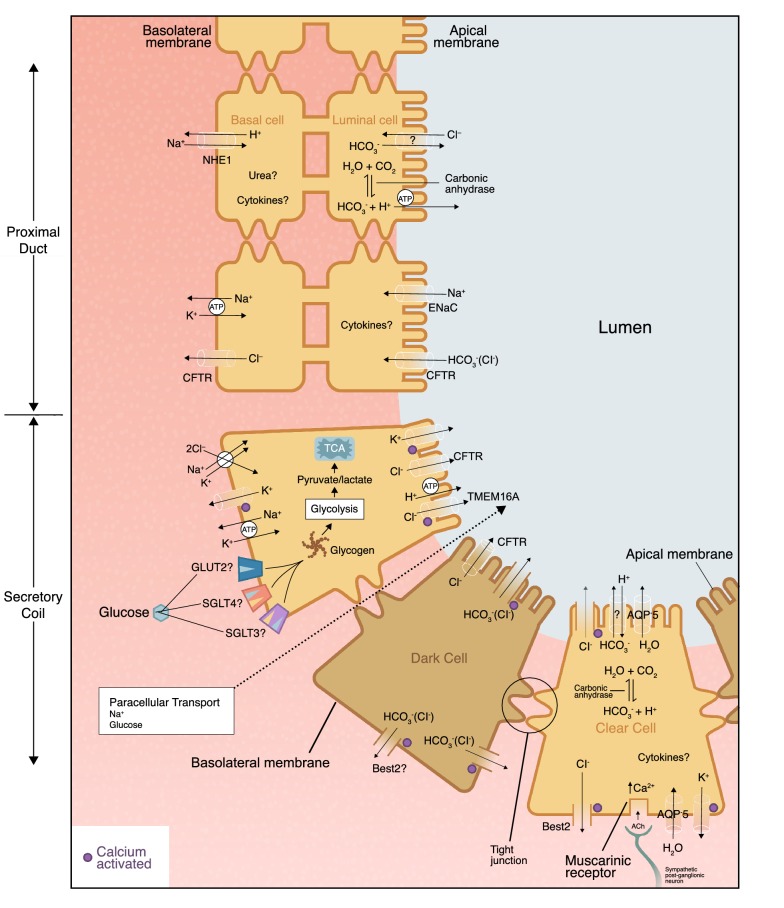
Purpose: The purpose of this paper is to review the physiological mechanisms determining eccrine sweat composition to assess the utility of sweat as a proxy for blood or as a potential biomarker of human health or nutritional/physiological status. Methods: This narrative review includes the major sweat electrolytes (sodium, chloride, and potassium), other micronutrients (e.g., calcium, magnesium, iron, copper, zinc, vitamins), metabolites (e.g., glucose, lactate, ammonia, urea, bicarbonate, amino acids, ethanol), and other compounds (e.g., cytokines and cortisol). Results: Ion membrane transport mechanisms for sodium and chloride are well established, but the mechanisms of secretion and/or reabsorption for most other sweat solutes are still equivocal. Correlations between sweat and blood have not been established for most constituents, with perhaps the exception of ethanol. With respect to sweat diagnostics, it is well accepted that elevated sweat sodium and chloride is a useful screening tool for cystic fibrosis. However, sweat electrolyte concentrations are not predictive of hydration status or sweating rate. Sweat metabolite concentrations are not a reliable biomarker for exercise intensity or other physiological stressors. To date, glucose, cytokine, and cortisol research is too limited to suggest that sweat is a useful surrogate for blood. Conclusion: Final sweat composition is not only influenced by extracellular solute concentrations, but also mechanisms of secretion and/or reabsorption, sweat flow rate, byproducts of sweat gland metabolism, skin surface contamination, and sebum secretions, among other factors related to methodology. Future research that accounts for these confounding factors is needed to address the existing gaps in the literature.
Overview
CoChat Summary
TL;DR
This narrative review concludes that final eccrine sweat composition is shaped not only by extracellular solute concentrations but also by glandular secretion/reabsorption, sweat flow rate, gland metabolism, skin contamination, and sebum, so sweat is not generally a reliable proxy for blood. Elevated sweat sodium and chloride remain useful for cystic fibrosis screening, but most other sweat constituents lack established blood correlations or diagnostic utility.
Key findings
- Na+ and Cl− are the most concentrated sweat electrolytes, ranging from ~10 to ~90 mmol/L; their secretion/reabsorption mechanisms are well established, but mechanisms for most other sweat solutes remain equivocal.
- Sweat-blood correlations have not been established for most constituents, with perhaps the exception of ethanol; sweat glucose is ~100× lower than blood glucose, and glucose, cytokine, and cortisol research is too limited to support sweat as a blood surrogate.
- Sweat electrolyte concentrations are not predictive of hydration status or sweating rate, and sweat metabolite concentrations are not reliable biomarkers of exercise intensity or other physiological stressors.
- Heat acclimation can decrease sweat [Na+] and [Cl−] by up to 30–60% after 7–10 days; within a bout, as forearm sweating rate increased from ~0.25 to 0.82 mg/cm2/min, sweat [Na+] rose from 19 ± 5 to 59 ± 10 mmol/L, with Na+ reabsorption falling from 86 ± 3% to 65 ± 6%.
Methods
- Narrative review of physiological mechanisms determining eccrine sweat composition during passive and active heat stress.
- Covers major electrolytes (Na+, Cl−, K+), other micronutrients (Ca2+, Mg2+, Fe2+, Cu2+, Zn2+, vitamins), metabolites (glucose, lactate, ammonia, urea, bicarbonate, amino acids, ethanol), cytokines, and cortisol.
- Synthesizes literature on secretion/reabsorption, collection and analytical confounders, heat acclimation/diet/training effects, and sweat-versus-blood correlations, including Table 1 ranges and supplemental tables.
Limitations
- Stated: mechanisms of secretion/reabsorption for most non-Na/Cl solutes are still equivocal; few well-designed, adequately powered sweat-blood correlation studies exist; methodological confounds include skin surface contamination, collection method, storage, and analytical technique; normative data are insufficient for most constituents; no longitudinal training studies and no sweat-blood cortisol comparisons are available.
- Evident from the text: as a narrative review, it does not use a systematic search or meta-analysis, and many cited studies are old, small, or report mixed/equivocal results, with the authors repeatedly calling for more controlled research.
Model-written summary. Check it against the paper before relying on it.
Integrity signals
Registry
Cites
Statistics
Figures
Verification
Claims the paper makes
76 Valid · 13 Not valid · 213 Not checked · 79 Own results and interpretations
At least one cited source doesn’t support this claim or points to a different paper, and none confirmed it — see the verdicts below.
In the paper
“some in vitro experiments suggest that ion channel (ENaC) activity is temperature dependent, such that higher temperature increases excitability and open probability”
§ Physiological mechanisms determining eccrine sweat composition > Mechanisms determining sweat composition > Electrolytes (sodium, chloride, and potassium)
What the sources say
- Disputedcites Chraibi and Horisberger 2002 sourceExperimental — accuracy not yet measured
The Results section (‘Effect of Temperature on the Steady-State Amiloride-sensitive Current’) reports that, under control conditions, ENaC current decreased as temperature rose; it increased only after protease treatment. The Discussion (‘Effect of Temperature and Kinetics of Self Inhibition’) says high temperature favors the low-open-probability state, contrary to the claimed increase in open probability. (LLM, conf=0.90)
Checked by a reasoning model — may be wrong.
- Disputedcites Chraibi and Horisberger 2003 sourceExperimental — accuracy not yet measured
The Discussion (p. 5) reports that ENaC open probability increased 2.3-fold on cooling, contrary to the claim that higher temperature increases it. The paper does report greater unitary current at higher temperature, but that is distinct from open probability; it does not establish increased excitability. (LLM, conf=0.89)
Checked by a reasoning model — may be wrong.
- Not checked — no full text of the sourcecites Ruff 1999 source
hedgedstates a cause- Asserted: passes — The authors put it forward as true.
- Checkable: passes — It can be checked against evidence.
- Load-bearing: unclear — It is unclear whether the paper’s conclusions depend on it.
- Based: passes — The paper gives a reason why it holds.
- Disputed
At least one cited source doesn’t support this claim or points to a different paper, and none confirmed it — see the verdicts below.
In the paper
“There is no experimental evidence that alcohol ingestion leads to an increase in sweating rate (Baker 2019).”
§ Physiological mechanisms determining eccrine sweat composition > Mechanisms determining sweat composition > Metabolites
What the sources say
- Disputedcites Baker 2019 sourceExperimental — accuracy not yet measured
In “Excretion of ethanol,” Baker reports that one laboratory study found a higher chest sweating rate 10–30 minutes after alcohol ingestion than after water. The increase was small and transient, and other studies found no difference, but the reported experiment contradicts the claim that there is no experimental evidence of an increase. (LLM, conf=0.88)
Checked by a reasoning model — may be wrong.
plain- Asserted: passes — The authors put it forward as true.
- Checkable: passes — It can be checked against evidence.
- Load-bearing: unclear — It is unclear whether the paper’s conclusions depend on it.
- Based: passes — The paper gives a reason why it holds.
- Disputed
The sources with a verdict support this claim; the rest weren’t checked yet, have no full text we could read, or their verdicts aren’t rated yet.
In the paper
“Since extracellular fluid is the precursor to primary sweat in the secretory coil of eccrine sweat glands (Cage and Dobson 1965; Sato 1977)”
§ Physiological mechanisms determining eccrine sweat composition > Introduction
What the sources say
- Supportedcites Cage and Dobson 1965 source
The Discussion states that the precursor of the secretory fluid must be interstitial fluid or blood plasma, both extracellular fluids. The paper also describes the secretory fluid as being produced in the secretory coil. (LLM, conf=0.93)
- Not checked — no full text of the sourcecites Sato 1977 source
plainstates a cause- Asserted: passes — The authors put it forward as true.
- Checkable: passes — It can be checked against evidence.
- Load-bearing: passes — The paper’s conclusions depend on it.
- Based: passes — The paper gives a reason why it holds.
- Supported
The sources with a verdict support this claim; the rest weren’t checked yet, have no full text we could read, or their verdicts aren’t rated yet.
In the paper
“its application has been limited to date (Brothers et al. 2019; Gao et al. 2018; Heikenfeld et al. 2018).”
§ Physiological mechanisms determining eccrine sweat composition > Introduction
What the sources say
- Not checked — no full text of the sourcecites Brothers et al. 2019 source
- Supportedcites Gao et al. 2018 source
The ‘Effects of environment on measuring sweat’ section says wearable sweat-monitoring devices existed as research prototypes but were not yet commercially available. It also describes practical barriers to their use, supporting the claim that application had been limited to date. No page number is provided in our copy. (LLM, conf=0.90)
- Supportedcites Heikenfeld et al. 2018 source
The Wearable Chemical Sensors section reports demonstrations of non-invasive, real-time sweat monitoring but says that no commercial wearable products for sweat-based chemical detection yet exist. Its discussion of unresolved sampling and validation challenges supports the claim that practical application remained limited; the passage has no page number in our copy. (LLM, conf=0.87)
plain- Asserted: passes — The authors put it forward as true.
- Checkable: passes — It can be checked against evidence.
- Load-bearing: unclear — It is unclear whether the paper’s conclusions depend on it.
- Based: passes — The paper gives a reason why it holds.
The cited sources support only part of this claim — read each source’s verdict below.
In the paper
“Whole body sweating rate can be > 3.0 L/h (Armstrong et al. 1986; Barnes et al. 2019; Bergeron 2003; Godek et al. 2005, 2010; Palmer and Spriet 2008).”
§ Physiological mechanisms determining eccrine sweat composition > Eccrine sweat glands and thermoregulatory sweating
What the sources say
- Not checked — no full text of the sourcecites Armstrong et al. 1986 source
- Partly supportedcites Barnes et al. 2019 sourceExperimental — accuracy not yet measured
Our copy of Barnes et al. (2019) repeatedly documents whole-body sweating rate (WBSR) in athletes and 'considerable overall inter-individual variation in sweating' (Conclusion; Discussion, p. n/a), with the highest sport means in American football (1.51 ± 0.70 L/h) and endurance (1.28 ± 0.57 L/h) (ABSTRACT; Table 3). However, no passage states that WBSR can exceed 3.0 L/h; the only explicit high-rate threshold given is that 'three of the 24 endurance athletes tested outdoors had sweating rates over 2.0 L/h' (Results, descriptive statistics), and the '>3–4' figure in the Introduction refers to grams of Na+ loss, not sweating rate. The range/maximum values that could carry the >3.0 L/h magnitude sit in Tables 2–3, which are not rendered in our copy (placeholder rows only). So the source supports high and highly variable WBSR in athletes but not the specific >3.0 L/h magnitude attributed to it. (LLM, conf=0.68)
- Not checked — no full text of the sourcecites Bergeron 2003 source
plain- Asserted: passes — The authors put it forward as true.
- Checkable: passes — It can be checked against evidence.
- Load-bearing: unclear — It is unclear whether the paper’s conclusions depend on it.
- Based: passes — The paper gives a reason why it holds.
257 more claims · 59 with their cited sources checked
Create a free account to see all 381 claims and to verify the 5 references still open.
- Probably not a substantial claim. 40
- It may state two separate claims as one. 90
Self-check
Percentages, sums and reported differences re-computed from the paper’s own numbers.
Each contradiction between two passages listed here was confirmed by an independent check.
Rated minor: it would not touch a result — a value no result rests on, a p-value that stays on the same side of the significance level, or a conflict that is clerical, resolved elsewhere in the paper, or outside its own findings.
In the paper
§ Physiological mechanisms determining eccrine sweat composition > Overview of sweat composition
“| Amino Acids | R–CH(NH2) –COOH | ≤ 13 × 10–3 each | ≤ 6.5 × 10⁻³ each | 75–204 each | Polar and nonpolar | Leaching of natural moisturizing factors from the skin | NA |”
§ Physiological mechanisms determining eccrine sweat composition > Effects of heat acclimation, diet, and physical training on sweat composition > Metabolites
“total amino acid concentrations in sweat were significantly lower in trained (physically active for an average of 9 h per week) than untrained (average of 1 h of sports per week) men during 15 min of cycling at 150 W while covered with a plastic blanket (12,797 vs. 24,855 µmol/L, respectively).”
Citations
Cites
Fully integrated wearable sensor arrays for multiplexed in situ perspiration analysis
Gao, W., Emaminejad, S., Nyein, H. Y. Y., Challa, S., Chen, K., Peck, A., Fahad, H. M., Ota, H., Shiraki, H., Kiriya, D., et al. (2016) · Nature · doi:10.1038/nature16521 · Cited by 5,087
American College of Sports Medicine position stand
Otis, C. L. (1997) · Medical Entomology and Zoology · Cited by 4,407
Webb, A. K. (2006) · Cited by 4,369
Cytokines, Inflammation, and Pain
Zhang, J.-M., & An, J. (2007) · International Anesthesiology Clinics · doi:10.1097/aia.0b013e318034194e · Cited by 2,945
USSING, H. H., & ZERAHN, K. (1951) · Acta Physiologica Scandinavica · doi:10.1111/j.1748-1716.1951.tb00800.x · Cited by 2,406
Adaptations of skeletal muscle to endurance exercise and their metabolic consequences
Holloszy, J. O., & Coyle, E. F. (1984) · Journal of Applied Physiology · doi:10.1152/jappl.1984.56.4.831 · Cited by 1,985
ACSM Position Stand: Exercise and Fluid Replacement
Convertino, V. A., Armstrong, L. E., Coyle, E. F., Mack, G. W., Sawka, M. N., Senay, L. C., & Sherman, W. M. (1996) · Medicine & Science in Sports & Exercise · doi:10.1097/00005768-199610000-00045 · Cited by 1,965
Salivary Cortisol in Psychobiological Research: An Overview
Kirschbaum, C., & Hellhammer, D. H. (2008) · Neuropsychobiology · doi:10.1159/000118611 · Cited by 1,532
Exercise and Fluid Replacement
(2007) · Medicine & Science in Sports & Exercise · doi:10.1249/mss.0b013e31802ca597 · Cited by 1,497
Gibson, L. E., & Cooke, R. E. (1959) · Pediatrics · doi:10.1542/peds.23.3.545 · Cited by 1,434 · cited 2×
“, pilocarpine or methacholine) transdermally to stimulate the muscarinic receptors on the sweat glands (Gibson and Cooke 1959; Webster 1983).”
Background
Research works printed but not linked: 10
- Brunner H (1906) Über Glykogen in der gesunden und kranken. Haut Verh Dtsch derm Gesellschaft 9:521–535
- Embden R, Tachau H (1910) Uber das Vorkommen von Serin im menschlichen. Schweisse Biochem Ztschr 28:230
- Kirschbaum C, Hellhammer DH (2000) Salivary cortisol. In: Fink G (ed) Encyclopedia of stress, 2nd edn. Academic, New York, pp 405–409
- Kuno Y (1956) Human perspiration. Charles C. Thomas Publisher, Springfield
- Kutchai HC (1998) Cellular membranes and transmembrane transport of solute and water. In: Berne RM, Levy MN (eds) Physiology. Mosby Press, St. Louis, pp 3–20
- Ladell WSS, Shephard RJ (1961) Aldosterone inhibition and acclimatization to heat. Proc Physiol Soc 3–4:19P–20P
- Sato K (1983) The physiology and pharmacology of the eccrine sweat gland. In: Goldsmith L (ed) Biochemistry and physiology of the skin. Oxford University Press, New York, pp 596–641
- Sato K (1993) The mechanism of eccrine sweat secretion. In: Gisolfi CV, Nadel ER (eds) Exercise, heat, and thermoregulation Perspectives in exercise science and sports medicine, vol 6. Brown & Benchmark, Dubuque, pp 85–117
- Wescor (2005) Sweat Chek™ sweat conductivity analyzer model 3120 instruction/service manual. Wescor Inc, USA
- Yuyama H (1935) On the histological examination of distribution of glycogen in the skin of leprosy with special reference to the relationship between the function of sweat glands and the changes of glycogen content. J Derm Urol 37:811–832
Cited by
Wearable chemical sensors for biomarker discovery in the omics era
Sempionatto, J. R., Lasalde-Ramírez, J. A., Mahato, K., Wang, J., & Gao, W. (2022) · Nature Reviews Chemistry · doi:10.1038/s41570-022-00439-w · Cited by 613
Human temperature regulation under heat stress in health, disease, and injury
Cramer, M. N., Gagnon, D., Laitano, O., & Crandall, C. G. (2022) · Physiological Reviews · doi:10.1152/physrev.00047.2021 · Cited by 491
Yin, L., Cao, M., Kim, K. N., Lin, M., Moon, J.-M., Sempionatto, J. R., Yu, J., Liu, R., Wicker, C., Trifonov, A., et al. (2022) · Nature Electronics · doi:10.1038/s41928-022-00843-6 · Cited by 358
The challenges and promise of sweat sensing
Davis, N., Heikenfeld, J., Milla, C., & Javey, A. (2024) · Nature Biotechnology · doi:10.1038/s41587-023-02059-1 · Cited by 211
Achievements and Challenges for Real-Time Sensing of Analytes in Sweat within Wearable Platforms
Brothers, M. C., DeBrosse, M., Grigsby, C. C., Naik, R. R., Hussain, S. M., Heikenfeld, J., & Kim, S. S. (2019) · Accounts of Chemical Research · doi:10.1021/acs.accounts.8b00555 · Cited by 207
Metadata
- Authors
- Baker, L. B., & Wolfe, A. S.
- Affiliations
- Gatorade Sports Science Institute (US)
- Corresponding author
- Baker, Lindsay B.
- ORCID
- Baker, Lindsay B.
- Venue
- European Journal of Applied Physiology
- Published
- 2020-03-02
- Volume
- 120
- Issue
- 4
- Pages
- 719-752
- ISSN
- 0020-9376 (ISSN-L)
- 1439-6319
- 1439-6327
- PMC
- PMC7125257
- OpenAlex
- W3010240226
- Semantic Scholar
- 3a7f3eeeee43ce9bbcb7b652fe248abe7d8d2ac5
- Cited by
- 367
- References
- 365
- Citations by year
- 2026: 85 · 2025: 76 · 2024: 66 · 2023: 53 · 2022: 40 · 2021: 34 · 2020: 10
- FWCI
- 4.07
- Type
- journal article
- Language
- en
- Open access
- hybrid
- doi.org
- Licence
- cc-by
- creativecommons.org/licenses/by/4.0 (tdm)
- creativecommons.org/licenses/by/4.0 (vor)
- Locations
- European Journal of Applied Physiology (publishedVersion, cc-by)
- Europe PMC (PubMed Central) (publishedVersion, cc-by)
- PubMed Central (publishedVersion, cc-by)
- PubMed (publishedVersion)
- Funders
- Gatorade Sports Science Institute (NA)
- Topics
- Health Sciences › Medicine › Physiology (medical) › Thermoregulation and physiological responses
- Health Sciences › Medicine › Physiology (medical) › Cardiovascular and exercise physiology
- Health Sciences › Medicine › Physiology (medical) › Exercise and Physiological Responses
- Keywords
- eccrine sweat, sweat composition, sweat electrolytes, sodium, chloride, potassium, sweat biomarkers, cystic fibrosis screening, cortisol, exercise intensity
- MeSH terms
- Acclimatization, Eccrine Glands, Electrolytes, Humans, Specimen Handling, Sweat, Sweating, Sodium Chloride, Dietary, Micronutrients, Physical Conditioning, Human
About these checks
Registry, retraction, Cites and statistics results are computed, not judged, with one exception: a printed reference that no index lists is read once by a model before it counts as a citation error. Claims are extracted by a model and kept only when their quote appears verbatim in the text; each cited source is then checked, with a model’s help, for whether it says what the claim relies on. Those verdicts can be wrong — read the claim’s quote and the cited source before relying on one.
The claim verdicts this report counts are experimental: their accuracy is not yet measured.
A language model drew the claims from the paper on 2026-10-07, under version 3 of the claim definition (model deepseek-v4.1-flash, prompt extract-v3).
A second model labelled each claim on 2026-10-07 (model jev-1.13-20260917, definition revision gold-guideline-v0.2).
Cited sources are checked with a language model’s help (gpt-6-sol and qwen3.8-omni-flash).
Statistics and arithmetic are recomputed, not judged.
Confidence bands are shown only for fields calibrated on our annotated test set. None is calibrated yet, so no band is shown.
What counts as a claim ›How we measure confidence ›How we check this ›
Are you an author, or do you see a problem with this page? Request a review
How to cite
Cite CoChat for the checks on this page, and the paper for its own findings.
- This page
- CoChat. (2026). Citation check: Physiological mechanisms determining eccrine sweat composition. https://app.cochat.ai/papers/10.1007/s00421-020-04323-7
- The paper
- Baker, L. B., & Wolfe, A. S. (2020). Physiological mechanisms determining eccrine sweat composition. European Journal of Applied Physiology. https://doi.org/10.1007/s00421-020-04323-7
Data sources
Bibliographic data: Semantic Scholar, OpenAlex, Crossref.
Contains information from the Semantic Scholar Academic Graph Datasets, made available under the ODC Attribution License (ODC-BY 1.0).
Semantic Scholar’s data is described in: Kinney, R., et al. (2023). The Semantic Scholar Open Data Platform. arXiv:2301.10140.
