

Expediting systematic reviews: methods and implications of rapid reviews
Open accessThe DOI matches its Crossref record; 47 of the 51 references it cites were found in a registry or an index.
Abstract
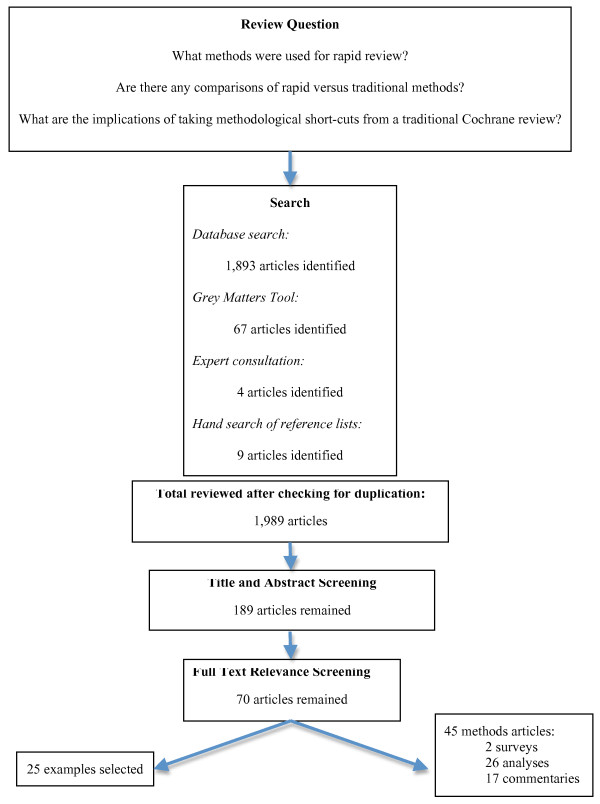
BACKGROUND: Policy makers and others often require synthesis of knowledge in an area within six months or less. Traditional systematic reviews typically take at least 12 months to conduct. Rapid reviews streamline traditional systematic review methods in order to synthesize evidence within a shortened timeframe. There is great variation in the process of conducting rapid reviews. This review sought to examine methods used for rapid reviews, as well as implications of methodological streamlining in terms of rigour, bias, and results. METHODS: A comprehensive search strategy--including five electronic databases, grey literature, hand searching of relevant journals, and contacting key informants--was undertaken. All titles and abstracts (n = 1,989) were reviewed independently by two reviewers. Relevance criteria included articles published between 1995 and 2009 about conducting rapid reviews or addressing comparisons of rapid reviews versus traditional reviews. Full articles were retrieved for any titles deemed relevant by either reviewer (n = 70). Data were extracted from all relevant methodological articles (n = 45) and from exemplars of rapid review methods (n = 25). RESULTS: Rapid reviews varied from three weeks to six months; various methods for speeding up the process were employed. Some limited searching by years, databases, language, and sources beyond electronic searches. Several employed one reviewer for title and abstract reviewing, full text review, methodological quality assessment, and/or data extraction phases. Within rapid review studies, accelerating the data extraction process may lead to missing some relevant information. Biases may be introduced due to shortened timeframes for literature searching, article retrieval, and appraisal. CONCLUSIONS: This review examined the continuum between diverse rapid review methods and traditional systematic reviews. It also examines potential implications of streamlined review methods. More of these rapid reviews need to be published in the peer-reviewed literature with an emphasis on articulating methods employed. While one consistent methodological approach may not be optimal or appropriate, it is important that researchers undertaking reviews within the rapid to systematic continuum provide detailed descriptions of methods used and discuss the implications of their chosen methods in terms of potential bias introduced. Further research comparing full systematic reviews with rapid reviews will enhance understanding of the limitations of these methods.
Overview
The claims and statistics of this paper haven’t been checked yet.
Free: it reads the open-access text and checks the first 5 claims that cite a source we can check. Create a free account to check every claim.
Integrity signals
Registry
Cites
Statistics
Figures
Verification
Claims the paper makes
The claims and statistics of this paper haven’t been checked yet.
Free: it reads the open-access text and checks the first 5 claims that cite a source we can check. Create a free account to check every claim.
Claims other papers make about this one
Each is checked against this paper’s own text: does it say what the citing paper says it does?
The source backs part of the claim, not all of it — or backs it for a different population, condition or comparison.
In the citing paper
“The conduct of SRs can be a time-consuming, cost- and resource-intensive task, which may take on average from 6 months to several years [4–6].”
From How to conduct systematic reviews more expeditiously? (2015) · cites this paper as [5]
Experimental — accuracy not yet measuredThe source backs part of the claim, not all of it — or backs it for a different population, condition or comparison.
In the citing paper
“In response to the challenge of timeliness, there has been a growing number of ‘rapid reviews’ (RRs), described as ‘literature reviews that use methods to accelerate or streamline traditional systematic review processes’ [4, 5, 21–23].”
From How to conduct systematic reviews more expeditiously? (2015) · cites this paper as [5]
Experimental — accuracy not yet measuredThe source backs part of the claim, not all of it — or backs it for a different population, condition or comparison.
In the citing paper
“the methodological rigor and process that makes SR evidence trustworthy often take one to 2 years to complete [[1], [2], [3], [4]] and limit their utility to meet the time-sensitive needs of stakeholders.”
From Cochrane Rapid Reviews Methods Group offers evidence-informed guidance to conduct rapid reviews (2021) · cites this paper as [1]
Experimental — accuracy not yet measuredThe cited source says what the claim attributes to it.
In the citing paper
“In contrast, the empirical evidence from studies comparing findings between RRs and SRs is insufficient [5, 24, 26].”
From How to conduct systematic reviews more expeditiously? (2015) · cites this paper as [5]
The check wasn’t confident either way, so it gives no verdict — never disputed.
In the citing paper
“Reviewer characteristics seem to have only a moderate influence on extraction errors [ 7 , 9 ].”
From Frequency of data extraction errors and methods to increase data extraction quality: a methodological review (2017) · cites this paper as [7]
Experimental — accuracy not yet measured
2 more claims about this paper
Create a free account to see every claim other papers make about this one.
Self-check
Percentages, sums and reported differences re-computed from the paper’s own numbers.
The self-check needs the paper’s full text.
Citations
Cites
Moher, D., Pham, B., Jones, A., Cook, D. J., Jadad, A. R., Moher, M., Tugwell, P., & Klassen, T. P. (1998) · The Lancet · doi:10.1016/s0140-6736(98)01085-x · Cited by 3,560
Assessing the quality of controlled clinical trials
Jüni, P., Altman, D. G., & Egger, M. (2001) · BMJ · doi:10.1136/bmj.323.7303.42 · Cited by 3,309 · cited 1×
“Juni, Altman, and Egger also suggest that failure to conduct quality assessments of primary studies can distort the results of a review [48].”
BackgroundPublication and related bias in meta-analysis
Sterne, J. A. C., Gavaghan, D., & Egger, M. (2000) · Journal of Clinical Epidemiology · doi:10.1016/s0895-4356(00)00242-0 · Cited by 2,282
meta-analysis bias in location and selection of studies
Egger, M., & Smith, G. D. (1998) · BMJ · doi:10.1136/bmj.316.7124.61 · Cited by 1,374
Egger, M., Jüni, P., Bartlett, C., Holenstein, F., & Sterne, J. (2003) · Health Technology Assessment · doi:10.3310/hta7010 · Cited by 1,181 · cited 3×
“For example, the methodological quality of harder-to-find studies also needs to be considered, as they may be of lower methodological quality and actually increase bias by their inclusion [40].”
BackgroundResultInfluentialDirection and impact of language bias in meta-analyses of controlled trials: empirical study
Jüni, P., Holenstein, F., Sterne, J., Bartlett, C., & Egger, M. (2002) · International Journal of Epidemiology · doi:10.1093/ije/31.1.115 · Cited by 892
Epidemiology and reporting characteristics of systematic reviews.
Moher, D., Tetzlaff, J., Tricco, A. C., Sampson, M., & Altman, D. G. (2007) · PLoS Medicine · doi:10.1371/journal.pmed.0040078 · Cited by 891 · cited 1×
“found that the quality of systematic reviews themselves are inconsistent, thereby blurring lines further between systematic review and rapid review methods [49].”
BackgroundMcAuley, L., Pham, B., Tugwell, P., & Moher, D. (2000) · The Lancet · doi:10.1016/s0140-6736(00)02786-0 · Cited by 812
Royle, P., & Milne, R. (2003) · International Journal of Technology Assessment in Health Care · doi:10.1017/s0266462303000552 · Cited by 693
Do Certain Countries Produce Only Positive Results? A Systematic Review of Controlled Trials
Vickers, A., Goyal, N., Harland, R., & Rees, R. (1998) · Controlled Clinical Trials · doi:10.1016/s0197-2456(97)00150-5 · Cited by 683
Grey literature in meta-analyses of randomized trials of health care interventions
Hopewell, S., McDonald, S., Clarke, M. J., & Egger, M. (2007) · Cochrane Database of Systematic Reviews · doi:10.1002/14651858.mr000010.pub3 · Cited by 598
Moher, D., Fortin, P., Jadad, A. R., Jüni, P., Klassen, T., Le Lorier, J., Liberati, A., Penna, A., & Linde, K. (1996) · The Lancet · doi:10.1016/s0140-6736(96)90538-3 · Cited by 537
Jadad, A. R., Cook, D. J., Jones, A., Klassen, T. P., Tugwell, P., Moher, M., & Moher, D. (1998) · JAMA · doi:10.1001/jama.280.3.278 · Cited by 534
Moher, D., Pham, B., Lawson, M., & Klassen, T. (2003) · Health Technology Assessment · doi:10.3310/hta7410 · Cited by 500 · cited 1×
“found that language restricted meta-analyses did not differ significantly in intervention effectiveness estimates when compared to language inclusive meta-analyses [38,39].”
ResultWhat contributions do languages other than English make on the results of meta-analyses?
Moher, D., Pham, Klassen, T. P., Schulz, K. F., Berlin, J. A., Jadad, A. R., & Liberati, A. (2000) · Journal of Clinical Epidemiology · doi:10.1016/s0895-4356(00)00188-8 · Cited by 453
Edwards, P., Clarke, M., DiGuiseppi, C., Pratap, S., Roberts, I., & Wentz, R. (2002) · Statistics in Medicine · doi:10.1002/sim.1190 · Cited by 340 · cited 2×
“In addition, Edwards et al. examined the accuracy and reliability of reviewers in screening records, and found that while a single reviewer is likely to identify the majority of relevant records, having a second reviewer maximizes inclusion and can increase the records identified by an average of 9% [ 33 ].”
BackgroundImproving the Use of Research Evidence in Guideline Development
Oxman, A. D., Schünemann, H. J., Fretheim, A., Boyd, E. A., Bero, L. A., & Edejer, T. T.-T. (2007) · BIBSYS Brage (BIBSYS (Norway)) · Cited by 261
National Institute for Health and Clinical Excellence
(2008) · Nursing Standard · doi:10.7748/ns2008.08.22.50.30.p4587 · Cited by 260
Handsearching versus electronic searching to identify reports of randomized trials
Hopewell, S., Clarke, M. J., Lefebvre, C., & Scherer, R. W. (2007) · Cochrane Database of Systematic Reviews · doi:10.1002/14651858.mr000001.pub2 · Cited by 247
Watt, A., Cameron, A., Sturm, L., Lathlean, T., Babidge, W., Blamey, S., Facey, K., Hailey, D., Norderhaug, I., & Maddern, G. (2008) · International Journal of Technology Assessment in Health Care · doi:10.1017/s0266462308080185 · Cited by 226 · cited 3×
“Due to the limitations in drawing conclusions and ability to answer questions, rapid reviews should only be viewed as interim guidance until more systematic reviews can be conducted [4,45].”
BackgroundMethodOliver, S., Harden, A., Rees, R., Shepherd, J., Brunton, G., Garcia, J., & Oakley, A. (2005) · Evaluation · doi:10.1177/1356389005059383 · Cited by 221
Overview of the clinical effectiveness of positron emission tomography imaging in selected cancers
Facey, K., Bradbury, I., Laking, G., & Payne, E. (2007) · Health Technology Assessment · doi:10.3310/hta11440 · Cited by 219
Pham, B., Klassen, T. P., Lawson, M. L., & Moher, D. (2005) · Journal of Clinical Epidemiology · doi:10.1016/j.jclinepi.2004.08.021 · Cited by 206
Royle, P., & Waugh, N. (2003) · Health Technology Assessment · doi:10.3310/hta7340 · Cited by 194
McManus, R. J., Wilson, S., Delaney, B. C., Fitzmaurice, D. A., Hyde, C. J., Tobias, R. S., Jowett, S., & Hobbs, F. D. R. (1998) · BMJ · doi:10.1136/bmj.317.7172.1562 · Cited by 185
RAPID VERSUS FULL SYSTEMATIC REVIEWS: VALIDITY IN CLINICAL PRACTICE?
Watt, A., Cameron, A., Sturm, L., Lathlean, T., Babidge, W., Blamey, S., Facey, K., Hailey, D., Norderhaug, I., & Maddern, G. (2008) · ANZ Journal of Surgery · doi:10.1111/j.1445-2197.2008.04730.x · Cited by 163 · cited 2×
“found that although the scope of rapid reviews is limited, they can provide adequate advice for clinical and policy decisions [18].”
BackgroundLewis, R., Whiting, P., ter Riet, G., O'Meara, S., & Glanville, J. (2001) · Health Technology Assessment · doi:10.3310/hta5140 · Cited by 163
Should meta-analysts search Embase in addition to Medline?
Sampson, M. (2003) · Journal of Clinical Epidemiology · doi:10.1016/s0895-4356(03)00110-0 · Cited by 160
Jobanputra, P., Barton, P., Bryan, S., & Burls, A. (2002) · Health Technology Assessment · doi:10.3310/hta6210 · Cited by 126
Zanamivir for the treatment of influenza in adults: a systematic review and economic evaluation
Burls, A., Clark, W., Stewart, T., Preston, C., Bryan, S., Jefferson, T., & Fry-Smith, A. (2002) · Health Technology Assessment · doi:10.3310/hta6090 · Cited by 120
O'Meara, S., Riemsma, R., Shirran, L., Mather, L., & ter Riet, G. (2001) · Health Technology Assessment · doi:10.3310/hta5180 · Cited by 117
Oxman, A. D., Schünemann, H. J., & Fretheim, A. (2006) · Health Research Policy and Systems · doi:10.1186/1478-4505-4-20 · Cited by 116
Clark, W. K., Jobanputra, P., Barton, P. M., & Burls, A. (2004) · Health Technology Assessment · doi:10.3310/hta8180 · Cited by 107
Doust, J. A., Pietrzak, E., Sanders, S., & Glasziou, P. P. (2005) · Journal of Clinical Epidemiology · doi:10.1016/j.jclinepi.2004.09.011 · Cited by 106 · cited 1×
“compared sensitivity and precision of search strategies, comparing use of bibliographic databases with hand searching for references [28].”
MethodBEYOND MEDLINE: Reducing Bias Through Extended Systematic Review Search
Savoie, I., Helmer, D., Green, C. J., & Kazanjian, A. (2003) · International Journal of Technology Assessment in Health Care · doi:10.1017/s0266462303000163 · Cited by 105
THE USE AND IMPACT OF RAPID HEALTH TECHNOLOGY ASSESSMENTS
Hailey, D., Corabian, P., Harstall, C., & Schneider, W. (2000) · International Journal of Technology Assessment in Health Care · doi:10.1017/s0266462300101205 · Cited by 82 · cited 2×
“Due to the limitations in drawing conclusions and ability to answer questions, rapid reviews should only be viewed as interim guidance until more systematic reviews can be conducted [4,45].”
BackgroundTransforming Chronic Care: Evidence about improving care for people with long-term conditions
Singh, D. (2011) · Cited by 67
Lehoux, P., Tailliez, S., Denis, J.-L., & Hivon, M. (2004) · International Journal of Technology Assessment in Health Care · doi:10.1017/s026646230400114x · Cited by 66
Topfer, L.-A., Parada, A., Menon, D., Noorani, H., Perras, C., & Serra-Prat, M. (1999) · International Journal of Technology Assessment in Health Care · doi:10.1017/s0266462399015226 · Cited by 59
Improving the use of research evidence in guideline development: 14. Reporting guidelines
Oxman, A. D., Schünemann, H. J., & Fretheim, A. (2006) · Health Research Policy and Systems · doi:10.1186/1478-4505-4-26 · Cited by 55
Cummins, C., Connock, M. J., Fry-Smith, A., & Burls, A. (2002) · Health Technology Assessment · doi:10.3310/hta6170 · Cited by 54
Langham, J., Thompson, E. A., & Rowan, K. (1999) · Annals of Emergency Medicine · doi:10.1016/s0196-0644(99)70268-4 · Cited by 51
Bryant, S. L., & Gray, A. (2006) · Health Information & Libraries Journal · doi:10.1111/j.1471-1842.2006.00652.x · Cited by 44
Lawson, M. L., Pham, B., Klassen, T. P., & Moher, D. (2005) · Journal of Clinical Epidemiology · doi:10.1016/j.jclinepi.2004.08.022 · Cited by 40
HEALTH TECHNOLOGY ASSESSMENT IN THE UNITED STATES: Past, Present, and Future
Eisenberg, J. M., & Zarin, D. A. (2002) · International Journal of Technology Assessment in Health Care · doi:10.1017/s026646230200020x · Cited by 38
Health technology assessment in Canada: diversity and evolution
Hailey, D. M. (2007) · The Medical Journal of Australia · doi:10.5694/j.1326-5377.2007.tb01245.x · Cited by 34
Kaltenthaler, E., Papaioannou, D. E., Boland, A., & Dickson, R. (2011) · Value in Health · doi:10.1016/j.jval.2011.06.007 · Cited by 22
Research works printed but not linked: 23
- Garces K The health technology inquiry service (HTIS): Providing information for Canadian health care decision makers Canadian Agency for Drugs and Technologies in Health Invitational Symposium 2006
- Moher D Altman D Enabling systematic reviews: reporting research with clarity, accuracy and transparency 17th Annual Cochrane Colloquium 2009 Singapore
- Butler G Hodgkinson J Holmes E Marshall S Evidence based approaches to reducing gang violence 2004 West Midlands, UK: Government Social Research Unit
- Burls A Evolving methods of technology appraisal 2004 Birmingham, UK: University of Birmingham
- Singh D Making the shift: Key success factors. A rapid review of best practice in shifting hospital care into the community 2006 Birmingham, UK: National Health Service, University of Birmingham
- Singh D Ham C Improving care for people with long-term conditions: A review of UK and international frameworks 2006 NHS, University of Birmingham, UK
- Cameron A Rapid versus full systematic reviews: an inventory of current methods and practice in Health Technology Assessment 2007 Australia: ASERNIPS 1 119 1-119 18400114
- Government Social Research (Ed.) Magenta Book Background Papers. Paper 2: what do we already know? Harnessing existing research 2007 London
- Butler G Deaton S Hodgkinson J Holmes E Marshall S Quick but Not Dirty: Rapid Evidence Assessments as a Decision Support Tool in Social Policy 2005 London: Government Social Research Unit
- Helmer D Do extended searches fill the bill? Evaluating the quality of the literature retrieved ISTAHC 17th Annual Meeting; 2001/06/03/ 2001 BC Office of Health Technology Assessment, Centre for Health Services and Policy Research
- McRobbie H Hajek P Bullen C Feigin V Rapid review of non-NHS treatments for smoking cessation 2006 1 203 1-203
- Low N Bender N Nartey L Redmond S Shang A Stephenson J Revised rapid review of evidence for the effectiveness of screening for genital chlamydial infection in sexually active young women and men 2006 1 199 1-199
- Vlayen J Camberlin C Paulus D Ramaekers D Rapid assessment van nieuwe wervelzuil technologieën: totale discusprothese en vertebro/ballon kyfoplastie KCE Reports 2006 39A Brussels: Federaal Kenniscentrum voor de gezondheidszorg (KCE)
- Muthu V The Wessex Institute for Health Research and Development Non-myeloablative bone marrow and peripheral stem cell transplantation 2001 1 London: STEER 1 14 1-14
- Adi Y Bayliss S Taylor R Systematic review of clinical effectiveness and cost-effectiveness of radiofrequency ablation for the treatment of varicose veins 2004 Birmingham: West Midlands Health Technology Assessment Collaboration
- Jolliffe D Farrington DP A rapid evidence assessment of the impact of mentoring on re-offending: A summary 2007 London, UK: Research Development and Statistics Directorate, Home Office
- Middleton P Simpson B Maddern G Australian Safety Efficacy Register of New Interventional Procedures Surgical Spinal Cord Stimulation (Neurostimulation): An Accelerated Systematic Review ASERNIP-S REPORT NO 43 2003 Adelaide, South Australia
- Parker H Making the shift: A review of NHS experience 2006 Birmingham: University of Birmingham
- Coomber R Millward L Chambers J Warm D Health Development A A Rapid Interim Review of the 'Grey' Literature on Risky Behaviour in Young People Aged 11-18 with a Special Emphasis on Vulnerable Groups 2004 1 35 1-35
- London Health Commission Health Inequalities and Equality Impact Assessment of 'Healthcare for London: consulting the capital' 2008 London, UK
- Foerster V Murtagh J Fiander M Pulsed dye laser therapy for port wine stains [Technology Report number 78] 2007 Ottawa: Canadian Agency for Drugs and Technologies in Health
- Australian Safety Efficacy Register of New Interventional Procedures - Surgical Rapid Review: Sacral nerve stimulation for treatment of urge incontinence 2008 North Adelaide, Australia: Australian Safety Efficacy Register of New Interventional Procedures - Surgical
- World Health Organization WHO Rapid Advice Guidelines on pharmacological management of humans infected with avian influenza A (H5N1) virus 2006 1 136 1-136
Cited by
Munn, Z., Peters, M. D. J., Stern, C., Tufanaru, C., McArthur, A., & Aromataris, E. (2018) · BMC Medical Research Methodology · doi:10.1186/s12874-018-0611-x · Cited by 11,385
CDC Guideline for Prescribing Opioids for Chronic Pain—United States, 2016
Dowell, D., Haegerich, T. M., & Chou, R. (2016) · JAMA · doi:10.1001/jama.2016.1464 · Cited by 5,161
Loades, M. E., Chatburn, E., Higson-Sweeney, N., Reynolds, S., Shafran, R., Brigden, A., Linney, C., McManus, M. N., Borwick, C., & Crawley, E. (2020) · Journal of the American Academy of Child & Adolescent Psychiatry · doi:10.1016/j.jaac.2020.05.009 · Cited by 2,906
“9,10 It uses “abbreviated” systematic review methodology, including limiting search criteria, faster data extraction, and using narrative synthesis methods.(11,12)”
MethodCDC Guideline for Prescribing Opioids for Chronic Pain — United States, 2016
Dowell, D., Haegerich, T. M., & Chou, R. (2016) · MMWR. Recommendations and Reports · doi:10.15585/mmwr.rr6501e1 · Cited by 2,697
Evidence based medicine: a movement in crisis?
Greenhalgh, T., Howick, J., Maskrey, N., & for the Evidence Based Medicine Renaissance Group (2014) · BMJ · doi:10.1136/bmj.g3725 · Cited by 1,766
Metadata
- Authors
- Ganann, R., Ciliska, D., & Thomas, H.
- Affiliations
- McMaster University (CA)
- Corresponding author
- Ganann, Rebecca
- Venue
- Implementation Science
- Published
- 2010-07-19
- Volume
- 5
- Issue
- 1
- Pages
- 56-56
- ISSN
- 1748-5908 (ISSN-L)
- PMC
- PMC2914085
- OpenAlex
- W2092255211
- Cited by
- 752
- References
- 51
- Citations by year
- 2026: 19 · 2025: 50 · 2024: 49 · 2023: 85 · 2022: 66 · 2021: 78 · 2020: 81 · 2019: 46 · 2018: 55 · 2017: 51 · 2016: 49 · 2015: 39 · 2014: 31 · 2013: 23 · 2012: 19
- FWCI
- 4.69
- Type
- journal article
- Language
- en
- Open access
- gold
- doi.org
- Licence
- Locations
- Implementation Science (publishedVersion, cc-by)
- PubMed Central (publishedVersion, cc-by)
- PubMed (publishedVersion)
- DOAJ (DOAJ: Directory of Open Access Journals) (submittedVersion, cc-by-sa)
- Radboud Repository (Radboud University) (submittedVersion)
- Radboud Repository (Radboud University) (submittedVersion, other-oa)
- Topics
- Social Sciences › Decision Sciences › Statistics, Probability and Uncertainty › Meta-analysis and systematic reviews
- Health Sciences › Medicine › Public Health, Environmental and Occupational Health › Clinical practice guidelines implementation
- Social Sciences › Sociology and Political Science › Delphi Technique in Research
- Keywords
- rapid review, data extraction, literature searching, methodological quality assessment
About these checks
Registry, retraction, Cites and statistics results are computed, not judged, with one exception: a printed reference that no index lists is read once by a model before it counts as a citation error. Claims are extracted by a model and kept only when their quote appears verbatim in the text; each cited source is then checked, with a model’s help, for whether it says what the claim relies on. Those verdicts can be wrong — read the claim’s quote and the cited source before relying on one.
Statistics and arithmetic are recomputed, not judged.
Confidence bands are shown only for fields calibrated on our annotated test set. None is calibrated yet, so no band is shown.
What counts as a claim ›How we measure confidence ›How we check this ›
Are you an author, or do you see a problem with this page? Request a review
Data sources
Bibliographic data: Semantic Scholar, OpenAlex, Crossref.
Contains information from the Semantic Scholar Academic Graph Datasets, made available under the ODC Attribution License (ODC-BY 1.0).
Semantic Scholar’s data is described in: Kinney, R., et al. (2023). The Semantic Scholar Open Data Platform. arXiv:2301.10140.
