

The DOI matches its Crossref record; 32 of the 32 references it cites were found in a registry or an index.
Realist synthesis: illustrating the method for implementation research
Open accessAbstract
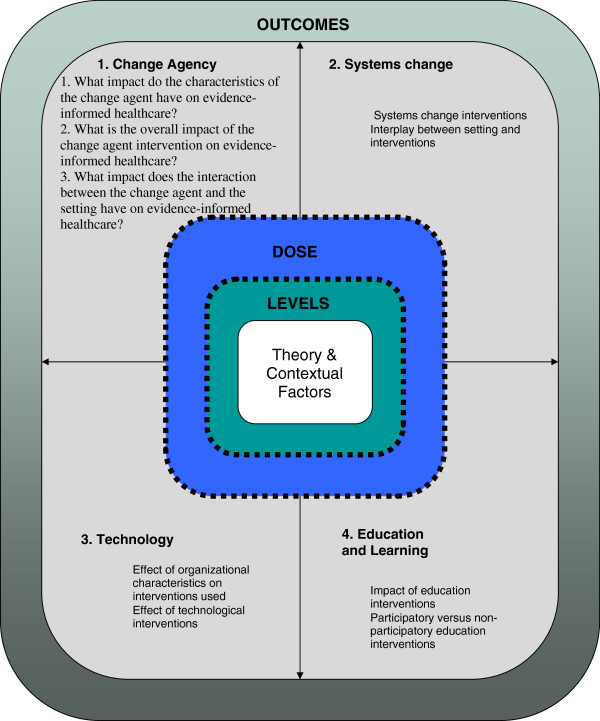
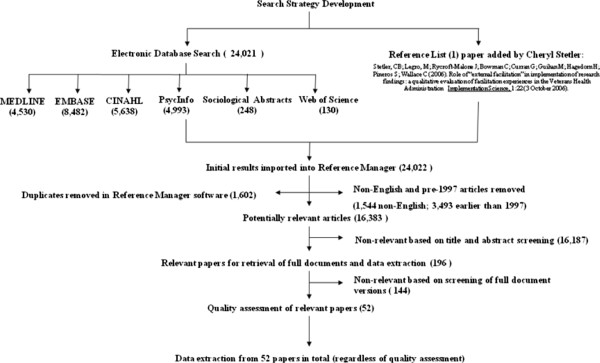
BACKGROUND: Realist synthesis is an increasingly popular approach to the review and synthesis of evidence, which focuses on understanding the mechanisms by which an intervention works (or not). There are few published examples of realist synthesis. This paper therefore fills a gap by describing, in detail, the process used for a realist review and synthesis to answer the question 'what interventions and strategies are effective in enabling evidence-informed healthcare?' The strengths and challenges of conducting realist review are also considered. METHODS: The realist approach involves identifying underlying causal mechanisms and exploring how they work under what conditions. The stages of this review included: defining the scope of the review (concept mining and framework formulation); searching for and scrutinising the evidence; extracting and synthesising the evidence; and developing the narrative, including hypotheses. RESULTS: Based on key terms and concepts related to various interventions to promote evidence-informed healthcare, we developed an outcome-focused theoretical framework. Questions were tailored for each of four theory/intervention areas within the theoretical framework and were used to guide development of a review and data extraction process. The search for literature within our first theory area, change agency, was executed and the screening procedure resulted in inclusion of 52 papers. Using the questions relevant to this theory area, data were extracted by one reviewer and validated by a second reviewer. Synthesis involved organisation of extracted data into evidence tables, theming and formulation of chains of inference, linking between the chains of inference, and hypothesis formulation. The narrative was developed around the hypotheses generated within the change agency theory area. CONCLUSIONS: Realist synthesis lends itself to the review of complex interventions because it accounts for context as well as outcomes in the process of systematically and transparently synthesising relevant literature. While realist synthesis demands flexible thinking and the ability to deal with complexity, the rewards include the potential for more pragmatic conclusions than alternative approaches to systematic reviewing. A separate publication will report the findings of the review.
Overview
The claims and statistics of this paper haven’t been checked yet.
Run the check — free, no account needed. It reads the open-access text and checks the sources it cites.
Integrity signals
Registry
Cites
Statistics
Figures
Verification
Claims the paper makes
The claims and statistics of this paper haven’t been checked yet.
Run the check — free, no account needed. It reads the open-access text and checks the sources it cites.
Claims other papers make about this one
Each is checked against this paper’s own text: does it say what the citing paper says it does?
In the citing paper
“Here, it is important to understand that scoping reviews are not the same as ‘realist reviews’ which can also be used to examine how interventions or programmes work.”
From Scoping reviews: reinforcing and advancing the methodology and application (2021) · cites this paper as [33]
In the citing paper
“Realist reviews are typically designed to ellucide the theories that underpin a programme, examine evidence to reveal if and how those theories are relevant and explain how the given programme works (or not) [33].”
From Scoping reviews: reinforcing and advancing the methodology and application (2021) · cites this paper as [33]
Self-check
Percentages, sums and reported differences re-computed from the paper’s own numbers.
The self-check needs the paper’s full text.
Citations
Cites
Audit and feedback: effects on professional practice and healthcare outcomes
Ivers, N., Jamtvedt, G., Flottorp, S., Young, J. M., Odgaard-Jensen, J., French, S. D., O'Brien, M. A., Johansen, M., Grimshaw, J., & Oxman, A. D. (2012) · Cochrane Database of Systematic Reviews · doi:10.1002/14651858.cd000259.pub3 · Cited by 5,485
Realist review - a new method of systematic review designed for complex policy interventions
Pawson, R., Greenhalgh, T., Harvey, G., & Walshe, K. (2005) · Journal of Health Services Research & Policy · doi:10.1258/1355819054308530 · Cited by 3,190
Effectiveness and efficiency of guideline dissemination and implementation strategies
Grimshaw, J., Thomas, R., MacLennan, G., Fraser, C., Ramsay, C., Vale, L., Whitty, P., Eccles, M., Matowe, L., Shirran, L., et al. (2004) · Health Technology Assessment · doi:10.3310/hta8060 · Cited by 3,044
Bero, L. A., Grilli, R., Grimshaw, J. M., Harvey, E., Oxman, A. D., & Thomson, M. A. (1998) · BMJ · doi:10.1136/bmj.317.7156.465 · Cited by 2,396
Methods for the synthesis of qualitative research: a critical review
Barnett-Page, E., & Thomas, J. (2009) · BMC Medical Research Methodology · doi:10.1186/1471-2288-9-59 · Cited by 2,386
Synthesising qualitative and quantitative evidence: A review of possible methods
Dixon-Woods, M., Agarwal, S., Jones, D., Young, B., & Sutton, A. (2005) · Journal of Health Services Research & Policy · doi:10.1177/135581960501000110 · Cited by 2,132
Pawson, R. (2006) · doi:10.4135/9781849209120 · Cited by 1,791
(2001) · PubMed · Cited by 1,709
What counts as evidence in evidence‐based practice?
Rycroft‐Malone, J., Seers, K., Titchen, A., Harvey, G., Kitson, A. A., & McCormack, B. G. (2004) · Journal of Advanced Nursing · doi:10.1111/j.1365-2648.2004.03068.x · Cited by 960
Self-citationEffectiveness and efficiency of guideline dissemination and implementation strategies
Grimshaw, J. M., Thomas, R. E., MacLennan, G., Fraser, C., Ramsay, C. R., Vale, L., Whitty, P., Eccles, M. P., Matowe, L., Shirran, L., et al. (2005) · International Journal of Technology Assessment in Health Care · doi:10.1017/s0266462305290190 · Cited by 864
Research works printed but not linked: 1
- Pawson R, Tilley N: Realistic Evaluation. 1997, London, England: Sage
Cited by
Sorted by citations
Items 701–742 of 742
Dada, S., Brún, A. D., Banda, E. N., Bhattacharya, S., Mutunga, Z., & Gilmore, B. (2022) · Figshare · doi:10.6084/m9.figshare.21087203
de Graef, N., Hertroijs, D. F. L., Mukumbang, F. C., Westhorp, G., Cramm, J. M., Ruwaard, D., & Elissen, A. (2025) · Systematic Reviews · doi:10.1186/s13643-025-03039-z
Lock, K., Lee, L. Z. Y., Goh, A., Gerber, K., Lim, W. K., Tropea, J., & Astbury, B. (2025) · Palliative Medicine · doi:10.1177/02692163251400110
Abayneh, S., Asher, L., Smartt, C., Mutiso, V., Yaro, P. B., Misganaw, E., Kariuki, K., Mukami, F., Fofo, C. A., Legend, T. H., et al. (2026) · NIHR Open Research · doi:10.3310/nihropenres.14151.1
Simard, P., Déry, J., Best, K. L., & Lamontagne, M. (2026) · Disability and Rehabilitation · doi:10.1080/09638288.2025.2607592
Yin, S., & Chen, C. (2026) · Frontiers in Public Health · doi:10.3389/fpubh.2025.1748555 · Cited by 1
Jagosh, J., Briscoe, S., Greenley, S. L., Edwards, A., Klok, F. A., Johnson, M., Noble, S., & Pearson, M. (2026) · Research Synthesis Methods · doi:10.1017/rsm.2025.10068
Fishpool, K., Silverthorne, C. A., Brooke, M., McHugh, N. J., Morris, L., Ovens, J., Smith, T. R., Tillett, W. L., & Dures, E. K. (2026) · BMJ Open · doi:10.1136/bmjopen-2025-110531
Donegan, D., Teeling, S. P., & McNamara, M. S. (2026) · HRB Open Research · doi:10.12688/hrbopenres.14318.1
Krushynska, T., & Ursin, J. (2026) · Thinking Skills and Creativity · doi:10.1016/j.tsc.2026.102171
Clark, N., Bullon, A. A., Huq, M., & Mukumbang, F. C. (2026) · BMJ Open · doi:10.1136/bmjopen-2025-111367
Mead, E. S., Teeling, S. P., & McNamara, M. S. (2026) · Sustainability · doi:10.3390/su18062942 · Cited by 1
Bullon, A. A., Clark, N., Huq, M., & Mukumbang, F. C. (2026) · International Journal of Qualitative Methods · doi:10.1177/16094069261438488
Knowles, N., Ladwa, A., Price, L., Wright, K. A., Gillison, F., Harrison, J. T., & Anderson, R. (2026) · Advances in Mental Health · doi:10.1080/18387357.2026.2644914
Donegan, D., Teeling, S. P., & McNamara, M. S. (2026) · HRB Open Research · doi:10.12688/hrbopenres.14318.2
Gebre, N. T., Afolabi, O. A., Gafer, N., Nkhoma, K. B., Ayers, N., Hanlon, C., & Harding, R. (2026) · JMIR mhealth and uhealth · doi:10.2196/80321
Kim, B., & Lewis, C. C. (2026) · Implementation Science Communications · doi:10.1186/s43058-026-00914-1
Kocsis, E., Garcia-Barrios, J., Ayala, A. M., Wyngaarden, S., & Dodd, W. (2026) · International Journal of Adolescence and Youth · doi:10.1080/02673843.2026.2670396
Glass, G. F., Ang, C.-S., Weiss, M., Fan, X., Cleland, J., & Manski-Nankervis, J.-A. E. (2026) · BMJ Open · doi:10.1136/bmjopen-2026-118394
Abayneh, S., Asher, L., Smartt, C., Mutiso, V., Yaro, P. B., Misganaw, E., Kariuki, K., Mukami, F., Fofo, C. A., Legend, T. H., et al. (2026) · NIHR Open Research · doi:10.3310/nihropenres.14151.2
Stepanova, E., Cooper, M., Lawson, L., Harris, V., Rance, A., Husband, A., Lorencatto, F., Tovey, W., Crayton, E., Tolley, C. L., et al. (2026) · BMJ Open · doi:10.1136/bmjopen-2025-112464
Implementing women’s sexual and reproductive health interventions in prisons: a realist review
Rickard, J., & Meléndez‐Torres, G. J. (2026) · BMJ Open · doi:10.1136/bmjopen-2025-113940
Achieng, M. S. (2026) · Frontiers in Sustainable Food Systems · doi:10.3389/fsufs.2026.1847230
Medveyuk, S., Vervaecke, D., Nguyen, H., Corbett, K., Dymchuk, E., Baghini, B. Z., Slavescu, I., Tate, K., Hogan, D. B., Wagg, A., et al. (2026) · Research Square · doi:10.21203/rs.3.rs-9918025/v1
Coe, M., Woodward, K. F., Gimbel, S., & Mukumbang, F. C. (2026) · Implementation Science · doi:10.1186/s13012-026-01517-z
Lasanthika, C., Hole, B. D., Szczepura, A. K., Bonner, A., Coad, J. E., & Murphy, E. (2026) · BMJ Open · doi:10.1136/bmjopen-2025-114188
Hartland-Grant, L., Barker, S. L., Maguire, N., & Ward, R. J. (2026) · International Journal of Qualitative Methods · doi:10.1177/16094069261464497
Ng’uni, N. M. , Heine, M., Goma, F. M., Martens, M., Lisulo, M. M. , Kamanga, B., Milupi, I., & Hanekom, S. (2026) · PLoS ONE · doi:10.1371/journal.pone.0352599
Le, D., Duong, K. D., Peeler, A., Hocaoğlu, M., Normand, C. E. M., Higginson, I. J., & Harding, R. (2026) · Palliative Care and Social Practice · doi:10.1177/26323524261466691 · Cited by 1
Deivanayagam, T. A., Szawlowski, S., Abdul-Qayum, S., Camargo, A., Fonso, A., Isba, R., Narayan, S., Prost, A., van Schalkwyk, M. C., & Devakumar, D. (2026) · PLoS ONE · doi:10.1371/journal.pone.0356102
Knight, L. (2026) · International Journal of Qualitative Methods · doi:10.1177/16094069261480503
Hashim, J., Luck, C., Rustagi, N., Meléndez‐Torres, G. J., & Sevdalis, N. (2026) · BMJ Open · doi:10.1136/bmjopen-2026-123148
Feeley, C., Thaels, E., Booth, A., Quashie, M., Pradhan, F., Greenstock, K., Burnett, A., Walker, K., Chang, Y., Prescott, G., et al. (2026) · BMJ Open · doi:10.1136/bmjopen-2026-119351
Fitzmaurice, Y., & McMenamin, R. (2026) · Aphasiology · doi:10.1080/02687038.2026.2725590
Identifying Pathways between Socioeconomic Factors and Overdose: A Systematic Realist Synthesis
Mitra, S., Karamouzian, M., Gilbert, M., & Richardson, L. (2026) · Substance Use & Misuse · doi:10.1080/10826084.2026.2723585
Bullon, A. A., Lobban, F. A., & Harding, A. J. E. (2026) · Research Involvement and Engagement · doi:10.1186/s40900-026-00980-8
Bianchim, M. S., Joseph, R., Boivin, J., & Noyes, J. (2026) · BMJ Open · doi:10.1136/bmjopen-2025-114764
Vamadevan, A., Marwien, F., McMillan, I., Hurst, H., Iles‐Smith, H., & Walker, L. E. (2026) · JMIR Aging · doi:10.2196/97743
Arunagiri, K. P., Allison, P. J., Kannan, S., & Talla, P. K. (2026) · Digital Health · doi:10.1177/20552076261483455
Gawthorne, J. L., McCloughen, A., & Curtis, K. A. (2026) · Journal of Advanced Nursing · doi:10.1111/jan.70775
Day, S., Githaiga, J. N., Graham, J., Murphy, C. F., Bates, O. B., Besigye, I. K., Mash, B., & Redmond, P. (2026) · HRB Open Research · doi:10.12688/hrbopenres.14412.1
Mitani, S., Ogawara, H., Miyagawa, S., Doorenbos, A. Z., & Fukahori, H. (2026) · Health & Social Care in the Community · doi:10.1155/hsc/6693951
Metadata
- Authors
- Rycroft-Malone, J., McCormack, B., Hutchinson, A. M., DeCorby, K., Bucknall, T. K., Kent, B., Schultz, A., Snelgrove-Clarke, E., Stetler, C. B., Titler, M., Wallin, L., & Wilson, V.
- Affiliations
- University of Ulster (GB)
- Deakin University (AU)
- McMaster University (CA)
- Boston University (US)
- University of Michigan (US)
- Karolinska Institutet (SE)
- Venue
- Implementation Science
- Published
- 2012-04-19
- Volume
- 7
- Issue
- 1
- Pages
- 33-33
- ISSN
- 1748-5908 (ISSN-L)
- PMC
- PMC3514310
- OpenAlex
- W2097730860
- Cited by
- 742
- References
- 32
- Citations by year
- 2026: 54 · 2025: 71 · 2024: 92 · 2023: 66 · 2022: 84 · 2021: 82 · 2020: 55 · 2019: 46 · 2018: 48 · 2017: 49 · 2016: 29 · 2015: 27 · 2014: 19 · 2013: 14 · 2012: 1
- FWCI
- 34.69
- Type
- journal article
- Language
- en
- Open access
- gold
- doi.org
- Licence
- Locations
- Implementation Science (publishedVersion, cc-by)
- PubMed Central (publishedVersion, cc-by)
- PubMed (publishedVersion)
- Queen Margaret University Publications Repository (Queen Margaret University) (acceptedVersion)
- PEARL (University of Plymouth) (submittedVersion)
- Research Online (University of Wollongong) (submittedVersion)
- Deep Blue (University of Michigan) (submittedVersion)
- DOAJ (DOAJ: Directory of Open Access Journals) (submittedVersion, cc-by-sa)
- Lancaster EPrints (Lancaster University) (submittedVersion)
- Queen Margaret University Publications Repository (Queen Margaret University) (submittedVersion)
- Figshare (submittedVersion, cc-by)
- UTS ePRESS (University of Technology Sydney) (submittedVersion)
- Topics
- Health Sciences › Health Professions › General Health Professions › Health Policy Implementation Science
- Social Sciences › Decision Sciences › Statistics, Probability and Uncertainty › Meta-analysis and systematic reviews
- Social Sciences › Public Administration › Evaluation and Performance Assessment
- Keywords
- realist synthesis, realist review, causal mechanisms, change agency, implementation research, complex interventions, theoretical framework, data extraction, hypothesis generation
- MeSH terms
- Health Services Research, Humans, Review Literature as Topic, Evidence-Based Medicine
About these checks
Registry, retraction, Cites and statistics results are computed, not judged, with one exception: a printed reference that no index lists is read once by a model before it counts as a citation error. Claims are extracted by a model and kept only when their quote appears verbatim in the text; each cited source is then checked, with a model’s help, for whether it says what the claim relies on. Those verdicts can be wrong — read the claim’s quote and the cited source before relying on one.
Statistics and arithmetic are recomputed, not judged.
Confidence bands are shown only for fields calibrated on our annotated test set. None is calibrated yet, so no band is shown.
What counts as a claim ›How we measure confidence ›How we check this ›
Are you an author, or do you see a problem with this page? Request a review
