

The DOI matches its Crossref record; 47 of the 49 references it cites were found in a registry or an index.
The stages of implementation completion for evidence-based practice: protocol for a mixed methods study
Open accessAbstract
BACKGROUND: This protocol describes the 'development of outcome measures and suitable methodologies for dissemination and implementation approaches,' a priority for implementation research. Although many evidence-based practices (EBPs) have been developed, large knowledge gaps remain regarding how to routinely move EBPs into usual care. The lack of understanding of 'what it takes' to install EBPs has costly public health consequences, including a lack of availability of the most beneficial services, wasted efforts and resources on failed implementation attempts, and the potential for engendering reluctance to try implementing new EBPs after failed attempts.The Stages of Implementation Completion (SIC) is an eight-stage tool of implementation process and milestones, with stages spanning three implementation phases (pre-implementation, implementation, sustainability). Items delineate the date that a site completes implementation activities, yielding an assessment of duration (time to complete a stage), proportion (of stage activities completed), and a general measure of how far a site moved in the implementation process. METHODS/DESIGN: We propose to extend the SIC to EBPs operating in child service sectors (juvenile justice, schools, substance use, child welfare). Both successful and failed implementation attempts will be scrutinized using a mixed methods design. Stage costs will be measured and examined. Both retrospective data (from previous site implementation efforts) and prospective data (from newly adopting sites) will be analyzed. The influence of pre-implementation on implementation and sustainability outcomes will be examined (Aim 1). Mixed methods procedures will focus on increasing understanding of the process of implementation failure in an effort to determine if the SIC can provide early detection of sites that are unlikely to succeed (Aim 2). Study activities will include cost mapping of SIC stages and an examination of the relationship between implementation costs and implementation performance (Aim 3). DISCUSSION: This project fills a gap in the field of implementation science by addressing the measurement gap between the implementation process and the associated costs. The goal of this project is to provide tools that will help increase the uptake of EBPs, thereby increasing the availability of services to youth and decreasing wasted resources from failed implementation efforts.
Overview
The claims and statistics of this paper haven’t been checked yet.
Run the check — free, no account needed. It reads the open-access text and checks the sources it cites.
Integrity signals
Registry
Cites
Statistics
Figures
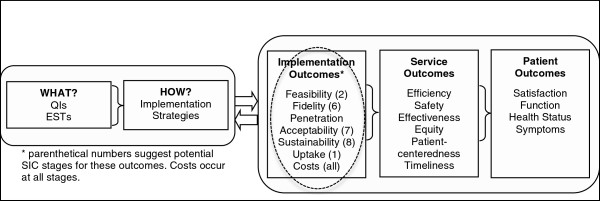
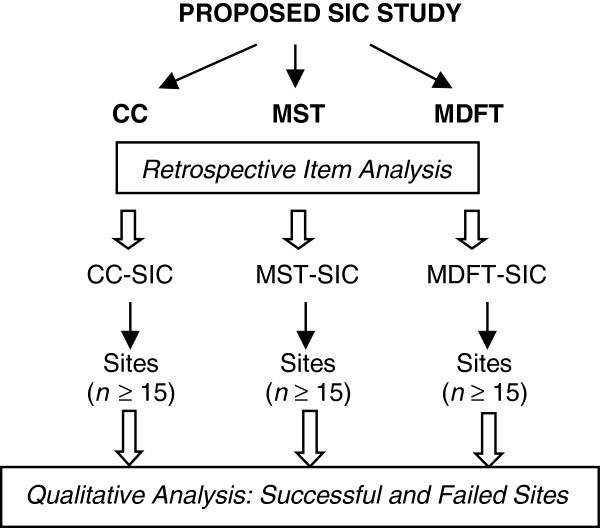
Verification
Claims the paper makes
The claims and statistics of this paper haven’t been checked yet.
Run the check — free, no account needed. It reads the open-access text and checks the sources it cites.
Claims other papers make about this one
Each is checked against this paper’s own text: does it say what the citing paper says it does?
In the citing paper
“a primary outcome for most of these designs can be constructed as a composite process and output score, using dimensions of speed, quality and quantity (11, 25, 101).”
From An Overview of Research and Evaluation Designs for Dissemination and Implementation (2017) · cites this paper as [101]
Self-check
Percentages, sums and reported differences re-computed from the paper’s own numbers.
The self-check needs the paper’s full text.
Citations
Cites
Qualitative Data Analysis: An Expanded Sourcebook
(1994) · Journal of Environmental Psychology · doi:10.1016/s0272-4944(05)80231-2 · Cited by 48,420
Wagner, H. R., Glaser, B. G., & Strauss, A. L. (1968) · Social Forces · doi:10.2307/2575405 · Cited by 46,525
(1998) · Sage eBooks · Cited by 38,631
Designing and Conducting Mixed Methods Research
Robinson, P. M. (2007) · Australian and New Zealand Journal of Public Health · doi:10.1111/j.1753-6405.2007.00096.x · Cited by 23,362
(1998) · Cited by 13,501
Designing and Conducting Mixed Methods Research
นิลพันธุ์, ม. (2010) · Silpakorn Educational Research Journal · Cited by 9,351
Focus Groups as Qualitative Research
Morgan, D. (1997) · doi:10.4135/9781412984287 · Cited by 8,863
Proctor, E., Silmere, H., Raghavan, R., Hovmand, P., Aarons, G., Bunger, A., Griffey, R., & Hensley, M. (2011) · Administration and Policy in Mental Health and Mental Health Services Research · doi:10.1007/s10488-010-0319-7 · Cited by 8,721
Evaluating the public health impact of health promotion interventions: the RE-AIM framework.
Glasgow, R. E., Vogt, T. M., & Boles, S. M. (1999) · American Journal of Public Health · doi:10.2105/ajph.89.9.1322 · Cited by 7,217
Probabilistic Models for Some Intelligence and Attainment Tests
Psychology, M. (1961) · Information and Control · doi:10.1016/s0019-9958(61)80061-2 · Cited by 6,936
Research works printed but not linked: 13
- Mittman B: Presentation. Partnering for Improvement across Research, Practice, and Policy: The Case of Implementation Research in Health. 2011, Los Angeles, CA: VA Greater Los Angeles Healthcare System
- Fixsen DL, Blase K: NIRN Implementation Brief, 1. Implementation: The Missing Link Between Research and Practice. 2009, Chapel Hill: The University of North Carolina
- Proctor EK, Landsverk J: Challenges of Translating Evidence-Based Treatments into Practice Contexts and Service Sectors. Presentation. 2005, Washington, DC: Mental Health Services Research Conference
- Blasé KA, Fixsen DL: The National Implementation Research Network: Improving the science and practice of implementation. Children, Youth & Families (CFY) News. 2005, Washington, DC: American Psychological Association, 8-12.
- Linacre JM: WINSTEPS. Rasch Measurement Computer Program. 2011, Chicago: Winsteps.com
- Linacre JM: FACETS. Rasch Measurement Computer Program. 2011, Chicago: Winsteps.com
- Raudenbush SW, Bryk AS, Congdon R: HLM 6: Hierarchical Linear and Nonlinear Modeling [Computer software and manual]. 2005, Lincolnwood, IL: Scientific Software International
- Liddle HA: Multidimensional Family Therapy Treatment (MDFT) for Adolescent Cannabis Users: Vol. 5 Cannabis Youth Treatment (CYT) Manual Series. 2002, Rockville, MD: Center for Substance Abuse Treatment, Substance Abuse and Mental Health Services Administration
- Kendall PC, Khanna M: Coach’s Manual for Camp Cope-A-Lot: The Coping Cat CD-ROM. 2008, Ardmore, PA: Workbook Publishing Inc.
- Schoenwald SK, Kelleher K, Hoagwood K, Landsverk J, Glisson C: The Research Network on Youth Mental Health Clinic System Project (CSP) Director Survey. Unpublished instrument. 2003, Chicago, IL: The MacArthur Foundation
- Linacre JM: Sample size and item calibrations stability. Rasch Measurement Transactions. 1994, 7: 328-
- Bernard HR: Qualitative Methods in Cultural Anthropology. 1988, Newbury Park, CA: Sage
- Fraser D: QSR NVivo NUS*IST Vivo Reference Guide. 2000, Melbourne: QSR International
Cited by
Sorted by citations
Items 101–189 of 189
Waterman, C. (2021) · Journal of Family Therapy · doi:10.1111/1467-6427.12349 · Cited by 4
Ford, J. H., Zehner, M. E., Schaper, H., & Saldana, L. (2023) · Implementation Research and Practice · doi:10.1177/26334895231200379 · Cited by 3
Self-citationNorman, M. Z., Torres, K. A., Saldana, L., Spiro, K., Naranjo, D. M., Wong, J. C., Reed, A., Bensen, R., Barry, S., Harris, M. A., et al. (2025) · Global Implementation Research and Applications · doi:10.1007/s43477-025-00182-6 · Cited by 3
Self-citationSelove, R., Combs, T., Heckman, C. J., Neil‐Sztramko, S., Scheuermann, T. S., Ginossar, T., Leng, J. C. F., Walker, P. D., Sidani, J. E., & Salloum, R. G. (2025) · Nicotine & Tobacco Research · doi:10.1093/ntr/ntaf155 · Cited by 3
Marriott, B. R., Hulvershorn, L. A., Oliver, J., Jones, C., O’Reilly, L. M., Wiehe, S. E., Monahan, P. O., Bearman, S. K., Saldana, L., & Aalsma, M. C. (2025) · Contemporary Clinical Trials Communications · doi:10.1016/j.conctc.2025.101518 · Cited by 3
Self-citationPilar, M. R., Proctor, E. K., & Pineda, J. A. (2020) · Implementation Science Communications · doi:10.1186/s43058-020-00012-w · Cited by 4
Practice to Research and Back in a Social Service Agency: Trying to DO BETTER
Tyler, P. M., Mason, W. A., Vollmer, B., & Trout, A. L. (2020) · Child & Youth Care Forum · doi:10.1007/s10566-020-09548-3 · Cited by 3
Weijers, M., Boumans, N. P. G., van der Zwet, J., FERON, F. J. M., & Bastiaenen, C. H. G. (2023) · Pilot and Feasibility Studies · doi:10.1186/s40814-022-01214-w · Cited by 3
Elwy, A. R., Taubenberger, S. P., Dodds, N. E., DeSensi, R., Gillman, A. G., Wasan, A. D., & Greco, C. M. (2023) · Medical Care · doi:10.1097/mlr.0000000000001890 · Cited by 3
Grover, T., Bennett, I. M., Campbell, M. R., Vredevoogd, M. A., & Saldana, L. (2024) · Research Square · doi:10.21203/rs.3.rs-5256122/v1 · Cited by 3
Self-citationMatson, T. E., Navarro, M. A., Idu, A., Bobb, J. F., Patrick, B. M., Phillips, R., Barrett, T. D., Rossi, F. S., Krawczyk, N., Doud, R., et al. (2025) · Addiction Science & Clinical Practice · doi:10.1186/s13722-025-00605-7 · Cited by 2
What scientific inferences can be made with randomized implementation rollout trials
Brown, C. H., Smith, J. D., Haegerich, T. M., Simon, G. E., Cero, I., Aarons, G. A., Prado, G. J., Wyman, P. A., Kane, J. M., Robinson, D. G., et al. (2025) · Implementation Science · doi:10.1186/s13012-025-01465-0 · Cited by 4
Dorsey, S., Pullmann, M. D., Kerns, S. E. U., Deblinger, E., Lucid, L., Harrison, J. P., Thompson, K., & Berliner, L. (2018) · Implementation Science · doi:10.1186/s13012-018-0715-z · Cited by 2
Logan, R. G., Vamos, C. A., Detman, L. A., & Sappenfield, W. M. (2022) · Maternal and Child Health Journal · doi:10.1007/s10995-022-03491-6 · Cited by 2
Sepsis screening protocol implementation: a clinician-validated rapid realist review
Melville, J., Carr, T., Goodridge, D. M., Muhajarine, N., & Groot, G. (2024) · BMJ Open Quality · doi:10.1136/bmjoq-2023-002593 · Cited by 2
Watson, D. P., Singh, R. R., Taylor, L., Dennis, M. L., Grella, C. E., Johnstone, C., Browne, K., & Saldana, L. (2024) · Frontiers in Public Health · doi:10.3389/fpubh.2024.1443409 · Cited by 2
Self-citationLery, B., Haight, J., & Roscoe, J. N. (2020) · Journal of Social Work Education · doi:10.1080/10437797.2020.1742260 · Cited by 2
Editorial: Methods and Applications in Implementation Science
Northridge, M. E., Shelley, D., Rundall, T. G., & Brownson, R. C. (2019) · Frontiers in Public Health · doi:10.3389/fpubh.2019.00213 · Cited by 2
Knust, S. K., Booth, L. C., Toner, K. A., Lingat, J. E. M., & Adrian, A. L. (2025) · Journal of Military Veteran and Family Health · doi:10.3138/jmvfh-2023-0104 · Cited by 1
Olson, J. R., Estep, K. M., Coviello, K. A., Linkous, O. S., & Bruns, E. J. (2025) · Psychiatric Services · doi:10.1176/appi.ps.20240288 · Cited by 1
Donenberg, G. R., Nwaozuru, U., Adebajo, S. B., Tucker, J. D., Iwelunmor, J., Kuhns, L. M., Mirembe, B. G., Hightow‐Weidman, L., Zanoni, B. C., Tembo, T. A., et al. (2025) · BMC Public Health · doi:10.1186/s12889-025-24995-0 · Cited by 1
Kull, M. A., Farrell, A. F., Moore, F., & Morton, M. (2026) · Psychology in the Schools · doi:10.1002/pits.70145 · Cited by 1
Young, W. N., Glass, J. E., & Saldana, L. (2026) · Implementation Science · doi:10.1186/s13012-026-01510-6 · Cited by 1
Self-citationEisman, A. B., Cronin, J., Ritzwoller, D. P., Murphy, S. M., Saldana, L., & Glasgow, R. E. (2026) · Implementation Research and Practice · doi:10.1177/26334895261438501 · Cited by 1
Self-citationHearld, L. R., Pratt, M. C., Smith, D. L., Parman, M. A., Murphree, R., Michaels, K. P., Woods-Crawford, S., Rana, A., & Matthews, L. T. (2024) · Annals of Epidemiology · doi:10.1016/j.annepidem.2024.10.005 · Cited by 1
Eisman, A. B., Koffkey, C., Brown, S., Holmes, C., Schmidt, B., Swihart, E., Robinson, T., & Kim, B. (2025) · Prevention Science · doi:10.1007/s11121-025-01787-x · Cited by 1
Sutton, S. (2023) · Scholars Archive - University at Albany (University at Albany, State University of New York) · doi:10.54014/ma7q-67dh · Cited by 1
Rubio-Valera, M., Sánchez‐Viñas, A., Corral‐Partearroyo, C., Peñarrubia‐María, M. T., Gil‐Girbau, M., Olmos-Palenzuela, M. D. C., Gallardo‐Gonzalez, C., & Aznar-Lou, I. (2025) · Research Square · doi:10.21203/rs.3.rs-8348455/v1 · Cited by 1
Holmes, L., Thomas, C. B., Hyde‐Dryden, G., & Williams, A. L. (2017) · Digital Education Resource Archive (University College London)
Sykes, P. (2015) · UTAS Research Repository · doi:10.25959/23238803
Stegenga, S. M. (2019) · Scholars' Bank (University of Oregon)
Faust, J. I., & Bloch, J. R. (2016) · iDEA - Drexel University Institutional Repository · doi:10.17918/etd-6827
Simione, M., Frost, H. M., Cournoyer, R. N., Mini, F. N., Cassidy, J., Craddock, C., Moreland, J., Wallace, J., Metlay, J. P., Kistin, C. J., et al. (2020) · doi:10.21203/rs.2.22385/v1
Lamming, L., Crosswaite, K., Faisal, M., McDonach, E., Montague, J., Mohammed, M. A., Cracknell, A. L., Lovatt, A., & Slater, B. (2021) · Research Square · doi:10.21203/rs.3.rs-513298/v1
Hamilton, A. B., Farmer, M. M., Bean‐Mayberry, B., Moin, T., Lang, A. J., Adams, L., Chanfreau, C., Fenwick, K., Canelo, I., Oberman, R., et al. (2026) · Implementation Science · doi:10.1186/s13012-026-01521-3
Personalized preventive child health care
Weijers, M. (2023) · doi:10.26481/dis.20230419mw
Implementation research: Design and analysis
Reynolds, C. D., Bittle, S., Kruse, J. J., & Woodhead, G. J. (2023) · Elsevier eBooks · doi:10.1016/b978-0-12-823026-8.00082-1
Garst, B. A., Gagnon, R. J., Dickes, L., & Bowers, E. P. (2024) · International Journal of Adolescence and Youth · doi:10.1080/02673843.2024.2316061
Dellabarca, P. (2024) · Open Access Victoria University of Wellington | Te Herenga Waka (Figshare) · doi:10.26686/wgtn.26036188
Papaz, T., Seto, E., Anthony, S. J., Pol, S. J., Hayeems, R. Z., Barwick, M. A., & Mital, S. R. (2024) · CJC Open · doi:10.1016/j.cjco.2024.10.002
Riandari, F., Afrisawati, A., Afifa, R. M., Syahputra, R., & Ginting, R. (2024) · International Journal of Basic and Applied Science · doi:10.35335/ijobas.v13i2.499
Hulvershorn, L. A., Aalsma, M. C., Dellucci, T. V., Burns, A. B., Marriott, B. R., Pescosolido, B. A., Green, H. D., Saldana, L., Chapman, J. E., Monahan, P. O., et al. (2025) · Contemporary Clinical Trials · doi:10.1016/j.cct.2025.107928
Self-citationMelby, L. M. H., Anthun, K. S., & Toussaint, P. J. (2025) · Health Informatics Journal · doi:10.1177/14604582251344839
Yasmin, T., Kausar, T., & Anwar, F. (2025) · NURSEARCHER (Journal of Nursing & Midwifery Sciences) · doi:10.54393/nrs.v5i3.76
Yuan, C. T., Wang, N., Fink, T., Almirall, D., Appel, L. J., Cook, C., Cooper, L. A., Dalcin, A., Gennusa, J. V., Goldsholl, S., et al. (2025) · Implementation Science · doi:10.1186/s13012-025-01461-4
Nevedal, A., Reardon, C. M., Jackson, G. L., Cutrona, S. L., White, B. S., Gifford, A. L., Orvek, E., DeLaughter, K. L., White, L., King, H. A., et al. (2020) · Figshare · doi:10.6084/m9.figshare.12610079
Nevedal, A., Widerquist, M. A. O., Reardon, C. M., Arasim, M. E., Jackson, G. L., White, B. S., Burns, M., Fix, G. M., DeLaughter, K. L., Cutrona, S. L., et al. (2024) · Figshare · doi:10.6084/m9.figshare.26717059
Additional file 1 of Six practical recommendations for improved implementation outcomes reporting
Lengnick‐Hall, R., Gerke, D. R., Proctor, E. K., Bunger, A. C., Phillips, R. J., Martin, J. K., & Swanson, J. C. (2022) · Figshare · doi:10.6084/m9.figshare.19144714
Zhang, X., Wu, K., Pan, Y., Yin, R., Zhang, Y., Kong, D., Wang, Q., & Chen, W. (2024) · Figshare · doi:10.6084/m9.figshare.26606056
Lamming, L., Montague, J., Crosswaite, K., Faisal, M., McDonach, E., Mohammed, M. A., Cracknell, A. L., Lovatt, A., & Slater, B. (2021) · Figshare · doi:10.6084/m9.figshare.16725862
Nevedal, A., Widerquist, M. A. O., Reardon, C. M., Arasim, M. E., Jackson, G. L., White, B. S., Burns, M., Fix, G. M., DeLaughter, K. L., Cutrona, S. L., et al. (2024) · Figshare · doi:10.6084/m9.figshare.26717053
Reardon, C. M., Damschroder, L. J., Opra Widerquist, M. A., Arasim, M. E., Jackson, G. L., White, B. S., Cutrona, S. L., Fix, G. M., Gifford, A. L., DeLaughter, K. L., et al. (2024) · Figshare · doi:10.6084/m9.figshare.26561785
Ford, J. H., Cheng, H. L., Gassman, M., Fontaine, H., Garneau, H. C., Keith, R., Michael, E., & McGovern, M. P. (2022) · Figshare · doi:10.6084/m9.figshare.21249591
Nevedal, A., Reardon, C. M., Jackson, G. L., Cutrona, S. L., White, B. S., Gifford, A. L., Orvek, E., DeLaughter, K. L., White, L., King, H. A., et al. (2020) · Figshare · doi:10.6084/m9.figshare.12610073
Hall, A., Shoesmith, A., Doherty, E. L., McEvoy, B., Mettert, K. D., Lewis, C. C., Wolfenden, L., Yoong, S., Kingsland, M., Shelton, R. C., et al. (2023) · Figshare · doi:10.6084/m9.figshare.22608673
Lamming, L., Montague, J., Crosswaite, K., Faisal, M., McDonach, E., Mohammed, M. A., Cracknell, A. L., Lovatt, A., & Slater, B. (2021) · Figshare · doi:10.6084/m9.figshare.16725856
Zhang, X., Wu, K., Pan, Y., Yin, R., Zhang, Y., Kong, D., Wang, Q., & Chen, W. (2024) · Figshare · doi:10.6084/m9.figshare.26606059
Hamilton, A. B., Finley, E. P., Bean‐Mayberry, B., Lang, A., Haskell, S. G., Moin, T., & Farmer, M. M. (2024) · Figshare · doi:10.6084/m9.figshare.26573665
Nevedal, A., Reardon, C. M., Jackson, G. L., Cutrona, S. L., White, B. S., Gifford, A. L., Orvek, E., DeLaughter, K. L., White, L., King, H. A., et al. (2020) · Figshare · doi:10.6084/m9.figshare.12610085
Hall, A., Shoesmith, A., Doherty, E. L., McEvoy, B., Mettert, K. D., Lewis, C. C., Wolfenden, L., Yoong, S., Kingsland, M., Shelton, R. C., et al. (2023) · Figshare · doi:10.6084/m9.figshare.22608670
Hamilton, A. B., Finley, E. P., Bean‐Mayberry, B., Lang, A., Haskell, S. G., Moin, T., & Farmer, M. M. (2024) · Figshare · doi:10.6084/m9.figshare.26573671
Spoelstra, S., Schueller, M., Basso, V., & Sikorskii, A. (2022) · Figshare · doi:10.6084/m9.figshare.20678806
Hall, A., Shoesmith, A., Doherty, E. L., McEvoy, B., Mettert, K. D., Lewis, C. C., Wolfenden, L., Yoong, S., Kingsland, M., Shelton, R. C., et al. (2023) · Figshare · doi:10.6084/m9.figshare.22608667
Zhang, X., Wu, K., Pan, Y., Yin, R., Zhang, Y., Kong, D., Wang, Q., & Chen, W. (2024) · Figshare · doi:10.6084/m9.figshare.26606074
Lamming, L., Montague, J., Crosswaite, K., Faisal, M., McDonach, E., Mohammed, M. A., Cracknell, A. L., Lovatt, A., & Slater, B. (2021) · Figshare · doi:10.6084/m9.figshare.16725853
Goodarzi, H., Teymourzadeh, E., Rahimi, S., & Nasiri, T. (2021) · Figshare · doi:10.6084/m9.figshare.15568843
Nevedal, A., Widerquist, M. A. O., Reardon, C. M., Arasim, M. E., Jackson, G. L., White, B. S., Burns, M., Fix, G. M., DeLaughter, K. L., Cutrona, S. L., et al. (2024) · Figshare · doi:10.6084/m9.figshare.26717056
Zhang, X., Wu, K., Pan, Y., Yin, R., Zhang, Y., Kong, D., Wang, Q., & Chen, W. (2024) · Figshare · doi:10.6084/m9.figshare.26606071
Ford, J. H., Cheng, H. L., Gassman, M., Fontaine, H., Garneau, H. C., Keith, R., Michael, E., & McGovern, M. P. (2022) · Figshare · doi:10.6084/m9.figshare.21249594
Nevedal, A., Reardon, C. M., Jackson, G. L., Cutrona, S. L., White, B. S., Gifford, A. L., Orvek, E., DeLaughter, K. L., White, L., King, H. A., et al. (2020) · Figshare · doi:10.6084/m9.figshare.12610082
Hamilton, A. B., Finley, E. P., Bean‐Mayberry, B., Lang, A., Haskell, S. G., Moin, T., & Farmer, M. M. (2024) · Figshare · doi:10.6084/m9.figshare.26573668
Zhang, X., Wu, K., Pan, Y., Yin, R., Zhang, Y., Kong, D., Wang, Q., & Chen, W. (2024) · Figshare · doi:10.6084/m9.figshare.26606053
Zhang, X., Wu, K., Pan, Y., Yin, R., Zhang, Y., Kong, D., Wang, Q., & Chen, W. (2024) · Figshare · doi:10.6084/m9.figshare.26606065
Reardon, C. M., Damschroder, L. J., Opra Widerquist, M. A., Arasim, M. E., Jackson, G. L., White, B. S., Cutrona, S. L., Fix, G. M., Gifford, A. L., DeLaughter, K. L., et al. (2024) · Figshare · doi:10.6084/m9.figshare.26561788
Additional file 2 of Six practical recommendations for improved implementation outcomes reporting
Lengnick‐Hall, R., Gerke, D. R., Proctor, E. K., Bunger, A. C., Phillips, R. J., Martin, J. K., & Swanson, J. C. (2022) · Figshare · doi:10.6084/m9.figshare.19144717
Nevedal, A., Reardon, C. M., Jackson, G. L., Cutrona, S. L., White, B. S., Gifford, A. L., Orvek, E., DeLaughter, K. L., White, L., King, H. A., et al. (2020) · Figshare · doi:10.6084/m9.figshare.12610076
Lamming, L., Montague, J., Crosswaite, K., Faisal, M., McDonach, E., Mohammed, M. A., Cracknell, A. L., Lovatt, A., & Slater, B. (2021) · Figshare · doi:10.6084/m9.figshare.16725859
Zhang, X., Wu, K., Pan, Y., Yin, R., Zhang, Y., Kong, D., Wang, Q., & Chen, W. (2024) · Figshare · doi:10.6084/m9.figshare.26606068
Zhang, X., Wu, K., Pan, Y., Yin, R., Zhang, Y., Kong, D., Wang, Q., & Chen, W. (2024) · Figshare · doi:10.6084/m9.figshare.26606062
Goodarzi, H., Teymourzadeh, E., Rahimi, S., & Nasiri, T. (2021) · Figshare · doi:10.6084/m9.figshare.15568825
Hasson, R. E., Dros, D., Roy-Borland, H., Eisman, A. B., Friday, P. J., Schwartz, A., & Abbas, H. (2026) · Translational Behavioral Medicine · doi:10.1093/tbm/ibag005
Comber, E. R., Ullman, A. J., Gibson, V., Takashima, M., Byrnes, J., & Keogh, S. J. (2026) · European Journal of Oncology Nursing · doi:10.1016/j.ejon.2026.103216
Singh, R. R., Jaramillo, J., Dickerson, D. L., D’Amico, E. J., Bonar, E. E., Walton, M. A., Philyaw-Kotov, M. L., Pendergrass, T. M., Hoerner, L. A., Su, K. J., et al. (2026) · Health Promotion Practice · doi:10.1177/15248399261449217
Self-citationSolomon, S. R., Abaya, R., Kaplan, K. C., & Davey-Rothwell, M. A. (2026) · Implementation Research and Practice · doi:10.1177/26334895261450993
Köberlein–Neu, J., Dymek, N. G., Zimmer, V., Bommhardt, T., Stirner, A. K., Schwab, I., Ohnhäuser, T., Wiesen, D., Dresbach, T., & Scholten, N. (2026) · BMC Medicine · doi:10.1186/s12916-026-05211-1
Johnson, K., Vermeer, W., Adegbola, A., Gerhardt, T. F., Chin-Purcell, L., Haney, B., French, R., Hills, H. A., Saldana, L., Gotham, H. J., et al. (2026) · Global Implementation Research and Applications · doi:10.1007/s43477-026-00252-3
Self-citationHomsted, F. A. E., Fiellin, D. A., Ghitza, U. E., Gardner, V. T., McLeman, B. M., Joudrey, P. J., Cochran, G., Moore, S. K., Saldana, L., Chongsi, E., et al. (2026) · Journal of General Internal Medicine · doi:10.1007/s11606-026-10924-3
Self-citationBurduli, E., Dir, A. L., Navarro, M. A., Powell, B. J., & Saldana, L. (2026) · Frontiers in Health Services · doi:10.3389/frhs.2026.1975860
Self-citation
Metadata
- Authors
- Saldana, L.
- Affiliations
- Oregon Social Learning Center (US)
- Corresponding author
- Saldana, Lisa
- ORCID
- Saldana, Lisa
- Venue
- Implementation Science
- Published
- 2014-04-05
- Volume
- 9
- Issue
- 1
- Pages
- 43-43
- ISSN
- 1748-5908 (ISSN-L)
- PMC
- PMC4234147
- OpenAlex
- W2135938538
- Cited by
- 188
- References
- 49
- Citations by year
- 2026: 11 · 2025: 21 · 2024: 30 · 2023: 18 · 2022: 19 · 2021: 25 · 2020: 22 · 2019: 15 · 2018: 8 · 2017: 9 · 2016: 4 · 2015: 4 · 2014: 2
- FWCI
- 11.44
- Type
- journal article
- Language
- en
- Open access
- gold
- doi.org
- Licence
- Locations
- Implementation Science (publishedVersion, cc-by)
- Europe PMC (PubMed Central) (publishedVersion, cc-by)
- PubMed Central (publishedVersion, cc-by)
- PubMed (publishedVersion)
- Funders
- National Institute of Mental Health (MH080916, R01MH097748, R25MH080916)
- National Institute on Drug Abuse (P50DA035763)
- Topics
- Health Sciences › Health Professions › General Health Professions › Health Policy Implementation Science
- Health Sciences › Health Professions › General Health Professions › Health Sciences Research and Education
- Health Sciences › Medicine › Public Health, Environmental and Occupational Health › Clinical practice guidelines implementation
- Keywords
- evidence-based practice, implementation process, implementation costs, implementation failure, sustainability, pre-implementation, child and youth services, juvenile justice, child welfare, schools, substance use services, cost mapping
- MeSH terms
- Child, Child Welfare, Humans, Outcome and Process Assessment, Health Care, Prospective Studies, Retrospective Studies, Program Development, Evidence-Based Practice, Translational Research, Biomedical
About these checks
Registry, retraction, Cites and statistics results are computed, not judged, with one exception: a printed reference that no index lists is read once by a model before it counts as a citation error. Claims are extracted by a model and kept only when their quote appears verbatim in the text; each cited source is then checked, with a model’s help, for whether it says what the claim relies on. Those verdicts can be wrong — read the claim’s quote and the cited source before relying on one.
Statistics and arithmetic are recomputed, not judged.
Confidence bands are shown only for fields calibrated on our annotated test set. None is calibrated yet, so no band is shown.
What counts as a claim ›How we measure confidence ›How we check this ›
Are you an author, or do you see a problem with this page? Request a review
