

Multiple conserved regulatory domains promote Fezf2 expression in the developing cerebral cortex
Open accessThe DOI matches its Crossref record; 49 of the 50 references it cites were found in a registry or an index.
Abstract
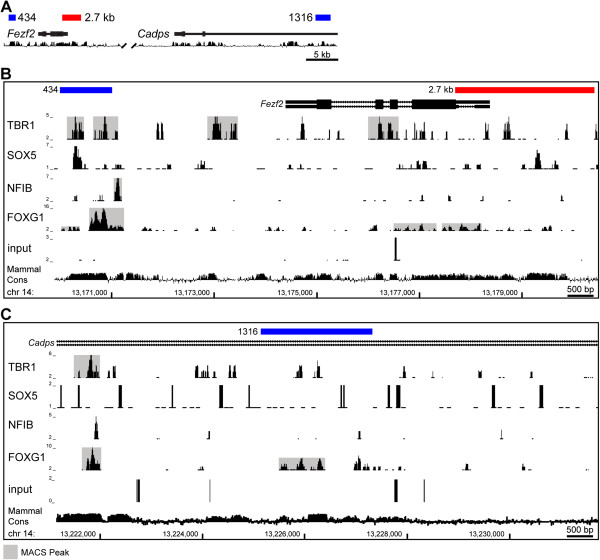
BACKGROUND: The genetic programs required for development of the cerebral cortex are under intense investigation. However, non-coding DNA elements that control the expression of developmentally important genes remain poorly defined. Here we investigate the regulation of Fezf2, a transcription factor that is necessary for the generation of deep-layer cortical projection neurons. RESULTS: Using a combination of chromatin immunoprecipitation followed by high throughput sequencing (ChIP-seq) we mapped the binding of four deep-layer-enriched transcription factors previously shown to be important for cortical development. Building upon this we characterized the activity of three regulatory regions around the Fezf2 locus at multiple stages throughout corticogenesis. We identified a promoter that was sufficient for expression in the cerebral cortex, and enhancers that drove reporter gene expression in distinct forebrain domains, including progenitor cells and cortical projection neurons. CONCLUSIONS: These results provide insight into the regulatory logic controlling Fezf2 expression and further the understanding of how multiple non-coding regulatory domains can collaborate to control gene expression in vivo.
Overview
The claims and statistics of this paper haven’t been checked yet.
Free: it reads the open-access text and checks the first 5 claims that cite a source we can check. Create a free account to check every claim.
Integrity signals
Registry
Cites
Statistics
Figures



Verification
Claims the paper makes
The claims and statistics of this paper haven’t been checked yet.
Free: it reads the open-access text and checks the first 5 claims that cite a source we can check. Create a free account to check every claim.
Claims other papers make about this one
Each is checked against this paper’s own text: does it say what the citing paper says it does?
In the citing paper
“For example, Lhx2-CreER and FezF2-CreER drivers captured embryonic day (E)12.5 RGs in the dorsal neuroepithelium, distributed along a medial-high and lateral-low gradient, consistent with their mRNA expression at this stage59,60.”
From A multimodal cell census and atlas of the mammalian primary motor cortex (2021) · cites this paper as [60]
Self-check
Percentages, sums and reported differences re-computed from the paper’s own numbers.
The self-check needs the paper’s full text.
Citations
Cites
Initial sequencing and analysis of the human genome
International Human Genome Sequencing Consortium, Whitehead Institute for Biomedical Research, C. F. G. R., Lander, E. S., Linton, L. M., Birren, B., Nusbaum, C., Zody, M. C., Baldwin, J., Devon, K., Dewar, K., et al. (2001) · Nature · doi:10.1038/35057062 · Cited by 24,216 · cited 1×
“Current estimates suggest that greater than half of evolutionarily conserved sequences in the human genome do not correspond to protein coding regions [1-4].”
BackgroundModel-based Analysis of ChIP-Seq (MACS)
Zhang, Y., Liu, T., Meyer, C. A., Eeckhoute, J., Johnson, D. S., Bernstein, B. E., Nusbaum, C., Myers, R. M., Brown, M., Li, W., et al. (2008) · Genome Biology · doi:10.1186/gb-2008-9-9-r137 · Cited by 18,386
The sequence of the human genome
Venter, J. C., Adams, M. D., Myers, E. W., Li, P. W., Mural, R. J., Sutton, G. G., Smith, H. O., Yandell, M., Evans, C. A., Holt, R. A., et al. (2001) · Science · doi:10.1126/science.1058040 · Cited by 13,909
A map of human genome variation from population-scale sequencing.
The 1000 Genomes Project Consortium (2010) · Nature · doi:10.1038/nature09534 · Cited by 7,877
Initial sequencing and comparative analysis of the mouse genome
Mouse Genome Sequencing Consortium (2002) · Nature · doi:10.1038/nature01262 · Cited by 7,187
Topological domains in mammalian genomes identified by analysis of chromatin interactions
Dixon, J. R., Selvaraj, S., Yue, F., Kim, A., Li, Y., Shen, Y., Hu, M., Liu, J. S., & Ren, B. (2012) · Nature · doi:10.1038/nature11082 · Cited by 6,829 · cited 1×
“Recently published high throughput chromosome conformation capture (Hi-C) suggests an interaction between enhancer 1316 and the Fezf2 promoter [38].”
BackgroundEvolutionarily conserved elements in vertebrate, insect, worm, and yeast genomes
Siepel, A., Bejerano, G., Pedersen, J. S., Hinrichs, A. S., Hou, M., Rosenbloom, K., Clawson, H., Spieth, J., Hillier, L. W., Richards, S., et al. (2005) · Genome Research · doi:10.1101/gr.3715005 · Cited by 3,971 · cited 1×
“Current estimates suggest that greater than half of evolutionarily conserved sequences in the human genome do not correspond to protein coding regions [1-4].”
BackgroundStrong association of de novo copy number mutations with autism
Sebat, J., Lakshmi, B., Malhotra, D., Troge, J., Lese-Martin, C., Walsh, T., Yamrom, B., Yoon, S., Krasnitz, A., Kendall, J., et al. (2007) · Science · doi:10.1126/science.1138659 · Cited by 2,795 · cited 1×
“Genome-wide association studies (GWAS) have identified sequence variations within putative enhancers that are associated with a wide range of neurological disorders such as autism, epilepsy, and schizophrenia [6-10].”
BackgroundA gene expression atlas of the central nervous system based on bacterial artificial chromosomes
Gong, S., Zheng, C., Doughty, M. L., Losos, K., Didkovsky, N., Schambra, U. B., Nowak, N. J., Joyner, A., Leblanc, G., Hatten, M. E., et al. (2003) · Nature · doi:10.1038/nature02033 · Cited by 2,108 · cited 1×
“Although enhancer 1316 is not contained within this BAC, GFP, or CRE expression in these transgenic mice recapitulates endogenous Fezf2 gene expression [36,39,40], suggesting that this enhancer is not essential for Fezf2 expression during”
BackgroundManipulating the Mouse Embryo: A Laboratory Manual
Behringer, R. R., Gertsenstein, M., Nagy, K. V., & Nagy, A. (2002) · Cited by 2,046
The Sequence of the Human Genome
Venter, J. C., Smith, H. O., & Adams, M. D. (2015) · Clinical Chemistry · doi:10.1373/clinchem.2014.237016 · Cited by 1,648
ChIP-seq accurately predicts tissue-specific activity of enhancers
Visel, A., Blow, M. J., Li, Z., Zhang, T., Akiyama, J. A., Holt, A., Plajzer-Frick, I., Shoukry, M., Wright, C., Chen, F., et al. (2009) · Nature · doi:10.1038/nature07730 · Cited by 1,639 · cited 2×
“The product was then cloned into the hsp68-lacZ expression vector using Gateway cloning according to the manufacturer’s protocol [11].”
BackgroundMethodSelf-citationThe evolutionary significance of cis-regulatory mutations
Wray, G. A. (2007) · Nature Reviews Genetics · doi:10.1038/nrg2063 · Cited by 1,521 · cited 1×
“Genome-wide association studies (GWAS) have identified sequence variations within putative enhancers that are associated with a wide range of neurological disorders such as autism, epilepsy, and schizophrenia [6-10].”
BackgroundRare chromosomal deletions and duplications increase risk of schizophrenia
The International Schizophrenia Consortium (2008) · Nature · doi:10.1038/nature07239 · Cited by 1,475
VISTA Enhancer Browser—a database of tissue-specific human enhancers
Visel, A., Minovitsky, S., Dubchak, I., & Pennacchio, L. A. (2007) · Nucleic Acids Research · doi:10.1093/nar/gkl822 · Cited by 1,080 · cited 1×
“gov) for sequences in and near Fezf2 that may regulate its expression [34].”
BackgroundSelf-citationVirus induction of human IFNβ gene expression requires the assembly of an enhanceosome
Thanos, D., & Maniatis, T. (1995) · Cell · doi:10.1016/0092-8674(95)90136-1 · Cited by 1,014
Satb2 Is a Postmitotic Determinant for Upper-Layer Neuron Specification in the Neocortex
Britanova, O., de Juan Romero, C., Cheung, A., Kwan, K. Y., Schwark, M., Gyorgy, A., Vogel, T., Akopov, S., Mitkovski, M., Agoston, D., et al. (2008) · Neuron · doi:10.1016/j.neuron.2007.12.028 · Cited by 674 · cited 9×
“(B-C’) LacZ was expressed in some CTIP2+ and TBR1+ cells in deep layers.”
InfluentialSatb2 Regulates Callosal Projection Neuron Identity in the Developing Cerebral Cortex
Alcamo, E. A., Chirivella, L., Dautzenberg, M., Dobreva, G., Fariñas, I., Grosschedl, R., & McConnell, S. K. (2008) · Neuron · doi:10.1016/j.neuron.2007.12.012 · Cited by 658 · cited 9×
“(B-C’) LacZ was expressed in some CTIP2+ and TBR1+ cells in deep layers.”
InfluentialFezl Is Required for the Birth and Specification of Corticospinal Motor Neurons
Molyneaux, B. J., Arlotta, P., Hirata, T., Hibi, M., & Macklis, J. D. (2005) · Neuron · doi:10.1016/j.neuron.2005.08.030 · Cited by 492
Transcriptional co-regulation of neuronal migration and laminar identity in the neocortex
Kwan, K. Y., Šestan, N., & Anton, E. S. (2012) · Development · doi:10.1242/dev.069963 · Cited by 395 · cited 1×
“that deep-layer neurons, layers 5 and 6 (L5 and L6), are born before upper-layer neurons [12].”
BackgroundFoxg1 Suppresses Early Cortical Cell Fate
Hanashima, C., Li, S. C., Shen, L., Lai, E., & Fishell, G. (2004) · Science · doi:10.1126/science.1090674 · Cited by 380 · cited 9×
“(B-C’) LacZ was expressed in some CTIP2+ and TBR1+ cells in deep layers.”
InfluentialChen, B., Schaevitz, L. R., & McConnell, S. K. (2005) · Proceedings of the National Academy of Sciences · doi:10.1073/pnas.0508732102 · Cited by 356 · cited 3×
“Phenotypic analysis of Fezf2 mice indicates that it is required for both the patterning and maintenance of forebrain progenitors [45], and the fate specification of deep-layer cortical projection neurons [13-16].”
BackgroundSelf-citationChen, B., Wang, S. S., Hattox, A. M., Rayburn, H., Nelson, S. B., & McConnell, S. K. (2008) · Proceedings of the National Academy of Sciences · doi:10.1073/pnas.0804918105 · Cited by 339 · cited 4×
“Phenotypic analysis of Fezf2 mice indicates that it is required for both the patterning and maintenance of forebrain progenitors [45], and the fate specification of deep-layer cortical projection neurons [13-16].”
BackgroundInfluentialSelf-citationSOX5 Controls the Sequential Generation of Distinct Corticofugal Neuron Subtypes
Lai, T., Jabaudon, D., Molyneaux, B. J., Azim, E., Arlotta, P., Menezes, J. R. L., & Macklis, J. D. (2008) · Neuron · doi:10.1016/j.neuron.2007.12.023 · Cited by 300 · cited 10×
“(B-C’) LacZ was expressed in some CTIP2+ and TBR1+ cells in deep layers.”
BackgroundInfluentialKwan, K. Y., Lam, M. M. S., Krsnik, Ž., Kawasawa, Y. I., Lefebvre, V., & Šestan, N. (2008) · Proceedings of the National Academy of Sciences · doi:10.1073/pnas.0806791105 · Cited by 271 · cited 10×
“(B-C’) LacZ was expressed in some CTIP2+ and TBR1+ cells in deep layers.”
BackgroundInfluentialA High-Resolution Enhancer Atlas of the Developing Telencephalon
Visel, A., Taher, L., Girgis, H., May, D., Golonzhka, O., Hoch, R. V., McKinsey, G. L., Pattabiraman, K., Silberberg, S. N., Blow, M. J., et al. (2013) · Cell · doi:10.1016/j.cell.2012.12.041 · Cited by 257 · cited 3×
“We generated stable transgenic lines expressing LacZ under the control of enhancer 434 and the hsp68 minimal promoter [37].”
BackgroundMethodInfluentialSelf-citationTbr1 and Fezf2 Regulate Alternate Corticofugal Neuronal Identities during Neocortical Development
McKenna, W. L., Betancourt, J., Larkin, K. A., Abrams, B., Guo, C., Rubenstein, J. L. R., & Chen, B. (2011) · The Journal of Neuroscience · doi:10.1523/jneurosci.4131-10.2011 · Cited by 252 · cited 11×
“(B-C’) LacZ was expressed in some CTIP2+ and TBR1+ cells in deep layers.”
BackgroundMethodInfluentialSelf-citationChen, J.-G., Rašin, M.-R., Kwan, K. Y., & Šestan, N. (2005) · Proceedings of the National Academy of Sciences · doi:10.1073/pnas.0509032102 · Cited by 248 · cited 3×
“Phenotypic analysis of Fezf2 mice indicates that it is required for both the patterning and maintenance of forebrain progenitors [45], and the fate specification of deep-layer cortical projection neurons [13-16].”
BackgroundMultiple enhancers ensure precision of gap gene-expression patterns in the Drosophila embryo
Perry, M. W., Boettiger, A. N., & Levine, M. (2011) · Proceedings of the National Academy of Sciences · doi:10.1073/pnas.1109873108 · Cited by 228 · cited 1×
“These results are similar to the regulation of the eve gene locus in Drosophila where multiple, partially redundant enhancers control expression in individual stripes along the anterior-posterior axis of the embryo [41,42].”
ResultThe Cell-Intrinsic Requirement of Sox6 for Cortical Interneuron Development
Batista-Brito, R., Rossignol, E., Hjerling-Leffler, J., Denaxa, M., Wegner, M., Lefebvre, V., Pachnis, V., & Fishell, G. (2009) · Neuron · doi:10.1016/j.neuron.2009.08.005 · Cited by 214 · cited 9×
“(B-C’) LacZ was expressed in some CTIP2+ and TBR1+ cells in deep layers.”
InfluentialSOX6 controls dorsal progenitor identity and interneuron diversity during neocortical development
Azim, E., Jabaudon, D., Fame, R. M., & Macklis, J. D. (2009) · Nature Neuroscience · doi:10.1038/nn.2387 · Cited by 207 · cited 9×
“(B-C’) LacZ was expressed in some CTIP2+ and TBR1+ cells in deep layers.”
InfluentialHan, W., Kwan, K. Y., Shim, S., Lam, M. M. S., Shin, Y., Xu, X., Zhu, Y., Li, M., & Šestan, N. (2011) · Proceedings of the National Academy of Sciences · doi:10.1073/pnas.1016723108 · Cited by 206 · cited 10×
“(B-C’) LacZ was expressed in some CTIP2+ and TBR1+ cells in deep layers.”
BackgroundInfluentialDirect lineage reprogramming of post-mitotic callosal neurons into corticofugal neurons in vivo
Rouaux, C., & Arlotta, P. (2013) · Nature Cell Biology · doi:10.1038/ncb2660 · Cited by 205 · cited 1×
“Collectively, these studies suggest that Fezf2 functions high in a transcriptional hierarchy that regulates SCPN development and fate specification [14,17-19].”
BackgroundIn vivo reprogramming of circuit connectivity in postmitotic neocortical neurons
De la Rossa, A., Bellone, C., Golding, B., Vitali, I., Moss, J., Toni, N., Lüscher, C., & Jabaudon, D. (2013) · Nature Neuroscience · doi:10.1038/nn.3299 · Cited by 191 · cited 1×
“Collectively, these studies suggest that Fezf2 functions high in a transcriptional hierarchy that regulates SCPN development and fate specification [14,17-19].”
BackgroundCis-regulatory control of corticospinal system development and evolution
Shim, S., Kwan, K. Y., Li, M., Lefebvre, V., & Šestan, N. (2012) · Nature · doi:10.1038/nature11094 · Cited by 183 · cited 6×
“Recent deletion analysis demonstrated that this enhancer is critical for subcerebral projection neuron identity and connectivity [36].”
InfluentialGuo, C., Eckler, M. J., McKenna, W. L., McKinsey, G. L., Rubenstein, J. L. R., & Chen, B. (2013) · Neuron · doi:10.1016/j.neuron.2013.09.037 · Cited by 174 · cited 2×
“We recently reported that in addition to deep-layer cortical neurons, Fezf2 is expressed in progenitor cells throughout cortical neurogenesis [39].”
BackgroundSelf-citationMarinić, M., Aktaş, T., Ruf, S., & Spitz, F. (2013) · Developmental Cell · doi:10.1016/j.devcel.2013.01.025 · Cited by 162 · cited 1×
“Similar regulatory paradigms have also been uncovered in mammals through analysis of the interferon-beta [43] or Fgf8 [44] loci.”
BackgroundMiyoshi, G., & Fishell, G. (2012) · Neuron · doi:10.1016/j.neuron.2012.04.025 · Cited by 159 · cited 9×
“(B-C’) LacZ was expressed in some CTIP2+ and TBR1+ cells in deep layers.”
InfluentialZinc finger gene fez‐like functions in the formation of subplate neurons and thalamocortical axons
Hirata, T., Suda, Y., Nakao, K., Narimatsu, M., Hirano, T., & Hibi, M. (2004) · Developmental Dynamics · doi:10.1002/dvdy.20068 · Cited by 124 · cited 1×
“Consistent with previous reports [20,21], at E12.”
Fezf2 directs the differentiation of corticofugal neurons from striatal progenitors in vivo
Rouaux, C., & Arlotta, P. (2010) · Nature Neuroscience · doi:10.1038/nn.2658 · Cited by 117 · cited 2×
“Collectively, these studies suggest that Fezf2 functions high in a transcriptional hierarchy that regulates SCPN development and fate specification [14,17-19].”
BackgroundZinc-finger genes Fez and Fez-like function in the establishment of diencephalon subdivisions
Hirata, T., Nakazawa, M., Muraoka, O., Nakayama, R., Suda, Y., & Hibi, M. (2006) · Development · doi:10.1242/dev.02585 · Cited by 100
Shimizu, T., Nakazawa, M., Kani, S., Bae, Y., Shimizu, T., Kageyama, R., & Hibi, M. (2010) · Development · doi:10.1242/dev.047167 · Cited by 91 · cited 1×
“Phenotypic analysis of Fezf2 mice indicates that it is required for both the patterning and maintenance of forebrain progenitors [45], and the fate specification of deep-layer cortical projection neurons [13-16].”
BackgroundBaranek, C., Dittrich, M., Parthasarathy, S., Bonnon, C. G., Britanova, O., Lanshakov, D., Boukhtouche, F., Sommer, J. E., Colmenares, C., Tarabykin, V., et al. (2012) · Proceedings of the National Academy of Sciences · doi:10.1073/pnas.1108718109 · Cited by 90 · cited 9×
“(B-C’) LacZ was expressed in some CTIP2+ and TBR1+ cells in deep layers.”
InfluentialEnhancers: From Developmental Genetics to the Genetics of Common Human Disease
Williamson, I., Hill, R. E., & Bickmore, W. A. (2011) · Developmental Cell · doi:10.1016/j.devcel.2011.06.008 · Cited by 78 · cited 1×
“Transcriptional enhancers, non-coding DNA sequences that promote gene expression in a spatial and temporal manner, constitute a substantial portion of these regions [5].”
BackgroundAnterior repression of a Drosophila stripe enhancer requires three position-specific mechanisms
Andrioli, L. P. M., Vasisht, V., Theodosopoulou, E., Oberstein, A., & Small, S. (2002) · Development · doi:10.1242/dev.129.21.4931 · Cited by 78
Analysis of four DLX homeobox genes in autistic probands
Hamilton, S. P., Woo, J. M., Carlson, E. J., Ghanem, N., Ekker, M., & Rubenstein, J. L. (2005) · BMC Genetics · doi:10.1186/1471-2156-6-52 · Cited by 72 · cited 1×
“Genome-wide association studies (GWAS) have identified sequence variations within putative enhancers that are associated with a wide range of neurological disorders such as autism, epilepsy, and schizophrenia [6-10].”
BackgroundSelf-citationMultiple non-cell-autonomous defects underlie neocortical callosal dysgenesis in Nfib-deficient mice
Piper, M., Moldrich, R. X., Lindwall, C., Little, E., Barry, G., Mason, S., Sunn, N., Kurniawan, N. D., Gronostajski, R. M., & Richards, L. J. (2009) · Neural Development · doi:10.1186/1749-8104-4-43 · Cited by 67 · cited 9×
“(B-C’) LacZ was expressed in some CTIP2+ and TBR1+ cells in deep layers.”
InfluentialFez1 is layer‐specifically expressed in the adult mouse neocortex
Inoue, K., Terashima, T., Nishikawa, T., & Takumi, T. (2004) · European Journal of Neuroscience · doi:10.1111/j.1460-9568.2004.03763.x · Cited by 59 · cited 1×
“Consistent with previous reports [20,21], at E12.”
Fezf1 and Fezf2 are required for olfactory development and sensory neuron identity
Eckler, M. J., McKenna, W. L., Taghvaei, S., McConnell, S. K., & Chen, B. (2011) · The Journal of Comparative Neurology · doi:10.1002/cne.22596 · Cited by 42 · cited 1×
“Immunostaining and in situ hybridization were performed as previously described [47].”
MethodSelf-citation
Cited by
A multimodal cell census and atlas of the mammalian primary motor cortex
BRAIN Initiative Cell Census Network (BICCN), BRAIN Initiative Cell Census Network (BICCN) Corresponding authors, Callaway, E. M., Dong, H.-W., Ecker, J. R., Hawrylycz, M. J., Huang, Z. J., Lein, E. S., Ngai, J., Osten, P., et al. (2021) · Nature · doi:10.1038/s41586-021-03950-0 · Cited by 522
Uzquiano, A., Kedaigle, A. J., Pigoni, M., Paulsen, B., Adiconis, X., Kim, K., Faits, T., Nagaraja, S., Antón-Bolaños, N., Gerhardinger, C., et al. (2022) · Cell · doi:10.1016/j.cell.2022.09.010 · Cited by 244
Genetic dissection of the glutamatergic neuron system in cerebral cortex
Matho, K. S., Huilgol, D., Galbavy, W., He, M., Kim, G., An, X., Lu, J., Wu, P., Di Bella, D. J., Shetty, A. S., et al. (2021) · Nature · doi:10.1038/s41586-021-03955-9 · Cited by 155
Toma, K., Kumamoto, T., & Hanashima, C. (2014) · Journal of Neuroscience · doi:10.1523/jneurosci.2334-14.2014 · Cited by 119
McKenna, W. L., Ortiz-Londono, C. F., Mathew, T. K., Hoang, K., Katzman, S., & Chen, B. (2015) · Proceedings of the National Academy of Sciences · doi:10.1073/pnas.1504144112 · Cited by 95
“We have generated stable transgenic mouse lines that expressed a lacZ gene under the control of enhancer 434 and an hsp68 minimal promoter (enhancer 434-lacZ mice) (15).”
BackgroundMethodSelf-citation
Metadata
- Authors
- Eckler, M. J., Larkin, K. A., McKenna, W. L., Katzman, S., Guo, C., Roque, R., Visel, A., Rubenstein, J. L. L., & Chen, B.
- Affiliations
- University of California, Santa Cruz (US)
- Lawrence Berkeley National Laboratory (US)
- Corresponding author
- Chen, Bin
- Venue
- Neural Development
- Published
- 2014-03-12
- Volume
- 9
- Issue
- 1
- Pages
- 6-6
- ISSN
- 1749-8104 (ISSN-L)
- PMC
- PMC4008173
- OpenAlex
- W2153518972
- Cited by
- 27
- References
- 50
- Citations by year
- 2025: 1 · 2024: 4 · 2023: 1 · 2022: 4 · 2021: 4 · 2020: 1 · 2019: 1 · 2017: 5 · 2016: 2 · 2015: 2 · 2014: 2
- FWCI
- 1.27
- Type
- journal article
- Language
- en
- Open access
- gold
- doi.org
- Licence
- cc-by
- Locations
- Neural Development (publishedVersion, cc-by)
- Europe PMC (PubMed Central) (publishedVersion, cc-by)
- PubMed Central (publishedVersion, cc-by)
- PubMed (publishedVersion)
- OSTI OAI (U.S. Department of Energy Office of Scientific and Technical Information) (submittedVersion)
- eScholarship (California Digital Library) (submittedVersion)
- eScholarship (California Digital Library) (submittedVersion, cc-by)
- Funders
- California Institute of Regenerative Medicine
- National Institute of Mental Health (R01MH094589)
- National Human Genome Research Institute (R01HG003988)
- National Institute of Neurological Disorders and Stroke (R01NS062859, R01 NS062859A, NS34661, R01NS034661, R01NS099099)
- Topics
- Life Sciences › Neuroscience › Developmental Neuroscience › Neurogenesis and neuroplasticity mechanisms
- Life Sciences › Biochemistry, Genetics and Molecular Biology › Molecular Biology › Genomics and Chromatin Dynamics
- Life Sciences › Biochemistry, Genetics and Molecular Biology › Molecular Biology › Developmental Biology and Gene Regulation
- Keywords
- Fezf2, cortical development, transcription factor binding sites, enhancers, promoter, non-coding regulatory elements, cortical progenitor cells, forebrain, gene expression regulation
- MeSH terms
- Animals, Cerebral Cortex, DNA-Binding Proteins, Enhancer Elements, Genetic, Mice, Transgenic, Nerve Tissue Proteins, Regulatory Elements, Transcriptional, Mice
About these checks
Registry, retraction, Cites and statistics results are computed, not judged, with one exception: a printed reference that no index lists is read once by a model before it counts as a citation error. Claims are extracted by a model and kept only when their quote appears verbatim in the text; each cited source is then checked, with a model’s help, for whether it says what the claim relies on. Those verdicts can be wrong — read the claim’s quote and the cited source before relying on one.
Statistics and arithmetic are recomputed, not judged.
Confidence bands are shown only for fields calibrated on our annotated test set. None is calibrated yet, so no band is shown.
What counts as a claim ›How we measure confidence ›How we check this ›
Are you an author, or do you see a problem with this page? Request a review
Data sources
Bibliographic data: Semantic Scholar, OpenAlex, Crossref.
Contains information from the Semantic Scholar Academic Graph Datasets, made available under the ODC Attribution License (ODC-BY 1.0).
Semantic Scholar’s data is described in: Kinney, R., et al. (2023). The Semantic Scholar Open Data Platform. arXiv:2301.10140.
