

The Greig cephalopolysyndactyly syndrome
Open accessThe DOI matches its Crossref record; 31 of the 31 references it cites were found in a registry or an index.
Abstract
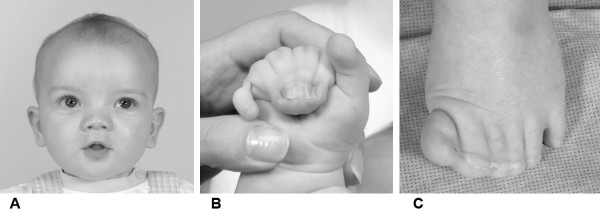
The Greig cephalopolysyndactyly syndrome (GCPS) is a pleiotropic, multiple congenital anomaly syndrome. It is rare, but precise estimates of incidence are difficult to determine, as ascertainment is erratic (estimated range 1–9/1,000,000). The primary findings include hypertelorism, macrocephaly with frontal bossing, and polysyndactyly. The polydactyly is most commonly preaxial of the feet and postaxial in the hands, with variable cutaneous syndactyly, but the limb findings vary significantly. Other low frequency findings include central nervous system (CNS) anomalies, hernias, and cognitive impairment. GCPS is caused by loss of function mutations in the GLI3 transcription factor gene and is inherited in an autosomal dominant pattern. The disorder is allelic to the Pallister-Hall syndrome and one form of the acrocallosal syndrome. Clinical diagnosis is challenging because the findings of GCPS are relatively non-specific, and no specific and sensitive clinical have been delineated. For this reason, we have proposed a combined clinical-molecular definition for the syndrome. A presumptive diagnosis of GCPS can be made if the patient has the classic triad of preaxial polydactyly with cutaneous syndactyly of at least one limb, hypertelorism, and macrocephaly. Patients with a phenotype consistent with GCPS (but which may not manifest all three attributes listed above) and a GLI3 mutation may be diagnosed definitively with GCPS. In addition, persons with a GCPS-consistent phenotype who are related to a definitively diagnosed family member in a pattern consistent with autosomal dominant inheritance may be diagnosed definitively as well. Antenatal molecular diagnosis is technically straightforward to perform. Differential diagnoses include preaxial polydactyly type 4, the GCPS contiguous gene syndrome, acrocallosal syndrome, Gorlin syndrome, Carpenter syndrome, and Teebi syndrome. Treatment of the disorder is symptomatic, with plastic or orthopedic surgery indicated for significant limb malformations. The prognosis for typically affected patients is excellent. There may be a slight increase in the incidence of developmental delay or cognitive impairment. Patients with large deletions that include GLI3 may have a worse prognosis. The Article is a work of the United States Government. Title 17 U.S.C 5 105 provides that copyright protection is not available for any work of the United States Government in the United States. The United States hereby grants to anyone a paid-up, nonexclusive, irrevocable worldwide license to reproduce, prepare derivative works, distribute copies to the public and perform publicly and display publicly the work, and also retains the nonexclusive right to do all of the above for or on behalf of the United States.
Overview
The claims and statistics of this paper haven’t been checked yet.
Free: it reads the open-access text and checks the first 5 claims that cite a source we can check. Create a free account to check every claim.
Integrity signals
Registry
Cites
Statistics
Figures
Verification
Claims the paper makes
The claims and statistics of this paper haven’t been checked yet.
Free: it reads the open-access text and checks the first 5 claims that cite a source we can check. Create a free account to check every claim.
Claims other papers make about this one
Each is checked against this paper’s own text: does it say what the citing paper says it does?
The cited source says what the claim attributes to it.
In the citing paper
“Both genes are known regulators of mouse cortical development33–35 and are associated with developmental disorders in humans14,36.”
From Inferring and perturbing cell fate regulomes in human brain organoids (2023) · cites this paper as [14]
In the citing paper
“In humans, mutations in GLI3 are associated with Greig cephalopolysyndactyly syndrome and Pallister Hall syndrome, in which patients have variable presentations of brain malformations depending on the particular mutations14.”
From Inferring and perturbing cell fate regulomes in human brain organoids (2023) · cites this paper as [14]
Self-check
Percentages, sums and reported differences re-computed from the paper’s own numbers.
The self-check needs the paper’s full text.
Citations
Cites
Nevoid Basal-Cell Carcinoma Syndrome
GORLIN, R. J. (1987) · Medicine · doi:10.1097/00005792-198703000-00002 · Cited by 883
Syndromes of the Head and Neck
Gorlin, R. J., Cohen, M. M., & Hennekam, R. C. M. (2001) · doi:10.1093/oso/9780195118612.001.0001 · Cited by 839
GLI3 zinc-finger gene interrupted by translocations in Greig syndrome families
Vortkamp, A., Gessler, M., & Grzeschik, K.-H. (1991) · Nature · doi:10.1038/352539a0 · Cited by 545
The Sonic Hedgehog–Patched–Gli Pathway in Human Development and Disease
Villavicencio, E. H., Walterhouse, D. O., & Iannaccone, P. M. (2000) · The American Journal of Human Genetics · doi:10.1016/s0002-9297(07)62934-6 · Cited by 435
Johnston, J. J., Olivos-Glander, I., Killoran, C., Elson, E., Turner, J. T., Peters, K. F., Abbott, M. H., Aughton, D. J., Aylsworth, A. S., Bamshad, M. J., et al. (2005) · The American Journal of Human Genetics · doi:10.1086/429346 · Cited by 280
Self-citationJenkins, D., Seelow, D., Jehee, F. S., Perlyn, C. A., Alonso, L. G., Bueno, D. F., Donnai, D., Josifiova, D., Mathijssen, I. M. J., Morton, J. E. V., et al. (2007) · The American Journal of Human Genetics · doi:10.1086/518047 · Cited by 276
Human Malformations and Related Anomalies
Stevenson, R. E. (2005) · Human Malformations and Related Anomalies Second Edition · doi:10.1093/oso/9780195165685.003.0001 · Cited by 271
Elements of morphology: Standard terminology for the head and face
Allanson, J. E., Cunniff, C., Hoyme, H. E., McGaughran, J., Muenke, M., & Neri, G. (2009) · American Journal of Medical Genetics Part A · doi:10.1002/ajmg.a.32612 · Cited by 191
Radhakrishna, U., Bornholdt, D., Scott, H. S., Patel, U. C., Rossier, C., Engel, H., Bottani, A., Chandal, D., Blouin, J.-L., Solanki, J. V., et al. (1999) · The American Journal of Human Genetics · doi:10.1086/302557 · Cited by 183
Point Mutations in Human GLI3 Cause Greig Syndrome
Wild, A., Kalff-Suske, M., Vortkamp, A., Bornholdt, D., Konig, R., & Grzeschik, K.-H. (1997) · Human Molecular Genetics · doi:10.1093/hmg/6.11.1979 · Cited by 170
Point Mutations Throughout the GLI3 Gene Cause Greig Cephalopolysyndactyly Syndrome
Kalff-Suske, M., Wild, A., Topp, J., Wessling, M., Jacobsen, E.-M., Bornholdt, D., Engel, H., Heuer, H., Aalfs, C. M., Ausems, M. G. E. M., et al. (1999) · Human Molecular Genetics · doi:10.1093/hmg/8.9.1769 · Cited by 147
Elements of morphology: Standard terminology for the hands and feet
Biesecker, L. G., Aase, J. M., Clericuzio, C. L., Gurrieri, F., Temple, I. K., & Toriello, H. V. (2009) · American Journal of Medical Genetics Part A · doi:10.1002/ajmg.a.32596 · Cited by 138
Self-citationElements of morphology: Standard terminology for the periorbital region
Hall, B. D., Graham, J. M., Cassidy, S. B., & Opitz, J. M. (2009) · American Journal of Medical Genetics Part A · doi:10.1002/ajmg.a.32597 · Cited by 121
What you can learn from one gene: GLI3
Biesecker, L. G. (2006) · Journal of Medical Genetics · doi:10.1136/jmg.2004.029181 · Cited by 93
Self-citationElson, E., Perveen, R., Donnai, D., Wall, S., & Black, G. C. M. (2002) · Journal of Medical Genetics · doi:10.1136/jmg.39.11.804 · Cited by 86
Phenotype of five patients with Greig syndrome and microdeletion of 7p13
Kroisel, P. M., Petek, E., & Wagner, K. (2001) · American Journal of Medical Genetics · doi:10.1002/ajmg.1443 · Cited by 73
Greig, D. M. (1926) · PubMed Central · Cited by 63
Johnston, J. J., Olivos-Glander, I. M., Turner, J. T., Aleck, K. A., Bird, L. M., Mehta, L., Schimke, R. N., Heilstedt, H. A., Spence, J. E., Blancato, J. K., et al. (2003) · American Journal of Medical Genetics Part A · doi:10.1002/ajmg.a.20318 · Cited by 60
Self-citationPolydactyly: How many disorders and how many genes?
Biesecker, L. G. (2002) · American Journal of Medical Genetics · doi:10.1002/ajmg.10779 · Cited by 60
Self-citationDebeer, P., Peeters, H., Driess, S., SMET, L. D., Freese, K., Matthijs, G., Bornholdt, D., Devriendt, K., Grzeschik, K., Fryns, J. P., et al. (2003) · American Journal of Medical Genetics Part A · doi:10.1002/ajmg.a.20018 · Cited by 53
New autosomal dominant syndrome resembling craniofrontonasal dysplasia
Teebi, A. S., & Reynolds, J. F. (1987) · American Journal of Medical Genetics · doi:10.1002/ajmg.1320280306 · Cited by 45
The clinical atlas of Greig cephalopolysyndactyly syndrome
Balk, K., & Biesecker, L. G. (2008) · American Journal of Medical Genetics Part A · doi:10.1002/ajmg.a.32167 · Cited by 43
Self-citationGreig cephalopolysyndactyly: report of 13 affected individuals in three families
Baraitser, M., Winter, R. M., & Brett, E. M. (1983) · Clinical Genetics · doi:10.1111/j.1399-0004.1983.tb00080.x · Cited by 42
Greig Cephalopolysyndactyly Syndrome
Duncan, P. A., Klein, R. E., Wilmot, P. L., & Shapiro, L. R. (1979) · Archives of Pediatrics and Adolescent Medicine · doi:10.1001/archpedi.1979.02130080058010 · Cited by 31
Greig syndrome in a large kindred due to reciprocal chromosome translocation t(6;7)(q27;p13)
Krüger, G., Götz, J., Kvist, U., Dunker, H., Erfurth, F., Pelz, L., & Zech, L. (1989) · American Journal of Medical Genetics · doi:10.1002/ajmg.1320320329 · Cited by 31
Johnston, J. J., Walker, R. L., Davis, S. R., Facio, F. M., Turner, J. T., Bick, D. P., Daentl, D. L., Ellison, J. W., Meltzer, P. S., & Biesecker, L. G. (2006) · Journal of Medical Genetics · doi:10.1136/jmg.2006.042473 · Cited by 25
Self-citationWilliams, P. G., Hersh, J. H., Yen, F., Barch, M. J., Kleinert, H. E., Kunz, J., & Kalff-Suske, M. (1997) · Clinical Genetics · doi:10.1111/j.1399-0004.1997.tb02565.x · Cited by 22
Mendoza‐Londono, R., Kashork, C. D., Shaffer, L. G., Krance, R. A., & Plon, S. E. (2004) · Genes Chromosomes and Cancer · doi:10.1002/gcc.20100 · Cited by 17
Gene symbol: GLI3. Disease: Greig cephalopolysyndactyly syndrome.
Driess, S., Freese, K., Bornholdt, D., Kobelt, A., Kress, W., Mortier, G., Radhakrishna, U., Antonarakis, S. E., Rauch, A. M., Suri, M., et al. (2002) · Human Genetics · doi:10.1007/s00439-002-0868-2 · Cited by 16
The spectrum of hand and foot malformations in patients with Greig cephalopolysyndactyly
Debeer, P., Devriendt, K., SMET, L. D., DERAVEL, T., González‐Meneses, A., Grzeschik, K., & Fryns, J. (2007) · Journal of Children s Orthopaedics · doi:10.1007/s11832-007-0022-8 · Cited by 16
Schulz, S., Volleth, M., Muschke, P., Wieland, I., & Wieacker, P. (2008) · The Application of Clinical Genetics · doi:10.2147/tacg.s4401 · Cited by 10
Research works printed but not linked: 2
- Kalff-Suske M Gene symbol: GLI3. Disease: Greig cephalopolysyndactyly syndrome Hum Genet 2000 107 203 12575660
- Gorlin RJ Cohen MM Jr Hennekam RCM Gorlin RJ, Cohen MM, Jr, Hennekam RCM Acrocallosal syndrome Syndromes of the Head and Neck 2001 Oxford: Oxford University Press 996 998 · DOI · Paper page
Cited by
Infantile hydrocephalus: A review of epidemiology, classification and causes
Tully, H. M., & Dobyns, W. B. (2014) · European Journal of Medical Genetics · doi:10.1016/j.ejmg.2014.06.002 · Cited by 402
Inferring and perturbing cell fate regulomes in human brain organoids
Fleck, J. S., Jansen, S. M. J., Wollny, D., Zenk, F., Seimiya, M., Jain, A., Okamoto, R., Santel, M., He, Z., Camp, J. G., et al. (2023) · Nature · doi:10.1038/s41586-022-05279-8 · Cited by 315
Johnston, J. J., Olivos-Glander, I., Killoran, C., Elson, E., Turner, J. T., Peters, K. F., Abbott, M. H., Aughton, D. J., Aylsworth, A. S., Bamshad, M. J., et al. (2005) · The American Journal of Human Genetics · doi:10.1086/429346 · Cited by 280
Self-citationGLI3: a mediator of genetic diseases, development and cancer
Matissek, S. J., & Elsawa, S. F. (2020) · Cell Communication and Signaling · doi:10.1186/s12964-020-00540-x · Cited by 149
Molecular analysis expands the spectrum of phenotypes associated with GLI3 mutations
Johnston, J. J., Sapp, J. C., Turner, J. T., Amor, D. J., Aftimos, S. F., Aleck, K. A., Bocian, M. E., Bodurtha, J. N., Cox, G. F., Curry, C. J., et al. (2010) · Human Mutation · doi:10.1002/humu.21328 · Cited by 137
Self-citation
Metadata
- Authors
- Biesecker, L. G.
- Affiliations
- National Institutes of Health (US)
- Corresponding author
- Biesecker, Leslie G
- ORCID
- Biesecker, Leslie G
- Venue
- Orphanet Journal of Rare Diseases
- Published
- 2008-04-24
- Volume
- 3
- Issue
- 1
- Pages
- 10-10
- ISSN
- 1750-1172 (ISSN-L)
- PMC
- PMC2397380
- OpenAlex
- W2096997450
- Cited by
- 98
- References
- 31
- Citations by year
- 2026: 1 · 2025: 3 · 2024: 11 · 2023: 1 · 2022: 4 · 2021: 12 · 2020: 8 · 2019: 6 · 2018: 3 · 2017: 5 · 2016: 1 · 2015: 6 · 2014: 8 · 2013: 3 · 2012: 6
- FWCI
- 3.48
- Type
- journal article
- Language
- en
- Open access
- gold
- doi.org
- Licence
- cc-by
- Locations
- Orphanet Journal of Rare Diseases (publishedVersion, cc-by)
- PubMed Central (publishedVersion, cc-by)
- PubMed (publishedVersion)
- DOAJ (DOAJ: Directory of Open Access Journals) (submittedVersion)
- Topics
- Life Sciences › Biochemistry, Genetics and Molecular Biology › Developmental Biology › Congenital limb and hand anomalies
- Life Sciences › Biochemistry, Genetics and Molecular Biology › Genetics › Genomics and Rare Diseases
- Health Sciences › Medicine › Surgery › Craniofacial Disorders and Treatments
- Keywords
- Greig cephalopolysyndactyly syndrome, polydactyly, syndactyly, hypertelorism, macrocephaly, autosomal dominant inheritance, Pallister-Hall syndrome, acrocallosal syndrome, Gorlin syndrome, Carpenter syndrome, differential diagnosis
- MeSH terms
- Abnormalities, Multiple, Zinc Finger Protein Gli3, Brain, Diagnosis, Differential, Humans, Hypertelorism, Nerve Tissue Proteins, Prenatal Diagnosis, Prognosis, Recurrence, Risk Factors, Syndactyly, Syndrome, Rare Diseases, Kruppel-Like Transcription Factors
About these checks
Registry, retraction, Cites and statistics results are computed, not judged, with one exception: a printed reference that no index lists is read once by a model before it counts as a citation error. Claims are extracted by a model and kept only when their quote appears verbatim in the text; each cited source is then checked, with a model’s help, for whether it says what the claim relies on. Those verdicts can be wrong — read the claim’s quote and the cited source before relying on one.
Statistics and arithmetic are recomputed, not judged.
Confidence bands are shown only for fields calibrated on our annotated test set. None is calibrated yet, so no band is shown.
What counts as a claim ›How we measure confidence ›How we check this ›
Are you an author, or do you see a problem with this page? Request a review
Data sources
Bibliographic data: Semantic Scholar, OpenAlex, Crossref.
Contains information from the Semantic Scholar Academic Graph Datasets, made available under the ODC Attribution License (ODC-BY 1.0).
Semantic Scholar’s data is described in: Kinney, R., et al. (2023). The Semantic Scholar Open Data Platform. arXiv:2301.10140.
