

The DOI matches its Crossref record; 32 of the 33 references it cites were found in a registry or an index.
The epidemiology and medical management of low back pain during ambulatory medical care visits in the United States
Open accessAbstract
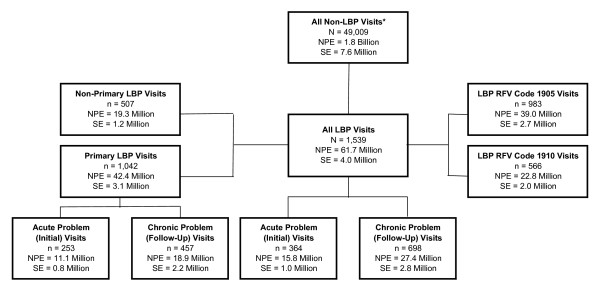
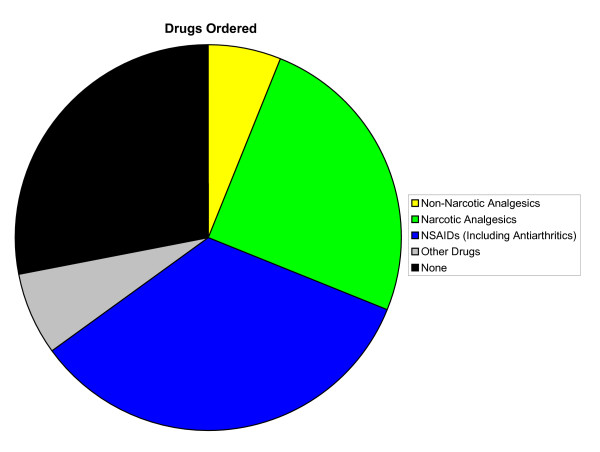
BACKGROUND: Low back pain (LBP) is a common symptom. METHODS: Patient visits attributed to LBP in the National Ambulatory Medical Care Survey (NAMCS) during 2003-2004 served as the basis for epidemiological analyses (n = 1539). The subset of patient visits in which LBP was the primary reason for seeking care (primary LBP patient visits) served as the basis for medical management analyses (n = 1042). National population estimates were derived using statistical weighting techniques. RESULTS: There were 61.7 million (SE, 4.0 million) LBP patient visits and 42.4 million (SE, 3.1 million) primary LBP patient visits. Only 55% of LBP patient visits were provided by primary care physicians. Age, geographic region, chronicity of symptoms, injury, type of physician provider, and physician specialty were associated with LBP patient visits. Age, injury, primary care physician status, type of physician provider, and shared physician care were associated with chronicity of LBP care. Osteopathic physicians were more likely than allopathic physicians to provide medical care during LBP patient visits (odds ratio [OR], 2.61; 95% confidence interval [CI], 1.75-3.92) and chronic LBP patient visits (OR, 4.39; 95% CI, 2.47-7.80). Nonsteroidal anti-inflammatory drugs (NSAIDs) and narcotic analgesics were ordered during 14.2 million (SE, 1.2 million) and 10.5 million (SE, 1.1 million) primary LBP patient visits, respectively. Drugs (OR, 0.29; 95% CI, 0.13-0.62) and, specifically, NSAIDs (OR, 0.40; 95% CI, 0.25-0.64) were ordered less often during chronic LBP patient visits compared with acute LBP patient visits. Overall, osteopathic physicians were less likely than allopathic physicians to order NSAIDs for LBP (OR, 0.43; 95% CI, 0.24-0.76). Almost two million surgical procedures were ordered, scheduled, or performed during primary LBP patient visits. CONCLUSION: The percentage of LBP visits provided by primary care physicians in the United States remains suboptimal. Medical management of LBP, particularly chronic LBP, appears to over-utilize surgery relative to more conservative measures such as patient counseling, non-narcotic analgesics, and other drug therapies. Osteopathic physicians are more likely to provide LBP care, and less likely to use NSAIDs during such visits, than their allopathic counterparts. In general, LBP medical management does not appear to be in accord with evidence-based guidelines.
Overview
The claims and statistics of this paper haven’t been checked yet.
Run the check — free, no account needed. It reads the open-access text and checks the sources it cites.
Integrity signals
Registry
Cites
Statistics
Figures
Verification
Claims the paper makes
The claims and statistics of this paper haven’t been checked yet.
Run the check — free, no account needed. It reads the open-access text and checks the sources it cites.
Claims other papers make about this one
Each is checked against this paper’s own text: does it say what the citing paper says it does?
The cited source says what the claim attributes to it.
In the citing paper
“Indeed, data from the National Ambulatory Medical Care Survey demonstrated that osteopathic physicians provided a disproportionately large volume of medical visits for low back pain and prescribed nonsteroidal anti-inflammatory drugs less frequently than allopathic physicians [5].”
From The process and outcomes of chronic low back pain treatment provided by osteopathic and allopathic physicians: a retrospective cohort study (2023) · cites this paper as [5]
The cited source says what the claim attributes to it.
In the citing paper
“Indeed, data from the National Ambulatory Medical Care Survey demonstrated that osteopathic physicians provided a disproportionately large volume of medical visits for low back pain and prescribed nonsteroidal anti-inflammatory drugs less frequently than allopathic physicians [5].”
From The process and outcomes of chronic low back pain treatment provided by osteopathic and allopathic physicians: a retrospective cohort study (2023) · cites this paper as [5]
Self-check
Percentages, sums and reported differences re-computed from the paper’s own numbers.
The self-check needs the paper’s full text.
Citations
Cites
Chapter 4 European guidelines for the management of chronic nonspecific low back pain
Airaksinen, O., Brox, J. I., Cedraschi, C., Hildebrandt, J., Klaber-Moffett, J., Kovacs, F., Mannion, A. F., Reis, S., Staal, J. B., Ursin, H., et al. (2006) · European Spine Journal · doi:10.1007/s00586-006-1072-1 · Cited by 2,594
Pincus, T., Burton, A. K., Vogel, S., & Field, A. P. (2002) · Spine · doi:10.1097/00007632-200203010-00017 · Cited by 1,633 · cited 1×
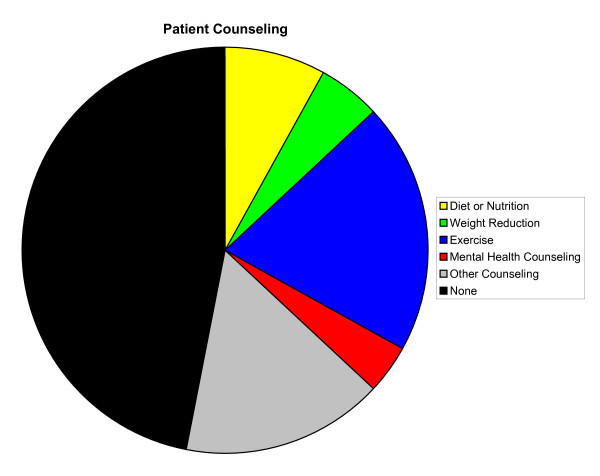
“This study suggests that cognitive behavioral therapy (as proxied by mental health counseling) may be under-utilized in the medical management of chronic LBP (6% of patient visits), which is often characterized by depression and somatization [26].”
Diagnosis and treatment of low back pain
Koes, B. W., van Tulder, M. W., & Thomas, S. (2006) · BMJ · doi:10.1136/bmj.332.7555.1430 · Cited by 1,287
Frymoyer, J. W. (1988) · New England Journal of Medicine · doi:10.1056/nejm198802043180506 · Cited by 1,097 · cited 1×
“Low back pain is often classified as acute when it lasts for less than 6 weeks, subacute when it lasts between 6 weeks and 3 months, and chronic when it persists for longer than 3 months [6].”
Physician Office Visits for Low Back Pain
Hart, L. G., Deyo, R. A., & Cherkin, D. C. (1995) · Spine · doi:10.1097/00007632-199501000-00003 · Cited by 889 · cited 2×
“Previous studies including an analysis of older NAMCS data [20] and a randomized controlled trial [30] have provided evidence to help support this theory.”
Design and estimation for the National Health Interview Survey, 1995-2004
Botman, S., & Moriarity, C. L. (2000) · Cited by 785
Martell, B. A., O’Connor, P. G., Kerns, R. D., Becker, W. C., Morales, K. H., Kosten, T. R., & Fiellin, D. A. (2007) · Annals of Internal Medicine · doi:10.7326/0003-4819-146-2-200701160-00006 · Cited by 773 · cited 1×
“analgesics varies widely, from 3% to 66%, based on the treatment setting [27].”
National Ambulatory Medical Care Survey: 2001 summary.
Cherry, D. K., Burt, C. W., & Woodwell, D. A. (2003) · PubMed · Cited by 762
Clinical Guidelines for the Management of Low Back Pain in Primary Care
Koes, B. W., van Tulder, M. W., Ostelo, R., Burton, K. A., & Waddell, G. (2001) · Spine · doi:10.1097/00007632-200111150-00022 · Cited by 703
Krismer, M., & van Tulder, M. (2007) · Best Practice & Research Clinical Rheumatology · doi:10.1016/j.berh.2006.08.004 · Cited by 694
Research works printed but not linked: 3
- Tenney JB White KL Williamson JW National Ambulatory Medical Care Survey: Background and Methodology Vital and Health Statistics Series 2, No 61 1974 U.S. Department of Health and Human Services. Hyattsville, MD: National Center for Health Statistics 25102417
- Food and Drug Administration National Drug Code Directory, 1995 Edition 1995 Washington, D.C.: Public Health Service
- Siller AB Tompkins L The big four: analyzing complex sample survey data using SAS®, SPSS®, STATA®, and SUDAAN® (Paper 172-31) Proceedings of the Thirty-first Annual SAS® Users Group International Conference: 2006; Cary, NC 2006 SAS Institute Inc
Cited by
Sorted by citations
Franke, H., Franke, J.-D., & Fryer, G. (2014) · BMC Musculoskeletal Disorders · doi:10.1186/1471-2474-15-286 · Cited by 261
“In the United States, osteopathic physicians are more likely to provide LBP care than their allopathic medical counterparts [27].”
Fritz, J. M., Childs, J. D., Wainner, R. S., & Flynn, T. W. (2012) · Spine · doi:10.1097/brs.0b013e31825d32f5 · Cited by 259
“Physical therapy utilization in this sample was low (7%), but consistent with other reports from large national databases.(4,8,30) We found a majority of patients who went to physical therapy did so quickly (within 2 weeks) after the primary care visit.”
Friedman, B. W., Chilstrom, M., Bijur, P. E., & Gallagher, E. J. (2010) · Spine · doi:10.1097/brs.0b013e3181d952a5 · Cited by 204
Licciardone, J. C., Minotti, D., Gatchel, R. J., Kearns, C. M., & Singh, K. P. (2013) · The Annals of Family Medicine · doi:10.1370/afm.1468 · Cited by 194
Self-citationDownie, A., Hancock, M. J., Jenkins, H. J., Buchbinder, R., Harris, I. A., Underwood, M. R., Goergen, S., & Maher, C. G. (2019) · British Journal of Sports Medicine · doi:10.1136/bjsports-2018-100087 · Cited by 175
Metadata
- Authors
- Licciardone, J. C.
- Affiliations
- University of North Texas Health Science Center (US)
- Corresponding author
- Licciardone, John C
- ORCID
- Licciardone, John C
- Venue
- Osteopathic Medicine and Primary Care
- Published
- 2008
- Volume
- 2
- Issue
- 1
- Pages
- 11
- ISSN
- 1750-4732 (ISSN-L)
- PMC
- PMC2631527
- OpenAlex
- W2033305798
- Cited by
- 126
- References
- 33
- Citations by year
- 2026: 1 · 2025: 9 · 2024: 10 · 2023: 8 · 2022: 16 · 2021: 7 · 2020: 3 · 2019: 6 · 2018: 5 · 2017: 6 · 2016: 6 · 2015: 8 · 2014: 9 · 2013: 9 · 2012: 7
- FWCI
- 3.75
- Type
- journal article
- Language
- en
- Open access
- hybrid
- doi.org
- Licence
- cc-by
- Locations
- Osteopathic Medicine and Primary Care (publishedVersion, cc-by)
- PubMed Central (publishedVersion, cc-by)
- PubMed (publishedVersion)
- Funders
- Osteopathic Heritage Foundation
- National Institutes of Health
- National Center for Complementary and Alternative Medicine
- National Center for Complementary and Integrative Health (K24AT002422)
- Topics
- Health Sciences › Health Professions › Physical Therapy, Sports Therapy and Rehabilitation › Musculoskeletal pain and rehabilitation
- Health Sciences › Medicine › Orthopedics and Sports Medicine › Spine and Intervertebral Disc Pathology
- Health Sciences › Medicine › Public Health, Environmental and Occupational Health › Opioid Use Disorder Treatment
- Keywords
- low back pain, outpatient visits, primary care physicians, osteopathic physicians, chronic low back pain, acute low back pain, nonsteroidal anti-inflammatory drugs, opioid analgesics, surgical procedures, physician specialty, National Ambulatory Medical Care Survey, health care utilization, drug prescribing, regional variation in care, shared decision-making
About these checks
Registry, retraction, Cites and statistics results are computed, not judged, with one exception: a printed reference that no index lists is read once by a model before it counts as a citation error. Claims are extracted by a model and kept only when their quote appears verbatim in the text; each cited source is then checked, with a model’s help, for whether it says what the claim relies on. Those verdicts can be wrong — read the claim’s quote and the cited source before relying on one.
Statistics and arithmetic are recomputed, not judged.
Confidence bands are shown only for fields calibrated on our annotated test set. None is calibrated yet, so no band is shown.
What counts as a claim ›How we measure confidence ›How we check this ›
Are you an author, or do you see a problem with this page? Request a review
